Skip to content

Category: Tools and Technology

Mini Rant About Gtalk’s Idle Status

Part of the reason I love IM and dislike the phone is that I have a better chance of telling if the person on the other end is interruptable before I interrupt them when we’re talking via IM. Phones don’t have statuses, so I get shy.

Most the time IM statuses make sense. People are either available or away. It’s not rocket science. But Google just had to mess with a good thing and use an “Idle” status that every other chat client I’ve used interprets as “Away.” Not only that, but if you were once available but haven’t done anything for a couple of minutes, it sets you to Idle. If you were once busy but haven’t done anything for a while, it sets you to Idle. Both look exactly the same, and both look like you’re “Away” from any other chat client. This means that I now have no clue if you’re available, and that the only ways I might have a chance at guessing are if I remember that you tend to use Google Talk through the Gmail page or the Gtalk client or if you add clarifying text to your status.

Dear Google, if you’re going to do Idle statuses, you should really stick to something that means “I used to be available but I haven’t chatted in a while,” and this should not look like an Away status to every other client out there. If people were Away and have been for a long time, chances are they’re still Away, so switching to Idle doesn’t make a whole lot of sense. If it makes a difference, though, you could have another status that means “I used to be away but I haven’t checked in for a while.” This way we’re return to a land of less confusion.

2 Comments

Minor Tweaks and Major Reminders

This past week, Dorothea sent a link to FriendFeed on the art of writing and designing for readers. It’s called In Defense of Readers, and it’s one of those pieces of writing that pulls me in, engrosses me completely, makes time stand still, and then leaves me thinking about it for days afterward. I loved everything about it, but two very different things keep coming back to me as I cook dinner, walk across campus, or drive through town. I want to make sure this space reflects those principles to the best of my ability, and I loved the reminder that the best writing assumes the best of its readers.

The blog template portion of my reflections probably isn’t very interesting. Little by little I’m tweaking small things like line spacing, distribution of white space, and figuring out how to keep the sidebar from competing for eye-time with the body text. (Just as a side note, I’ve realized that for the kind of writing I do, the sidebar and the navigational function it represents isn’t the most important piece of the site, and therefore shouldn’t have the coveted left side.) I know just enough CSS to mess up a good template, and I use it so rarely that every time I do, I have to relearn it. But little by little I’m tweaking the site to allow for easier reading. And this challenge is enough fun that I’m ignoring the little voice in my head that screams, “But everyone’s reading this in their feed readers anyway! Who cares what the site looks like!!”

The article’s respect for the reader, though, has much farther reaching implications. It stretches into the far corners of my experience to touch everything from interpersonal relations to prose. For example, my co-workers and I were talking over dinner about how the best managers are those that assume that their employees have good intentions and want to do well. This assumption helps them approach difficult situations in constructive ways, and goes a long way toward helping employees to actually do well. I realized that this was analogous to the epiphany I had in graduate school when I realized that the best articles and essays assumed that those who did or would disagree with them had arrived at their conclusions in perfectly reasonable ways. Up until that point, I’d thought the best “argue against those who disagree with you” portions of my papers should be point by point deconstructions of my opponent’s arguments with the goal of showing how much smarter I was than they were. But as it turns out, in the real world this just makes people think you’re arrogant and a bit of a rhetorical show-off.

No, what I like about Mandy Brown’s writing is that she didn’t take the easy attacks on either side of the debate about reading online vs reading in glorious everyone-knows-this-is-aesthetically-more-pleasing print. Her writing could be appreciated by those who think books are the only way to go and those who rarely curl up with anything other than a laptop. It embodied the kind of attitude toward potentially disagreeing readers that I’ve always hoped I could pull off, if I tried very hard. And by pulling this off, Brown’s writing was not only “In Defense of Readers,” but it also defended its readers from the gratuitous barbs that might have prevented them from hearing her underlying arguments.

2 Comments

Facebook’s Devilish Contract

News of changes to Facebook’s Terms of Service hit FriendFeed yesterday and sparked several debates amongst the relatively small set of librarians I follow. Facebook has always claimed ownership of everything you post there, but now there are two new lines that have caused the buzz:

You may remove your User Content from the Site at any time. If you choose to remove your User Content, the license granted above will automatically expire, however you acknowledge that the Company may retain archived copies of your User Content.

And:

The following sections will survive any termination of your use of the Facebook Service: Prohibited Conduct, User Content, Your Privacy Practices, Gift Credits, Ownership; Proprietary Rights, Licenses, Submissions, User Disputes; Complaints, Indemnity, General Disclaimers, Limitation on Liability, Termination and Changes to the Facebook Service, Arbitration, Governing Law; Venue and Jurisdiction and Other.

In other words, they own everything, forever, even if you delete your account.

The reactions to these changes tended to fall into one of four categories:

  • I’m deleting everything today!
  • It’s not so bad if you’re using Facebook in the way it intends you to use it.
  • Privacy is Dead, get over it.
  • If you don’t like it, don’t use Facebook.

I don’t know what reaction I was hoping for, but these weren’t it. Here’s why:

  • Deleting everything today won’t solve anything. They’re caching this stuff, remember, and they’ve already laid claim to the cache.
  • Telling me that some categories of content are wrong to post because I’m not using Facebook for the kinds of things it was made for also seems a little facile. Social networking sites really can’t dictate the sort of social networking that happens on them. That’s defined by each individual network. Part of what has always made Facebook complicated is that any individual person might be using their profiles for personal and professional purposes simultaneously. (They may not do this well, but there’s no good way to prohibit one or the other of these uses.)
  • And privacy may be dead, but that doesn’t mean that we should throw our content willy-nilly into the hands of people who want to use it for commercial purposes if we can help it. There should be an opt-out option.
  • And while it’s usually a perfectly fine response to say “if you don’t like the contract, don’t sign it,” this response isn’t actually very helpful in this case. First of all, it’s too big of a network right now, and is often the only way of staying in contact with whole groups of your acquaintances. Goodness knows I’ve tried to leave several times (it’s just too complicated, too big, and too much for me), but I then realized that this would be tantamount to putting myself into a social time out chair. Unfortunately, we’ve been put in a position where protest might hurt the individual more than the institution. Also, it’s too late to protest if you already have a profile. They already own your stuff.

So what would be a good response? Well, I’m not exactly sure (boy was I hoping somebody could have articulated it for me!). Living online is a constant process of figuring out which pieces of yourself you’re willing to leave for others to use, though, so we always have to be aware of what we’re giving up and then use that knowledge to help us decide what to share in any given space. So in the case of Facebook, I’m willing to give them my status updates, wall posts, profile pictures, and the contact info that is already findable elsewhere online. And that’s about it. I’ve stopped feeding this blog into my profile there because I’d prefer they don’t have this content from now on.

This rather pragmatic response doesn’t diminish my righteous indignation toward Facebook, though. I’d love it if they got their tyrannical Terms fed to them in a goopy mash by a horde of gleeful lawyers. And I’m unwilling to say we should just get over it and move on. I guess what I am saying is that this is a perfect reminder for me that I am always giving up pieces of myself to The Internet, and that I should step back and think for a minute about what I’m doing on Facebook, why I’m doing it, and how many pieces of myself I’m willing to pay for the privilege of staying out of the social time out chair.

[Update 2/18: Facebook has heard the hue and cry and has reverted to its old TOS. I wonder what the new version will look like once they’ve taken all the comments in. Also, I found this fascinating comparison between the draconian TOS and those of other social sites.]

3 Comments

The Obama Drama that Interests Me The Most

I have no idea how to fix the current economic crisis, create peace in the Middle East, or make sure everyone gets health insurance. I listen to the news pretty passively, hoping that the Powers That Be make good decisions on my behalf, since there’s no way I’d be able to make these decisions with any confidence of success. So while events of great magnitude wash over me day in and day out, what sticks? What do I go back to at the end of the day and ask Google for updates that I may have missed? Obama’s Blackberry.

It had never occurred to me that he wouldn’t be able to use one while off being president. It seemed like the perfect accessory to a presidential suit. Who knew that it would have such security ramifications? Who knew that it would spark debate about the kinds of filtered information top leaders get, and what this will mean for historians of the future? Fascinating!!

As long as he doesn’t do what one rather thoughtless congressman did, I’m thrilled that he’s got a new spy-proof Blackberry (or, as I like to think about it, the First Crackberry).

Leave a Comment

Anti-Choice (or Pro-Simplicity) is Nice When You Can Get It

We’re knee-deep in our MetaLib implementation project, and as we do our best to make decisions about our interface, we keep removing all the extra links and options and tabs that clutter up the default interface. Do we really need two different ways to get to the database list? Do we really need both Simple and Advanced Search options when the Advanced search only adds one search box to the already existing search box? Do we really need a button to switch languages when we only have an English interface? Little by little we try to strike a balance between simplicity and function. One by one, buttons and options and tabs disappear and the interface starts to make a little more sense.

Then, today, I watched a TED talk in which Barry Schwartz talks about his theories about how increased choice does not, in fact, make for better decision-making outcomes. Apparently greater choice means (unsurprisingly) more brain time spent making decisions, but even beyond that it raises our expectations that the outcomes will be wonderful. When the outcome is just good and not absolutely amazing, we’re more easily disappointed now that our expectations have been raised. So while our decisions may actually be better, we’re less happy. If you want the long version of these theories, he has a whole book out: The Paradox of Choice. (Also, if you watch the TED talk you’ll notice at about minute 6:10 that even TED people don’t get wifi at their conference hotel. This makes me feel just a teensy bit better about every conference I’ve ever been to. But I digress.)

Being a librarian with search interfaces on the brain, I couldn’t help but think about all those calls for beautiful, simple, Google-like, single search boxes. It’s not a perfect analogy, but in both cases people hope that by reducing options, the experience will be improved. With the single search box, there’s never any doubt what you’re supposed to do or how to do it at least minimally effectively. It’s such a wonderful goal.

But there’s a catch. The simpler the interface is, the more powerful the behind-the-scenes mechanisms have to be. They have to do more interpretation of search terms, smarter retrieval, more robust relevance ranking. If I can’t specify how things should look when I’m done searching, then things had better be done in a way I would have anticipated to begin with or I’ll get frustrated with the lack of options to “fix” my results. Google didn’t get famous because it had a single search box. It got famous because that single search box yields consistent results based on an algorithm that’s incredibly complex and equally secret.

So while I’d love to be able to reduce our interface down to just a couple of well-chosen elements, we still have to compensate for the fact that the behind-the-scenes mechanisms just aren’t up to that kind of challenge. And so we’re left doing our balancing act: how much can we strip away in the interests of removing excess choice, and how much do we have to leave so that people can manipulate the system enough to get it to spit back results they can use.

5 Comments

The OCLC Kerfuffle: In which I write much but come to few conclusions

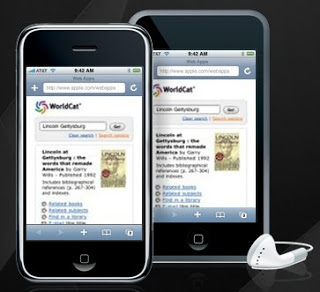
I’ve been watching the OCLC policy change discussion unfold slowly over the last few weeks, and I’ve got to say, I’m flummoxed. On the one hand, I don’t like the new license. I agree with most of what’s been written about the potential dangers it poses to innovation and the odd irony that member institutions will pay large sums of money to hand over their data to OCLC so that OCLC can lock it down for them. (I’ve included links to key posts and documents down at the bottom of this post, for those who’d like to catch up.) On the other hand, who am I to claim that OCLC has no right to try to sustain itself financially?

For me, the topic hinges on three main questions:

  • Is this really a change, and if so, how significant of a change is it?
  • What do they really mean by “Reasonable Use”?
  • And what does this mean for those of us that aren’t in the business of creating and maintaining bibliographic systems?

So first of all, is this really a change?

Karen Calhoun of OCLC has written more than once that the new license is just a clarification of the old license and that it serves to protect the community’s investment in the WorldCat records. She commented on Aaron Swartz’s blog post that “the policy carries forward the principles, if not the wording of the current Guidelines, which have been in place since 1987.” Later she wrote on her own blog at length and again asserted:

The difference is not in the principles, then, but the environment in which the principles are applied. The Guidelines [meaning the old policy] came from the limited data sharing environment of the 1980s. The updated policy’s landscape is the Web and the incredibly dynamic data sharing environment it represents. (cite)

In other words, the old policy protected community investment in the cooperative at a time when mass data sharing was not the norm, and the new policy protects that same community investment in the current environment where the default assumption on the web is that if there’s a big pile of data out there, anyone who wants to can play with it and make it work for them.

I have no idea whether the old policy felt restrictive 21 years ago, but I know that the new one feels restrictive now. It seems to me that the paradigm shifted right out from under OCLC and that reinforcing the principles of information sharing from 21 years ago is akin to re-inventing the information searching environment of 10-20 years ago.

It also seems to me that if libraries invest time, effort, and money into building a massive dataset, the best return on that investment would be to have people (OCLC or anyone else) take that data and make it work for us and for our patrons. This is what we do when we invest in the stock market, or even put money into savings accounts. We effectively sign it over to whomever can take it and make it work for us. The way this new policy reads, it feels more like protecting our treasures by tucking them into a safe deposit box. We rent the space and gain no interest, causing our “investment” to depreciate over time.

So maybe we’re just protecting OCLC’s investment in our data. Personally, I’d feel better about the whole thing if they just came out and said that.

What about this “Reasonable Use“ clause?

There’s also one clause in the policy that I find disturbingly vague. It’s the clause that defines “reasonable use,” and serves a very similar function in this license as the Fair Use clause serves in copyright law. Here it is:

13. “Reasonable Use” means Use of WorldCat Records that is reasonable for the intended Non-Commercial Use and consistent with the intent of this Policy. Without limiting the foregoing, the term “Reasonable Use” does not include any Use of WorldCat Records that:

a. discourages the contribution of bibliographic and holdings data to WorldCat, thus damaging OCLC Members’ investment in WorldCat, and/or
b. substantially replicates the function, purpose, and/or size of WorldCat. Please see the FAQ for a discussion of Z39.50 for cataloging using WorldCat-derived bibliographic records.

As Greg Schwartz noted on this week’s Uncontrolled Vocabulary, there are a lot of weasel words here. How big, how related in function, and how related in purpose does a system have to be before it violates this clause? And then there are the conspicuous “and/or” weasel words that leave OCLC room to claim license violation if any part of this clause begins to make them uneasy.

Seems to me that the biggest violator of section 13.b in existence right now is the Library of Congress, and that makes no sense at all. But if you think about it, its catalog is massive and exactly duplicates most of the functions of WorldCat. LibraryThing is also massive, but serves such a completely different purpose that I can’t see how it harms the “investment” of the cooperative. If anything, its giving the cooperative ideas about what might be possible in our own catalogs given the data they produce.

Just as a side note, I wonder if they have to grant Google and other search engines the right to crawl WorldCat.org.

Implications for those us in the public services world?

So what. Why do I care? In my day-to-day work, I search WorldCat when I need it, and I’ll continue to do so. I don’t do cataloging work. I won’t be the one deciding whether or not to put the new field that links to OCLC’s license in our records. And I certainly don’t build discovery systems that would make use of WorldCat records.

Well, I worry about two things. First, that this will stall efforts to invent a discovery system that actually works, and works well — one that patrons are happy to use, and one that puts to good use all of the metadata that catalogers put so much time and effort into creating.

I also worry that this move might implode OCLC. It has the chance to take a hard look at its “principles” and come up with creative ways to position itself as the nexis of all bibliographic data on the web, or it could spark its potential user community to rebell and rebuild elsewhere. My favorite analogy for this comes from Steve Lawson’s blog where he writes:

Coincidentally, I was reading Matthew Battles’ Library: An Unquiet History today and came across this interesting tidbit on page 29 about the Library of Alexandria:

In an effort to stop the growth of the libraries at Rhodes and Pergamum, both of which threatened Alexandria’s preeminence, the city’s rulers banned the export of papyrus. The move backfired, however, spurring the Pergamenes to invent parchment (charta pergamenum), which for its strength and reusability would prove to be the preferred writing medium in Europe for more than a thousand years.

WorldCat has been making great strides forward recently, and I would hate to see it shoot itself in the foot over a piece of papyrus. It also has an incredible treasure trove of information, one that would be a shame to have to duplicate, and one that could yield huge dividends if invested wisely rather than stuffed into a safe deposit box.

Or is this the push we all needed?

For further reading:

3 Comments

Whatever Happened to Library Blogs?

Something’s shifted. Maybe it’s just that I’ve shifted. My life has become almost unrecognizable compared to a year ago, so I wouldn’t rule this possibility out just yet. But even so, I’m inclined to think that the landscape and function of librarians’ blogs is in the process of a transformation.

Two years ago, I mentioned that participating in the biblioblogosphere was like attending a conference every day. A year ago, a good portion of my evenings were spent reading, thinking about, and responding to other librarians’ blogs. This was what kept me feeling connected to the larger world of librarianship. This was what made me feel useful beyond my own patron community. And this was a major source of contact with librarians whom I had come to regard as friends.

But lately, I wake up to find that my RSS aggregator has very few new posts from this once-prolific core of librarian bloggers, and I certainly haven’t been contributing to anyone’s aggregator overload recently. Not by a long stretch.

In my darker moments, I worry that we’re a little bit burned out, or that we’ve given up trying to change the world by weighing in on issues large and small. But while there may be some of this at work, I think it has more to do with a shift in communication patterns. Two years ago, blogs provided a venue for people’s carefully thought-out ideas as well as for their off-the-cuff thoughts, gut reactions, and general banter. In this way, they were like the sessions and the between- and after-session banter at a conference. Today I think that blogs have begun to take on the more focused character of the actual sessions at a conference while places like Twitter and FriendFeed have become the venue for the between-and after-session banter. We pass each other in the micro-blogging hallway, have conversations about everything from OCLC’s latest craziness to weekend entertainment plans, shout hello to other passers-by, and show each other our pictures or the latest new gaget we’re playing with. Then, when we have something more formal to say, we take the time to sit down and compose a blog post to present to our peers.

Then again, maybe this is just a very long justification for the decline and fall of a small portion of the librarian blogosphere.

4 Comments

eJournals, Blessing and Curse

I love electronic access to journal articles. I admit to being a teensy bit annoyed if I have traipse downstairs (one floor down and all of 100 feet over from my desk) to get the hard copy of an article. I’m even more reluctant to ILL articles, though I know how easy it is and how incredibly speedy compared to my past ILL experiences. Point and click is the way to go (as long as it’s not one of those nasty “HTML full text” articles, by which they mean “we’ll give you the text but none of the foreign characters or charts or images that you’ll need to understand the text… oh, and we won’t give you the original pagination either… mwa-ha-ha-ha…”).

And I’m certainly not alone in this. Students seem to have an even more marked preference than I do, and the faculty helped us move to being much more of an e-only library during the biennial serial review we completed last spring. More than half of our budget was spent on a electronic resources last year, and our stats show downloads are up by over 60%. We’ve tipped over that point, folks. And for the most part, there is great rejoicing in the land.

I say “for the most part” because all of a sudden, people are having to deal with an overly complex system of getting to our stuff from off campus. The new faculty were, understandably, confused and rather frustrated. Most of the systems we have in place (LibX, a proxy server, telling Google Scholar about our holdings, etc) work for most of our resources. But that doesn’t mean that things are any easier because these new faculty use Google, we don’t always subscribe through the publisher web site, and yet publishers put tantalizing web sites up for Google to find. The professor finds a great article via Google, clicks on it, and is told to log in or subscribe when, in fact, the library does subscribe, just through another source.

Sure, there are browser extensions that can help with that. We could OpenURL-ify everything under the sun if people would download extensions and remember to log into the proxy server whenever they sit at their computers. But that’s a pain. We mentioned this kind of thing at new faculty orientation and were met with weary stares.

There’s got to be a better way.

p.s. I’ve also talked before about the problem of eJournals when it comes to copyright and ILL (here).

1 Comment

LSW Meebo Room Etiquette: One Woman’s Guide for the Newbie

LSW as a whole is kind of opposed to rules, but like any ecosystem some order appears out of the chaos after a sufficient amount of time. I find this process fascinating, so I thought I’d start a list of the social norms (from the trivial to the foundational) I’ve observed in the LSW Meebo Room (listed in mostly random order).

  • You can change your nickname by right-clicking on it in the room’s roster. Most people do, and it’s totally up to you, but expect people to ask you your real life name or place of employment. There’s very little anonymity in this room.
  • People like to greet you as you enter and bid you farewell as you leave. They like it if you give them warning that you’re about to leave and then hang around for a bit so they have a chance to send you off in style… or at least send you off.
  • Don’t worry if the conversation doesn’t stay “on topic” (whatever that is).
  • Don’t worry if the conversation lags. Think of it like your living room on a quiet night… you know how it is. Somebody’s reading, somebody’s watching TV, and every once in a while somebody says, “Hey, guess what I just read,” and you talk about it for a bit and then go back to what you were doing. LSW is this living room.
  • You aren’t obliged to look at all the pictures or watch all the videos in the media window. Just close the window if it bothers you and click the links to the things that interest you (I do).
  • Assume we all know each other. And assume we all like each other. (Many of us have hung out there for well over a year, now.) Read everything with this assumption in mind, and share things with that in mind.
  • It’s ok to ask questions and get help with everything from reference questions to technical questions. Basic questions are just as welcome as advanced questions. Really. I promise.
  • It’s not ok to force people to respond to your comments. Either people have stepped away from the keyboard for a bit and the conversation moved on, or they just didn’t want to respond. If you didn’t get help with a question, though, ask again (especially if new people have entered the room).
  • No TV spoilers! We come from many time zones, remember.
  • If you have really personal stuff to share, try using the private IM function (right-click on the name of the person you want to talk with).
  • If you want to show the room off at a conference or other public place, please stop by and give the room some warning so we can cleans the buffer if necessary. Things aren’t always neat and tidy in our room and we want it to look its best for company.
  • It’s a great place to vent and get help with frustrating circumstances, but don’t sabotage your own career, please.
  • Sharing food or beverages is always encouraged. If you don’t know how, just ask.
  • Use of the Pacman emoticon is strictly prohibited… at least when I’m around. It’s the only thing I hate about the room. Any of the other emoticons are fair game, and are quite fun to play with.
  • The room tends to be full of hard-working, intelligent, and generally cool people. Enter, know yourself to be a peer, and don’t be shy. We really are happy to see you.
  • Remember, there’s a buffer of about 100 lines of chat transcript that newcomers can read when they enter. Don’t say anything you wouldn’t want to have show up in that buffer.
  • Library folks from all kinds of libraries hang out there and genuinely respect each other’s work. In fact, Respect is the currency of highest value, edging above Fun by the narrowest of margins.
9 Comments
css.php