
Skip to content

Month: September 2008

Three Inches To The Left


There is a very industrious spider that has made her web across my patio door. She started it in July, and very carefully stretched it from a couple of inches into the screen of the door to a couple of inches into the brick of the wall.

Unfortunately for her, I have to open that door nearly every day to water the plants, or sit on the porch, or pick up the porch chair the blows over in storms. So nearly every day I’d split her admittedly rather shabby web in half. And nearly every day she’d repair it. And after the first couple of weeks we both stopped caring too much about the process. I no longer thought twice about opening the door, and she no longer freaked out or waited very long to get back to the business of building her web. She never seemed to care that if she’d moved the entire operation three inches to the left, her life would have been so much less tiring.

All this has set me to thinking. What are the things that I could shift three inches to the left in my life? Are there things in the library that we don’t feel we have control over, but that we actually do control, and that we could shift ever so slightly?

For me, for today, it means not getting too emotionally involved in stuff, and taking a walk over my lunch break, and sending off an email I’ve been dreading for no good reason.

Picture originally uploaded to flickr by Swaminathan.

2 Comments
The P Word

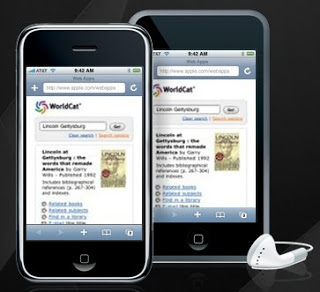
I must have missed the privacy class in library school. I’ll admit to having been pretty taken aback the first time I heard heated privacy debates once I was out and librarianating. As far as I can tell, the two edges of the range of opinions on the topic are: “Privacy is a fundamental right and we are the champions of that right” on the one hand and “Privacy is dead, get over it” on the other. I have problems with both of these positions. The former seems paternalistic and the latter seems cavalier.

So do we, in fact, have a mandate to protect patron privacy regardless of the patron’s views on the topic? Personally, I don’t think so. I consider it part of my job to help people understand when they’re giving up pieces of their private lives, but then let them decide if they care or not. In fact, I think that holding on too tightly to the “guard everyone’s privacy with your lives” philosophy directly contradicts some of the other bedrocks of librarianship, such as making information easily findable, for example. How can we gush about comments, tags, ratings, and other user-generated content and at the same time prophesy in the name of privacy? How can we recommend social bookmarking? At an even higher level, how can we acknowledge that things like smart interfaces and personalized relevance ranking are the way to go (especially on mobile devices where space is at a premium and browsing result lists is painfully slow) while we simultaneously forbid our systems from using data about researcher-behavior?

No, privacy isn’t dead. And yes, I think education about this kind of thing is an important part of protecting the research process. But I think we can no longer afford the simplicity of preemptively guarding everyone’s privacy in every situation. I think we live in an opt-in or opt-out world. Whichever of those we choose as our default, the “opt” part of it should be clearly presented to our patrons so that they rather than we take control of their research experience. I also think that our jurisdiction over their privacy becomes even more tenuous when it spreads beyond the research experience.

Maybe it’s my experience as one who is fairly comfortable living online, maybe it’s my life as an educator in a beautiful Midwestern Ivory Tower. Who knows. But at least for today, my position is that we exist to educate people rather than to take away their choices.

2 Comments

Best End-Of-Class Question Ever

Today I was teaching 6 upper-level linguistics students the ins and outs of Linguistics & Language Behavior abstracts, the crazy rules indexers have to follow that force the rest of us to OR together broad and narrow terms, using what you have to find bunches of other things you might need, and the Web of Knowledge.

It was a pretty good class, if I do say so myself, but the best bit was the very last 2 minutes when the very last question of the day went like this:

Student: “Do you really love being a librarian?”
Me: “Yes! [insert mini-blurb about what I love so much about it and how I got here in 2 sentences or less]”
Student: “How do you become one? Is there a special degree for it?”
Me: “Yes, there is. It’s a master’s degree. [insert mini-plug for being a librarian]”

I love my job.

Leave a Comment

eJournals, Blessing and Curse

I love electronic access to journal articles. I admit to being a teensy bit annoyed if I have traipse downstairs (one floor down and all of 100 feet over from my desk) to get the hard copy of an article. I’m even more reluctant to ILL articles, though I know how easy it is and how incredibly speedy compared to my past ILL experiences. Point and click is the way to go (as long as it’s not one of those nasty “HTML full text” articles, by which they mean “we’ll give you the text but none of the foreign characters or charts or images that you’ll need to understand the text… oh, and we won’t give you the original pagination either… mwa-ha-ha-ha…”).

And I’m certainly not alone in this. Students seem to have an even more marked preference than I do, and the faculty helped us move to being much more of an e-only library during the biennial serial review we completed last spring. More than half of our budget was spent on a electronic resources last year, and our stats show downloads are up by over 60%. We’ve tipped over that point, folks. And for the most part, there is great rejoicing in the land.

I say “for the most part” because all of a sudden, people are having to deal with an overly complex system of getting to our stuff from off campus. The new faculty were, understandably, confused and rather frustrated. Most of the systems we have in place (LibX, a proxy server, telling Google Scholar about our holdings, etc) work for most of our resources. But that doesn’t mean that things are any easier because these new faculty use Google, we don’t always subscribe through the publisher web site, and yet publishers put tantalizing web sites up for Google to find. The professor finds a great article via Google, clicks on it, and is told to log in or subscribe when, in fact, the library does subscribe, just through another source.

Sure, there are browser extensions that can help with that. We could OpenURL-ify everything under the sun if people would download extensions and remember to log into the proxy server whenever they sit at their computers. But that’s a pain. We mentioned this kind of thing at new faculty orientation and were met with weary stares.

There’s got to be a better way.

p.s. I’ve also talked before about the problem of eJournals when it comes to copyright and ILL (here).

1 Comment

Things I Will Probably Never Understand

  • The Minnesota State Fair
  • “Counsel” vs. “council” or, for that matter, “hermeneutics” … I have to look them up every time
  • Fall Term, just generally
  • Anything poached
  • eHRAF
  • why bad things happen to people I like
  • CSS
  • post-structuralism
  • why I don’t listen to more music
  • napping
  • gini coefficients
  • my relationship with the fact that I lived in Dorchester
  • cats
  • SciFinder Scholar
  • did I mention Fall Term yet?
Leave a Comment

LSW Meebo Room Etiquette: One Woman’s Guide for the Newbie

LSW as a whole is kind of opposed to rules, but like any ecosystem some order appears out of the chaos after a sufficient amount of time. I find this process fascinating, so I thought I’d start a list of the social norms (from the trivial to the foundational) I’ve observed in the LSW Meebo Room (listed in mostly random order).

  • You can change your nickname by right-clicking on it in the room’s roster. Most people do, and it’s totally up to you, but expect people to ask you your real life name or place of employment. There’s very little anonymity in this room.
  • People like to greet you as you enter and bid you farewell as you leave. They like it if you give them warning that you’re about to leave and then hang around for a bit so they have a chance to send you off in style… or at least send you off.
  • Don’t worry if the conversation doesn’t stay “on topic” (whatever that is).
  • Don’t worry if the conversation lags. Think of it like your living room on a quiet night… you know how it is. Somebody’s reading, somebody’s watching TV, and every once in a while somebody says, “Hey, guess what I just read,” and you talk about it for a bit and then go back to what you were doing. LSW is this living room.
  • You aren’t obliged to look at all the pictures or watch all the videos in the media window. Just close the window if it bothers you and click the links to the things that interest you (I do).
  • Assume we all know each other. And assume we all like each other. (Many of us have hung out there for well over a year, now.) Read everything with this assumption in mind, and share things with that in mind.
  • It’s ok to ask questions and get help with everything from reference questions to technical questions. Basic questions are just as welcome as advanced questions. Really. I promise.
  • It’s not ok to force people to respond to your comments. Either people have stepped away from the keyboard for a bit and the conversation moved on, or they just didn’t want to respond. If you didn’t get help with a question, though, ask again (especially if new people have entered the room).
  • No TV spoilers! We come from many time zones, remember.
  • If you have really personal stuff to share, try using the private IM function (right-click on the name of the person you want to talk with).
  • If you want to show the room off at a conference or other public place, please stop by and give the room some warning so we can cleans the buffer if necessary. Things aren’t always neat and tidy in our room and we want it to look its best for company.
  • It’s a great place to vent and get help with frustrating circumstances, but don’t sabotage your own career, please.
  • Sharing food or beverages is always encouraged. If you don’t know how, just ask.
  • Use of the Pacman emoticon is strictly prohibited… at least when I’m around. It’s the only thing I hate about the room. Any of the other emoticons are fair game, and are quite fun to play with.
  • The room tends to be full of hard-working, intelligent, and generally cool people. Enter, know yourself to be a peer, and don’t be shy. We really are happy to see you.
  • Remember, there’s a buffer of about 100 lines of chat transcript that newcomers can read when they enter. Don’t say anything you wouldn’t want to have show up in that buffer.
  • Library folks from all kinds of libraries hang out there and genuinely respect each other’s work. In fact, Respect is the currency of highest value, edging above Fun by the narrowest of margins.
9 Comments

What I Learned about Libraries from Football

Not understanding football frequently makes casual conversation difficult, especially on Sundays during the football season. Hanging out in the LSW Meebo room yesterday and watching people talk about the various games they were watching, I thought I should do something to rectify this obvious gap in my cultural literacy. I had no idea there were so many games on TV on a Sunday. Mostly at random, I settled on a match between Indianapolis and Minnesota (though why it’s a city against a state I don’t quite understand) and settled in to watch my first football game…

…And I think I learned an awful lot about what it might be like to navigate an academic library for the first time.

It’s been a while since I was faced with a thing of great complexity and too little context to see patterns in the details. Most of the time, I couldn’t even figure out if what I’d just seen was a Good Thing or a Bad Thing in football. But, undaunted, I used my librarianish skills to find the NFL page on Wikipedia and follow the links from there to a glossary and set of rules. Yay, right?

Not right. Here’s the definition of that mysterious thing called a “down”: The period of action that starts when the ball is put in play and ends when it is dead. If you don’t quite know if you understand “put in play” and “dead,” this isn’t all that helpful. And besides, downs get counted up… why? and how far? and what’s the significance of that anyway? But there was no way I’d answer those questions by poking around on the NFL site.

Thankfully, the people in the LSW room very patiently explained these basics to me, and they didn’t laugh at me quite as hard as they had when I first thought that the football team here was the Twins… or maybe that was the basketball team… (I kid you not. And I am ashamed.) But you know what? It took me 20 minutes to figure out enough to even know if I was asking them answerable questions.

I wonder now if my library’s physical and online presence is as impenetrable to the uninitiated as this game and reference source were to me.

(By the way, by luck I watched a game that got pretty exciting near the end.)

5 Comments

Rethinking Instruction … Again

One of my favorite things about teaching is that I never feel like I’ve figured out how to do it well. There’s always something new to try, or something old to tweak, or something tried and true to throw out because as it turns out, the students don’t need it any more. All of this means that I’m never bored, and that I’ve never taught the same session twice.

Of course, this also means that I’m always a little uncertain about what I’m doing, how effective it was, and how meaningful it was. So far, no assessment I’ve done has completely set these nagging uncertainties to rest.

But uncertainties notwithstanding, I’m going to try something new this fall. When and where appropriate, I’m going to combine the idea of the Knowledge Survey* with classroom clickers.

I’ve been hearing about clickers for years and have experience their effectiveness myself. Quite against my own will, and in spite of feeling that I was participating in something as corny as any of those team building exercises I always hated (like falling backwards and getting caught), I found myself being sucked in and engaged in the activity at hand. If that could happen to me against my will, maybe I can use it to sucker some nearly sleeping freshmen into my sessions with a couple of well-placed participatory activities.

Still, my innate aversion to gimmicky things kept me from getting too excited until after I heard about Knowledge Surveys. Those things are amazing! Students get an accurate assessment of their own abilities (the Macalester Geology department has found incredibly high correlations between the responses on knowledge surveys and the students’ actual abilities), but I get a quick way to assess students, and I get a less-gimmicky way of encouraging participation and curiosity.

Now, if I could only get the stupid clickers to work, that’d be a great first step. So far, they hang at the “sending” notification whenever I test them, and never make it through to the actual recording of a response. I’ll have to get someone to help me figure out if they’re actually not working or if I’ve set something up wrong.

* I’ve heard Karl Wirth speak about these surveys three times, now, and ever time I came away thinking that there’s got to be a way to incorporate these things into my teaching somehow. Here’s a paper he and Dexter Perkins wrote on the topic.

Leave a Comment

Shifting Patterns

I realized this evening, as I checked my mailbox on the way back home, that communication patterns have really shifted. At least, they have for me. There was a time when I’d open mail addressed to me as soon as it was delivered, but I’d only check email once or twice a week. Now I check email multiple times per day, but I only open my accumulated snail mail about once a week.

2 Comments
css.php