Head back over to pegasuslibrarian.com for the actual site
Leave a CommentLearning in Libraries and Loving It*
Head back over to pegasuslibrarian.com for the actual site
Leave a Comment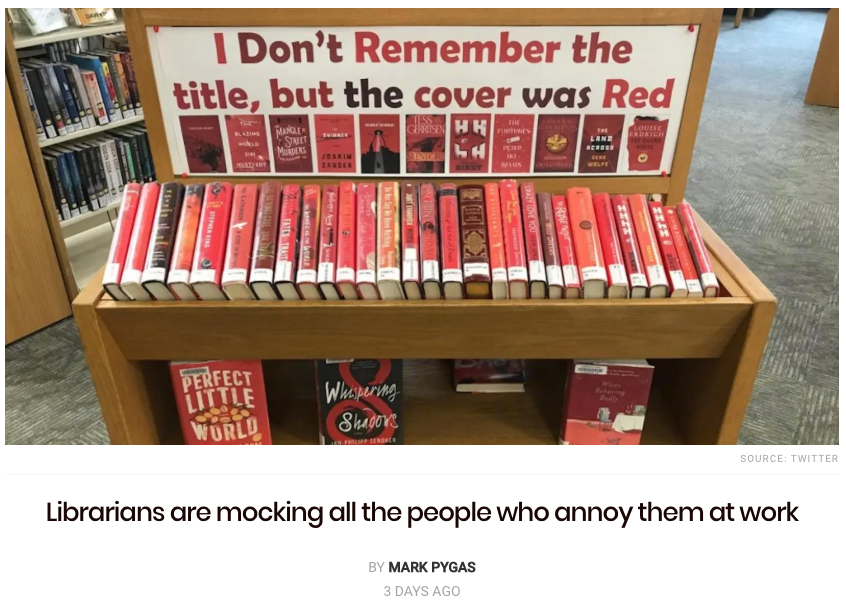
Every few years this picture makes the rounds on the internet, and every time it does the booksellers and librarians of the world nod in understanding. Public librarians and booksellers get this question day in and day out – academic librarians less so. (Most of our books in academic libraries don’t have their fancy covers on anymore, so this question would be pretty much impossible here anyway.)
Here’s the thing, though. It’s not that “people annoy us” with this question. It looks to me like there was some frustration behind this particular display, sure, and the result is wording that pokes fun at patrons in a way that makes me squirm, but that’s not the norm for people I’ve talked to. Most librarians and booksellers I’ve encountered are proud to know their collections and clients well enough to be able to match people with the books they want!
No, the thing that’s frustrating is that it’s hard for us when we can’t figure out the answer to the question (we’re very all-in on the identity of being able to answer questions), and our systems don’t let us search by cover design features. That mantra of librarianship, The User Is Not Broken, means that if we’re getting tons and tons of the same question, that means that the system isn’t set up right.
Of course, another piece of the frustration is that we often don’t have a ton of control over our search systems. Don’t get me started on the refrain from vendors about “what users want” that almost never matches what the people I work with every day ask me about… And, sure, often what people want and need aren’t technically feasible, or aren’t feasible within shrinking budgets, or aren’t feasible with reduced staff or with staff that gets less and less training.
But if we actually can’t change the systems, we can embrace the fact that we can foster humans who can say “Oh, maybe you’re thinking of this red book?” Humans are pretty incredible!
Leave a Comment
Every few years this picture makes the rounds on the internet, and every time it does the booksellers and librarians of the world nod in understanding. Public librarians and booksellers get this question day in and day out – academic librarians less so. (Most of our books in academic libraries don’t have their fancy covers on anymore, so this question would be pretty much impossible here anyway.)
Here’s the thing, though. It’s not that “people annoy us” with this question. It looks to me like there was some frustration behind this particular display, sure, and the result is wording that pokes fun at patrons in a way that makes me squirm, but that’s not the norm for people I’ve talked to. Most librarians and booksellers I’ve encountered are proud to know their collections and clients well enough to be able to match people with the books they want!
No, the thing that’s frustrating is that it’s hard for us when we can’t figure out the answer to the question (we’re very all-in on the identity of being able to answer questions), and our systems don’t let us search by cover design features. That mantra of librarianship, The User Is Not Broken, means that if we’re getting tons and tons of the same question, that means that the system isn’t set up right.
Of course, another piece of the frustration is that we often don’t have a ton of control over our search systems. Don’t get me started on the refrain from vendors about “what users want” that almost never matches what the people I work with every day ask me about… And, sure, often what people want and need aren’t technically feasible, or aren’t feasible within shrinking budgets, or aren’t feasible with reduced staff or with staff that gets less and less training.
But if we actually can’t change the systems, we can embrace the fact that we can foster humans who can say “Oh, maybe you’re thinking of this red book?” Humans are pretty incredible!
Leave a CommentWell, let’s try this again. DNS confusion meant that last Friday, when I thought I was all set, I actually wasn’t. But apparently NOW I’m all set, so here’s the post that I thought would get posted last week. (Many thanks to Reclaim Host tech support for all their extremely helpful help.)
I’m writing now from my new home on a new server and a new domain registrar for the first time in my blog’s history. Up until now I’ve been happily living in my own little corner of the LIShost server, carefully tended by the wonderful Blake Carver. Sadly, LIShost is shutting down after 18 years of dedicated service to library folks. I can’t thank Blake enough for his approach to hosting, giving me as much leeway as I had the skills for, and as much help as I needed to cover those areas where my skills were lacking.
But welcome, now, to my new home, here in my own corner of the Reclaim Hosting servers. If things continue as they have begun, I think I’ll be quite happy here in my new digs. But if you notice anything wonky do let me know. I’m still unpacking and figuring out the light switches and hanging pictures, and there’s no guarantee I’ll notice everything.
Leave a CommentIf you’re like us, you have a LibGuides-based list of databases for your library, and it went down for a bit this morning. If you’re like me, this pretty much cripples you until the list is back up and running. This kind of downtime could happen no matter your platform, so if you’re like me you might also want to have an option available to get around your database list during downtime. Here’s what I came up with about a year ago and was happy to have in place this morning.
Each month I download a CSV file of our databases – LibGuides has a nifty “export all” option and I click that. Then I paste that data dump information into a hidden sheet on a Google Sheet that I’ve made available to anyone with a link. From that messy data dump, I built formulae onto a visible sheet in that Sheet (really, Google has GOT to get better about its names for apps so that I don’t have refer to a sheet on a Sheet). These formulae help me display a full alphabetical list of all of our databases, their descriptions, their base URLs (a note on that in a second), vendor, and whether or not they need proxy access from off campus. Basically all the formulae say are “if the corresponding cell on that base sheet is blank, don’t put anything here, but if there’s information there, then display it here.” It looks like this:
=iF(isblank(Raw!B2),"",Raw!B2)
Then I use a slightly fancier formula to build a proxified version of that base URL into column dedicated to off-campus access. It goes like this:
=if(isblank(F2),"",if(F2="yes",CONCATENATE("http://ezproxy.carleton.edu/login?url=",C2),C2))
Translated, that formula means “If the cell in Column F that says whether this database needs a proxy string is blank, leave this cell blank (this just makes for a cleaner spreadsheet without a lot of error cells where the formula is there even if there’s no database listed). If that proxy cell is set to YES, then put together our proxy string and base URL, and put the resulting URL here. If the proxy cell is set NO, just put the base URL here.”
Then I hid the Proxy check column (column F) because nobody really needs to see that if they’re using the spreadsheet. I just needed it for calculation purposes. (Sure I could have referred to that proxy check cell on the base sheet, rather than bring it to the visible sheet and then hide it, but sometimes I just feel like doing things easiest way that occurs to me in the moment. Don’t judge!)
Finally, I gave this back-up spreadsheet a nicer URL: http://bit.ly/libedatabases And I posted this URL in places where librarians can find it when needed (such as our documentation for QuestionPoint cooperative librarians, our intranet, etc).
So now if our proxy server goes down (rendering our database list mostly useless), we can use the base URLs from this spreadsheet, at least from on campus or in combination with a VPN. It’s better than nothing. And if the whole database list goes down, we have access to all of our databases and their URLs from this list.
Edited to add: I forgot to mention that I’ve also built a script into Google Docs to unmerge cells. For whatever reason, exports from web-based products like Springshare tend to have random merged cells, which I don’t want. The only way I know of to get rid of these (other than looking for them all and then unmerging them individually) is via script.
So! In Google Sheets, click on the “Tools” menu and then “Script Editor” and then paste in the following:
function myFunction() {
   var breakRange = SpreadsheetApp.getActive().getRange('A:T');
 for(;;) {
   try {
     breakRange.breakApart();
     break;
   } catch(e) {
     breakRange = mySheet.getRange(
       breakRange.getRowIndex(),
       breakRange.getColumnIndex(),
       Math.min(
         breakRange.getHeight()+5,
         Sheet1.getMaxRows()-breakRange.getRowIndex()+1
       ),
       Math.min(
         breakRange.getWidth()+5,
         Sheet1.getMaxColumns()-breakRange.getColumnIndex()+1
       )
     );
   }
 }
 }
This will look at columns A through T (you can edit that in that second line if you need to) and unmerge any merged cells.
When you paste in a new export, just click “Tools” and “Script editor” and then the little “play” arrow to run the script, and it’ll unmerge all those merged cells for you.
Leave a CommentSince last I wrote, I’ve been able to learn more about a question that had plagued me: what of IPUMS, that unparalleled resource for census micro-data? For one thing, I was sure they must be thinking about privacy already – micro-data must be handled with care. For another, the 2020 Census “Privacy Budget” work is likely to make IPUMS’s work pretty complicated or even impossible.
Turns out, they are of course way ahead of me. Here’s their page on the topic, which also links to the Census’ released software and documentation, as well as to data available from IPUMS that researchers can use to test that software.
I also happen to know someone who works at IPUMS, and he says they’ve already been doing record swapping and injecting “noise” into their data to protect unique cases.
I certainly hope that everyone involved can figure out how to protect people’s privacy while still allowing vital research. This seems like an impossibly tangled knot to me.
Leave a CommentMaybe I’m the last one to know about this, but just in case… Did you know that the Census Bureau is changing what and how it’ll release data the 2020 Census? I mentioned this in passing in my last post, but here’s a little more, most of which you can find by reading the posts and presentations on the Census’ Disclosure Avoidance and the 2020 Census page.
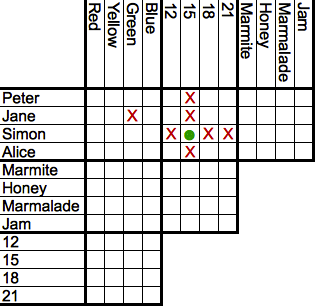
The data scientists at the Census Bureau have been experimenting for the last few years, and it turns out that they were able to reconstruct private information about individual citizens using a process not unlike solving a Sudoku puzzle or one of those grid logic puzzles. They only release de-identified data, but if you know what you’re doing you can figure out a goodly percentage of the identifications. It’s called Re-Identification or Database Reconstruction.
One way to solve this problem is to never provide 100% accurate results to queries on the database. Without 100% accurate query results, no clever data scientists can take the answers from query 1 and fit it next to the answers from queries 2 through x, or put it next to their dataset of bank loan applications or whatever, and know for sure that they have accurate answers to those queries and therefore reconstruct the database. Adjusting results by a privacy parameter, which will probably be a very very tiny parameter, is at the heart of what’s called Differential Privacy (and here a big shout out to Dr Steven Wu from the University of Minnesota, whose recent talk at Carleton helped me understand the math behind this process). The Census is presenting this parameter or set of parameters as their “Privacy Budget.” Once they’ve disclosed everything in the budget, they can’t disclose more without doing harm.
As of the presentation from October 1st, 2019 that’s posted to the Disclosure Avoidance and the 2020 Census page, the Census hasn’t yet quite decided what this privacy parameter will be. It sounds like they’re thinking it’ll vary depending on exactly how sensitive the information is or the amount of other information that’s been requested. But of course the main question is exactly how accurate the disclosed results have to be in order to allow people to do the work they need to do to run the country and distribute aid and know about our population. The more accurate the disclosures, the more risk of privacy problems. The more obscured the results, the more risk that we’ll struggle to know what we need to know in order to do what we need to do.
If this is a topic you’re interested in or care about, there are a bunch of things published by the Census statistician John Abowd that I found while exploring this topic with data-interested faculty here at Carleton.
I’m really curious to see how this plays out, not least because it’ll impact all the researchers I work with who use census data in so very many of their research projects. But I’m also curious to see how this and similar efforts bleed out into other Big Data conversations in my world, like Learning Analytics for example.
1 Comment
My roots are about as humanistic/artsy as they come. I majored in English and minored in Art. Then I got a masters in literary studies. Then I got my masters in library and information science. That last degree was first time the word “science” was part of my life in any way more substantial than checking the box next to required credits for graduation. (It took me a long time, actually, to figure out why “library science” was a pair of words that go together, but be that as it may, my official degree is Master of Library and Information Science, which sounds very scientific to me.) From there I became the Librarian for Languages and Literature here at Carleton. All my previous passions neatly packaged in a single job.
This week I’ve been thinking a lot about an almost-decade-old paper by dana boyd and Kate Crawford. “Six Povocations for Big Data” made a big impression on me back in 2011 purely because epistemology and ways of knowing are my stock in trade, and this paper felt somehow Very True to me at the time. (Plus I’d just heard dana boyd talk at a library conference and was pretty much determined to listen to anything she ever said from then on.) This week I pulled it out of my Zotero library for a refresher, and it felt even more Very True to me now.
Part of my current re-fascination with this piece is that my liaison departments have taken a decided turn toward data. It has become increasingly clear to me that a major role I can play for my new liaison department (Computer Science — hey look! a second science in my life!) is to become a Data Librarian Lite(TM). Not a huge surprise there, and something I’m greatly enjoying learning. But they’re definitely not the only department I serve that’s turning to data. I’ve gotten more and more requests for linguistics corpora (spawning a new page on my Linguistics Research Guide just this weekend). And multiple faculty in the English department are working with digital textual analysis and literature corpora.
So yes, the phrases that stood out to me 8 years ago from boyd and Crawford’s piece stood out again: “Big Data is no longer just the domain of actuaries and scientists. … Big Data creates a radical shift in how we think about research … about the constitution of knowledge, the process of research, how we should engage with information, and the nature and categorization of reality” (pages 2-3).
But then there was this gem: “Claims to objectivity and accuracy are misleading” (boyd and Crawford, page 4). That meant one thing to me in 2011, but a lot has happened since then that has made me understand this statement in new ways. First there’s all the research into bias in algorithms (e.g. Safiya Noble). Then last week there was a talk presented in the Computer Science department here about “differential privacy” and (tangentially in the talk, but centrally to my world) the 2020 census’ plan to add deliberate small inaccuracies into reported results in order to protect respondents’ privacy. So not only are claims to objectivity and accuracy misleading, but too much accuracy has become harmful enough that we’re backing away from it in key areas.
Meanwhile, as epistemologies shift and the world of research continues to remake itself, I’ll be over here learning to be a librarian who navigates the various worlds of data in addition to being a librarian who absolutely values close reading and minute observation. And I’m loving it.
Leave a CommentOne of the things I love about my job is that my overarching function is to make things possible. I love making things possible.
Sometimes this means pointing people toward a resource that fits their information need, but more often it means helping them think about what would make their work possible. Helping them translate their questions into the language and mechanisms of search systems and information pathways, helping them think about what part of their overwhelmingly large research question might make for a manageable project while still feeling meaningful, helping them think about what broader concepts might give context to a frustratingly specific question, validating their curiosities, validating their sense that the process isn’t necessarily easy or straightforward, and on and on. At the very least, we’re always looking for concrete next steps while keeping our eyes on some (hopefully) meaningful and interesting goal. Honestly, a lot of the work is making things that feel scary and uncertain and anxiety-provoking feel manageable and actionable.
I’m really lucky that this kind of enabling can be my role in life.
Leave a Comment
As the librarian for American Studies, I’ve supported a few relatively minor Indigenous Studies projects. Now, though, I’m supporting a class that’s just enough outside of my comfort zone that it’s forcing me to slow down and really think differently about what I’m doing. And I’m realizing that a) my past approaches aren’t going to work with this class, and b) I might have been wrong all along.
Just as a couple of examples, I hadn’t come to grips with the challenges of reconciling the essence of something as simple and work-a-day (for me) as a research guide (with all its implied and overt messages about Proper Research in Academia) with the realities of the harm that colonial epistemologies have done and continue to do. I hadn’t realized or grappled with the importance of foregrounding indigenous voices or ways of knowing, or of not relying on academic sources to legitimize observations and analysis (which is such a reflexive move in Western academia). I hadn’t ever coached students to recognize authority clues in contexts and constructions so far outside of my own background and training.
Of course, I haven’t solved these issues, and I’m sure I haven’t even recognized a whole world of similar issues. And on the one hand, one of my primary roles in the lives of these undergraduates is and should be to mentor them through academic ways of knowing. But on the other hand, I’m hoping to learn ways of doing this that don’t also do harm — ways that promote ethical, respectful, thoughtful approaches to research in general and to cultural research in particular.
As I start grappling with these questions, I’m reading. So far I highly recommend:
There’s so much to say about these readings, but here’s a quote that helped me come to terms with the uncertainties I was feeling.
“Because these culturally based hierarchies of access to certain domains of cultural knowledge are often determined by an individual’s gender, age, ancestry, clan, and status, they are directly in tension with some of the underlying principles of librarianship that place a high value on free and equitable access to information.”
Becvar and Srinivasan, page 422
The simple act of naming these tensions helped me sit more comfortably with the new-to-me epistemologies and their implications for my work, and it helped me begin the process of first recognizing and then integrating unfamiliar epistemologies. (From here, moving on to Christen’s article was quite lovely.)
And one last quote that stuck with me:
Can the imagination and technological prowess that promoted open access publishing, open source software, and Creative Commons licenses exist side-by-side with those alternative systems of knowledge production that rely instead on social relations maintained and forged through negotiated interdependencies, which have as their goal the mutual gain between stakeholders in social, economic, and cultural terms?
Christen, page 2880
Christen thinks this is possible, with work. I’m on board for the work.
Leave a Comment
