Skip to content

Category: Random Thoughts

New Phone!

I arrived this morning to find a brand new phone on my desk at work. Or rather, I found a new phone manual on my desk, wondered why somebody would leave me a manual, paged through it for a bit, and then realized that the phone sitting there was not my old phone, but a new one, complete with caller ID, conference calling, and the ability to go hands free!

Finally, I’ll be able to tell if my in-coming calls are likely to be questions, random calls from people not affiliated with the college, my co-workers, or (horror of horrors) a vendor. Finally, I’ll be able to pull more than one person in on my calls. Finally, I’ll be able to participate in those webinars that make you call in and participate online without choosing between full participation and a spasm in my neck.

This kicked me out of my Monday Mood for the rest of the day. Well… this and the first sunshine in weeks, and a glorious walk with co-workers to lunch, and the fact that it’s the last day of finals here. All in all, I guess it was a pretty good day.

Leave a Comment

Thinking of the Future

While we all run headlong toward the end of the term, a quiet transformation is taking place on campus. The seniors with the most – er – unique styles are suddenly turning up with shaved faces, fewer piercings, more form-fitting (and less hole-decorated) clothing, and combed hair.

I sense job interviews in the offing.

Leave a Comment

LSW Has Infiltrated My Life

An odd thing has happened. For the past several months, whenever I dream of work stuff (which is more often than I’ll admit in print), certain members of LSW are just… there. I’ll be in the middle of a dream meeting with my dream department, but in addition to the people who are in my real-life department there’ll be a couple of LSW people sitting there with us. We’ll all be sitting in our regular meeting spot in the library, tossing around ideas, planning big plans, talking about recent classes, and throwing out anecdotes about the reference desk. Sometimes LSW people will pop into my dream office to ask about something or to tell me about questions they just got, just like my real-life co-workers do. And all of this seems perfectly natural in my dreams. It’s not till I wake up that I realize these people don’t actually work at my library.

4 Comments

Cover Letters

An interesting idea sprouted over at Llyfrgellydd and was taken up at Guardienne of the Tomes. Here it is:

Post a cover letter that you wrote. It can be terrible, it can be wonderful, it can be the one that got you a job. But post it with the idea that other librarians (new, old, and not-yet-to-be) can learn something from it.

Well, I debated joining in, because I don’t feel like I have a great example of a letter, and I cringe whenever I read the ones I sent out (yes, I have copies of them… all of them…). But I’ve decided I’m OK with having people point at laugh if it helps someone figure out their writing style and what to include in or exclude from a cover letter.

The letter I’ve chosen is the one that I sent in when applying for my current job, which is my first job out of library school. I didn’t have much library experience (I’d worked part time in a public library and part time in an academic library for the past year) so I was trying to make a case for myself by tying together my tutoring (read “instruction”) and other instruction experience (I’d won an award for movement instruction), my public service experience at a small, independent bookstore I’d worked at for several years (I’d done reader’s advisory, ordering, and almost everything else you could do at that bookstore) and my commitment to the disciplines I’d be serving in this new job. I also wanted to be sure they knew that I understood the idea of the liberal arts and that I knew about this particular college.

I’d been advised to have a letter of no longer than one page (which I now know isn’t necessarily true, especially for academic positions), and to close with an “I’ll call you” statement… which I agonized about for longer than I care to admit, because it seemed so incredibly cocky to me. But I dutifully followed the advice. All I can say is that I’m glad at least somebody here didn’t hold it against me.

I should also say that I wrote my resumé much more like a bulleted cover letter than many resumés I’ve seen, so I didn’t duplicate that here in my letter. I’m not sure if that was wise. All I’ll say here is that under each of my jobs listed on the resumé I placed examples or quotes from people or anything else I could think of to show that the experiences I’d had at these other (mostly non-library) jobs could translate easily to the job I hoped to obtain. I figured anyone could guess the job duties of a tutor or book seller, but what they needed from me was a direct translation into this job.

So, without further ado, here it is:

January 26, 2005

[Future supervisor’s name]
[library and address]

Dear [future supervisor],

One of [the library’s] evening supervisors, my brother [brother’s name], recently explained the exciting work you are doing to increase the library’s effectiveness and visibility as the cultural and educational center of [the college]. As he spoke, I knew I wanted to be a part of your team.

I am addicted to learning, especially at a college like [this one] where students are encouraged to explore the intersections between disciplines. My personal research explores the dynamic fusion of history, philosophy, literary theory, language, art, and social context in the literary expressions of various times and cultures.

Learning is so important to me that I work vigorously to share it. I have been a highly successful tutor and instructor for the past seven and a half years because I approach instruction with creativity, enthusiasm, and humor.

I am also adept at information marketing and have eight years of experience providing superior customer service. I am especially good at working with “challenging” customers and with customers from other cultures and linguistic backgrounds.

I think I would make an excellent addition to your team and look forward to further conversations about the ways our goals complement each other. I will call you next week to see when we can talk in more detail about how my abilities will benefit your library.

Sincerely yours,

Iris Jastram

Enclosure: Resume and References

It feels rather like letting you peek under my bed to see if I’ve swept there recently (no, I haven’t). All I can say is that I tried. I tried hard. I probably tried too hard. But it got me a phone interview, which led to an on-site interview, which led to a job.
2 Comments

Evolutions in Communication

It’s always fun when I sit in my office and get to hear students practicing their class presentations outside my door. We have a large SMART board and some comfy couches right there, so it’s a natural place for that kind of activity, but somehow I never tire of hearing these run-throughs. It’s really one of the only times I see the fruits of research activities, since we almost never see student papers.

This morning I mused on the natural progressions I see in all kinds of communication skills, and that I remember going through myself during college and graduate school. There’s an interesting phase we go through where we imitate the rhetorical structures and even the mannerisms of some idealized Smart Person. We try on jargon and clump around in it like we did our grandparents’ shoes when we were young. We start questioning our conclusions and worrying that they’re self-evident. We aren’t quite sure which evidence might be too self-evident, so some key pieces of it never make it into the final product. (Just as a side note, I love watching undergrads negotiate this phase because it’s a great way to learn what it is that they see happening when accomplished scholars perform their work.)

The next phase is one of extreme confidence. This is when we think that our readers or listeners probably pay the same amount of attention to the words, phrases, arguments, and conclusions of our work that we are learning to pay to theirs as we pour over their works in preparation for assignments and lectures. This is when formal communication becomes less of an act of dress-up and more of a game or, in the worst cases, a contest. “If my readers can hold this allusion and that metaphor and this key phrase and that piece of evidence in their minds all at the same time, they’ll understand that I’m being witty in this statement and the whole piece will be even more interesting for them to read.” This kind of writing is fun. I remember the exhilaration of weaving together fine works of analytical art and handing them in, knowing full well that my professors would enjoy a carefully and consciously crafted piece of writing. And in some cases, this is the style of writing that particular audiences did want. But little by little, I realized that not all audiences are thrilled by the prospect of performing mental gymnastics. Which brings me to the next phase…

There’s a fine art to writing in a way that clearly communicates what you want to say without forcing your audience to work at understanding you. This is the stage where writers start deliberately trying to misunderstand their own writing (knowing full well that somebody will take that beautiful sentence the wrong way) and revising their work to make misunderstandings as rare as possible. And it’s not just about misunderstandings. Remember those comments that just said “awkward” in the margins of papers you got back from professors? This is the stage where that all begins to make sense. Whereas before, respecting your audience meant trusting that they could follow you through complex writing, now respecting your audience means knowing that they probably could follow you if they wanted to, but that they’re much happier if you don’t cause them fatigue.

This is the kind of writing I aspire to, but it’s much, much harder than the complex writing I practiced in grad school.

Having said that, watch as I glibly push “Publish Post” without re-reading this lengthy piece of writing about writing….

Leave a Comment

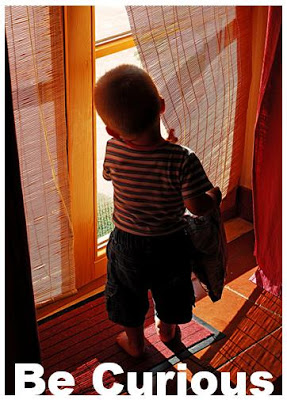
Passion Quilt: Be Curious

Ever since Greg tagged me, I’ve been mulling over a seemingly unanswerable cluster of questions. It goes something like this: “What? I have to choose just one thing? And how can I quantify ‘most passionate’ when I’m not given to passion? And it should probably be serious, right? And… one thing? Really?”

As often happens, I learned what it was that I wanted to say when I wasn’t actively thinking about this challenge. All of a sudden, while munching my sandwich and mentally rehearsing an upcoming instruction session, the phrase “Be Curious” popped into my head. Without curiosity libraries, childhood, and life would be pretty barren. And thus my Passion Quilt contribution was born.

Places to go from here:

The original meme rules (with commentary):

  • Post a picture from a source like FlickrCC or Flickr Creative Commons or make/take your own that captures what YOU are most passionate about for kids to learn about…and give your picture a short title. (Check, though I must say that if you search Flickr for “curious” you get a boat load of cute cat pictures.)
  • Title your blog post “Meme: Passion Quilt” and link back to this blog entry. (Mostly check and check.)
  • Include links to 5 folks in your professional learning network or whom you follow on Twitter/Pownce. (Clearly my rule-following ability can only be sustained through one and three-quarters rules. Consider yourself tagged, or not, as you wish.)

Technorati technorati tags: passion_quilt

Leave a Comment

Theory Feeds My Soul

I’m sitting here hunting for articles in hopes of creating a little literature review for myself on a topic I’ll be presenting on next week, and I’m cursing the practicality of my profession. Everyone’s writing “how to help students avoid plagiarism by teaching the proper mechanics” articles. But what I need is “why are the mechanics the way they are” articles. We’re To Practical, I Tell You!!!

In library school I got frustrated with those classmates who complained about my favorite class because “there’s nothing practical there.” At conferences, I don’t participate in the “I hope there’s some good practical stuff here” conversations that happen before the sessions.

It’s not that I don’t appreciate the practical. I live it. I get frustrated if there’s no practical connection or grounding when ideas get bandied about. But the theory and philosophy that forms the foundation of what I do, that is what feeds my soul, sparks my imagination, helps me judge the merits of practicalities, and helps me mold other people’s practicalities to my situation.

Maybe it’s the English major in me, I don’t know, but I feel starved for some well-thought-out theoretical research with a healthy mix of evidence (not all of which needs to come from practice), deep thinking, and logical reasoning. I look to blogs for my “how-to” needs, project reports, and increasingly for the philosophical musings that I would expect from journal articles. But our peer reviewed literature should be the strong-hold of our deepest thinking.

2 Comments

Transparent or Opaque?

Allow me to take a moment to rant a little. There are some common metaphors that are slowly but surely losing their meaning as people get them mixed up or use them to describe an ever broadening set of nouns. These metaphors are transparency and opacity. They are most often used to refer to processes and procedures, though lately I’ve seen them in all kinds of literature and used to describe everything from word definitions to philosophical ideas.

Here’s how they should work. Transparent processes are easy to understand. Opaque processes are not. Think of a box full of gears. If the box is transparent, you can see how the gears move and can therefore anticipate actions, think up changes to the process, and generally know what you’re dealing with. If the box is opaque, you can’t see any gears moving, so you have to guess how things might work.

This is why the metaphors get confusing when used to describe things that are not processes. If you’re talking about a thing (such as an idea), you might think, “If this idea were a physical thing, I’d want to be able to see it to understand it. Therefore I’d think it should be opaque, because you can’t see transparent things. If I can’t see this idea-thing I can’t understand it.” This makes sense but is not how the metaphor works. It just isn’t.

Here’s the rule: the transparency/opacity refers to an imaginary enclosure. If it’s transparent, you can see what’s going on inside the enclosure; if it’s opaque, you can’t. Transparency = understandable. Opacity = mysterious.

6 Comments

Happy End of National Library Week!

As we do every Friday of National Library Week, we handed out root beer floats at the library today. Usually, this is a fun day of standing in the sun and making lots of students happy as we wade our way through 10-ish gallons of ice cream and liters and liters of root beer. Today, it was a fun day of setting up inside the library where we were sheltered from the cold and the rain. But such is life. Ice cream is still ice cream. Root beer is still root beer. Even on cold, cloudy, rainy days, the two ingredients still taste good together. And we still ended up serving 8-ish gallons of ice cream in a little under an hour.

Best of all, it was a really fun hour squeezed into a crazy-busy day. Who says this was just about the students? It feeds my soul to feed root beer floats to happy students, to make a little ruckus in the library, and to make a little mess in the pursuit of levity.

2 Comments
css.php