Skip to content

Category: Random Thoughts

Mission: LSSP

This is how I ended up with 5 feet of scratch paper, no real idea of where to store it all, and the warm fuzzies for all my co-workers who instantly donated more paper than I thought we’d collect in a year.

Hello All,

As you probably know, the introduction of print management last year brought about a huge reduction in paper use here in the library (to the tune of about 17% less paper used!). With fewer duplicate print jobs being sent to multiple printers, fewer accidental print-outs, and more attention being paid to what and how much was being printed, we saw the massive piles of unclaimed printouts dwindle down to a few sheets here and there. And there was much rejoicing in the land.

Much rejoicing until students wanted scratch paper to write on, that is. Having grown accustomed to a Limitless Supply of Scratch Paper (hereafter called the LSSP) near the printers, students took to opening the printers and removing sheets of paper from the printer trays. Not only is this poor use of ITS supplies (they do not exist to underwrite students’ scratch paper needs), but the opening and closing of the printer trays seems to have caused a sharp increase in the rate at which those trays go out of alignment and need repairs. Clearly, something needs to change, and asking students to buy notebooks would probably be met with blank stares.

What we need is a good old bait and switch. To this end, the printer area will serve as bait (so much paper, so much history of free paper, so much traffic in general), but when the students arrive at the printers we will dazzle them with big, beautiful stacks of scratch paper which will mimic the LSSP. Not only will this fill a clear public service and save ITS many printer-tray-related headaches, but it will also be a good use of paper that would otherwise be recycled only partially-used.

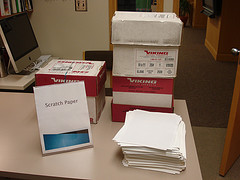
Your mission, should you choose to accept it, is to help us collect this precious scratch paper. On the middle shelf of the cart near the main black and white printer in the TS area you will find a double-decker Paper Collection Device (PCD). The top level of this PCD, the one marked “Scratch Paper,” is for paper that has been printed on one side and that contains no sensitive information (remember, this will end up in the hands of students) or even paper that is blank on both sides but is no longer fit for the printer. The lower level of the PCD is for anything else (colored paper seems to inhabit it now). The SCIC students [explanation of these students] and the reference librarians will use the paper from this PCD to attempt to keep a pile of scratch paper by the printers dazzling, big, and beautiful in order to mimic the LSSP as closely as possible.

I know what you’re thinking, but don’t worry, this message will not self-destruct.

Best,
Iris
4 Comments

I Could…

I could start getting ready for work, or I could eat breakfast. I could do a lot of things. But I’m not. Because, you see, I’m wrapped in a blanket, and I have a sleeping cat on my lap and a thunder storm to listen to. Standing up would ruin all of those things.

Leave a Comment

Library 3.0

Friends, Romans, countrymen. I am here to tell you that we are, yet again, behind the times. There are people out there who are still talking about Library 2.0 and spending great amounts of energy figuring out a) what that is, b) how that differs from the Library 1.0 that must have existed even though it was never named, and c) how to put it into practice.

This is no longer enough.

I don’t care if we still haven’t even agreed if there is such a thing as Library 2.0. I don’t care if we haven’t figured out quite how to do it. If we don’t drop everything and run, we’ll miss the Library 3.0 train. Forget about your 23 things, your webinars (who invented that term, anyway?), and your virtual worlds. Those are so 2007.

“But what are we to do, oh wise Pegasus?” you ask. In answer to that I say, I have absolutely no idea. Apparently we’re supposed to be more semantic and stuff, so go do that. Also, Wikipedia offers up this definition of the web analogy to Library 3.0 thusly:

Web 3.0, a phrase coined by John Markoff of the New York Times in 2006, refers to a supposed third generation of Internet-based services that collectively comprise what might be called ‘the intelligent Web’—such as those using semantic web, microformats, natural language search, data-mining, machine learning, recommendation agents, and artificial intelligence technologies—which emphasize machine-facilitated understanding of information in order to provide a more productive and intuitive user experience.

Since I’m already fluent in “natural language,” I think I’ll just check that one right off my list. And last I checked, we had several hulking cabinets full of microformats, so I’m going to declare that one done, too. I’m also pretty good at recommending things, though people rarely seem to pay attention. Their loss.

All in all, we’ve probably got our foot in the door on this one, thank goodness. Still, we might want to start taking sides now, just to save time later. We’ll need some volunteers for the “This will devalue Library 2.0” camp, and a “this is silly, don’t talk to me about it” camp. Of course, we’ll need the “3.0 evangelist” camp, but if you’ve already had a turn as a 2.0 Evangelist, please be aware that you may be needed in the “This will devalue Library 2.0” camp. You can’t be the stars of the show every time.

19 Comments

Really really really, I can help you. Please Believe Me!

I’ve been composing an email to the new faculty members in the departments I serve this afternoon, and another librarian I know has been composing a similar email to faculty in a particular program at her library. And you know what? These emails are hard. I want to come across as helpful and practical and not the least bit overwhelming or pushy or beggy.

I don’t really need a response from these people or anything, but I’d hate to see this email just get deleted and forgotten. There’s good stuff in there. Or at least I think so, though I may be a tad biased. Still, I know that I’m competing with a deluge of similarly information-full emails from other places on campus, not to mention the mountain of getting-hired paperwork, or the chaos of moving to a new town. So I’ve decided that the key is to start with the one or two things that are most likely worrying these new faculty. After that, the rest will probably fall into place on its own, but this first interaction has to be about them and their upcoming instructional challenges, not about me and my work. If they read no more than the first sentence or two, what will grab their attention and let them know that I have their interests at heart, not my own?

In this case I think that “I have to fit all this into ten weeks?!?” is probably foremost on these new faculty members’ minds. So I’ll start off by saying something about how I can help them fit research projects into a ten-week term without derailing their course content.

But I think that as I move forward, I’ll try to keep this shift from “here’s what I can do” to “here’s how I can help solve this problem you have” in mind whenever I write these emails. When I first started here, I wanted to prove to people that I could help them, so I gave lots of details about all the various kinds of help I could give. Then I shifted towards giving a couple of examples that illustrated many things, or that would spark people’s imaginations. And I still like using specific examples, but I’ve gone off the idea of telling them Everything They Must Know (here and in my instruction). No, my goal now is much more modest: I would like them to know at least one thing they really wanted to know. After that, details seem to work themselves out and they end up learning what they need as they need it. At least, I hope they do.

4 Comments

Busy Busy Busy

I don’t know what’s up, but this summer has been crazy busy at work. We’ve had projects and deadlines and research questions and emails and lots of Plan A’s that turned into Plan B’s and then some more projects. I’ve been at work late nearly every night for the past two weeks AND THERE ARE NO STUDENTS ON CAMPUS.

I know I always think that summer will be slower than it is. I always see two an a half months with no classes and think “Ah… I’ll have plenty of time to do all of that and maybe write an article.” I also know that I’m usually wrong. As evidence of this, note my modest (by academic librarian standards) publication count. It’s not for lack of things to say, that’s for sure.

But this summer has felt even more hectic. For a taste, here’s what we’ve done in this first half of the week.

  • We revamped our guidelines on how and what to record and count about our various interactions with students and faculty (reference desk, consultations, and classes). As our services evolved to meet the needs of our campus community, distinctions and practices we used to find uncomplicated now seem a little more confusing, so it was time to discuss some of these trickier scenarios and write down our conclusions so we don’t have to waste time making as many decisions about our statistical collection. In the process, we had to decide what we want to be able to investigate about our services, and how to collect information as accurately as possible and in a way that wouldn’t mess up our ACRL reporting.
  • I took all our discussion notes and actually drafted those guidelines. That took quite a lot of time.
  • We planned and began the planning phase of a pretty big assessment project. (That’s right, we planned to plan. Believe me, this was necessary.) We’re trying to figure out what we can learn about sophomore-level information literacy by reading a subset of the sophomore writing portfolios. This project has monopolized at least half of each day this week, and we have hours and hours more to do this week. If I weren’t deeply intrigued by the project, committed to making it a success, and so so so excited to see what that success looks like, I’d probably resent the amount of time it’s consumed already, before we’ve even gotten off the ground. But instead, it’s become one of those time-intensive projects that seems to energize rather than tire. This is Interesting Stuff, and there’s very little I’d rather be doing.
  • We’re planning to host a librarian from Cornell University, so a couple of us have spent time putting together an agenda for that day.
  • I’ve reorganized the way I keep my calendar (just a little, not a whole lot) so that I’ll be sure to have everything working the way I need it to work when Fall term hits.
  • Research questions don’t stop over the summer, they just get harder. This is when people ask the really hard-to-figure-out stuff. It’s also when I am not forced to find the best I can and then move on with my day, so I find myself obsessing just a little and not letting go of questions that maybe I should.
  • We drafted our departmental goals for the next year. That’s just about as fun as it sounds, but important. We’re getting pulled in many directions these days, so it helps to name our priorities.

And that’s just the stuff I can remember. Meanwhile, at home…

  • My cat spent Monday at the vet. The details are not for the squeamish and involve the words “necrotic” and “abscess” and one very sore paw. Now, twice a day, we get to struggle to decide the questions “Will those antibiotics make it into that stomach? And will the resulting blood on the carpet be yours or mine?”
  • But on the up-side, I’ve gotten completely sucked up in a couple of books, and I try to spend time every morning and every evening on my porch reading and sipping tea. I wouldn’t trade these hours for anything, but they sure do cut into time for things like, for example, sleeping. And eating. Oh, and doing my dishes.
  • I’ve felt like I have my old energy back for the first time in, well, months. I don’t know what was up between January and now, but whatever it was, I hope it’s gone for good.

But since I’ve already been teased for the length of my emails by three people in the last two weeks, I think I’ll stop now. Suffice it to say (which is a coy way to say “that looked like a lot but it wasn’t much, really”), it’s been incredibly busy but mostly in a good way, so I’m pleased.

Leave a Comment

Doing Something Well

We’ve all heard the phrase “victims of their own success.” An instruction program takes off and suddenly librarians run ragged trying to meet the demand. A web app gets so popular it crumbles under the weight of it’s adoring fans. A person becomes known as Someone Who Gets Things Done Well and suddenly ends up on every committee known to man. These things happen all the time, and they usually throw the person or service into a state of frantic instability followed by an uncertain period where it looks like they won’t be able to escape with their good name intact.

A fair number have seen this happen with Twitter lately. Things got so unstable that finally, last week, a bunch of librarians fled to FriendFeed. I don’t often post about this kind of site, mainly because I’m really not in the market for more followers, but last week this whole saga got me to thinking about what it was we liked about Twitter, what it is that I don’t like about FriendFeed, and how this resonates with similar sagas I’m witnessing elsewhere in my life (namely, the Impending Moodle Bloat, and the Continuing Adventure of the Library Catalog).

Since nobody needs to know everything I think about Twitter and FriendFeed, here’s the key difference as they apply to my needs and my preferences. Twitter does a small set of functions and (when it’s functioning properly) does them well. It concentrates on reverse-chronological order, brevity (which forces a certain kind of creativity), and makes its other features slave to those two governing laws. FriendFeed is intended to aggregate stuff and allow conversations to spring up around that stuff. If I wanted, I could share all my bookmarks and photos and blogs and twitter stream and, and, and… basically anything with a feed and a few things without feeds. It’s kind of like the Facebook of microblogging. You can add all kinds of things to it and it does it’s best to present all that stuff in a way that makes sense. And for me, this overabundance of features diluted the site’s effectiveness (though I know others who love it). It ended up eating up more of my time than I wanted (even after I “hid” pretty much everything that people added to their lifestreams) because I had no good way to mentally mark a conversation as “read” since there might be new comments on it, and while I was reading things the screen might reorganize itself so I’d have to go back and figure out what was new and what was old all over again. Non-static reverse chronological order takes more mental energy than I would have thought.

Well, all of this reminded me of some of the worries I have for Moodle. As people come up with all kinds of new things that it could do and new ways to feed information into and out of it and new roles it could fill, will it lose focus enough to hamper its ability to do core functions well? What are it’s core functions, anyway? As it moves from being a “course” management system to a “learning” management system, will it go through Twitter-ish frantic instability?

And, of course, when I think of systems that try to do too many things and therefore fail to do any one thing well, I immediately think of library catalogs and the ILSs of which they are a part.

So after I’d convinced myself that every application should strive to do one thing or a small set of things, and do those things really well, I realized it’s not that simple. The tricky bit is that not everyone’s workflow and preferences are the same. So how do you build a system with mass appeal that only does a few things?

And since I have no answers for these questions, I’ll leave you to answer them for me while I ponder the temptation to do all things for all people after learning that you do one thing really well.

4 Comments

Relaxing


I’m well and truly on vacation and have been all week. And, for the first time ever, I’m taking two weeks of vacation in a row. That’s right. I was on vacation this week, and I’ll also be on vacation next week. Hard to fathom, I know, but it’s true.

It’s not a vacation where I’m doing anything special. I’m mostly sitting on the couch, reading (I have a supply of fiction and a whole stack of New Yorker magazines to read), petting the kitty, watching episodes of Rosemary & Thyme on DVD, and generally being a slug. Today I even took a nap (not one of my talents, and not something I’d planned on doing, but something that ended up being really nice). And you know what? After a full work week spent not working, I’m starting to feel a little bit more like myself again! Maybe this means that next week I’ll have my brains back enough to start my Japanese lessons back up.

Oh! And I’m really excited to learn that we’ll be getting clickers for our library classroom! I’ll have to read up on Knowledge Surveys and see if I can combine what I’ve learned about clicker pedagogy with that kind of assessment. The ideas are bubbling!

Which reminds me, I still need to write about Knowledge Surveys, which I heard discussed very compellingly at the NITLE Moodle meeting I went to earlier this month. Hmmm…. and that reminds me that I still haven’t written much about Moodle and the crossroads I think it’s reached, and there are one or two other topics I haven’t covered yet from last month’s conferences. Maybe next week will be a week of blogging as well as Japanese lessons. Maybe. If I’m not too busy being a slug.

(Image credit: “Hammock” by Listen Missy shared under Creative Commons)

2 Comments

Glad to have gone – Glad to be home

I’m just home from a NITLE workshop on Moodle that was held in Tacoma, Washington. For being off the beaten path compared to other conferences and workshops I’ve gone to (I took notes on everything from upgrade paths and sysadmin tools to statistical analyses of pedagogical approaches and web 3.0), this workshop was surprisingly enjoyable to attend. Of course, a lot of that had to do with the hotel NITLE arranged for us to – er- experience. It’s the first time I’ve stayed in a hotel that operated under the impression that it was a modern art museum. (I’ve got more pictures in my Flickr stream.) The University of Puget Sound is also a beautiful campus, so going there for meeting every day didn’t feel like a chore at all.

I was a little less thrilled with the fact that NITLE sent out directions that landed us all on the wrong street as we hunted for the hotel, and that they kept promising more detailed information about parking that never came… but the hotel, university, and food were all top notch. Oh, and most of the sessions were pretty good, too.

I’ll write something substantive about the sessions later, but for right now, here’s an overview of my flights there and back. I got to the Minneapolis airport only to find that the parking ramp was full, so I had to park at the out-lier terminal that’s a mile or so away. Getting back main terminal involves lots of walking, a train, a tram, and lots more walking. In fact, it takes so long that the flight was delayed by nearly an hour as we waited for most of the passengers to make their way from their cars to the gate. Once in the air, I was treated to a most unusual family dynamic behind me. The family was made up of two kids (3-ish and 7-ish), two parents, and two grandparents (the mother’s parents). The kids behaved just fine. The mother, though, must have asked 4 or 5 times how much longer we’d be in the air. She also wondered, repeatedly, what time it was, and what time that would be in Seattle time, in Minneapolis time, and Seattle time again… She also did that thing that kids do where she’d say “Mom… mom… mom… mom” until her mom would respond. As icing on the cake, she turned to her 7-ish daughter and said (and I quote), “You’ve had a long turn with the iPod. I haven’t had a chance to listen to it at all yet. I think it’s mommy’s turn now.” Excuse me while I go find my jaw…

The flight back was much better, and even arrived 2o minutes early! This was greeted with much joy by my near neighbors on the flight, as we had been treated to the non-stop chatter of a 13-year-old kid flying without the benefit of parents. I didn’t mind so much. I grew up with lots of siblings and can pretty easily tune out chatter and read a book. My neighbors, though, were a little less skilled at that, and a little more amazed at the capacity of a 13-year-old to talk for 3 hours, absolutely non-stop.

Oh, and because I find this amusing, here’s how I spent my time since leaving the hotel today: 45 minute drive to the airport, 45 minute walk to the gate (including the time it takes to check in and go through security), 1 hour wait for flight, 3 hour flight, 1 hour trip from the gate to my car (which, you’ll remember, is a walk, a tram, a train, and a walk away from my terminal… thank goodness I didn’t have any checked luggage), 45 minute drive home, finished off by a half hour cuddle with my neglected kitty and then a half-hour session spent writing this over-long account of the least important aspects of my trip to Tacoma.

I promise, my next post will say something substantive, like maybe a discussion of community and how I’ve come to see that as Moodle’s main challenge.

4 Comments
css.php