Skip to content

Category: Random Thoughts

Identity, Community, and My Not-So-Virtual-Friends

Without a doubt, the best part of this last week has been meeting all those friends which up until now, I’ve called “eFriends.” I’ve known some of these people for 3 years, but never yet laid eyes on them. In many ways, this has been like what I always imagined a really good class reunion would be like. We already knew what everyone had been doing recently. We knew each other’s interests, fears, and aspirations. We’ve been there for highs and lows. And now, at long last, we know each other’s in-person mannerisms.

Now I wonder, will things go back to the way they were online or will they change? And if they change, what will that change look like? Will we be even more comfortable with each other, or will we become shy now that the subtle protection we’ve enjoyed so far, that cloak of safety in the knowledge that our companions know us but don’t know us? Of course, I hope things will be even more rich and wonderful, but I was surprised to look around one night and wonder if I was becoming shy now that people knew my mannerisms and expressions. “Will they still like me?” I couldn’t help wondering.

But all of this made me wonder again about these online personalities we have. We all bridled a bit when somebody expressed concern during the LSW presentation about the anonymity of screen names and wondered how true community could form in an environment that depends on screen names. And I firmly believe that communities do form in these environments. I’ve felt it. I’ve lived it. But I haven’t decided yet if that kind of community can be the same as a face-to-face community.

I can’t wait to see what does change, and what stays the same. But whatever happens, I’m confirmed in my opinion that these are amazing people. They make me proud to be a librarian and excited for the possibilities that can become reality with people like this put their minds to it. And I’m already pining just a little and wishing I could pop down to the lobby to hang out with the gang.

Technorati technorati tags: cil2008

2 Comments

It’s the Little Things

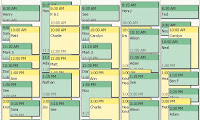
I’ve written before about our Research/IT desk, and how we sit elbow-to-elbow with student workers who don’t actually work for the library. These students work for the SCIC (Student Computing Information Center), but they’re in the library for almost all of its open hours to answer technological questions and keep the printers humming merrily along. (Have I mentioned how much I love this recently? It’s helped us concentrate on actually working with research related questions rather than spending most of our time filling printers with paper.) Well, I’ve never been good at learning names, and I’ve found it especially difficult to learn the names of the string of students who may sit beside me during any give week of reference shifts. So this fall I instituted the practice of getting their shift schedules from their supervisor and entering them into a calendar that I then shared with the rest of the reference staff. Now I can turn it on next to the reference librarian’s shift calendar, or my own calendar, and quickly “cheat” to find out who’s sitting next to me at any given time.

It always takes quite some time to build this calendar, since each shift requires between 14 and 18 clicks to enter… But it’s time well spent, in my opinion. It started as a way to cheat, but it’s actually helped me learn names over time. I feel like I’ve gotten to know students better this year and can carry on conversations with them much more easily, and I’ve drastically cut down on the mental shenanigans involved in trying to have conversations with people whose names you just cannot for the LIFE of you remember. You know the kind of conversations… “How can I talk about this without ever prompting the need to insert a name…” I hate those conversations, so I would often just sit there and not talk to the students, which contributed to the vicious cycle or awkwardness and lack of name recognition. Who would’a thought that a simple calendar would make such a difference in my ability not to look like a dork at the reference desk… oh, and have a great time with student workers?

Leave a Comment

On Trying New Things

I’ve been thinking a lot recently about an odd shift I’m seeing. It seems like a couple of years ago, there was a big push in my corner of libraryland to “try new things,” which was mostly code for “try a blog, try a wiki, try IM, try social bookmarking, try Flickr, try ANYTHING.! Please!!” It was pretty exciting to blog and read blogs during that time. I learned a lot from people who pointed to new extensions they were using, new social tools, new uses for “older” tools.

But recently I’ve felt (and I know others have felt) like there’s nothing more we can contribute to this discussion that’s really and truly new. We can go to conference sessions geared to introducing the newest of the new tools and already know about every single tool discussed and know a handful or even a fistful of libraries that are using them. We might even be using them ourselves.

The same can be said for “new” service models or collection changes or any number of other topics. Maybe it’s a function of my having been slightly too overextended in the last few months to have the energy to get excited about or imagine new implementations of the ideas I’ve heard about, but I know I’ve had the feeling recently that maybe there isn’t much more that’s new to learn about in my previous areas of interest right now. What’s more, I’ve heard a few other librarians say similar things. “I just can’t come up with anything that other libraries haven’t already tried. There’s just nothing actually new going on here.”

It’s almost like my whole corner of the library world took a collective sigh and realized we’re tired.

And maybe there’s truth in this feeling, though I doubt it. Maybe we’ve settled far enough into the social web or the fill-in-the-blank-new-Library2.0-service world that it’s no longer confusing enough to wonder about or new enough to get excited over. Or maybe we’re all just getting over the Long Winter (it’s snowing here today… seriously… maybe 8 inches by tomorrow morning). Or maybe there’s enough communication now that where we would previously have had a hard time knowing about what other libraries are up to, now it’s quite easy to skim a feed reader and get a quick run-down every single day. (If this is the case, I think it’s a wonderful development.)

But my hunch is that while we’re pretty much trained from college on upward that “original” is a synonym for “good,” and “derivative” is a synonym for “lazy,” it actually doesn’t work that way in real life. It doesn’t matter if 3/4 of the libraries you know about are implementing a new service or tool. Even if other libraries have tried whatever you’re trying, there’s still usually no way to adopt implementations wholesale. Almost always, you have to evaluate and tweak and shift and re-mix ideas to fit your own context and your own community.

And this leads me to believe that maybe the problem isn’t that there isn’t anything new happening; that the problem is with me. I’m the one sighing and acknowledging that I’m tired. I’m the one who’s been overextended just enough to shut off that creative part of me that used to read what people are doing and start scheming about how it would look at MY library. If this is the case, I sincerely hope that my trip to Computers in Libraries will jump start that portion of my brain and help me not just know but actually believe that it doesn’t matter that other people are doing cool things already. They’d still be new and cool to think about trying here. And these reports I’m reading and the others that I’m generating, and the lessons I’m learning from planning a conference, and the other lessons I’m learning from helping out with Print Management implementation?… Maybe these are still interesting and not just “the same thing that everyone else is doing, so why would they care.”

We’ll see. Here’s hoping.

Technorati tags:

6 Comments

Spring… un-Break

Spring term starts on Monday after two full weeks of what most people choose to call “Spring Break.” Clearly, I must not understand the meaning of the word “break,” or else it means something other than it has meant for the rest of my life. This was not a break. In fact, it was probably at least as tiring as peek weeks of the term. Here’s a sample of what I’ve been up to for the past two weeks:

  • Helping to plan a conference.
    (This has been quite a learning experience, I must say. It’s fun to watch people who’ve done this before thing through possible scenarios, brainstorming, and problem solving. I don’t have any expertise beyond knowing what kinds of sessions I’d want to attend, but I do have a network, which I have exploited to the best of my ability. Thanks Twitter People!!!)
  • Interviewing librarians
  • Presenting to our college InfoServices group
    (I presented on things to think about when inhabiting online social networks.)
  • Dealing with preparations for the impending implementation of print management in the library and in all campus labs.
    (Unfortunately, this became inextricably entwined with a project to implement ID card access to printing and copying as our coin-operated copiers left us and as we tried to figure out how non-Carleton-affiliated people would be able to print once print management went live, and this is the part of the project that has taken the most work recently. This has been by far the most stressful part of the last few weeks, but I’ve learned some valuable lessons about working on projects that have crucial components parts grounded in various offices on campus. I’ve also worked to create policy and procedure documents, handouts, brochures, and anything else that’ll help people feel like this will work smoothly and be successful.)
  • Fixing dead links on my research guides
    (and realizing that a few of them will need major over-hauling as soon as I have the time for it.
  • Drafting a proposal to acquire and implement federated search.
    (This has also become a major project beyond what I’d imagined possible. I’ve had to be in contact with vendors to see what goes into actual implementation and what timelines are possible and gaze into my crystal ball to figure out exactly how people might use the tool and how much time librarians will spend making it work well. I tell you, it’ll take me longer to draft my portion of this proposal than it’ll take for me to learn and implement the tool itself.)
  • Scheduling classes for early Spring term.
    (And feeling guilty about not prepping for them now, before students start invading my office on a regular basis.)
  • Work with professors on their copyright questions as they prepare reading lists for their upcoming classes.
  • Troubleshooting Moodle issues.
    (Which reminds me… I was supposed to talk to our web dev people about something. I guess that’ll have to happen on Monday.)
  • Driving home to visit my family for Easter
    (and [sniff] leave Pippin with them for the next month or so to simplify life just a bit. By all reports, Pippin is having the time of his life. There are birds to watch at several bird feeders, and there’s a big and gentle dog to torment.)

I’m sure there was more, but those are the biggies. Can you see why I don’t think “break” adequately describes the last two weeks? (Of course, we won’t even mention how un-spring-like it is, still…)

And now may I please have a spring break?

Leave a Comment

How Many Bagels?

How many bagels do you suppose it takes to stock a 2-hour study break in the library on the last day before finals at a college with just under 2000 students?

… Yes, I want you to guess…

…

… No really. Pick a number…

…

…Got one?…

Ok. Campus Activities bought 20 dozen, and it didn’t turn out to be way too many. TWENTY DOZEN.

Also, free massages, coffee, juice, and board games help make the event fun.

4 Comments

Calendars: Mostly the Bane of My Existence

I always used to think that calendars were simple affairs. You’d either write appointments and deadlines into a paper calendar, or you’d write them into an electronic calendar. What could be simpler? Well, apparently even the enigma that is The Research Process is easier to get right than a process for simultaneously keeping track of my affairs and advertising my availability for research consultations. Here’s how it’s worked for me for the years that I’ve been a librarian.

2005-2006: My palm kept me pretty much on track with my own schedule. I could sync it with my work desktop and my personal laptop, take it with me to meetings, and generally keep up with my life. To broadcast my availability to students, I’d make up a new printed calendar each week and hang it outside my office, just like my co-workers did. This was kind of annoying, and felt like duplication of effort, but it seemed like our best option at the time, even though they’d get out of date really quickly.

2006-2007: Weeeee!!! Google Calendars made it easy to feed a pretty looking calendar to an HTML page. At this point I retrained myself to keep track of my schedule on my palm, and then publish an “Availability Calendar” which, instead of saying when I was busy, said when I was available to meet. This took off almost immediately. Students who had been shy about adding to my full-looking (and full-feeling) days were now much more confident to ask for times that were clearly designated as being for them. They also grasped the analogy to faculty office hours much more readily. My co-workers and I noticed that the number of surprise drop-in appointments dropped as students started emailing us to reserve slots from the “available” periods, and this not only reduced our stress levels and helped us provide better service, but it also just gave us more control over our work days. Of course, the down-side was that we were each still maintaining two calendars: Google and Palm.

2007-early 2008: Enter Zimbra. We couldn’t sync Palms anymore, but if we wanted to be able to schedule meetings with each other we’d have to use Zimbra and not Palm. I sure wasn’t about to maintain THREE calendars, so something had to go. Clearly, the Google Calendars couldn’t go. They were our one best option for working out logistics with students. Therefore, we retired our Palms. This left us with no portable calendars, so a few of us actually bought paper calendars to take to meetings. I rather stubbornly refused to go that route, though. If I wasn’t prepared to maintain three electronic calendars, there was no way I’d maintain two electronic calendars and one paper calendar.

The rest of 2008: But today I finally sat down and put the latest upgrade of Zimbra to work for me. It’s finally able to publish calendars just like Google Calendar can. (Well, almost just like… but enough for my purposes.) I created a new calendar within Zimbra, designated my “Available” times, and published it to my web site. Today I’m officially down to one calendar for the first time since I’ve worked here. Of course… I still can’t take my calendar with me to meetings unless I shell out for some wireless device or other (or better yet, my library supplies us with them). So maybe it’s time to start thinking about that paper calendar…

2 Comments

I Don’t Use Phones

… apparently. Which is perfectly fine with me. I actually don’t like calling people. How do you know if they’ll be there or not? Or if they’re busy? IM and email work best for me because I can decide how my message will arrive and whether or not I care that it’ll arrive when the other person can deal with it immediately or put it off till it’s convenient.

Well, today I retired my very first phone log. This is nothing fancy. It’s just a little pad of paper where I’d write down the date of in-coming and out-going calls, and relevant notes about date/person/subject and such. What makes this moment significant is that it took me three and a half years to fill up a little pad of lined note paper. That’s not a lot of calls.

3 Comments

On Being Appreciated and Appreciative

Have you ever noticed how we work and we work and somethings go right and some things go wrong and some things are frustrating and every once in a long while somebody stops and says, “You did a great job.” Ever noticed how you have the impression that those “great job” moments are incredibly few and far between?

When I stop and think about it, I usually think that people almost never stop and thank their librarians. I mean, I usually have a pretty good sense of of when I’ve done a good job, and I’m generally an internally motivated person, so I don’t go around getting gloomy about how rarely people tell me when I’ve done well. But you know the feeling. And I’m sure the same is true for lots of other professions. And I actually don’t think this stems from a general lack of gratitude. I think it happens because most people see a job well done and think to themselves, “That person is so good at his/her job” or “That person speaks so eloquently,” and then figure that the person must know this about themselves, and that lots of other people must tell them this all the time.

The longer I’ve been a professional, the more I’ve come to realize that most people, even the famous people, actually don’t hear from people when they’ve been especially helpful or insightful or eloquent. I realized this about a year and a half ago when I worked up my courage to write to a very famous library-type to thank him for a presentation he’d given that my colleagues and I found immensely useful. His reply shocked me in its pure joy at having been thanked. Since then I’ve worked much harder to get over my shyness and thank people when they’ve made an impression. I still don’t do it nearly enough, but I’m working on that.

Well, today I’ve been putting together my dreaded annual review document for which I’m supposed to condense an entire year into a page or two of “highlights.” As part of this process, I’ve gone through my “100 Dollar” folder. This is the folder where I throw printouts of emails expressing appreciation, notes about when people have complemented me, and anything else that will help me remember the good days. This folder grew out of something a co-worker said to me shortly after coming to work here. She said, “People tend to remember frustrations and failures more than they remember their successes, so you need to think of a way to counteract that. The way I do it is by keeping notes about successes in my 100 Dollar folder. That way, when I’m in one of those periods when everything seems to be going wrong, I can look back and remember when things went right.” She then explained that the name came from a line in a book where a boy remembers the good times “back when everything was 100 dollars.” At first I thought it was strange and a little bit self-indulgent, but I’ve come to realize that it really is true: we need to be reminded that people are appreciative, and that we really do make a difference in and among the routines and stresses of day-to-day work life.

Today, as I went through my folder, I realized that I have at least a couple of notes in there for every month I’ve worked here since the beginning of my very first Fall Term. Every note made me smile, and everyone brought back a flood of generally pleasant memories (especially the one from a student who said she heard from a classmate that I was “a queller of panicked fears” and could she please meet with me). In fact, I’m somewhat in awe of the number of notes that are there, and feel a little bit small for not having remembered most of them until faced with a physical reminder. It really is true that we dwell on weaknesses and make those into the dominant features of our realities. So I write this now as a reminder to myself to look back over this folder from time to time and remember that in and among all the times when I haven’t been able to find the research a student wanted, or when a class crashed and burned, or when I failed to communicate in a way that helped rather than hurt a situation… in and among all these things, these are not the only things people remember when they think of me.

This realization sure is a pleasant way to end a long Monday. But it’s more than just pleasant; it’s also motivating. I know I’ll make mistakes, fail, flounder, and generally mess up. I can guarantee you I’ll do these things quite frequently if history is any guide. But you know what? Life goes on, and it’s generally going in the right direction.

And you know what else? I love my job and the people with whom I’m privileged to work.

And you know what else? That’s definitely enough gushing for one post.

4 Comments

Yes, I Went to School For This. And No, It’s Not Easy

I was in the midst of walking a student through a complex research question early this week, and we were making decent progress, if slow, when we happened upon an excellent article for his topic. “Oh goody!” I said (yes… I said “goody,” I’m sorry), “Now we can take this and find more like it, and we can even find out if people have cited this one.” I headed toward the Web of Science and it’s glorious Cited Reference Search when the student looked at me and asked, “Wow. Did you have to take a class in this or something to learn all this stuff?”

Why yes. Yes I did. Several classes, in fact.

So the questions that keep running circles in my head are these: Is it wrong that I’m glad that I looked competent enough that the student figured I must have received special training? Shouldn’t I be worried that this looked so complicated that special training became evident? Or does it serve students well to learn that this is hard and requires a set of skills beyond plunking phrases into Google? Why do I simultaneously enjoy the complexity and feel bad for enjoying it? If research were easy, would that shake the foundations of academia? But if the tools for research were easier, wouldn’t that free up mental energies for actually learning from the research and doing something with it? But if it were too easy, would we ever find anything by accident that changed our topic ideas or challenged us to take on new views? So is it wrong of me to kind of enjoy not being able zero in on the 5 perfect sources within a space of seconds?

2 Comments

I Love Catalogers

I just spent 20 minutes with a student hunting down the album number of a particular jazz album that was released last year. Lord’s Jazz Discography didn’t have it (the album is too recent to be included), Amazon didn’t have it (preferring to list only their own unique identifier, the ASIN number), the artist’s site didn’t list it (preferring to link to Amazon for all album information… For Circular Reference, see Reference, Circular; For Reference, Circular, see Circular Reference), and the recording label didn’t list it in their catalog either.

Then, just as we were deciding between giving up, going out to a music store and just looking at the album itself, or emailing the artist (who’s young and new and would probably do anything for a student who mentions studying the artist’s work in college), I remembered catalogers and the wonderfully meticulous work they do. Surely somebody has this album in their collection, and surely some cataloger has already done this hunting for us.

A quick WorldCat search brought up the album, and sure enough, there it was! Not only the album number, but also the recording and release dates… just sitting there waiting for us. O Frabjous Day! Catalogers ROCK!!

9 Comments
css.php