I come out of semi-seclusion to tell you that my co-worker just blogged an absolutely wonderful list of things students should think about as they approach research.
Leave a CommentLearning in Libraries and Loving It*
I come out of semi-seclusion to tell you that my co-worker just blogged an absolutely wonderful list of things students should think about as they approach research.
Leave a CommentI’m sitting here hunting for articles in hopes of creating a little literature review for myself on a topic I’ll be presenting on next week, and I’m cursing the practicality of my profession. Everyone’s writing “how to help students avoid plagiarism by teaching the proper mechanics” articles. But what I need is “why are the mechanics the way they are” articles. We’re To Practical, I Tell You!!!
In library school I got frustrated with those classmates who complained about my favorite class because “there’s nothing practical there.” At conferences, I don’t participate in the “I hope there’s some good practical stuff here” conversations that happen before the sessions.
It’s not that I don’t appreciate the practical. I live it. I get frustrated if there’s no practical connection or grounding when ideas get bandied about. But the theory and philosophy that forms the foundation of what I do, that is what feeds my soul, sparks my imagination, helps me judge the merits of practicalities, and helps me mold other people’s practicalities to my situation.
Maybe it’s the English major in me, I don’t know, but I feel starved for some well-thought-out theoretical research with a healthy mix of evidence (not all of which needs to come from practice), deep thinking, and logical reasoning. I look to blogs for my “how-to” needs, project reports, and increasingly for the philosophical musings that I would expect from journal articles. But our peer reviewed literature should be the strong-hold of our deepest thinking.
2 CommentsYesterday reference and instruction librarians from the five Oberlin Group libraries in Minnesota. I always love these meetings. They’re a chance to reconnect with our colleagues at other libraries, to think together about issues that will shape our futures, and to take large issues and examine how they map onto our particular experiences. This time the issue was the future of reference service. Just a little topic… but it was really interesting to see the range of strategies these five libraries are taking employing to continue their quest to serve their faculty and students.
Not surprisingly, an underlying theme of the presentations and discussion sessions was communication. How do you communicate effectively in new media? How do you communicate the worth and weight and legitimacy of a reference question to an embarrassed student? How do you communicate the value of the library to faculty at a liberal arts institution?
These are posts for another evening, though, because what’s been on my mind today started as a lunch-time conversation on a similar theme. I was talking to Barbara Fister (who writes in too many places to make name-linking easy, so I’ll just choose ACRLog for her this time) and two librarians from St. Olaf when the topic of professional communication came up. Specifically, where is the professional discussion about librarianship happening right now, and what’s happening with email lists?
And it got me thinking (again) about the modes of professional communication that work for me and the ones that don’t. And for me, for most things, email lists do not work. Something about writing a post to an email list intimidates me to my very core. This feels odd to say, since I happily write here for all to see. And yet, the though of all those “lurkers” on email lists paralyzes me. Maybe it’s because whatever I’d post to an email list will end up in somebody’s inbox. I’m shy about “spamming” people who may not know me or care about what I have to say, especially when I don’t know who I’m spamming. At least with this blog, I know that if you click on my URL or subscribe to my feed, you meant to do that. And if I get on your nerves you can just not read me any more. This sense that I’m not intentionally intruding on people’s inboxes seems to be the key to my being able to actually participate in a professional community.
I’ll write later about why I think multiple modes of communication are important, but it boils down to this: different people are shy about different things. I’m shy about intruding on people’s inboxes. Other people are not, and I always appreciate when people email me. (Hey, I never claimed to be logical!) Email lists just don’t work for me. I’m glad they work for others.
Leave a CommentAllow me to take a moment to rant a little. There are some common metaphors that are slowly but surely losing their meaning as people get them mixed up or use them to describe an ever broadening set of nouns. These metaphors are transparency and opacity. They are most often used to refer to processes and procedures, though lately I’ve seen them in all kinds of literature and used to describe everything from word definitions to philosophical ideas.
Here’s how they should work. Transparent processes are easy to understand. Opaque processes are not. Think of a box full of gears. If the box is transparent, you can see how the gears move and can therefore anticipate actions, think up changes to the process, and generally know what you’re dealing with. If the box is opaque, you can’t see any gears moving, so you have to guess how things might work.
This is why the metaphors get confusing when used to describe things that are not processes. If you’re talking about a thing (such as an idea), you might think, “If this idea were a physical thing, I’d want to be able to see it to understand it. Therefore I’d think it should be opaque, because you can’t see transparent things. If I can’t see this idea-thing I can’t understand it.” This makes sense but is not how the metaphor works. It just isn’t.
Here’s the rule: the transparency/opacity refers to an imaginary enclosure. If it’s transparent, you can see what’s going on inside the enclosure; if it’s opaque, you can’t. Transparency = understandable. Opacity = mysterious.
6 CommentsIn my library, we hear two phrases all the time: “Tech Support” and “Research Support.” But don’t you think these should be “Tech User Support” and “Researcher Support”?
Not only do these new phrases more accurately reflect what we actually do on a day to day basis, but they also keep increasing numbers of technological devices and applications and increasing numbers of research resources from sounding quite as overwhelming. For me, they also help me assess when problems are actually problems or when I can stop worrying so much that we don’t have something or that something doesn’t work quite right. On the flip side of that, it helps me know when I’ve done a good job. If I helped that researcher accomplish that goal, that’s a success.
Leave a CommentAs we do every Friday of National Library Week, we handed out root beer floats at the library today. Usually, this is a fun day of standing in the sun and making lots of students happy as we wade our way through 10-ish gallons of ice cream and liters and liters of root beer. Today, it was a fun day of setting up inside the library where we were sheltered from the cold and the rain. But such is life. Ice cream is still ice cream. Root beer is still root beer. Even on cold, cloudy, rainy days, the two ingredients still taste good together. And we still ended up serving 8-ish gallons of ice cream in a little under an hour.
Best of all, it was a really fun hour squeezed into a crazy-busy day. Who says this was just about the students? It feeds my soul to feed root beer floats to happy students, to make a little ruckus in the library, and to make a little mess in the pursuit of levity.
2 CommentsThis week Gavin Baker came to talk to us and our students about open access. I wasn’t able to attend his formal talk, unfortunately, but the discussion session in the morning got me thinking… Why, when I hear that we should make sure students understand the benefits of open access, do I immediately think that it’s going to be a tough battle? After all, OA is free — students like free stuff — should be a no-brainer, right?
Wrong. Students have a hard time caring that OA is free because to them, everything is free. All our wonderful IP range subscriptions even populate Google links with juicy full text. So one answer might be to somehow make it clear which links uncover full text because the library paid through the nose for it to work that way, and which full text would be free no matter what the library does.
While there is some merit to that idea, I think there are some problems with it, too. For one thing, lots of our vendors would probably disown us if we broadcast what we pay them. They prefer to keep everyone guessing what a “good deal” actually looks like by keeping us from sharing information. But even if we could have a resource say “brought to you by your library for somewhere between 10,000 and 50,000 dollars per year,” I’m not convinced this would be enough of a motivator for students to care about open access because most of them don’t realize that they’ll want access to this kind of thing later. They don’t associate “access to journal articles” with warm fuzzies, wonder, awe, or gratitude. They associate it with completing assignments. With this attitude, it makes perfect sense to them that the college would provide the materials they need to complete coursework, no matter the cost, just like the college provides professors and classrooms and projection equipment and academic support and all the other “free” things that they know full well cost money. So what we need to do is readjust the attitudes that students have about journal literature. We need to get them to associate it with something larger than coursework.
Actually, I think that it’s this problem of attitude that might be the trickiest to navigate. I spend my days trying to instill a sense of the wonder and joy of research into my students. I want them to see a great article and have them thrill to the possibilities of putting it to use. And they have to get to this point before they can possibly care that they won’t have access later, or that other people don’t have easy access now. So here I am, helping students fall in love with journal literature, but I know I also have to make the complicated move of problematizing journal publishers and arousing righteous indignation in my students that less privileged individuals simply cannot afford access to these treasure troves of research.
Combine all this with the reality that librarians (at least as we function here at my library) are almost purely opportunistic teachers, and the situation seems even more difficult. We don’t have very many built in soapboxes from which to trumpet the benefits and complexities of Open Access in any systematic way. I’m not saying it’s impossible, and I’m certainly not saying it’s not worth the effort. I’m just trying to wrap my head around the difficulties.
I’d love to learn if anyone else has been able to navigate these issues effectively.
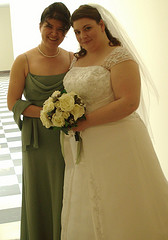
2 CommentsAfter CIL, I rented a car and drove down to Bluefield, West Virginia, to be in my best friend’s wedding. She made a beautiful bride. I think all brides should have red hair.
Now they’re on their honeymoon and I’m back home getting ready for the evening reference shift. I must say, I’m having a harder than normal time making the transition back to everyday life after more than a week of travel, conferences, more travel, wedding stuff, and even more travel. But I’ve got to get my head on straight soon because the next few weeks are going to be incredibly full.

I looked up and instantly got shy when I saw Cindi pointing her camera at me. But somehow she managed to snap a picture of me that I love. You can see all the other stunning portraits she took in her CIL 2008 photo set.
2 Comments