Skip to content

Category: Carleton

Carleton is an Excellent Library!

It’s official. Carleton College is this year’s recipient of ACRL’s Excellence in Academic Libraries award in the college library division!!!!! (press release)

I’ve said it before, but I can’t say it enough: I’m so lucky to work with such a dedicated and creative bunch of co-workers, and I’m so lucky to be able to work with them in a library and on a campus like this one. Reading over the essay that my colleague, Matt, wrote for the award application, I realized yet again how much I’ve learned by working with this group and how much I value their energy, their creativity, and their friendship. They are Teh Awesome!

4 Comments

Come Work With Me?

We’ve re-opened the search for a new (as in “additional” rather than “replacement) Social Sciences librarian.

From the job ad:

Carleton College seeks an innovative and energetic librarian to join us in our lively and imaginative program of information resources and services in a liberal arts setting. Within this dynamic library, the Reference and Instruction programs emerge out of and are informed by the skills, interest, and passions of the members of the Reference team. This is an ideal position for an individual who is 1) looking for an opportunity to work in a liberal arts institution focused on teaching, in collaboration with an unusually fine group of students, faculty, and colleagues; 2) committed to excellence in teaching and student learning; and 3) deeply rooted in and excited about a social sciences discipline.

Leave a Comment

Let the Pilot Begin!

I spent a good portion of today working out the logistics of a new pilot program we’re trying. I’m so excited to see if it works, it’s not even funny!

But first, the background. Our writing center contacts professors who will be teaching WR (“writing rich”) courses across the curriculum to see if these professors would like a writing assistant assigned specifically to their classes. So, for example, a bunch of English courses and a handful of sociology/anthropology, PoliSci, and History classes promise to provide their students with a portion of the intensive writing experience that’s required for graduation. And professors teaching these courses have the option of working closely with a single writing assistant who will shepherd enrolled students through all the writing assignments.

Well, last year the director of the our writing center and I began scheming ways to make our two operations work together more closely. I attended a writing professionals’ mini-conference with her. She invited me to start training new writing assistants. And this winter we’re taking it a step further.

She provided me with a list of courses that have a writing assistant assigned to them. Each week at our departmental meeting, I’ll check with the other librarians to see if they’ve been asked to work with any of these WR courses. If they have, they will contact the writing assistant for those courses in invite the assistants to the library session. That way the writing assistant will understand the research process and options when working with each of the enrolled students. They’ll also be encouraged to send students our way when they read drafts.

I’m going to choose one course to take this set-up one step further, just to see how it goes. I’m going to have one writing assistant take down the names of student that could use a librarian’s help and (with the students’ permission, of course) hand that list over to me. I’ll then initiate the contact with the students. I’m curious to see if overcoming that initial shyness of approaching a librarian for help makes a significant difference. On the other hand, I’m a little worried that this might be more of a workload than we can handle. Hence the pilot within a pilot… and zero publicity. It’ll just be between me and my writing assistant (and a few thousand of my closest internet buddies).

So today I got the list of courses and their corresponding assistants and spent some time creating a new section of the Moodle space we use to collaborate within my department. Hopefully with courses listed, contact information easily at hand, and spaces for noting our impressions of the process we can keep this thing moving forward smoothly and effectively. Goodness knows that if the process isn’t as easy as falling off a log by the time classes start (tomorrow, by the way), the scheme will never fly.

Wish us luck!

Leave a Comment

Writing with Numbers: a Faculty Workshop

Today was the last day of the annual faculty workshop sponsored by our writing program. This year we’re reprising a topic from two years ago: Writing with Numbers. The idea being that students often have minimal expertise in integrating numerical evidence into their papers regardless of whether the paper is primarily about numerical evidence or is a non-numerical paper that could nevertheless benefit from a few well-placed numbers. This is Numbers As Rhetorical Tools rather than a workshop on statistics.

On the first day John Bean (from Seattle University) walked us through the fine art of creating assignments that both encourage students to learn by grappling with problems and also learn to match their writing to various audiences. The next day, my co-worker introduced strategies and sources for find everything from census numbers to large datasets. (And by the way, she deserves a lot of credit for structuring a talk intended for an audience made up of professors from all sorts of disciplines, some of which routinely analyze huge datasets and some of which only occasionally need a population number from the census.) That day was fun because so many people had their imaginations tickled with possibilities for integrating numerical information into their course assignments.

Today the professors teamed up to revise assignments for their upcoming classes. And of course, we had our annual Sock Contest! For this contest, the Dean of the College appears and judges all of our socks to see which are the worst. There are two categories: Holiday and GodAwful. (Though many people spanned the two.) I won last year in the Holiday division for some truly ghastly Santa socks, but this year I dug through my drawers only to find that I’d already thrown away the shocking-green-and-orange shaggy socks that I wore constantly as a kid. Ah well… the world is probably a better place without having to see those socks.

Leave a Comment

Working with our Writing Center

I’ve written before about working with writing centers. About a year and a half ago the director of our writing center invited me to a joint meeting of writing center professionals and librarians. As is usual with such things, the meeting was great, but the conversations that our campus’ writing center professionals and I had on the way to and from the meeting was even better. In fact, it resulted in my being invited to make a 10 minute appearance in the writing consultant orientation the next fall, and for our two services to exchange publicity materials and generally start talking to each other in a new way.

Well, this fall things progressed much further. Rather than repeat my 10-minute appearance at the tutor orientation, the WC director generously handed over a full week of their fall mentor group sessions. (Writing consultants here don’t take a course prior to working in our writing center. Instead, they gather for one Saturday early in the term, and then for the rest of the term they meet in small “mentor groups” each week for an hour, during which time they discuss a reading with their writing center mentor. One week may be “Working with ESL students,” and another may take on plagiarism. This year, one of the weeks was library week.)

Preparing for these sessions proved to be challenging for several reasons. First, there were logistics. 5 sections of a class in the space of a week puts quite a dent in my calendar, and this year there were some scheduling snafus which will hopefully be ironed out next time we do this. Then there was the challenge of finding a reading that would be appropriate for students, that would give them some touchstone issues to discuss that would be relevant to their work, and that would encapsulated the practical and epistemological worth of the library on an academic campus. Turns out, our profession doesn’t really write such thought-pieces in a way that is appropriate for students. Either that or I just couldn’t find what was out there. So I assigned a piece James Elmborg had written about writing centers and libraries and how we’re a good match.* And finally, I realized that I’ve become completely dependent on preparing library sessions with an assignment in mind. Not having an assignment stymied my efforts to put this thing together for quite some time. I hadn’t realized how dependent I am on using the assignment as a way to prioritize what gets included in a session.

Anyway, at the advice of a co-worker, I finally decided to build the session around a theme of “how we are similar.” I hoped that this would give them something to latch onto (since they lacked the grounding force of an assignment, too), and that it would give me a way to work out my own uncertainties about turf.

Yes, I said “turf.” Here I am, going around believing that if we librarians feel the need to “own” Information Literacy, we lock ourselves into an unsustainable, less-than-perfectly effective, and ultimately untenable position. Not only are we insufficiently staffed to be the sole purveyors of Information Literacy to our population of undergraduates, but our students need to learn these skills in the context of their other learning if they’re to develop any kind of facility or nuanced understanding of the research process. What’s more, how can we make the claim that IL is an essential part of a liberal arts education, that it is inherently intertwined with learning on many levels, and then sequester it in the safe confines of the library? And yet, here was I, worried about turning these writing consultants into mini-librarians.

Luckily, my co-workers have wise heads on their shoulders and pointed out that I was worrying for very little reason. The best outcome possible would be to equip these consultants to help their peers think through research problems at point of need, and that they would know enough about what we do to feel comfortable making the decision to refer writers to us when needed.

So these sessions stressed our similarities. Just as consultants “work with to develop writers, not writings,” so librarians work to develop good researchers rather than hand over the perfect research. We both deal with citation, so we talked about resources for that and when consultants could, perhaps, want to steer students our way. We both deal with “it’s due tomorrow” issues, so we talked through strategies for dealing with these students. Of course, we also covered a few library basics, the “how do I know if this counts as a print source” conundrum (they loved the idea of Ulrich’s as a giant cheat sheet of “print” resources), and where to find the research guides that we create for most classes we support.

All of this seemed to go over well, so next term we’re stepping it up a notch. The writing center director and I are coordinating support for the “writing rich” courses on campus so that each librarian can know if classes they’ve been asked to support also have a dedicated writing assistant. If there is a WA, we’ll invite them to the course’s instruction session so that the WA will have the same understanding of the research involved as do the students we’ll all be serving.

Meanwhile, I’m going to try my own little pilot project. I’m going to arm one of my WAs with a reverse sign-up sheet. This way, the WA can identify students would could benefit from an individual session with me, provide me with the students’ names, and I can follow up and schedule one-on-one appointments. We’ll see how that goes.

*Elmborg, James K. “Locating the Center: Libraries, Writing Centers, and Information Literacy.” Writing Lab Newsletter. March, 2006. (Available Online)
1 Comment

New Trading Cards

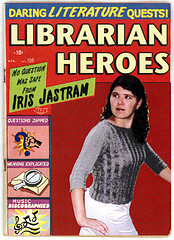
I finally got around to scanning my trading card for this year. We changed up the theme quite a bit, and my coworker surpassed herself in photoshop fu when she designed and executed these cards.

Each librarian has a different banner across the very top (clearly the science librarian wouldn’t want to be involved in Daring Literature Quests), and each has a different set of inset pictures down the left side. Only the question mark picture remains the same in all 8 cards.

One thing I’ve noticed is that these cards seem to appeal to a wider age-range than our previous cards did, which is fun!

1 Comment

Anyone Want to Come Work With Me?

The seven of us in the Reference & Instruction department are thrilled with the idea that soon we will be eight! Here’s the ad (and here):

Purpose of this Position:

Carleton College seeks an innovative and energetic librarian to join us in our lively and imaginative program of information resources and services. This new full-time position will increase our support of the social sciences from 1.0 FTE to 2.0 FTE. This is an ideal position for an individual who is 1) looking for an opportunity to work in an institution focused on teaching, in collaboration with an unusually fine group of students, faculty, and colleagues; 2) committed to excellence in teaching; and 3) deeply rooted in and excited about a social sciences discipline. The Reference and Instruction Librarian for the Social Sciences will report to the Head of Reference and Instruction.

Responsibilities:

  • Work closely with current liaison to expand support to faculty and students in social sciences. See: http://www.carleton.edu/campus/library/reference/liaisons.html.
  • Assist in information literacy planning, teaching, development, and instruction.
  • Participate in a well-utilized individual student appointment model.
  • Participate in our Research/IT desk service.

All members of the team participate in campus initiatives and faculty development presentations, evening and weekend reference rotation, and reference collection development. Liaisons also work together on user guide design and development, production of handouts and publications, and quirky publicity activities. We are committed to collaborating with IT and other academic support units.

Carleton College is a highly selective, residential, liberal arts college located about 45 miles south of Minneapolis and St. Paul. The Gould Library (http://www.carleton.edu/campus/library) strongly encourages and supports professional development, initiative, and imaginative approaches to information services. We place a high value on a solid grounding in the world of books and scholarly information.

Minimum Qualifications:

Required:

  • ALA-accredited MLS or equivalent.
  • Strong service orientation, initiative, and flexibility.
  • The desire and ability to work both independently and as a part of a collaborative, decision-making team.
  • Excellent interpersonal skills.
  • Outstanding oral and written communication skills.
  • Strong teaching skills.

Preferred:

  • Academic library experience, including reference and teaching experience.
  • Strong interest in, knowledge, or experience in assessing user needs.
  • Intrigued by uses of social software in libraries.
  • Advanced degree in the social sciences.

If interested, please send a letter of interest (including where you learned about this position), résumé, and three references complete with address, email, and phone numbers to Carleton College, Human Resources, One North College Street, Northfield, MN 55057. Application review begins October 22, 2007, and continues until the position is filled. Visit our web site at www.carleton.edu. Carleton College is an equal opportunity employer committed to excellence through diversity.

“Social Sciences” at our school means Economics, Education, International Relations, Political Economy, Political Science, and Sociology & Anthropology (a dual department here).

So… who wants to come work with me?

Leave a Comment

Reinventing Quiet

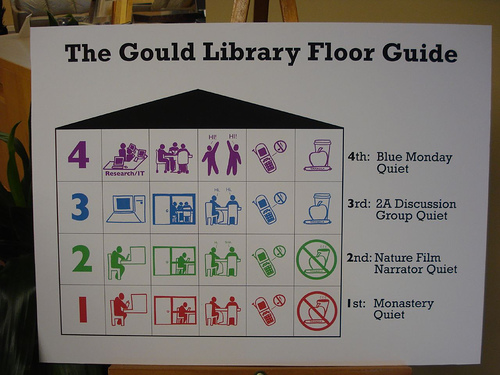
For the last several years, our library has attempted to describe the level of socialization and group activity that happens on each of our four levels by defining them as “Crime Scene Investigation Quiet,” “Water Cooler Quiet,” “Nature Film Narrator Quiet,” and “Monetary Quiet.” (Here’s my previous post on the topic.)

Well, this year, we had to revamp the signs anyway because the food and beverage policy changed. We also realized that pre-work-life students had been consistently confused by “Water Cooler Quiet,” and CSI isn’t quiet as popular as it was a few years ago. So we revamped the top two levels.

“Blue Monday” or rather “Goodbye Blue Monday” is a coffee shop and popular hangout in town. The noise level is generally fairly high, but there’s almost always work going on. Students go there if they want to work on projects together or do homework while socializing at the same time. In other words, precisely what we want to recreate on the main floor of the library.

One floor down, we want to encourage group work and talk, but with more restraint than on 4th. Group work happens, but not as much socializing. This was by far the hardest floor to name. What conveys work being done, talk, but restraint? We decided on “2a Discussion Group Quiet.” On our campus, 2a refers to the second class time-slot on Mondays, Wednesdays and Fridays. Imagine being the professor leading discussion before 10am… yes, now you see why we chose that time-slot. Discussion happens, but not boisterously.

Students told us not to mess with Nature Film Narrator Quiet or Monastery Quiet, so we didn’t. Down on first, if you type too loudly somebody might just pass you a note (rather than whisper) saying that you should respect the needs of your fellow sleep-, light-, and food-deprived students as they labor through their comps research.

4 Comments
css.php