Skip to content

Category: Carleton

Selecting a Sample of Papers to Assess for Information Literacy

Here at Carleton we’re getting ready to do our next ILSW reading. It’s my first time coordinating the project (the amazing Heather Tompkins who coordinated in the past has moved on to another institution), and I’m working with our fantastic Institutional Research folks to select a sample of papers, but I’m also curious to know any ideas or advice you, gentle reader, might have about the sample selection process.
We select our papers from the campus-wide Sophomore Writing Portfolio, where every sophomore has to submit 3-5 papers for rating by the Writing Program and faculty and staff volunteers (which is actually going on as I type). We typically select 100 portfolios (sometimes a little more), creating a representative stratified sample… and of course the first big question is “representative of what.” In the past we’ve used gender and portfolio reader score for this first selection, making sure that we read portfolios from about the same proportion of men and women as we have on our campus, and reading proportional numbers of portfolios that were given a Pass, Needs Work, and Exemplary score. This year we’re also balancing proportional U.S. White, U.S. Student of Color, and International Student portfolios.
Once the portfolios are gathered, we then run at least one more pass to select individual papers from those portfolios (we read one paper per student). We have the option of balancing out papers based on:
  • What the Writing Program calls “Gen Ed:” Science, Reasoning, Social Inquiry, Arts Practice, Humanistic Inquiry, Lit/Art Analysis
  • Characteristics the students identify about each their submitted papers, choosing from: reporting an observation, analyzing complex information, interpretation (of data, text, art, etc), documenting sources, articulating and supporting a thesis driven argument. (Papers can fall into more than one category but must fall into at least one category).
  • Department housing the course for which the paper was written (History, Biology, etc)
  • “Overlay” (A Carleton thing where faculty have the option of saying that their courses are Writing Rich, enhance Quantitative Reasoning, Intercultural Domestic Studies, and International Studies)
The big questions, of course, are how far we want to control the sample given our relatively modest sample size, and exactly what controls matter to how we’re thinking about our reading and our results. If you were faced with these choices, what might you use to select that single paper from the full portfolio? And are there other demographics that you would use to select the portfolios themselves?
Leave a Comment
Get your applications in! The search is underway!

Come work with me! The search committee for our Reference & Instruction Liaison Librarian for Humanities and Digital Scholarship position is meeting soon to start reviewing applications, so get your application in soon. I’ve gotten a sneak peak at some of the job duties as I’ve been the interim digital scholarship person, and it’s really a neat area to be involved in on our campus. What started as an experiment is now growing wings, so it’s right at that interesting stage where there’s a lot going on and a great network of people to work with, but it isn’t a solidified program on campus so the new librarian will have plenty of room to move the program in interesting directions.

Also, you’d get to have a trading card made for you to match this year’s postcard theme.

Here’s the job ad:

Carleton College seeks a Reference and Instruction Librarian to join us in a lively, imaginative and team-based program of information resources and services. The library is committed to an intellectual partnership with the faculty in integrating information literacy into the curriculum of the college. Our information literacy program is linked to a college-wide initiative to address the basic literacies (information, quantitative, visual, writing, and speaking) that cut across the curriculum. Our digital scholarship work happens throughout the library and is done in close collaboration with colleagues on the faculty and in ITS.  We place a high value on a solid grounding in the world of scholarship, regardless of format.

This is an ideal position for an individual who is 1) looking for an opportunity to work in an institution focused on teaching, in collaboration with an unusually fine group of students, faculty and colleagues; 2) committed to excellence in teaching and to information literacy as a liberal art; 3) deeply rooted in and excited about humanities research; and 4) engaged in the methods of digital scholarship and its application to the liberal arts.

The full job description and application instructions can be found here: https://jobs.carleton.edu/postings/2456

Founded in 1866, Carleton is a private, highly selective liberal arts college with 1950 undergraduates located in Northfield, Minnesota, 45 miles south of Minneapolis and St. Paul. Best known for its academic excellence and warm, welcoming campus community, Carleton offers 37 majors and 15 concentrations in the arts, humanities, natural sciences, and social sciences. Carleton is committed to attracting and retaining a diverse group of faculty and staff and offers a comprehensive benefits package.

As they say in all the best commercials: Apply Today!

I’m happy to answer any questions you might have, or direct you to members of the search committee who can also answer questions. Or you can contact my department head (and search committee chair) Ann Zawistoski.

Leave a Comment

Big fun with small data

While I’m on shift this Sunday (during the most glorious fall day we’ve had, on a day that combines Family Weekend and Homecoming Weekend), I played around a bit with our chat reference statistics.

Our students have never really used chat reference much. In part this was our fault (we didn’t have a very friendly chat widget and we didn’t have the unlimited funds needed to have 24/7 reference service) and in part this was because on a small residential campus, the majority of the people who wanted help while we were on staff were already in the library. (That’s what students told us when we asked, and the data from this year bears it out by a slim margin.)  So last year we’d fielded three whole chat reference questions in the first four weeks of school.

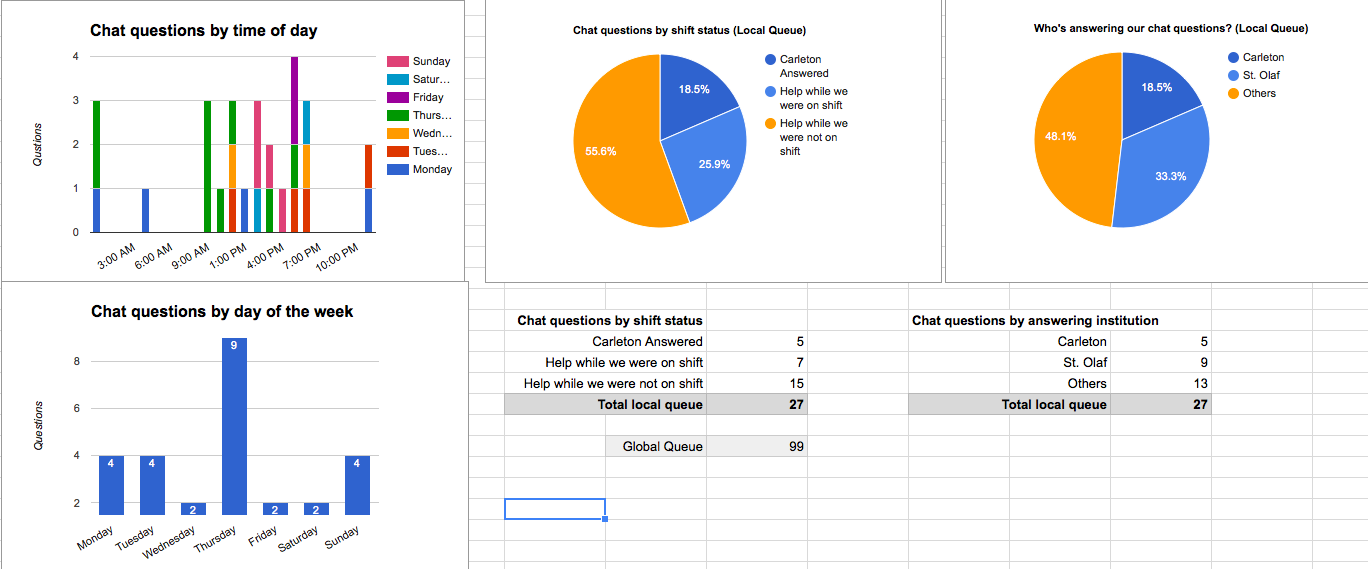
This year we’ve switched to QuestionPoint, which means we have 24/7 reference and access to a chat widget that looks a lot more like chat widgets people are used to seeing. Now here’s where the big fun with small data comes in. Because last year’s n was so small, I can say that this year we’ve had a 800% increase in chat questions. Woo!

If we’d changed nothing but the interface, we would likely have answered just the 5 questions that we have answered while on shift this term (66% increase), but the change in librarian coverage has made a huge difference. 15 of this year’s 27 questions were answered while we weren’t on staff, and another 7 question were answered while we were on staff but otherwise occupied. So that’s pretty cool. Usability and coverage FTW!

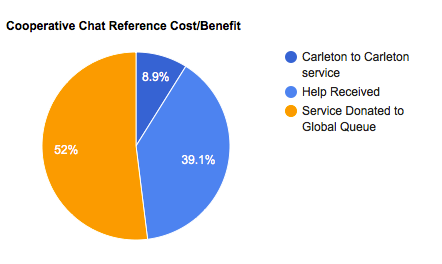
Updated to add: I was curious to see how the service is working from a cost/benefit perspective. We donate a specific number of hours per week based on our FTE, and it looks like the formula is working ok. We have answered 29 questions for other institutions, and between the help the collective has given us us and our own efforts, our patrons have gotten 27 questions answered.

2015-10-11_2246

Leave a Comment

Come work with me!

Photo by  Brenda Gottsabend
Photo by
Brenda Gottsabend

Have you been wanting to come work at Carleton? Here’s your opportunity!

The library at Carleton College seeks a Reference & Instruction librarian to join us in a lively, imaginative and team-based program of information resources and services. The library is committed to an intellectual partnership with the faculty in integrating information literacy into the curriculum of the college. Our information literacy program is linked to a college-wide initiative to address the basic literacies (information, quantitative, visual, writing, and speaking) that cut across the curriculum.

This is an ideal position for someone who is 1) looking for an opportunity to work in an institution focused on teaching, in collaboration with an unusually fine group of students, faculty and colleagues; 2) committed to excellence in teaching and to information literacy as a liberal art; and 3) deeply rooted in and excited about interdisciplinary or area studies. We place a high value on a solid grounding in the world of books and scholarly information.
The full job description and application instructions can be found here: https://jobs.carleton.edu/postings/2383
If you have any questions, feel free to contact either me or the Head of Reference and Instruction — we’re both on the search committee and happy to talk to you about the position. My contact information is here, and Ann’s is here.
Edited to add: Some people have asked if we are deliberately looking for entry-level librarians, and the answer is that we are deliberately NOT restricting our pool to only people who have a specific amount of experience. If you would like to come work with us, please apply!
Leave a Comment

Gigi ends her public service

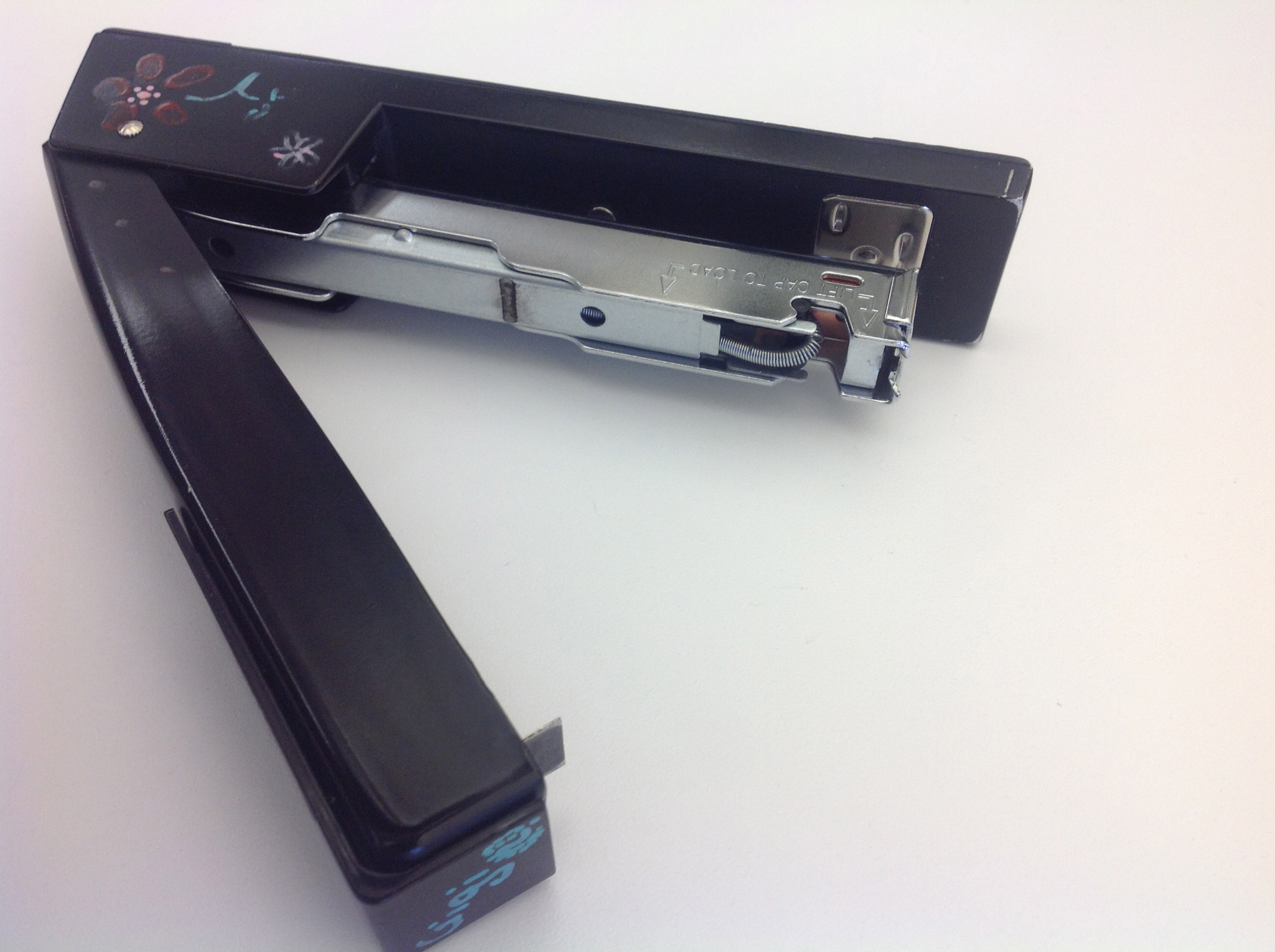
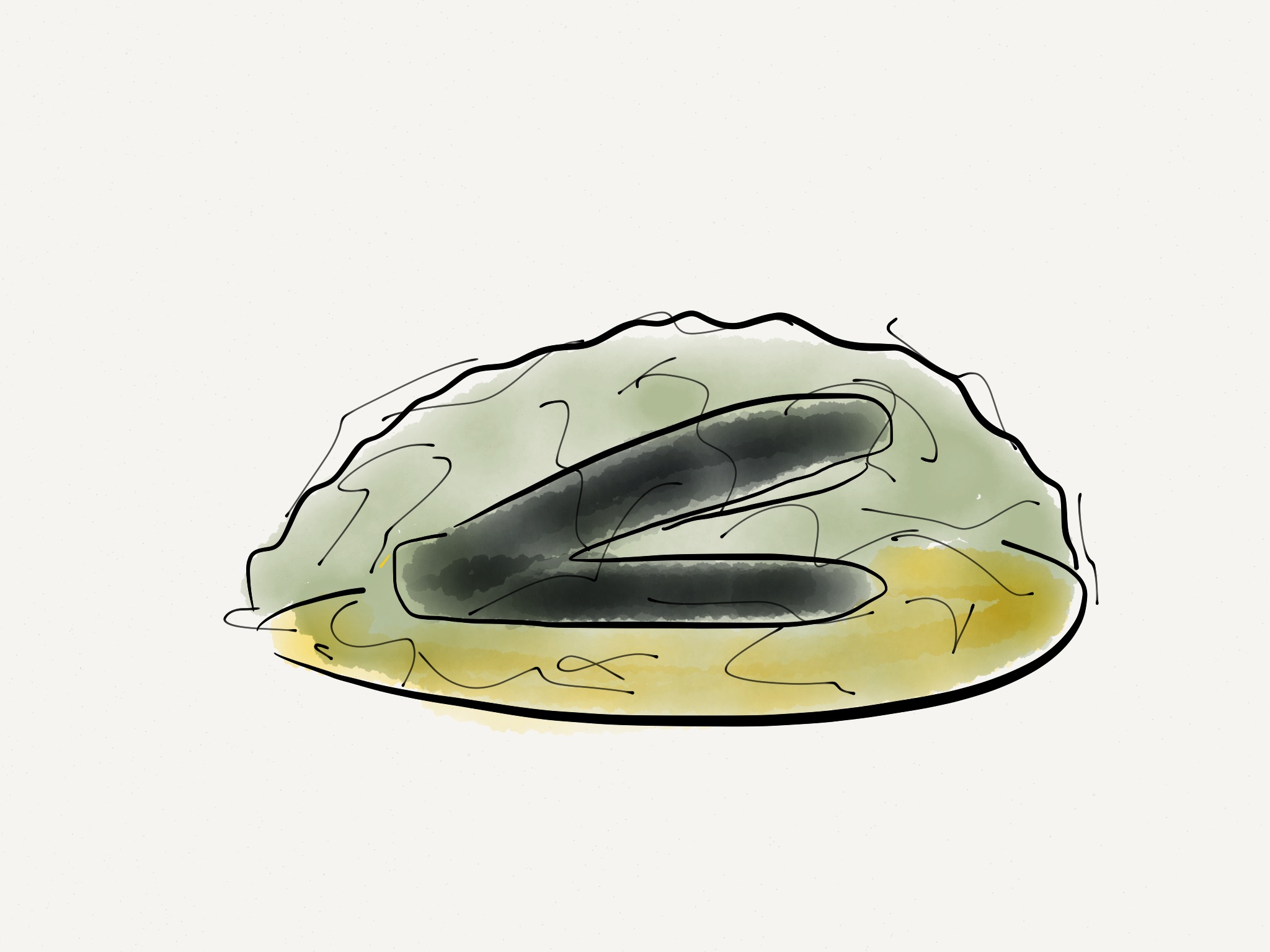
Just 3 days short of turning 13 months old (or 383 years old in people years), Gigi the stapler must finally give up her unprecedented tenure as a public servant in our library. She exploded some parts last night, hitting an unsuspecting bystander, and now her casing has come separated from her guts.

IMG_1099

She will be sent to a quiet shelf to retire in peace and think back over her incredibly long career. We wish her well in her retirement.

Leave a Comment

Situating Information Literacy Within the Curriculum: Using a Rubric to Shape a Program

For the past 5 years my department in the library at Carleton College have developed and engaged in an ongoing assessment project, the Information Literacy in Student Writing (ILSW) project. We published a piece in In The Library With The Lead Pipe in 2011, and this month Portal published our second article on the topic,  “Situating Information Literacy Within the Curriculum: Using a Rubric to Shape a Program.”

Danya, Heather, and I asked for and signed a license with Portal that allowed us to keep ownership of our copyrights, so I’m able to provide the full text of that article, but you should definitely take a look at the rest of the issue. I happen to know that Catherine Pellegrino also has an interesting article in this issue, for example.

Jastram, Iris, Danya Leebaw, and Heather Tompkins. “Situating Information Literacy Within the Curriculum: Using a Rubric to Shape a Program.” Portal Libraries and the Academy 14, no. 2 (2014): 165–86.

Abstract: This article reports on a pilot study to examine undergraduate students’ help-seeking behavior when undertaking library research in online courses. A novel methodology incorporating elements of ethnographic research resulted in a small, but rich and detailed, collection of qualitative data. The data suggest that the methodology has promise for future, larger studies on students in online learning environments. The article includes a detailed discussion of the methodology’s strengths and weaknesses, and offers recommendations for modifications that will improve the research design.

I should note that I’m the first author only by virtue of the alphabet. This was truly a group effort.

Please note: all figures are out of place by one position.


2 Comments

The OTHER nasty underbelly of copyright

We got a letter from the Copyright Clearance Center on behalf of someone who wants permission to use a chapter out of a book published in 1960, so I set about figuring out what the book was and who could sign for the college. Simple right?

The permissions request form listed the author as Pierre Corneille and the book as “The Continental Model.” Ok, off to the catalog. Surely we own something if people are asking our permission for it. But the author’s name didn’t bring anything up, and it listed him as being alive and kicking in the 17th century, so that was confusing…

Then it turns out that Corneille was the original author of the chapter in this work of compiled essays, and the essays were all translated from the french by two guys. Ok, so this would probably be pretty straight forward. I’d just check to see if they’d renewed the copyright before sending the paper work over to the vice president’s office and he’d sign and we’d be done.

So I searched the Copyright Renewal Database from Stanford REALLY hoping nobody had renewed it so that I wouldn’t have to keep figuring out if we owned the copyright. Unfortunately, they had. And just to throw an extra wrinkle into the mix, the two authors were listed as the renewers, which probably means Carleton doesn’t own the copyright. So maybe this won’t be so bad. I’ll figure out if one of them is alive and send the paperwork off to him.

But then I found both of their obituaries. So now I have to figure out if the copyright might have fallen to us. WHAT A PAIN. So after a couple of phone calls, it seemed like the next step was our college archives. We need to know if there’s any contract that would tell us that we’re the copyright holders. And just to make this more interesting, the book turns out to have been jointly published by Carleton and by the University of Minnesota Press, and have been published using grant funding provided by then-president Larry Gould (for whom our library is named, by the way).

So then the archivist hunted for any paperwork associated with the two professors or with that grant from Gould. He didn’t find anything, so now we’re pretty sure that since the two guys renewed the copyright, their estates must hold the rights. The poor prof will now get a form letter back with the “I do not hold rights to this work” checked.

And the kicker is that, the prof who asked for our permission has asked to use one chapter from a book, and to use it for a class reading distributed to five students. So the use falls squarely within fair use, but there’s no way on this earth that the Copyright Clearance Center is going to pass that message on to the prof from me.

What a royal pain! We should start charging the CCC for fear mongering.

2 Comments

Bagel Study Break in the Libe: A story in pictures

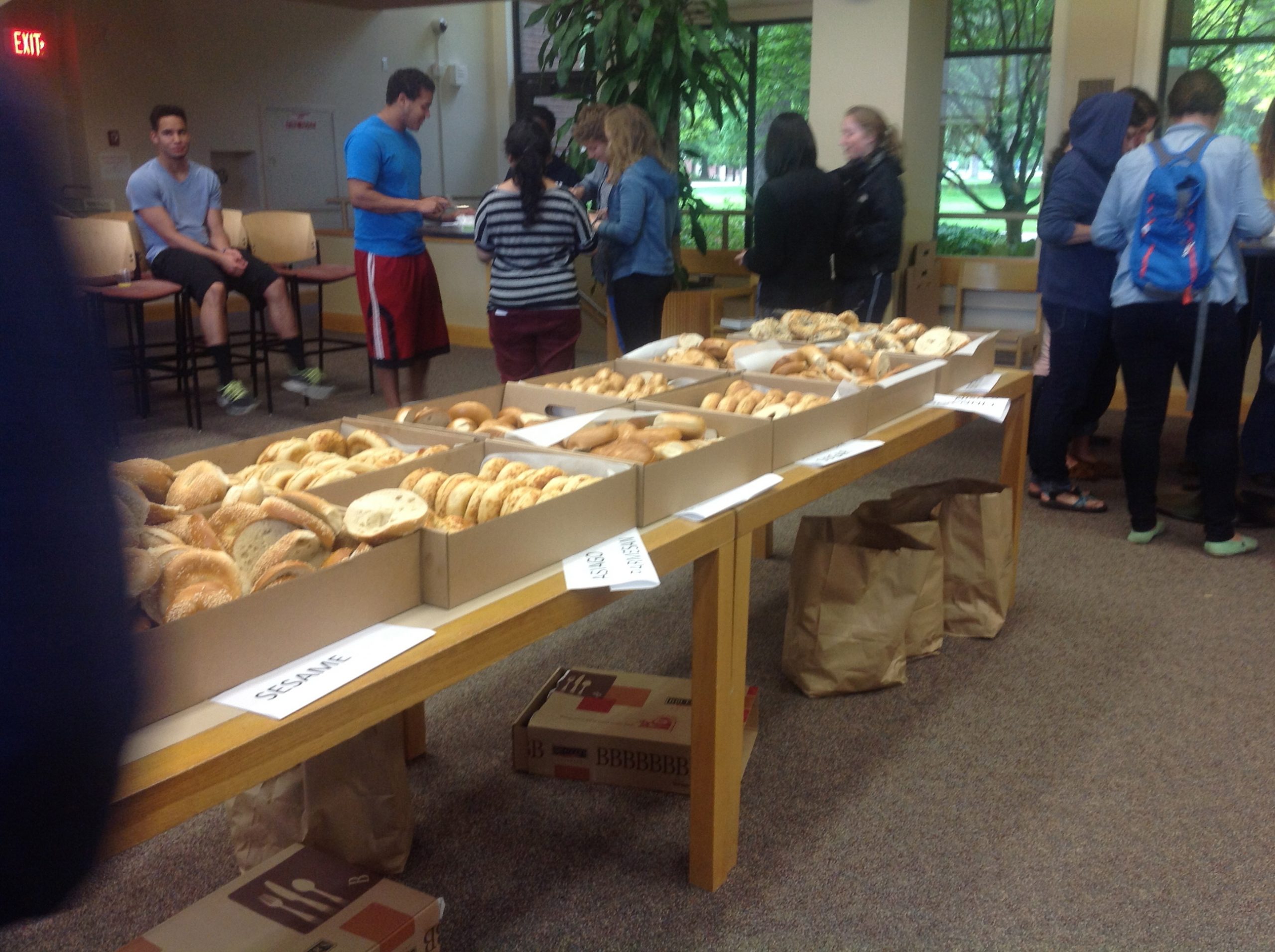
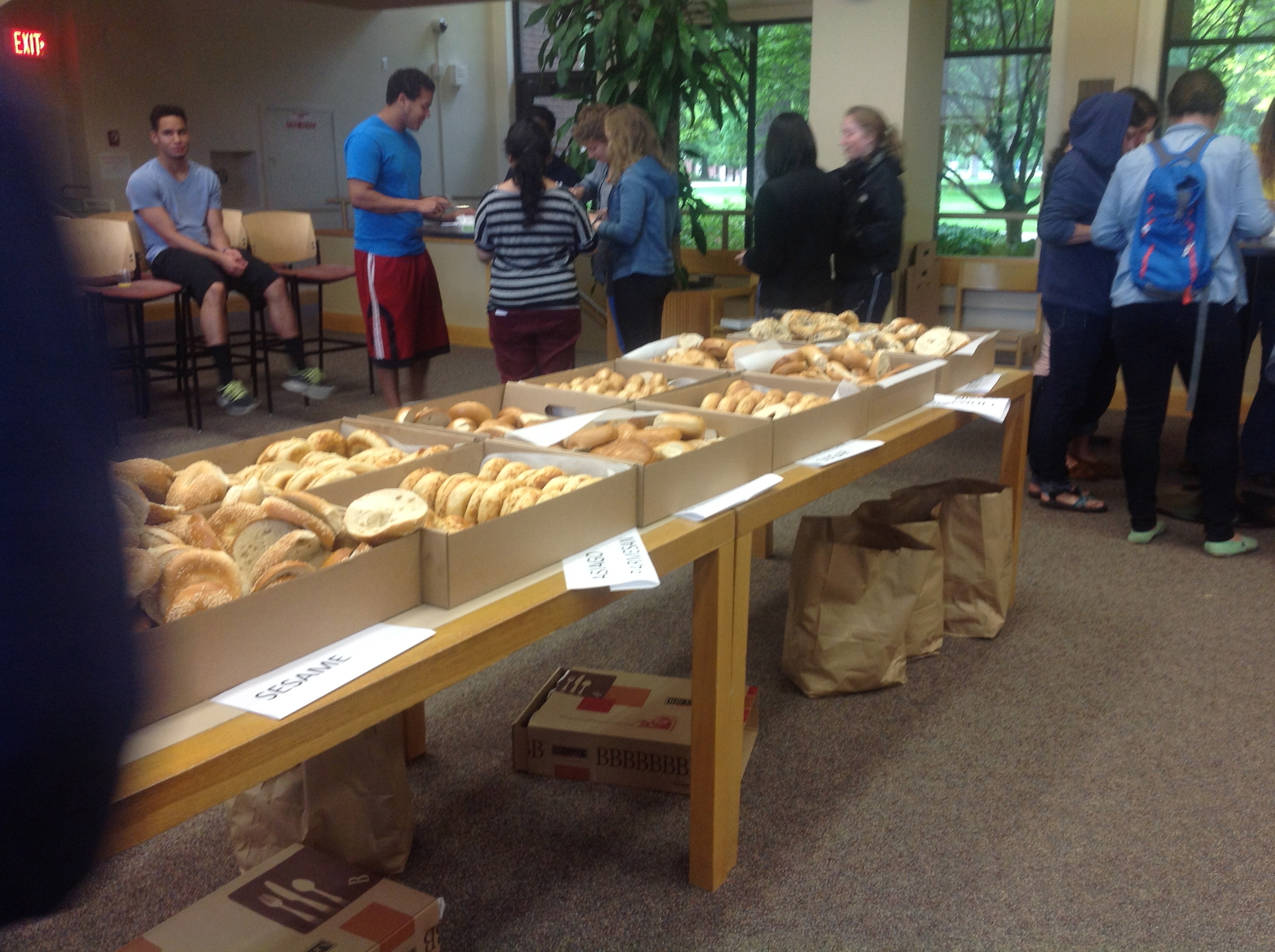
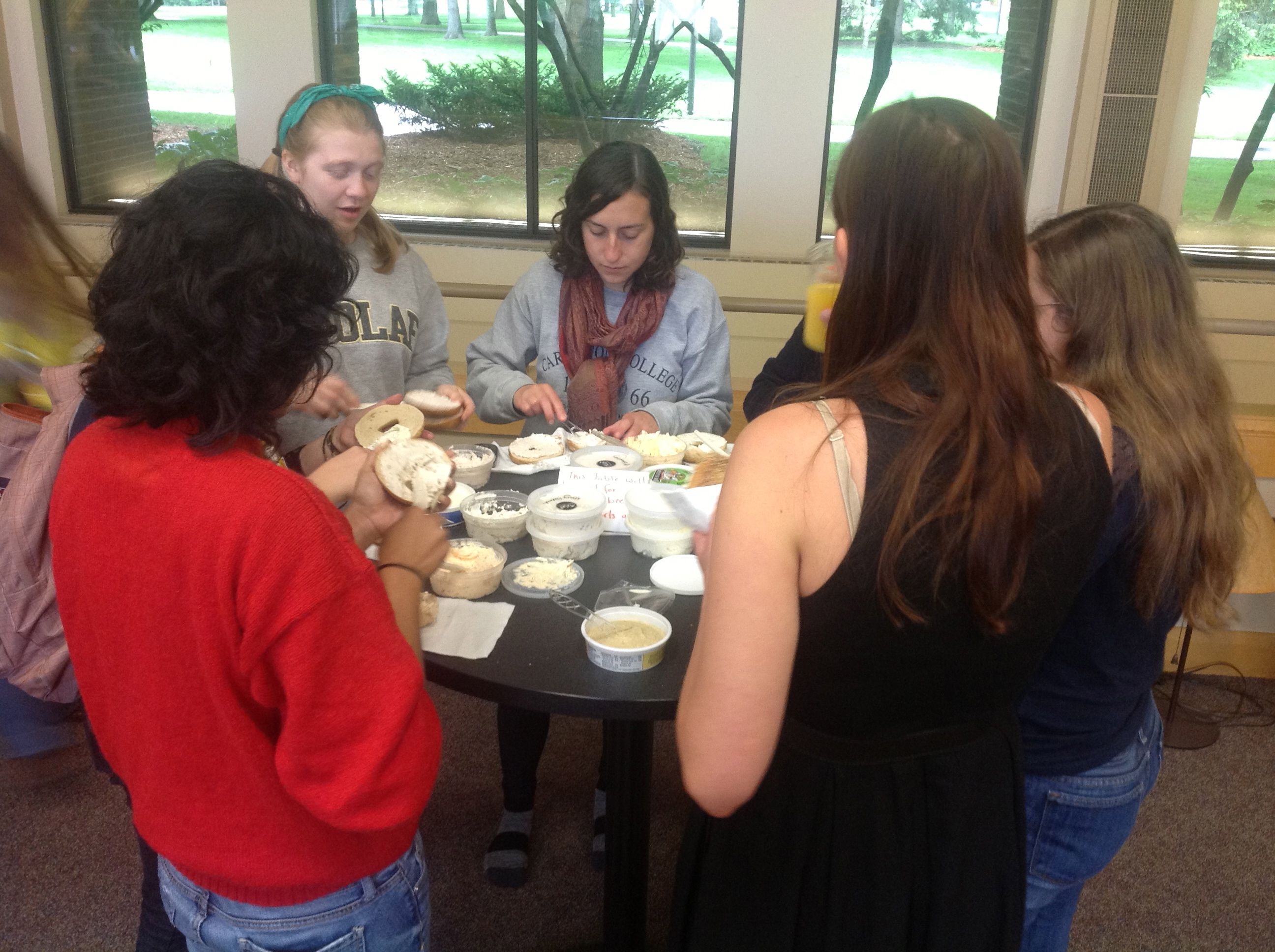
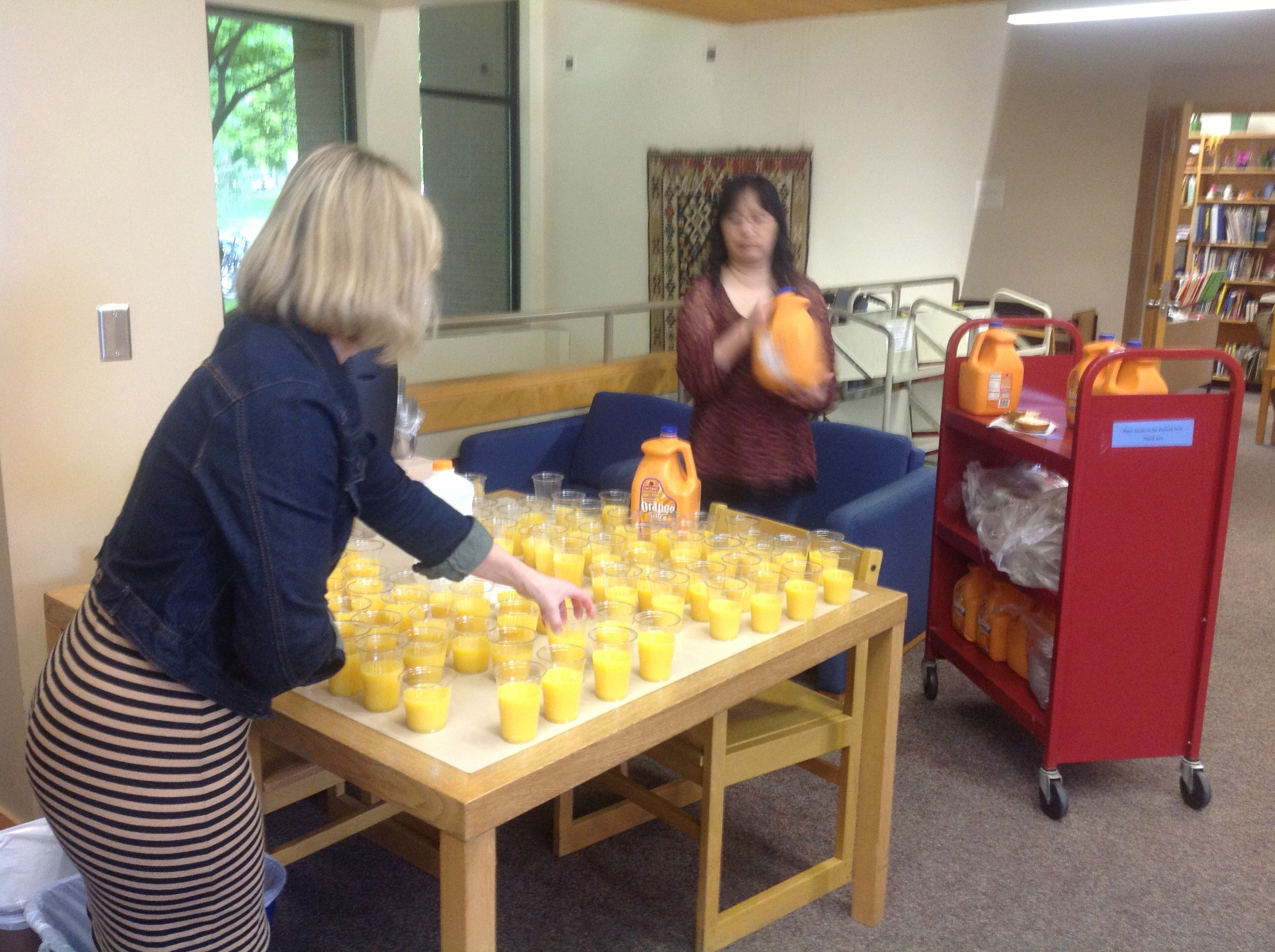
Yesterday we hosted our traditional bagel study break for reading days. As usual, the bagels went fast.

Hundreds of Bagels
Hundreds of Bagels
Several tables of cream cheese.
Gallons of orange juice.
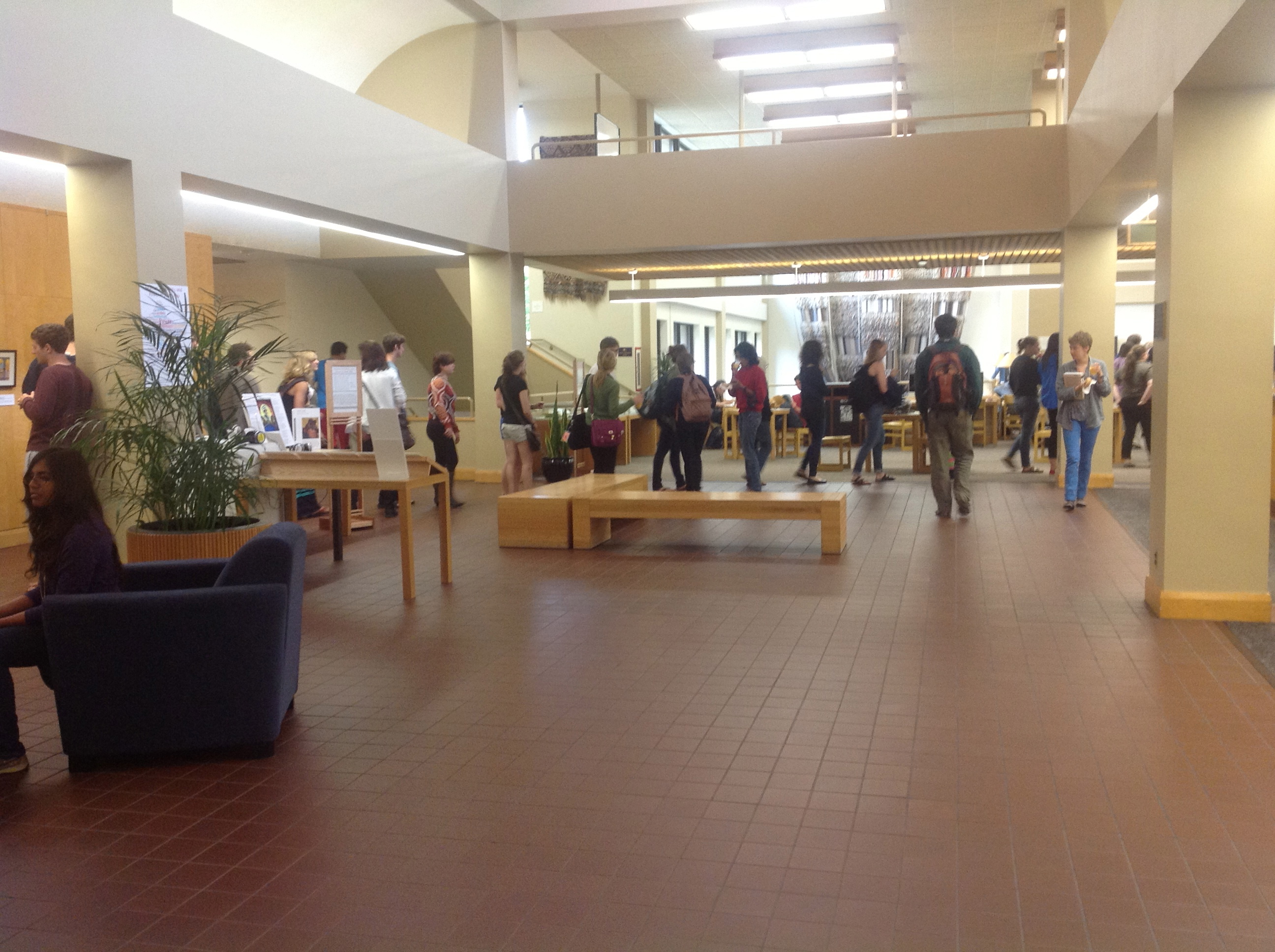
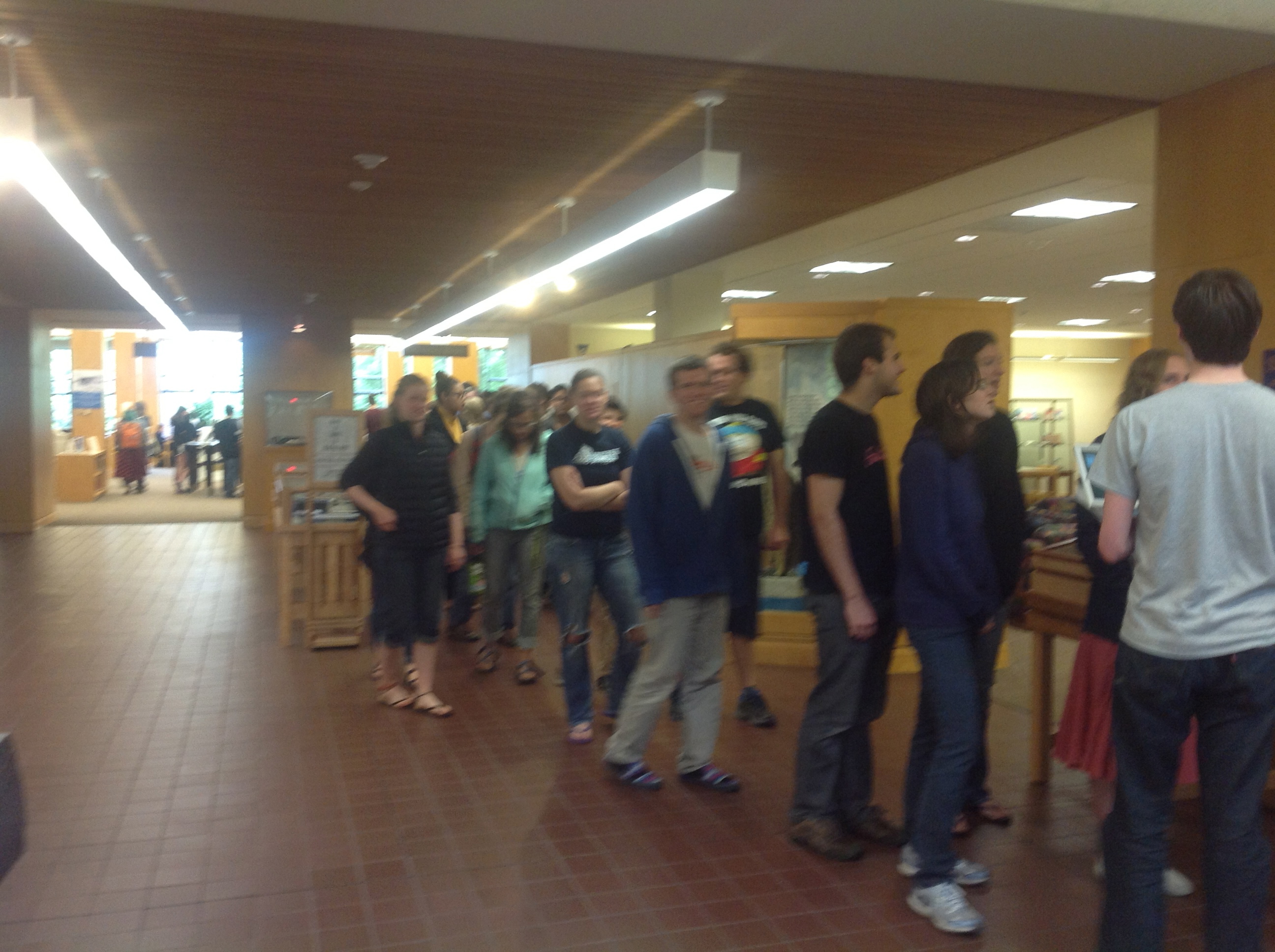
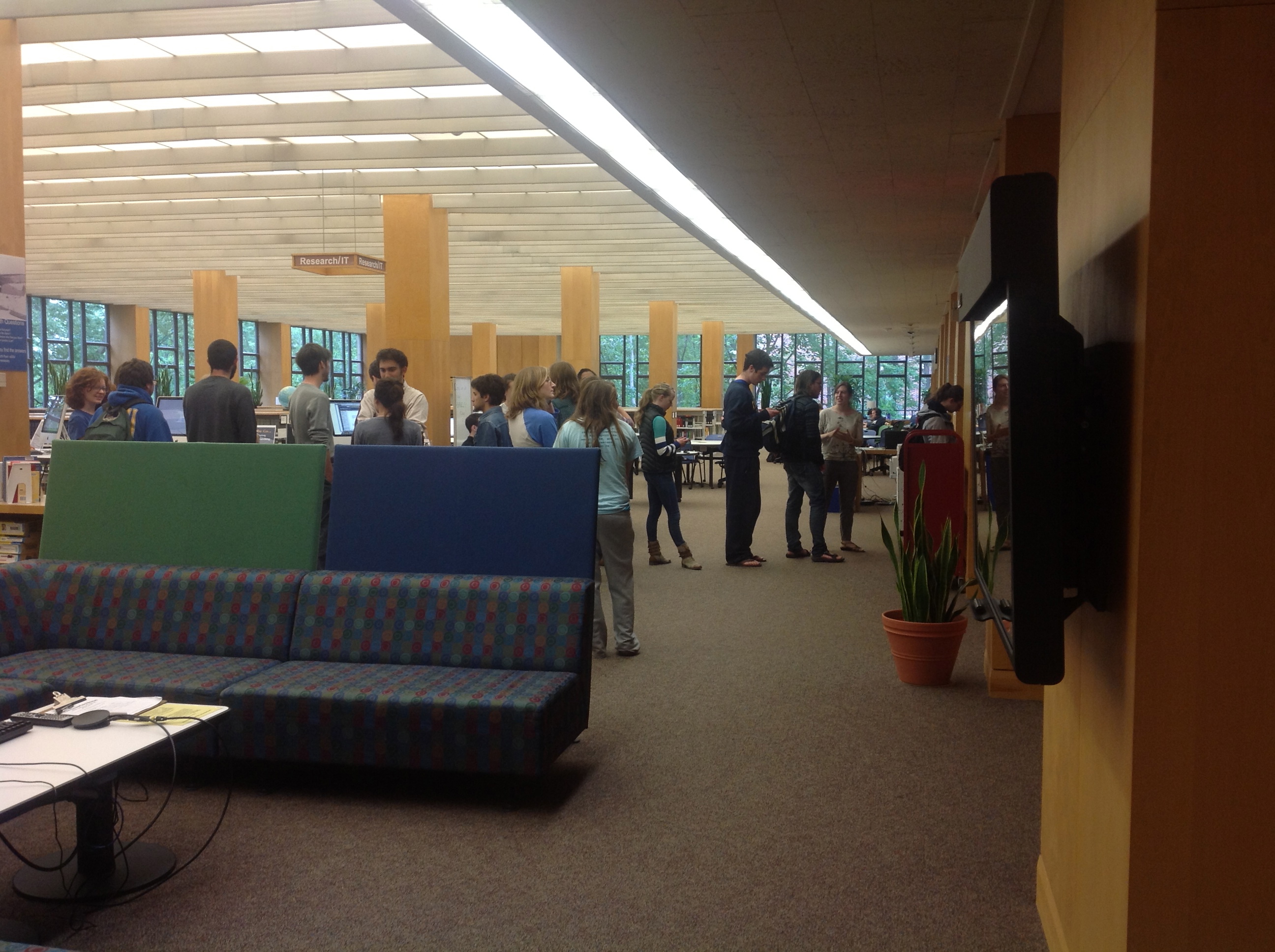
The line snakes all the way around the large study space called the East Wing and then out into the library's main lobby.
The line snakes all the way around the large study space called the East Wing and then out into the library’s main lobby.
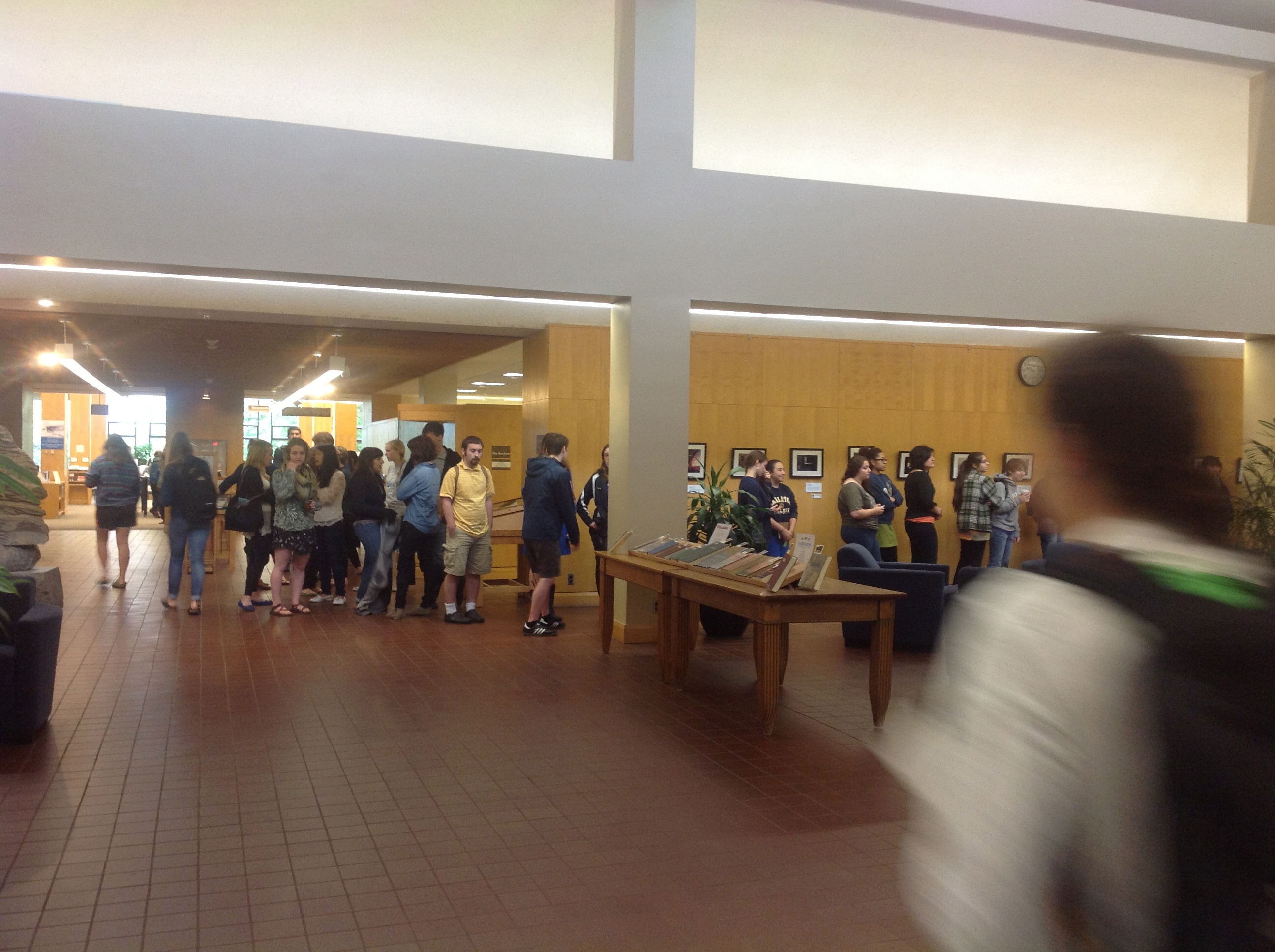
Then the line goes all the way across the lobby and down the main hallway to the reference room.
Did I mention there was a line?
Finally, the line ends after crossing the entire library in a massive Z shape, ending in the Reference Room.
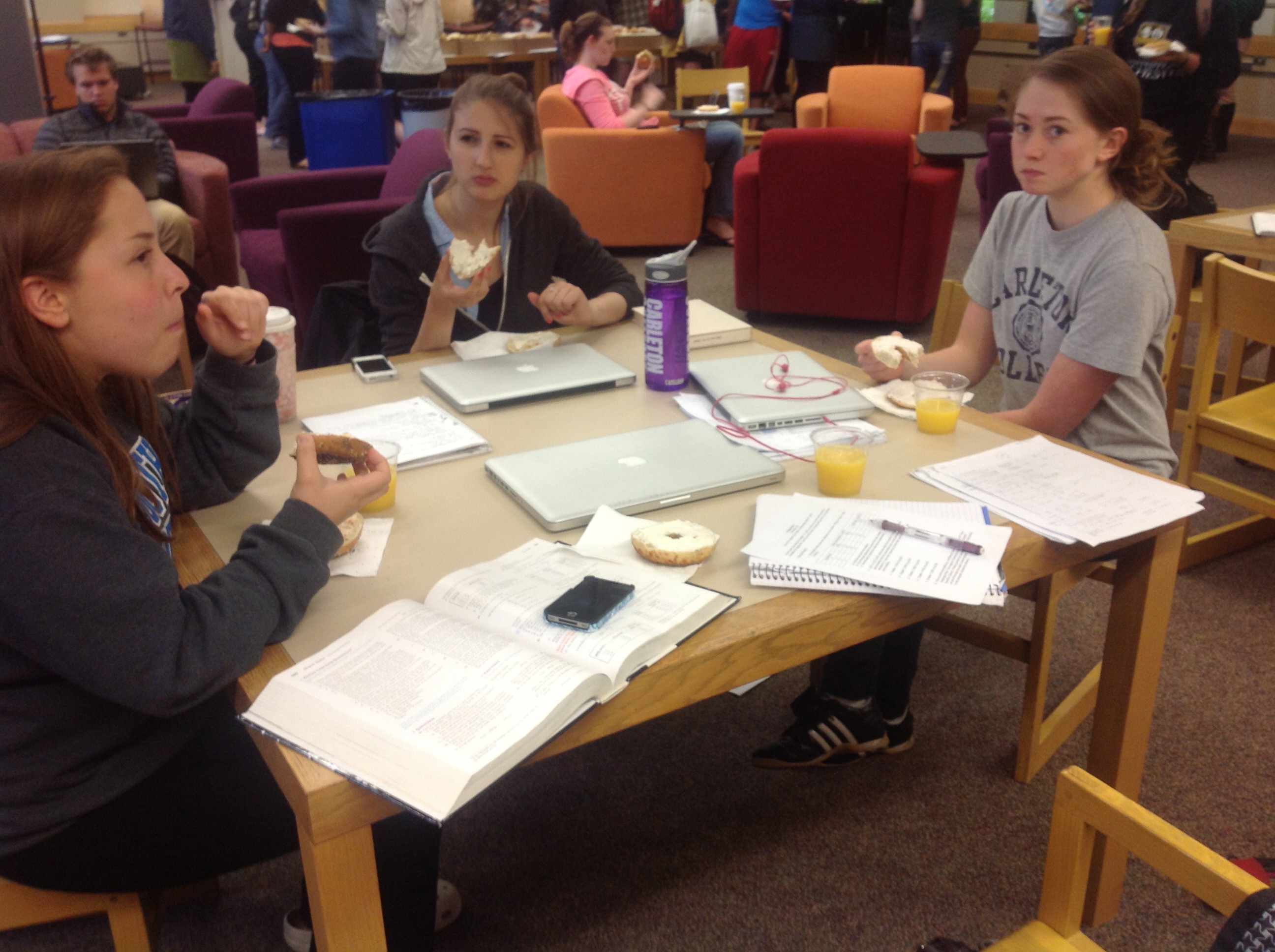
Studying in style.
Studying in style.
2 Comments

Digital Humanities Speed Dating

The director of our Humanities Center instituted a First Fridays informal gathering at our local pub geared toward people who are interested in digital humanities. It’s only met three or four times so far, and I had to miss the first one, but it’s been really great to sit around and listen to people say what projects they’re working on.

At the December gathering one of the profs there said what I think a lot of people were thinking when she admitted that she wasn’t speaking up because she didn’t know enough about the digital side of things to envision what she might do for a digital humanities project. She’s well aware of great digitization projects in her area, and web archives, but beyond digitizing things, what kinds of questions would she want to ask that computers could help her with? On the other side, the CS types said that they knew that computers could be great thesauri, but they didn’t really know enough about what keeps humanists awake at night to really suggest projects.

This seemed like such a fundamental question that we hatched a plan. We set up a “digital humanities speed dating” session. Humanists would come with some description of their own research, and CS-types would listen with their CS-perspective and would also talk about what they were working on. And maybe the more we knew about each other the more we would be able to see collaboration potential.

So this evening we conducted our Speed Dating session, and whatdyaknow, some CS profs and students had highly humanistic interests, and some humanists got really helpful ideas from the CS profs and students. My favorite moment was when one of our classicists was telling us about a set of fragmentary Roman documents that she is really interested in. They’re documents that record the auction prices of quite a few people’s property (they’d been convicted of something or other, and the proceeds were to be in some way presented to whichever god they’d offended). And people were discussing what she might or might not be able to learn from the fragments she has, and one CS prof said it’d be interesting to see if they could infer something about the data that’s missing. You could use each sale as a kind of user rating of the item, he said, and the missing items would be something like the things in Amazon or Netflix that haven’t yet been rated, and you could infer something about their potential value based on what had been rated/priced already. Well, that blew our humanist minds.

So after the gathering the CS prof went to talk to the Classicist a bit more, and then I happened to be there in the hall when he debriefed another CS prof. “Yeah,” he said, “I’m just going to take her spreadsheet and run a ……” and here he and the other guy went into a dialog that I assume wasn’t actually in Greek, but it might have been.

I love it when I come face to face with expertise I can’t even parse. And also, I think that’s part of the point of this whole thing.

2 Comments

Close but no cigar?

Poor Bilal
Poor Bilal

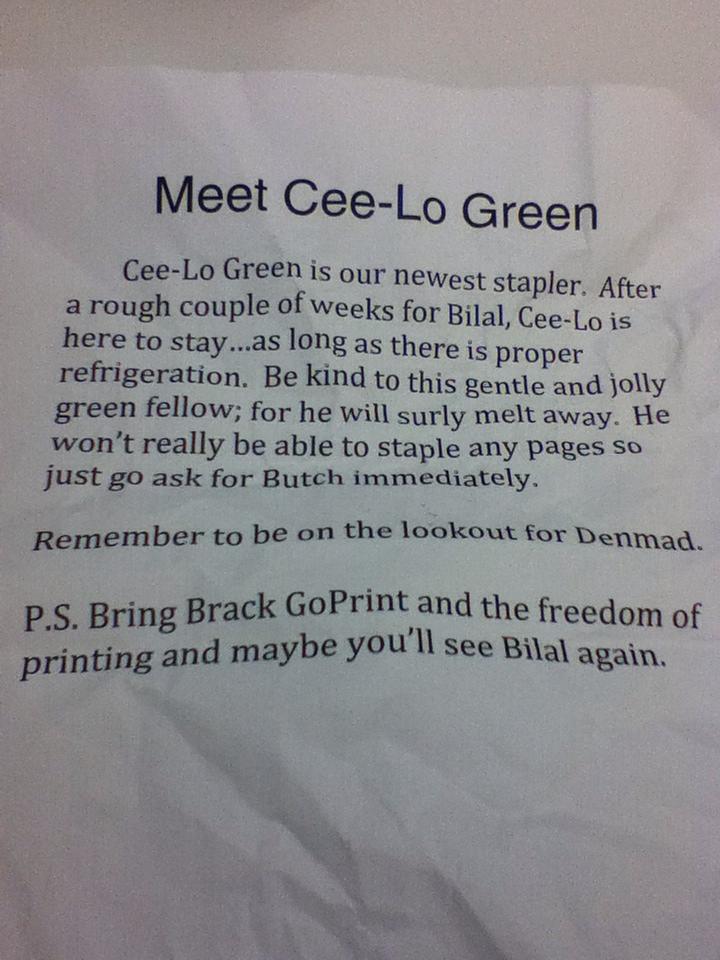
So, apparently our current stapler, Bilal, was kidnapped late Tuesday night, solidified in jello, and a ransom note left saying that he would be returned safely if we switched back to our old print management system.

I laughed so hard.

But then, as it turned out that nobody in the library knew that this had happened, and that only a few student workers in other departments on campus would say “oh, yeah, I heard about that” it became clear that Carleton students are pretty inept ransomers. Shouldn’t they at least made sure that some staff saw a picture of the jello-ed stapler? Or the note?

Clearly our curriculum is lacking in some areas.

———

UPDATE:

A facebook post reveals a picture of the ransom note. Seen here in all of its stunning brilliance:

Ransom Note
Ransom Note

Butch is our heavy-duty stapler. GoPrint is the old print management system.

1 Comment
css.php