Skip to content

Category: Carleton

Holy paper reams, Batman

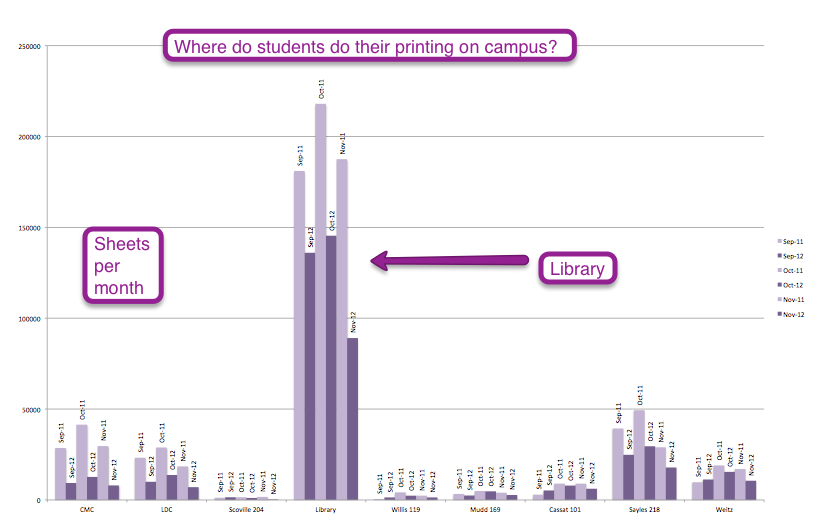
The care and feeding of the library’s public printers takes a lot of our time, both in the library and in ITS. We have a special load-balancing set-up designed to keep individual printers from melting or going up in smoke. We have students who devote the bulk of their time to watching over the printers and emptying case after case of paper into them. A good portion of the meetings I attend and lead have printing somewhere on the agenda. Basically, printing is a big deal.

And now there are graphs to prove it.

libeprinting

There’s a lot of extraneous information in that chart for my purposes since it’s lifted from another report on Fall term printing. But I think the GIGANTIC MOUNTAIN OF PRINTED SHEETS in the middle pretty much speaks for itself.

Where do students print on campus? In the library, that’s where

(p.s. If you’re curious, that’s about 5,300 pages every day of the term, or about 7 pages every minute the library is open, which was a 36% reduction over last year.)

5 Comments

A bunny and a monk and the pope walked into a library…

Wait, no, there was no monk or pope, just a little baby bunny.  It ran into the library right through the front door as someone else walked in, spent some quality time eluding near capture, and finally cornered itself under a radiator where the radiator entered the wall at a corner. The archivist with a lab coat at the ready for capturing the bunny moved in. The pregnant social sciences librarian with the box moved in. Another librarian and myself blocked off escape routes.

And then the bunny hopped up into the radiator.

After some rummaging around to see if we could get into the wall from behind, I went to get a mirror from my office, crammed myself under the radiator, and realized that there was no bunny in sight. We weren’t going to be getting it out on our own.

A circulation supervisor called security who called facilities. Two facilities guys and several tools of increasing size and wattage later, a saw-dust-covered bunny was revealed.

It was so shaken up that it even sat still for a picture when we released it.

Leave a Comment

Remembering Toff

Toff

Toff the campus cat lived a charmed life here, sneaking into dorm rooms, sauntering up to the reference desk, or serving as greeter in the student union. His Facebook page was very popular, and he’d use it to tell us what he’d been up. Each year on his April 1st birthday the food service on campus would make birthday pastries to stock the dining halls and cafe, and the library would display Toff’s pick of books. He got elected to the student senate as a write-in candidate, and he probably attended more lectures on campus than I have, and he has his own video. And on Sunday he died of cancer.

The St. Paul Pioneer Press ran his obituary today, and his Facebook page has had over 11,400 hits since Sunday. The campus radio station is doing a “we found Toff’s iPod and will play selections” show tomorrow. He will be missed. But according to his last Facebook post he’s doing well:

Hey, you guys!! Thanks for all the kind words. Just to let you know that I got here safely, and this is some cool campus! Are there ever some awesome white birds flying around up here! I miss you, but just know that I am happy, really happy. And Pete has kitty treats! Toff

Leave a Comment

Uncovering Research Practices in Student Writing

When I was a baby librarian, I thought Information Literacy was about searching and evaluating. The ACRL standards had some other stuff in there, but it seemed like abstract stuff that I couldn’t do much about. Keywords, operators, relevance, currency, authority — just learn the formula and my work here is done. No wonder librarians were the only people who cared about information literacy, I thought.

In my defense, I was young. In my defense, this is how it had been presented to me all the way up through library school.

In the past three years, I’ve been part of a project that really expanded my thinking and made me fall in love with what information literacy could be and with the ways in which it really is relevant to people and projects on my campus.

But let me back up.

All of our sophomores are required to submit a portfolio of their writing, and passing this assessment is a graduation requirement. When they submit their portfolios, they’re given the choice of designating that their writing can be used for research, which many of them do, and lately the college has been doing three large projects (that I know of) based on these writing portfolios.

  1. Our quantitative initiative (QUiRK) reads a subset of the papers to determine how sophomores use quantitative evidence in their writing.*
  2. The writing program and SERC are pairing up for the Tracer Project, which studies how faculty development (which includes writing portfolio assessment) impacts student learning.
  3. And starting in 2008, we in the library have been reading portfolios to see how information literacy is revealed in academic writing at the sophomore level.

As part of that last one, my department had fascinating hours of discussion about what we could and couldn’t evaluate about information literacy when presented with a finished paper. One of the most interesting and useful of these discussions (for me) was the one which revealed that we could, in fact, assess evaluation of sources even when the paper didn’t use “outside” sources beyond primary sources or sources prescribed by the professor. We could watch students picking primary sources, even from assigned readings, that worked well together and could be used to make a compelling point, or we could see them cramming two such sources together and either treating them entirely separately or in other ways not using them instrumentally toward making a point. We also confirmed what we had always suspected: that implementation of attribution was about more than just mechanics, and that failures in attribution could often signal a fundamental misunderstandings of the sources the student was using or of the purpose of reporting evidence in the first place. And we articulated for ourselves some of the ways in which integrating evidence into a paper can help or hinder the student’s rhetorical goals.

We couldn’t assess much (if anything) about the actual steps in the process that resulted in the writing we had in front of us, but we could look for habits of mind associated with using evidence, and we could look for the ways in which conventions of communicating evidence manifest in sophomore level student writing.

In the end, after much testing and revision, we came up with a rubric for assessing information literacy in writing and sat down to score papers. And yesterday, we finally presented our work and some preliminary findings, handed around a sample of student writing and watched as the faculty and staff attendees pulled interesting and useful insights out of the writing and then all came up with exactly the same score on the rubric (inter-reader reliability!), and had a fun discussion about how this could be used on campus to build shared expectations for information literacy and to help inform our teaching.

For my part, participating in this project has fundamentally changed one of the major ways I think about my work. It was so liberating for me to realize in concrete fashion that “information literacy” does not equal “the research paper.” All of a sudden I discovered that I do have something to contribute to those parts of the curriculum that interest me but that don’t produce traditional research projects. All of a sudden I realized that I don’t have to help faculty squeeze research projects into courses where those projects don’t fit naturally, and that instead we could talk about context-building skills or source interpretation skills for thought-pieces, class discussions, and other non-research assignments.

For me, this project helped me realize that I actually do like the concept of information literacy and that it actually does have meaningfully deep and cross-cutting applications on a liberal arts college campus — that it’s not simply about making mini-librarians out of our students or about searching for searching’s sake. I’m hoping that as we open it up to include faculty readers this year, that same sense seeps through the campus. I hope this is something we can get behind and dig into and find interesting, and that what we learn from analyzing these portfolios will meaningfully inform our practice as teachers.

I’m just so excited about this project, and so glad to be involved in it. It’s probably been the most eye-opening and practice-changing project I’ve participated in.
* Rutz, Carol and Nathan D. Grawe. “Pairing WAC and Quantitative Reasoning through Portfolio Assessment and Faculty Development,” Across the Disciplines, December 2009; Grawe, Nathan D., Neil S. Lutsky, and Christopher J. Tassava. “ A Rubric for Assessing Quantitative Reasoning in Written Arguments,” Numeracy, January 2010.
[back to text]

1 Comment

Come Be My Boss

Help WantedOur director here at the Carleton library has announced his retirement, which means that we’re going to need a new director. I’m not sugar-coating this at all when I say that I’ve never worked with such a wonderful and functional group (and I’ve worked with some wonderful people in my lifetime). If you’ve been reading my blog, you know that we are passionate about the liberal arts, undergraduates, and facilitating high-level research experiences on campus.

I could go on, but instead I think I’ll leave it up to you to see if the job ad, the library’s mission, vision, and strategic plan, and our information literacy goals inspire you to work with us. You can also peek at the publications and presentations the staff have made.

3 Comments

New Student Week: A day in pictures

I love the day new students arrive. We all know they’re scared and kind of shell shocked, so the people who organize these first few days go out of their way to make everything incredibly upbeat, and it’s infectious! Now I’m utterly exhausted, but it’s been a good day.

Here’s how it went…

Welcome!

These students dance and cheer at the entrance to campus all day, and particularly when anyone walks or drives past them. I’ve decided that I love being cheered as I step onto campus. (And they said they loved me! *sniff*)

Popcorn!

The Northfield senior center owns this popcorn stand, which usually sits in downtown Northfield. Today they moved it to sit right in front of the student center and handed out free popcorn all day.

The East Wing

I led a tour of the library for students and their families. Here’s one of the brand new spaces that I think I’m going to really love. Comfy couches. Tables and chairs. Big screens to plug your laptop into. It’ll be grand.

There are several other places in the library that got updated with similar trappings this summer. I can’t wait to see how they get used.

Welcome Tent

Then I took my turn staffing the Welcome Tent. Students check in, get their room keys, get ethernet cables (from the IT people at the table next to us) hear about the library (we hand out trading cards that match their Fall term classes), and generally get all of their arriving-at-campus information in one place.

—

After all that, I hid in my office and frantically made research guides. I figure you don’t need a picture of that. 🙂

2 Comments

A Big News Day on Campus

Click to enlarge

The campus was all a-buzz today. We arrived this morning to be greeted by a surveying crew, bulldozers, and “new building” informational signs on the Bald Spot. An email from the college president pointed us all to the following video, which outlines the needs and plans for this new LEED Platinum certified administrative building.

As if that wasn’t enough, today Toff the Campus Cat celebrated his birthday. This cat has crashed parties, wandered into the president’s office, hung out in the library, slept over night in student houses. And today there were birthday cupcakes in the student cafe…

… and students lined up to sign a birthday card for him in the library

So yes, it was a very busy day on campus today. Happy April!

Leave a Comment

Carleton Infiltrates the Colbert Report

Carleton's Schiller (taken in December 2004)

For those of you who haven’t heard me talk about our Schiller before, the general idea is that at any given point, some secret group of students has him and every other student wants him. You can read about his more famous exploits on the CarlWiki.

Anyway, he use to make appearances at many of the mass gatherings on campus (always accompanied by the obligatory rush to try to capture him from those who have him), and one of the first stories I remember hearing about Carleton (long before I came here to work) was of the elaborate cloak-and-dagger methods used to change out an old, beaten up bust for a new one.

Clinton and Schiller, 2000

That’s my favorite Schiller tale, followed by the story of Bill Clinton holding Schiller up during his commencement address here in 2000. My brother, who was a student here at the time, reports that the whole student body remembered (just in time) that rushing Schiller probably wouldn’t be nearly as much fun with all those snipers everywhere. That Schiller, signed by Clinton, is now held in a safe retirement location on campus.

Schiller Reads

When the librarians here did a bunch of READ posters in 2006, we made one for Schiller, too. His book of choice was Kidnapped, of course.

Well, apparently the current keepers of Schiller planned the ultimate in public displays. They got him onto the Colbert Report last night. That’s our Schiller, folks!

The Colbert Report Mon – Thurs 11:30pm / 10:30c
Sign Off – Friedrich Schiller
www.colbertnation.com
Colbert Report Full Episodes Political Humor Health Care Reform
6 Comments
css.php