Skip to content

Category: Carleton

Friday

Friday Flowers
Friday Flowers

It’s been a weird week. I’m feeling very get-off-my-lawn-ish about a bunch of things that really don’t deserve my ire (as well as a couple of things that do). It’s cloudy and very windy and generally feels like I’ve stepped into a scene from Wuthering Heights. I’m tired. So yeah, things are generally blah.

Luckily, it happens to be Friday, and on Fridays at Carleton they sell flowers in the student union. Students buy flowers for each other and stick them into each others’ mail boxes, and every time I walk past those mail boxes (this time on my way to get hot chocolate) I fall in love with this tradition and this campus all over again.

1 Comment

Course and College Integrated Instruction

It has been an odd but inspiring week at work. It was odd because my department members and I took one entire day to sit down together and write a couple of documents on a very tight deadline. It was inspiring because one of these documents mapped our experiences with last year’s first-year seminars to the goals of our newly devised first-year seminars (which the college is calling “Argument & Inquiry” seminars), forcing us to articulate what it looks like to be an instruction librarian for first-year students at a liberal arts college.

It was doubly inspiring because immediately after drafting that description of instruction librarianship in the liberal arts, I got to go and actually do that work with a 100-level course that is one of my perennial favorites: Linguistics 110.

I love this class because it absolutely embodies one point we made in our document: “Locating discussions of content relevant to the course within the context of library instruction makes explicit the connection between information gathering and knowledge production.” The professor teaches his class, talking about the different cortical pathways used to process kanji and kana (with a healthy dose of the convoluted history of Japanese writing systems and vocabulary). Meanwhile, I jump in every once in a while and show how to find out if the article he’s used as the basis for this lecture is still being cited in the literature and is still thought to be credible (he supplied me with the article information ahead of time), how to use terms from that paper to find more papers on similar topics, and how to evaluate the web site that popped up when he used Google to find images of these cortical pathways. Meanwhile, he riffs off of the papers that we find to talk about how they either confirm or complicate what he already knows, or how they relate to other concepts they’ve covered in class.

This feels so much closer to the way real research happens. It’s not set aside as “library day” when students will step outside of their roles as Students Of Linguistics and step into their roles as Students Who Must Soon Write a Paper. This is thesis development that’s built on class discussion and lecture, sprinkled with “but is this really credible,” encouraging the habit of taking facts and asking “but how would I find out more about that” and “what do I do with what I’ve found,” and always circling everything back around to how the new information informs thesis development and relates to the course content.

This model wouldn’t work for all courses, certainly, but every Fall I look forward to the call that will schedule this particular session.

2 Comments

Low-Key Cooperative Continual Professional Development

A few years ago, my library decided to start a cooperative blog where we’d alert each other to developments in the wider world of librarianship, highlight interesting things we’d learned, and generally help each other keep up. There was enthusiasm, there was drive, there was an interesting blog… and then it died.

As far as I can tell, it died for three reasons: some people weren’t comfortable writing posts for it, people who rely on RSS to read blogs couldn’t deal with a blog that was locked down and therefore had no RSS option (one of those people was me me… no matter how useful, the site was dead to me without RSS), and everyone found they couldn’t get in the habit of clicking that bookmark and logging in to see if anything new had been posted recently.

Meanwhile, each of us continued to keep up with our own corners of the profession, some through email lists, some through professional journals, some through online social networks and blogs, and most through some combination of the three. But we all missed out on the richness that can come from hearing about things that affect our own worlds but originate in another person’s, and we all went back to been less and less aware of what interests and inspires our colleagues.

So this year we’re learning from the mistakes of our past effort and trying again, this time with more flexibility. I’ve set up a portal (still very much in progress) for those of us that really want a “home base” to check. There’s also a bookmarklet that will let people send annotated screenshots of web pages directly to my email account (using ToRead) for people who like that method of marking what they find, a Delicious tag for people who already use Delicious, and a general invitation to email me or pop in and tell me about interesting things that have come up.

So hopefully the collection piece will give people enough options that they don’t have to either conform or not participate. Hopefully there’s at least one option that will fit into each person’s existing habits, and people who are interested in experimenting with new-to-them options can do so without feeling locked into those options for all time.

Meanwhile, I’ll take whatever comes up and write a periodic blog post that glosses the things we’ve found (and behind the scenes, I’m going to see about getting password protected web-pub space on the college network so that I can link from the wide open blog to locked down documents that we aren’t comfortable sharing beyond ourselves). People can either subscribe to this newsletter via RSS or email, depending on their newsletter-reading preferences and workflow. It’ll also get fed into the portal for the “home base” folks. Just to round out our options, we’ll have low-key, face-to-face, brown bag lunch sessions once or twice a term for people who really prefer to discuss rather than read.

So hopefully the dissemination piece will also have enough options that people can work this seamlessly into their existing information-gathering processes.

The biggest challenge, then, will be striking the right balance between having a broad range of topics in each post/newsletter without overwhelming people with too many things that aren’t applicable to them. The idea is to have this be fun and interesting, not irrelevant and overwhelming. Wish me luck!

1 Comment

New Research Guides Went Live!

This is probably only really exciting for me, but I’m SO EXCITED, so I thought I’d share. Those libguides we were working on over the last few months? Well, they went live today with the start of classes. I give you … [insert drum roll here] … Gould Guides!

Now, as with any transition, some things still need some work (by which I mean nearly all of our “general” guides, which will get updated as time allows, and certainly before Winter term), but the meat of it is done. And making the transition gave us all a wonderful oportunity to think carefully about the purpose of our guides, redesign most of them, spark renewed interest with our faculty, and talk amongst ourselves about each of our tips and tricks for making research guides as useful as possible.

As soon as our MetaLib upgrade happens, we’ll also start peppering these guides with highly customized search boxes… but doing that before the upgrade will just be an exercise in frustration, so we’re holding off. That’s another whole story and set of headaches…

But for now, the message is: Yay! GouldGuides!!! So excited!!!!!

Leave a Comment

And So They Burned It

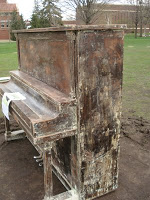
As I drove in to work this evening the familiar voice of a piano professor here spilled out of the car speakers that generally only bring me voices of people like Steve Inskeep, Michele Norris, Scott Simon and the other body-less NPR friends that follow me through my days. She was explaining that Annea Lockwood composed an avant-garde piece in which a piano is burned. It’s called “Piano Burning” (which strikes me as a not very avant-garde name for such a piece), and tonight they’re performing it on campus.

Arriving on campus, there was the dilapidated piano standing alone in the middle of the Bald Spot, waiting to be burned.


Pianos I’ve known have always lived in warm, homey spaces, or stood in state on a stage. They’ve always felt like they calmly conceal the potential to thrill you tomorrow or next year or when your grandchildren come to visit. They’ve always promised great things for the people who can touch them with care and skill, and for the people those artists know.

This piano, though, is just sitting in the middle of its rectangle of cleared earth in the middle of a wide, blank field, hunched under the gathering clouds, and waiting to be burned. I’ve never seen such a starkly alone piano.

And then they burned it.

4 Comments

Reading Sophomore Portfolios

This morning was the first of three that I’ll spend sitting in a room with 35 or so faculty members reading portfolio after portfolio.* Or rather, the faculty read through portfolio after portfolio while I gave up on ever reading that quickly and just got through as many as I could. And now my legs are sore from being tense all morning…. nerves and all. It’s rather intimidating to join a group of faculty and participate as a novice in an activity they do all the time, and to know that every portfolio you read will be read again by one of them, and to wonder how you can possibly say something constructive to a student in a couple of sentences especially when you’re struggling to come up with a cohesive sense of why you think they should pass or not, and to sit there wishing you’d brought a dictionary because spelling just isn’t your thing and there’s no spell-check built into these pens and sheets of paper and you’re critiquing writing, for goodness sake, so the students are likely to be really ticked off if the person evaluating their writing can’t even spell…

And so, my legs are sore.

So why did I volunteer for this? I mean, I’d done it once before. I knew I’d sit there with pen poised over the blue evaluation form and dread having to write to the student who’s academic career will be shaped in some small part by what I write. I knew I’d read at half the speed of my fellow portfolio readers. I knew all these things, but I also knew that if I chickened out, I’d kick myself. This is, after all, one of the only times I get to see the results of the work I do with students. Even more than that, it’s one of the only ways I’d ever get to read enough of my students’ work to get a sense of the patterns of successes and failures in underclassmen’s writing, use of outside sources, and argument structure. It’s also a rare opportunity to learn about faculty standards as they’re applying those standards. And you know, it’s a beautiful thing to watch experts glance over a random sample of writing and pull out patterns of writing indicative of the student’s writing ability over all.

So, as we all sat there norming our reading by evaluating some sample portfolios as a group, I also began the process of recalibrating my expectations for student work at the Sophomore level and listening for clues about what might be expected at the Junior level. For example, I learned again what a difficult project it is for college students to learn what a conclusion really is in a paper, and how to manage it effectively. I saw students learning to negotiate tone and voice and just how, exactly, to manage other people’s words in with your own.

And so I’ll be going back tomorrow and the next day as we plow through another 400 or so portfolios together. I’m not looking forward to the aching legs by the end of the week, but I am looking forward to coming through the experience with a better sense of what students can do by their second year in college. As I said to one of my co-workers, I hate reading the portfolios, but once I’m finished I love having done it.

* More info on the portfolio.

2 Comments

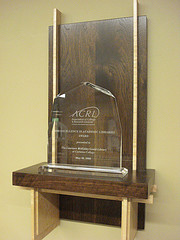
ACRL Award


ACRL Award
Originally uploaded by Pegasus Librarian.

On Friday we had the great honor of receiving the ACRL Excellence in Libraries Award in the College Library division. Our college president, while introducing the award to those present at the Honors Convocation spoke about the importance of collaboration and of intellectual curiosity on a college campus, and of how he sees these twin values in evidence in the library and across campus. And looking around at all the students, faculty, and staff, at all the representatives of various academic and computer support teams, and at the supervisor of the students who do all our public computing support in the library, I realized again how lucky I am to work in this place. I realized yet again that the whole truly is greater than the sum of its parts here, because no one of us alone could have done anything approaching award-worthy work. And I realized for the millionth time what an amazing experience it has been for me to work here as I learn to be a librarian in the midst of this type of community.

So what will we do with the award money? Well, people nominated ideas and we all voted, and kudos to whomever came up with this idea: we’re donating it to Katrina-damaged Dillard University’s library.

2 Comments

A Dose of History

Scoville

This week a student came to do a staff development presentation for us here in the library. He’d done his senior thesis on the history of the library building and the stylistic metaphors each incarnation used as a foundation.

I was completely captivated. I wish I’d taken notes because now the talk is receding into a mysterious and tantalizing blur of impressions and phrases. “The second building to be built on campus was the library.” … “The original library was built in what was, at the time, the quintessential library style. Anyone would have looked at that building and known it was a library.” … “The 1956 building strove for universality of style, a very modernist enterprise.” … “Two art history professors were the driving forces for bringing buildings in the modern style to Carleton.” … “The 1984 building was designed to fit with the buildings that made up its context.”

I haven’t been able to find an image of the 1956 version of our building, but what I found striking about the remodel wasn’t brought up in the talk. The 1956 building (which I can’t find an image of, sorry) had a grand “drawbridge” entrance, which was supposed to “usher students into the halls of learning” or something like that. But it also had the effect of making the library something that stood apart, something that you had to cross a long bridge to get to. The new building entrance seems to lean forward to be part of the campus rather than reserve itself as a hallowed destination.

8 Comments

Comps Day

Seniors here have to complete a Comprehensive Exercise (a senior thesis or similar project) commonly referred to as “comps.” Each major has it’s own rules and deadlines, but today was Comps Day for Econ majors. It was so fun to see them going up to the printer to collect their impressively long papers with impressively long titles and just glowing!

Most of these kids haven’t slept in about 3 weeks, they’ve been stressed to the hilt producing a paper that’s several times longer than anything they’ve ever produced before, and their graduations hang in the balance over this one project. But today they’re bursting with so much joy and so much pride that they just spontaneously come up the desk, show me their papers, and say, in wonder, “This is my comps!”

So between finding information about Korean assimilation into Japanese corporate culture, sussing out good starting points for a paper on the effects of globalization on education in inner-city Chicago high schools, and a whole bunch of citation questions for one class that has a project due tomorrow, I got to congratulate a steady stream of dazedly ecstatic Econ seniors and promise them that yes, they’ll be even happier tomorrow after they’ve eaten something and slept a little.

Leave a Comment
css.php