Skip to content

Month: April 2009

And So They Burned It

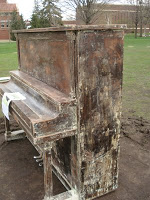
As I drove in to work this evening the familiar voice of a piano professor here spilled out of the car speakers that generally only bring me voices of people like Steve Inskeep, Michele Norris, Scott Simon and the other body-less NPR friends that follow me through my days. She was explaining that Annea Lockwood composed an avant-garde piece in which a piano is burned. It’s called “Piano Burning” (which strikes me as a not very avant-garde name for such a piece), and tonight they’re performing it on campus.

Arriving on campus, there was the dilapidated piano standing alone in the middle of the Bald Spot, waiting to be burned.


Pianos I’ve known have always lived in warm, homey spaces, or stood in state on a stage. They’ve always felt like they calmly conceal the potential to thrill you tomorrow or next year or when your grandchildren come to visit. They’ve always promised great things for the people who can touch them with care and skill, and for the people those artists know.

This piano, though, is just sitting in the middle of its rectangle of cleared earth in the middle of a wide, blank field, hunched under the gathering clouds, and waiting to be burned. I’ve never seen such a starkly alone piano.

And then they burned it.

4 Comments

It’s Been Quite A Week

Last Tuesday we hosted one of the periodic meetings of the reference and instruction librarians that work at the five Oberlin Group libraries in Minnesota. At least once a year we have a “Round Robin” session where we basically sit down, eat lunch, and then talk all afternoon about what each of our libraries are doing. We’ll set a theme for the day, but the themes are broad and nobody really cares if the conversation runs off on tangents. I love these days. This time the theme was about “Looking Forward” and included discussions of everything from mobile technologies to budgets. We also learned that we had about a week to decide if we wanted to purchase LibGuides.

That same day, the steering committee for that group of librarians met to begin planning what I’m now thinking of as the Coolest Project Ever: a day-long mini-Immersion just for us. We’ll meet, we’ll learn, we’ll teach each other pieces of the best instruction we know how to do, and we’ll remember again how much we can learn from each other. I can’t wait.

Wednesday was full, and neatly bookended by dentist and doctor appointments.

Thursday was a more-than-12-hour day that started with an un-fun budget meeting and finished with evening reference.

Friday I taught two classes and had two meetings before lunch, picked up Laura Crossett at the airport, made her hang out for a while so I could get a complicated research guide published, and then began the Weekend Of Fun. I have a very small handful of “best friends,” and two of them spent the weekend visiting me. Martha Hardy came down from the cities and joined me and Laura in what she called The Library Camp of Iris’ Living Room. Wonderful.

Monday morning, it was back to the airport and a fond farewell to Laura, followed by probably the hardest class I’ve ever had to teach, followed by a reference shift.

Which brings us to today. Today we got word that we have rooms and everything for MnObe Immersion, and I filled out paperwork that makes our imminent acquisition of LibGuides official! (I think that makes this the fastest library-related non-book acquisition I’ve ever been a part of, by the way.) I also started seeing some of the 60 students I’ve taught in the last 2 work-days, plus some of the students in another class that, yet again, cannot seem to make American Memory work for them. The professor and I have tried so many different ways over the last couple of years to make this particular class understand this particular resource, but for some reason it never seems to work out. I’m flummoxed.

In amongst all of this, in the last few days my cousin gave birth to a baby with Hypoplastic Left Heart Syndrome, a friend of a friend’s husband killed himself, another friend’s father tried in earnest to kill that friend’s brother, and my cousin spent all day today waiting for her baby girl to make it through the surgery that will begin the long process of constructing a functioning heart. I was feeling a little sorry for myself last week because of over-long work days full of too many things to do. Perspective gained. I have it pretty good.

1 Comment

The New New OCLC

Just when you thought you’d gotten to know the new OCLC, it shakes things up again. OCLC is now in the ILS business and WorldCat Local is now free to FirstSearch subscribers.

My first thought on reading about all of this yesterday was that all those pilot WorldCat Local schools must be steamed that this is now free.

My second thought was almost equal parts pleased and worried. I’m pleased that this is yet another competitor against the current lumbering giants in the ILS market, and I like the idea that (if I understand correctly) this will add a hosted option to the ILS market. (Hosted options aren’t always the best, but I like the idea of having it available as a choice for people.) On the other hand, this means that that pesky new policy on the transfer and use of OCLC records really wasn’t just about protecting a bunch of member-produced data after all. There were bigger plans afoot, and these plans involved leaning even farther toward the vendor model rather than the service model. And if OCLC is a vendor rather than a service, that new policy feels even more like a land-grab rather than an effort to protect member investments.

My third thought, on further reflection, will hopefully be less nebulous and conflicted and more grounded in fact and reasoning.

Leave a Comment

LSW’s Growing Pains

An interesting thing happened. This little group of friends decided, mostly as a joke, to call themselves the Library Society of the World. Then that Society got big.

The amateur anthropologist in me has been watching the group negotiate this phenomenon for a while now, and it’s fascinating. Here’s a short sketch.

Two years ago, Josh created a wiki and basically told his friends “Wouldn’t it be fun if we called ourselves the Library Society of the World? Sign up, give yourself a silly title, and have fun.” At that point, we mostly communicated via Twitter and a Meebo chat room. At that point, we talked just like we’d been talking before. The only difference was that we’d adopted a group name.

Fast forward about a year as friends of friends started joining in the discussion. We still hung out in the Meebo chat room, though Twitter had blown up one too many times and most people had jumped ship for FriendFeed. I now no longer knew everyone I was talking to if I posted to the LSW FriendFeed room, which was pretty cool. My core group of friends was still my core group of friends because we’d been friends for a while now (of course there were a few new friends in the mix, because that’s how friendships work over time), but the LSW was bigger and broader than that core group, and there were even whole social networks of LSW members that I hadn’t joined (like LinkedIn for example).

Then an interesting thing happened. People started joining the LSW never having known it in its infancy. People started hearing about it at conferences and workshops. Big Names started declaring allegiance. New members figured they were joining A Group, something substantial, something with heft and momentum and growing name recognition (albeit, a Group with a pretty lose sign-up mechanism). Joining and participating in A Group comes with a whole different set of expectations than joining and participating in a circle of friends.

And at this point, with membership estimates topping 800, it’s entirely reasonable for new members to expect the thing to feel like A Group rather than just a group. Protesting that it’s “just a group” is becoming less and less productive. At the same time, the thing is a grassroots collection of librarians doing stuff and sharing information, which means that there’s really no formalized set of processes, governance, or oversight that people might expect from a Group. I’m not even sure I know where all the social networks are that have been created in the name of the LSW. The whole idea is for people to jump in and just do stuff, kind of like we did when we were just librarians doing stuff who also happened to be friends.

I’m fascinated to watch this Group (for it is undeniably too big to protest that it’s not A Group) and see how it weathers these growing pains. For my part, if I hear “I wish the LSW were more [fill in the blank] than it is,” I hope I’ll answer with an encouraging “Then help make it that way! Or at least make your corner of it that way,” rather than with something along the lines of “But that’s irrelevant because it’s really not a formal Group.”

Personally, I think this is an exciting development. It means that things are different, sure, and that we should probably take a step back and decide what will have to change and what can and should stay the same. But if more and more people start doing stuff in the name of the LSW, developing friendships, and forming their corners of the LSW into whatever it is that they need it to be, I think this can only be a good thing.

2 Comments

Have Interest – Will Adopt New Conference

For the last couple of years, I’ve been wondering just which conference I should adopt as “my” conference. I want it to be one where the sessions are thought provoking and where I’ll get to hang out with people I know and like and are interested in things I’m interested in, and where I can meet people I’ve never heard of before and that have the potential to become my new best friends. So far, the conferences I know about are either so far above my technological abilities that I’d be lost the whole time and not have much reason to apply those skills in my everyday life, or they are at the “no really, the web can help you” level. And so far, I’ve attended the latter sort of conference primarily because that’s where other people who are stuck in the middle like me attend. These are the people I learn from the most, and this is where they go, so that’s where I want to go.

My experience last week reinforced this for me. I had a great conference! But reading Kathryn’s post, I realized that what we all want is a different conference to attend. We want something that falls in between the two kinds of conferences that are out there already but that has national (and international) draw like the current options do. Personally, I want something that gives nearly equal time to carefully thought-out presentations and less structured discussion. I want to hear from library-types and non-library-types. I want the moon.

Does this exist? Shall we descend on some unsuspecting conference and make it so? Shall we invent it from scratch?

1 Comment

Notes from One Who Aspires to Great Public Speaking

Catherine Pellegrino talks quite well about how active learning could be as much a part of conference presentations as it is a part of our classrooms. I won’t recreate her arguments here (go read them!), but they got me to thinking about my own presentation style, the styles of presenters I’ve seen recently that kept me engaged. I will simply add that active learning may not scale to suit large audiences, or suit every topic, or fit every audience. If, for whatever reason, I decide not to include active learning in my future presentations, it will be by choice, and I will remember that this choice comes with the same huge consequence that I face in similar circumstances in my own classroom: I will have to work even harder to make sure that my presentation is engaging in the absence of mandatory engagement.

While I’m at it, I will remember how comfortable I’ve become in my own classroom not using PowerPoint, or using it very sparingly. And I won’t feel cowed into using it simply by nerves or a false sense of serving future audiences. Back in the day (by which I mean, “I’ve heard of such things but only seen them in disciplines other than mine these days”) people used to present papers, which meant that the actual paper was available for perusing later. Pretty handy if you weren’t able to attend the actual session, but unfortunately you have to have a pretty stupendously amazing paper in order to be engaging as you stood in front of everyone and read it. I can’t imagine ever having such an amazing paper that I’d be comfortable delivering this type of presentation. My style is much more pseudo-extemporaneous: me, a few notes and an outline, careful rehearsal, and maybe a handout or a PowerPoint. And for me, this PowerPoint does not substitute for a presented paper because that entire genre of presentation is foreign to me. No, if I’m worried about future audiences I’ll make a handout or a summary or a blog post or a video or anything that will make sense to that audience without saddling my present audience with stuff they don’t need.

It’s too bad that knowing and doing are such completely separate acts. I guess the best remedy will be practice… which would mean submitting proposals… and, you know, actually presenting.

Leave a Comment

“The Library” and Other Grand Unifications

A few weeks ago, while attending ACRL, I heard a question that nagged at my imagination: “If we define a doctor as ‘one who practices the art of healing,’ what is the analogous one-sentence definition of a librarian?”

Yes, I know that boiling everything down we do into one sentence is a little bit absurd, and that the given definition for a doctor is similarly circumscribed. But to the extent that we use such questions to focus and motivate our thinking, I think they can help us to step out of our own day-to-day existences (full of tasks and politics and committees and budgets and “where is the bathroom”) and gaze out at the broad, breathtaking, and inspiring vista of our profession as a whole.

This is exactly what Kathryn Greenhill, John Blyberg, and Cindi Trainor have done in their Darien Statements on the Library and Librarians.

So what happens when you make “grand, optimistic, obvious, and thankful” statements about The Library-with-a-capital-L? So far, it seems that people take a deep breath, let the statements sink in, feel them, taste them, and then start comparing them to everything we do and have done and hope to do in this profession, trying to see how the statements stack up against reality. This strikes me as a beautiful response. Even most of the responses that contend that “Your Library-with-a-capital-L doesn’t pertain to my library” or that “saying that ‘The purpose of the Library is to preserve the integrity of civilization’ is far too ambiguous” are evidence of this kind of productive, stimulative thinking.

Today I’ve been thinking about the relationship of The Library to individual libraries, asking myself “What is the one-sentence definition of a library?” and wondering if it’s similar to asking “what is poetry?” Is it like porn, where you’ll “know it if you see it?” And what do we learn by theorizing a Platonic Library? In what ways does this focus our thoughts and motivate our futures regardless of our individual circumstances?

T. S. Eliot theorized about the art of great poets in his essay “Tradition and the Individual Talent.” A great piece of criticism in itself, I have always particularly appreciated the way he positions the best poets as those who display their individual talent through grounding in the poetic tradition rather than in opposition to it. He explicitly does not say that the best poetry is “traditional” or copy-cat-ish or anything like that. Quite the opposite. He writes that “tradition is a matter of much wider significance [than “blind adherence” to past forms]. It cannot be inherited, and if you want it you must obtain it by great labour” (Eliot, paragraph 3). In his view, writing from a sense of tradition requires that poets step outside of their own location in time and space, “write not merely with his own generation in his bones” (Eliot, paragraph 3), and become the catalyst that will make the particular and the general spark into art. In the same way, being a librarian in a particular library is rendered meaningful and significant not solely based on our own individual missions and actions. We have the fundamentals of The Library that bolster our efforts and define our innovations.

The beautiful part of Eliot’s essay, though, comes in the 4th paragraph in which he explains the ramifications of having all of poetry tied together by Tradition. “No poet, no artist of any art, has his complete meaning alone,” he writes. Everything written must be valued and appreciated in relationship to everything else that has been written, but this influence is not unidirectional. “The existing order is complete before the new work arrives,” he says, “For order to persist after the supervention of novelty, the whole existing order must be, if ever so slightly, altered” (Eliot, paragraph 4). If we accept the theory of the Platonic Library, the Tradition that allows for poetic creativity, then we are also accepting that as each of us effects change, we fundamentally affect The Library as a whole. This strikes me as a daunting, inspiring, thought provoking, somewhat terrifying, but empowering outcome of theorizing a Platonic Library even for the many individual libraries that may not feel included in the Darien Statements.

This post has gone on over-long and is really just a sketch, just my first attempt to figure out what about the idea of a Library-with-a-capital-L resonates with me so strongly. I hope some of you will speak up and help me figure out what I’m saying, where I’ve gone wrong, and what makes sense to you. I don’t fully understand my own stance at the moment, but like Steve, I know which conversation I want to be having.
7 Comments

Best Conference Ever… In An Odd Way

I’ve been lying here on the couch for most of the day, too tired to move, or read, or get up to put on a CD. I feel like I’ve been extruded, or beaten about the head, or like I’ve given blood twice in one day. But you know what? It was totally worth it to spend time in DC with so many of my favorite people.


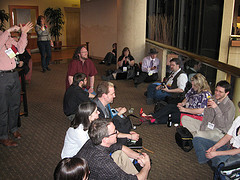
The really interesting thing, for me, was that I left this conference feeling like it had been the most productive conference I’ve ever attended… only I didn’t attend this conference. I just hung out in the lobby (or on the floor when our LobbyCon ran out of chairs and so we invented CarpetCon). And yet, I had all kinds of interesting conversations with other librarians about merging IT and research service points, unconferences, taking what we can from unconference philosophy and applying it to instruction (this Catherine’s idea, which she blogged about here), academic media librarianship, the death of Second Life as a viable experiment, Open Source library catalogs and how many people are seriously considering them now, to what extent it’s a good idea to shift our information to the cloud, benefits and drawbacks of WorldCat Local, … and whatever else came to mind. It was so much fun to sit there among these incredibly smart and talented people for two days and two nights, soaking in their ideas, feeding off their energy, and doing a healthy amount of joking around in the process.

I wish I’d had a little more energy to participate in everything while I was there. A couple of times I hit that “it hurts to be alive” level of tired and had to sit out some really interesting conversations. But other than that, there’s nothing I would have changed about this trip. I loved having the actual conference right there, with all the people going to actual sessions buzzing about the things they’d heard, what they thought had been interesting, and what they thought hadn’t worked out quite so well. It was like having the blogosphere happening in real life right there in front of me.

Oh! And since every conference must have at least one “Wow, it’s a small world” moment, here’s mine from this trip. Jessamyn and Laura Crossett and I stayed up far too late Tuesday night talking in full middle school sleep-over mode. Part way through the conversation, Jessamyn mentioned the town where she lived when she was young, and it turns out that for several years I drove right past her house every single week, at least once, on my way to the church where my dad was the assistant pastor. From there I moved to a suburb of Chicago and lived less than a mile from the Dominican, where Laura Crossett was at the time. So there the three of us were, in that room, and I’d spent years and years so near each of them. Weird.

P.S. The picture above was taken by baldgeekinmd and features me (or, the half of me that didn’t spill off the right hand side of the picture… yep, that’s me in the white sweater and jeans) and a healthy chunk of the lobbycon regulars.

1 Comment
css.php