Our new trading cards are done! This year, they’re comic book themed and uber-snazzy.
Learning in Libraries and Loving It*
I was just handed the proofs of this year’s trading card! Oh, the awesomeness!!! I will post images as soon as they’re officially done.
Leave a CommentI was updating my about me page on my professional web site this morning (an activity I engage in far too rarely), when it suddenly struck me how untidy my professional self is. I don’t mean that I have a messy desk (though at the moment there are two piles of papers and journals waiting to be sorted and acted upon). I don’t even mean that I don’t have any focus in my professional activities. What I mean is that many of the groups of people I work with and many of the projects we work on are never named and defined. Half the time I don’t know if I’m on a “committee,” a “working group,” a “task force,” or just a project, duty, or standing meeting. I don’t know what my new job helping to coordinate the activities at the Research/IT desk is called. Basically, I do a lot of things with a lot of people, and we get things done, but we rarely stop to define exactly where we fit into the structure and operations of the library or the campus.
And aside from the somewhat arbitrary decisions I make when trying to tell other people what I do, I’ve decided that this state of affairs is just fine with me. I’d much rather spend the time meeting and doing rather than waiting for formal charges to committees or writing project reports. I enjoy working at a place where people say, “Sure, let’s work on that. How’s next Tuesday for everyone?” and then proceed to meet regularly for a year or so to get whatever-it-is done. I just hadn’t realized until today how few formal names I had for the groups I’m on.
Leave a CommentFor the first time in about 10 months, my post on the possibility of an open database of book cover images is NOT the most clicked-upon post in my ouvre. (Statistics are always from the past 5 to 6 weeks, or however long it takes for 2000 page-loads. In this case it goes back to the 1 week of July.) What caused this upset in the natural order of things? This month’s conversation about books and ebooks. How interesting.
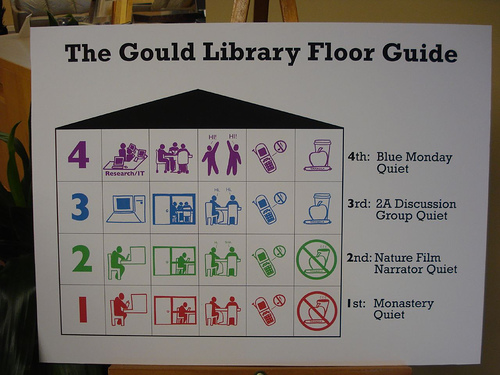
Leave a CommentFor the last several years, our library has attempted to describe the level of socialization and group activity that happens on each of our four levels by defining them as “Crime Scene Investigation Quiet,” “Water Cooler Quiet,” “Nature Film Narrator Quiet,” and “Monetary Quiet.” (Here’s my previous post on the topic.)
Well, this year, we had to revamp the signs anyway because the food and beverage policy changed. We also realized that pre-work-life students had been consistently confused by “Water Cooler Quiet,” and CSI isn’t quiet as popular as it was a few years ago. So we revamped the top two levels.

“Blue Monday” or rather “Goodbye Blue Monday” is a coffee shop and popular hangout in town. The noise level is generally fairly high, but there’s almost always work going on. Students go there if they want to work on projects together or do homework while socializing at the same time. In other words, precisely what we want to recreate on the main floor of the library.
One floor down, we want to encourage group work and talk, but with more restraint than on 4th. Group work happens, but not as much socializing. This was by far the hardest floor to name. What conveys work being done, talk, but restraint? We decided on “2a Discussion Group Quiet.” On our campus, 2a refers to the second class time-slot on Mondays, Wednesdays and Fridays. Imagine being the professor leading discussion before 10am… yes, now you see why we chose that time-slot. Discussion happens, but not boisterously.
Students told us not to mess with Nature Film Narrator Quiet or Monastery Quiet, so we didn’t. Down on first, if you type too loudly somebody might just pass you a note (rather than whisper) saying that you should respect the needs of your fellow sleep-, light-, and food-deprived students as they labor through their comps research.
4 CommentsIt’s been a kind of constant source of minor irritation that I haven’t been allowed to eat, munch, or even nibble while at my desk. If I needed a meal or a snack, I’d have to get up, go downstairs, remember I’d left my keys upstairs, go back up, grab keys, chat with a co-worker, answer a reference question (I tell you, being recognizable by students can have it’s down-sides), go back downstairs, unlock the staff room door, find my snack, eat it, and then return to work. You can see how that would put a crimp on things.
Well, all that has changed. Our new policy only prohibits eating in certain areas of the library (like anywhere near special collections, the archives, or the computer labs). Granted, anything greasy or sticky or smelly wouldn’t be approved. But technically I should be able to at least at my desk now, or rather at the desk in my office that doesn’t have a computer on it. (I’m not sure if my computer is a “computer workstation” or not.)
The problem is, now I’m not used to it. It doesn’t even feel like an option, so I haven’t taken advantage of our new freedom even once yet. In fact, I’d feel conspicuous and guilty if I did bring out an apple and start crunching away. What’s that syndrome where you start feeling loyal to your captor? Yeah… Stockholm Syndrome. Maybe I need to seek treatment for that or something.
1 CommentThere’s been a really interesting and thought-provoking discussion going on lately about “2.0” topics, spectrums (or rather,” spectra”), print vs. electronic books, and the like. It all started with David Lee King’s Library 2.0 Spectrum, which got so many comments that he wrote a whole post about wanting feedback. Meanwhile Steve Lawson wrote a response (in addition to several comments on David’s posts), Uncontrolled Vocabulary took up the topic, and several other blogs began puzzling out what worked and what didn’t work about the L2 Spectrum.
Well, now the conversation has morphed. Over at See Also, Steve and Dave are hashing out whether a book is a book if it’s not printed on paper. I must say, I didn’t know what to think about that question. Deep down, I’ve always reserved a special place for printed and bound books that is completely separate from manuscripts and eBooks. In my head, these wonderful and time-honored creations have always been Books with a capital B. … And then there were these derivative things called eBooks — sort of like postcards of the Mona Lisa. You know exactly what they are, but you just have to make do with the presentation.
Then David comes along and questions this assumption. He feels that books are books, no matter the format. And that seems like a very reasonable conclusion. You can digitize everything but the paper (and the smell), so what’s the problem? I’d hate to get caught in the trap of putting printed books on a pedestal just because I like the way they feel. And there’s nothing worse than finding yourself falling into the trap of “because that’s the way they’ve always been.” In fact, I’m not sure that I haven’t fallen into that trap, even now.
But something in the comments to Steve’s post struck a chord and I felt compelled to add my own comment to the string, even though I hadn’t figured out what I wanted to say. Steve had made the point that calling the paper and binding of a book a “container” might be too simplifying. He said:
I think my problem with the word “container” is similar to Dorothea’s problem with the word “just” in the post I linked to above. It makes it all sound very simple, very easy, when it isn’t. I can pour my ginger ale from an aluminum can container into a glass tumbler container, and it is still ginger ale. “Pour” Tristram Shandy from a paper book container to a Google scan container, and you no longer have Shandy, you have something else. (cite)
Then, as I typed, I puzzled out what I was thinking. I’m still not sure I’m “right”… but here’s what I wrote (edited only slightly to compensate for sloppy writing):
I think you’re right that the point is that it’s not simple. The point is not so much the words in a row. The point is not so much the placement of pictures, type face, or white space (which is also important). The point is that “containers” are not entirely benign. If they were entirely benign, people wouldn’t pour ginger ale from the can to the glass. There’s something about a glass that’s more comfortable to drink from. The edge feels different on the lips, the spray tickles your nose… the experience isn’t the same. And yet, the ginger ale is still ginger ale.
Ok, so the container matters in this case, but doesn’t change the substance. But what about the case of a Van Gogh painting? Seeing digital reproductions of his work is nothing like seeing the real thing. The colors aren’t as vibrant. The textures of the brushwork are simply shadows rather than spaces. In this case, the “container” changes the work absolutely and fundamentally.
So does the “container” change the substance of a book in the same way that it changes a painting? I’d say, “It depends.”
Ludlum might be a “book” no matter it’s container. Shandy, maybe, not so much. Complex texts are not generally read in as linear fashion as they are written. The words march forward, the same as ever, but my eyes jump back to the top of the facing page, the previous paragraph, the next sentence, almost without breaking the flow of my reading. Complex texts require this type of reading-while-reading as you make sense of them.
Some day, technology might be able to simulate the act of putting a finger on a page in order to mark a point you’re trying to interpret by reading forward. Some day eBook readers might allow the kind of non-linear reading that’s necessary for sense-making. And some day there might be a fully automatic process by which complex texts, these books that have never been anything but Books, can be converted to digital formats. Just like some day we may have digitally reproduced paintings where the experience of the painting isn’t fundamentally changed. (cite)
[Updated to add: I’ve been thinking more about things that get translated into different formats. Things like music, for instance. Music is one thing that’s drastically different live vs. recorded, and yet that’s entirely accepted and doesn’t phase anyone. So now my question is this: are books more like music or more like paintings? My gut reaction is still that they’re more like paintings because they’re not a linear experience, while music is always listened to in a metaphorically linear way.]
[Updated again to point to Mark’s excellent comment on Steve’s post. This reminder helps me a lot! Thanks Mark.]
16 CommentsThe new email system is all-around ok, but it’s by no means been a seamless transition for my department. My new mantra (and I swear I’m going to stick a little card on my computer monitor that says this) is:
Even this is worth it if the whole campus is on one system.
For one thing, it’s thrown a little monkey wrench into my department’s system of publishing our availability to our students. Last year we came up with a pretty slick plan of using Google Calendar, sharing our calendars with each other (to facilitate making meetings), and publishing separate “Available Time” calendars for everyone else to see (example). It worked very nicely.
Well now we’ve got our Zimbra calendars, which are really only useful if everyone uses them. These are very much like Outlook calendars, or Groupwise calendars. You know the drill: email and calendar all in one place, people can see when you’re busy when they schedule meetings… the whole nine yards. Except that in our case, we’re only up to about 4 yards because of two significant kinks.
First, even if we use Google Calendars to subscribe to our Zimbra calendar’s iCal feed, we cannot make Google Calendar understand that this is ok to publish this on our HTML web pages. We’re now in the process of searching for another 3rd party program that we could use to mimic this functionality, but currently we’re stuck updating two calendars. Why? Because even though students could propose a meeting time and see if we’re free, we don’t know how many students will be using the calendar function this first year, and we do know that sometimes it’s much easier just to glance at a calendar a week at a time to get a feel for free time. With all the appointments we do, we need an easy way for students to see when they can come see us that doesn’t require any training. So that knocks about two and a half yards off the “whole” right there.
Second, not everyone is going to use this new calendaring system. I know of one whole department in the library that’s said it’s going to stick with a Google Calendar system that’s working well. And I know full well that many professors and students won’t bother. This means that even within the library we won’t be able to use the new system to it’s full potential, let alone with the wider campus. So that knocks at least another yard off, if not two, and my optimistic nature has to work even harder to sprinkle it’s habitual pixie dust over the situation and keep me mellow in the belief that this will be wonderful.
A third kink doesn’t come nearly to the level of the first two, which is why I didn’t include it above. But for now it’s a pain. For now, we can’t sync with our palm pilots, so that means maintaining yet a third calendar for all those times when you’re in meetings trying to schedule new meetings and really need a portable calendar. (And no, we don’t have cool data-enabled phones, more’s the pity.) But hopefully this kink will disappear very soon, which is why I choose not to be annoyed by it for now.
Still, my optimistic self keeps thinking that there is still value in having a campus-wide system, and that there’s enough value that even this is worth it.
3 CommentsAs part of my liaison duties, I create and maintain the “subject” and “course” research guides designed for the departments I serve. Subject research guides are meant to give students a grasp of the resources available that most researchers in a given major or concentration will probably need at some point in their research. Course research guides are designed for specific courses that I’m supporting each term.
And really, the course research guides are pretty simple to come up with. They usually either replace or complement any handouts that are appropriate for a class, and they’re almost always tied to a specific assignment or set of assignments, so I generally have a fairly good idea of what those students will need.
Subject research guides are another matter entirely. I have no idea what I’m doing, really. Do I gather things by resource type (e.g. “Finding books,” “Finding articles,” “Useful web sites,” etc.), or do I gather things by topic? (Here’s an example of a page that’s organized by resource-type, and here’s one that’s organized by topic.) Either way, they’re long lists of stuff, and not very interesting, but with our current tools I’m tied to a heavily text-based, straight HTML page.
When you think about it, the idea of breaking things up by resource type vs. topic really comes down to your choice of audience. Am I creating these primarily for inexperienced researchers who need help getting started? If so, topical organization seems to make sense. It pulls together fewer things and makes it so students don’t have to jump around to see if other resource-types will be useful to their topics. But if I’m primarily making these things for more intermediate-level researchers who already know that all they want is the MLA International Bibliography, for example, a page full of topics (where the MLA-IB could appear in any one of the topics, or all of them) would probably drive them batty! If I were using these pages, I’d want to click “articles” and see a short list of the databases and indexes that are relevant to an area of study.
So who is my audience? I don’t really know. But I’ve finally realized that answering this question could make the creation of these subject pages so much easier.
3 CommentsI hadn’t really realized before coming here how important publicity is on a campus. Students aren’t naturally equipped with a gene that tells them to visit the library when they have one type of question, the writing center when they have another type of question, the IT help desk when they have yet another type of question, and so on. Neither are faculty, for that matter. So getting ready for fall means thinking up how to explain to new students precisely what we do, and how to encourage returning students to remember us without boring them to death with the same old news. Similarly, new faculty need to know both what we can do for them, and what we can do for their students. And the faculty who’ve always been here still need reminders, preferably packaged in such a way that they think of new and creative uses for us. That’s a pretty tall order for a department without its own publicist! That’d be a tall order for a publicist, I imagine, though I’d really like to find out (hint, hint).
On our task list for this fall we have:
Luckily most of these activities are interesting, and some are even really fun.
Leave a Comment