Skip to content

Pegasus Librarian* Posts

Four Years

Since the age of 14, I’ve been measuring my life in four-year increments. Each increment had its own challenge, and each one culminated in its own major life transition. But now, for the first time in my life, I’m not going through a major life transition after 4 years, and I’m not reaching toward some tantalizing, terrifying, and fascinating goal four years distant

First there was high school. I’d decided to continue being home schooled, which terrified me. How could I be sure that I’d learn enough to get into college if I stayed home? I couldn’t. So I learned absolutely as much as I could, fueled by a deep smoldering panic that I’d be horribly under-prepared for college. As it turns out, I wasn’t under-prepared. So I graduated from high school and went to college.

Then there was college. That terrified me. How could I possibly both figure out what I wanted to do with The Rest Of My Life (in my head that phrase was always in capital letters) and also learn enough to do whatever-that-was in only four years? As it turns out, I didn’t. And as it turns out, this is normal. So I graduated from college and, since I still didn’t quite know what I wanted to do for The Rest Of My Life, I went to grad school.

Grad school terrified me. All these smart people, all this work, all this pressure. I had no idea how I’d make it through the reading assignments, let alone the term papers that were twice as long as any I’d written before (with the exception of my college senior thesis). After two years of that, I’d learned enough to decide that English Professor was not going to be my title for The Rest Of My Life, so I skipped out with a masters and moved over to the School of Library and Information Science… which terrified me for a whole different set of reasons. The classes didn’t inspire me, and I’d never worked in a library, so I wondered what people did beyond sit at a desk and answer questions all day, which seemed like it could be unendingly dull. But just as I was going to quit and go back to the English Professor idea (the program had said I could come back any time), I got a job in a library and decided that this might suit me after all. As it turns out, it does suit me. So, after 2 years in English and 2 years in library school, I left graduate school and started my first job.

This Carleton job terrified me, so when I took it I promised myself that it need only be for four years. (After that, I planned to find a job closer to my family.) It was a job full of all kinds of opportunity, but also all kinds of responsibility. The people here were wonderful, but I worried that I’d be the weak link in their exhilarating, intense, and creative chain. As it turns out, our individual strengths and weaknesses seem to complement each other pretty well, so the job quickly grew to become my dream job. And so, as it turns out, I’m not looking for a job after my allotted four years.

And now, on this, the anniversary of the day I started here, I feel nearly qualified to hold the position I have. I’ve done a lot (started this blog, taught dozens of classes, met with hundreds of students, given conference talks, written articles and a book chapter). I’ve learned to negotiate tricky situations with at least outward confidence. And I’ve made fast friends for whom I’m continually grateful. These friends have talked me into confidence I’d never have found on my own, and they’ve talked me down when things seemed to be too much to handle. If it takes a village to raise a child, it apparently takes a sizable chunk of the internet and fair few face-to-face friends to raise a librarian, or at least this librarian.

I wonder what the next four years hold.

P.S. If 4 years seems about long enough to train up a librarian, I wonder how people like presidents feel.

4 Comments
Making FriendFeed Look the Way I Want It To

[Updated with a more modular version of the steps below. First, install Stylish. Then create the following three new blank styles, and populate them with the code here:

Now you can toggle things on and off at will depending on your minute-by-minute needs.]

——————–

I interrupt your regularly scheduled library-related thinking to bring you a brief note about FriendFeed. It recently changed its look rather significantly, and a few of us felt a little claustrophobic every time we looked at it. Luckily, if you’re running Firefox you can install Stylish, which lets you modify a site’s CSS. Once you install that, you need one or more of the following:

  1. Enough knowledge of CSS to modify the site as you wish
  2. Friends who know enough CSS to do that for you
  3. The Internet, where you can find ready-made styles like this one

I know enough CSS to break things or tinker mildly with things that already exist, and I have friends who put up with my requests for help and whose code I steal mercilessly (hi Steve), and I have the Internet. So I started with this style, modified it to make it look more the way I wanted, begged for help making it look even more the way I wanted, and now have a small suite of style options (which you can copy and paste into new Stylish styles):

  1. For when I’m in friend mode, at home: this cleaned up version. (last updated 5/29/2009)
  2. For when I’m in work mode and really just want text to skim: this stripped down version that gets rid of user icons. (last updated 5/29/2009)
  3. And since I’m not a very picture-oriented person, it seems: a style that makes all posted images into teensy thumbnails that I can click on to view in their larger sizes when I want to.

I have (1) and (3) running together at home, and I have (2) and (3) running at work.

Lest you think I’m at all good at this, I should point out that my tweaks were incredibly minor. Steve Lawson did the big stuff (by which I mean shrinking images to thumbnails, highlighting direct messages, and removing user icons). You’ll also notice, if you look carefully at the code, that I just commented out portions of the original code, so you can restore that stuff and tweak it if you want.

A couple of other people really liked seeing which services were responsible for individual FriendFeed posts (like Twitter, Facebook, Flickr, etc). If you’re like them, try this Greasemonky script (after installing Greasemonkey, of course).

2 Comments

Just When I Thought Life Needed a Little Spicing Up…

… Elsevier delivered for me. Ah, the sweet smell of fraud in the evening.

Tuesday, I heard that they’d (oops) published a fake journal under a fake imprint. Now they’ve admitted it, but not before the LSW had sunk its teeth in and decided that the upcoming zine could be hilariously renamed The Australasian Journal of Library Science (complete with some of the most pesky problems any journal could ever have… seriously, go read the thread behind that link), and that Elsevier could perhaps benefit from some customized Cod of Ethics merch.

Now we’re up to six fake journals (sorry for the registration required by that link, but it’s free), and Dorothea has contributed some less hilarious, more to-the-point commentary.

If I were writing the “scenes from next week’s show” for this particular drama, it’d include revelations that their peer review system is run via seance, or that there’s an invisible clause in their author agreements that really does sign over the authors’ souls in addition to their copyrights. But since I’m not in charge, all I can say is Stay Tuned!

Leave a Comment

Crazy Thought

Thinking about the things that I like about Google or about library databases in comparison with each other after my last post, I realized that library databases need crazy-easy URLs. I don’t click through 2 or 3 layers of a website to get to Google. I type “goo” into my address bar, which fills in the rest, which takes me to Google. If I could type “MLA” into the address bar and get to even something as complicated as “MLAbib.csa.com,” life would be easier. Sure beats my current option:
http://www.csa.com.ezproxy.carleton.edu/htbin/dbrng.cgi?username=carl&access=[gobbledygook]&db=mla-set-c&adv=1

If I could also set a cookie that would authenticate me from my own home computer, life would be even easier.

Still need to work on the seamless access to full text part of the equation, though.

2 Comments

I Really Wish It Were Easier

Tipping point: reached.

Up until maybe the middle of last year, it was pretty easy not to worry too much about the problems of doing “real” library research on the free web. “The kids are doing it” was a phrase that simultaneously helped us to worry about the state of information literacy in this web-ified era and to dismiss the problem as one that “the kids” would outgrow, like braces or a lisp or chicken pox, as they became better versed in scholarly research practices.

Well, it’s not just the kids any more, folks. Enough journal publishers have opened up their indexing and abstracts to the free web that it’s now possible (especially in some fields) to actually do “real” library research on the web. And so people are doing just that. This year, our new faculty orientation session brought questions about Google-friendly access right to our door-step in a big way, and part of this rather disorganized thread on FriendFeed brought it up again.

And yes, ideally everyone could use one nice, big, easy search mechanism to do everything from the most broad to the most narrow topic and then get instant access to the full text of whatever they find. Too bad that’s impossible.

Google is more familiar and forgiving, it’s faster, and there’s a lot of good stuff in it (particularly if you’re searching for something that hasn’t had any controlled vocabulary assigned to it, yet). But currently, disciplinary databases do a better job of collocating like items based on something more robust than the author’s choice in vocabulary and PageRank. Currently, disciplinary databases do a better job of allowing scholars to leverage their disciplinary vocabulary and a better job of helping novices stumble upon key vocabulary terms. Currently, disciplinary databases are the only things that can offer relief to my students who say that there are just too many false hits in everything from Google to JSTOR (free text search may be what they’re used to, but they’re often relieved to leave it behind as soon as they’re shown controlled vocabulary).

But all that aside, neither option does the “access to full text” piece of the equation very well. Unless your library subscribes to the publisher versions of pretty much every eJournal out there (an expensive proposition) Google can’t actually help you get to whole swaths of full text, and even then you’d have to be on campus or logged in to your library’s proxy server or something. And even if researchers are in a disciplinary database, they’ll still often have to step outside of that database to get the full text, and while a link resolver is a wonderful thing, it’s still a long way from being a perfect solution to this problem. Either way this lands you at the A-Z list figuring out if we have access to the particular issue of the particular journal you want.

I wish it were easier. I wish access issues didn’t make researchers jump to the conclusion that we’re “hiding” stuff from Google, or that we’re being unnecessarily silo-ish, or that indexing is over-rated, or that you have to do “complex” searches in library databases. I also wish that we could bringing together disciplinary databases in ways that allow easy cross-searching without giving up the time-saving specificity of disciplinary focus and vocabulary.

Right now it feels like we’re balanced precariously on that tipping point with a precipice on each side.

7 Comments

And So They Burned It

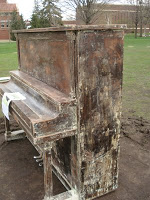
As I drove in to work this evening the familiar voice of a piano professor here spilled out of the car speakers that generally only bring me voices of people like Steve Inskeep, Michele Norris, Scott Simon and the other body-less NPR friends that follow me through my days. She was explaining that Annea Lockwood composed an avant-garde piece in which a piano is burned. It’s called “Piano Burning” (which strikes me as a not very avant-garde name for such a piece), and tonight they’re performing it on campus.

Arriving on campus, there was the dilapidated piano standing alone in the middle of the Bald Spot, waiting to be burned.


Pianos I’ve known have always lived in warm, homey spaces, or stood in state on a stage. They’ve always felt like they calmly conceal the potential to thrill you tomorrow or next year or when your grandchildren come to visit. They’ve always promised great things for the people who can touch them with care and skill, and for the people those artists know.

This piano, though, is just sitting in the middle of its rectangle of cleared earth in the middle of a wide, blank field, hunched under the gathering clouds, and waiting to be burned. I’ve never seen such a starkly alone piano.

And then they burned it.

4 Comments

It’s Been Quite A Week

Last Tuesday we hosted one of the periodic meetings of the reference and instruction librarians that work at the five Oberlin Group libraries in Minnesota. At least once a year we have a “Round Robin” session where we basically sit down, eat lunch, and then talk all afternoon about what each of our libraries are doing. We’ll set a theme for the day, but the themes are broad and nobody really cares if the conversation runs off on tangents. I love these days. This time the theme was about “Looking Forward” and included discussions of everything from mobile technologies to budgets. We also learned that we had about a week to decide if we wanted to purchase LibGuides.

That same day, the steering committee for that group of librarians met to begin planning what I’m now thinking of as the Coolest Project Ever: a day-long mini-Immersion just for us. We’ll meet, we’ll learn, we’ll teach each other pieces of the best instruction we know how to do, and we’ll remember again how much we can learn from each other. I can’t wait.

Wednesday was full, and neatly bookended by dentist and doctor appointments.

Thursday was a more-than-12-hour day that started with an un-fun budget meeting and finished with evening reference.

Friday I taught two classes and had two meetings before lunch, picked up Laura Crossett at the airport, made her hang out for a while so I could get a complicated research guide published, and then began the Weekend Of Fun. I have a very small handful of “best friends,” and two of them spent the weekend visiting me. Martha Hardy came down from the cities and joined me and Laura in what she called The Library Camp of Iris’ Living Room. Wonderful.

Monday morning, it was back to the airport and a fond farewell to Laura, followed by probably the hardest class I’ve ever had to teach, followed by a reference shift.

Which brings us to today. Today we got word that we have rooms and everything for MnObe Immersion, and I filled out paperwork that makes our imminent acquisition of LibGuides official! (I think that makes this the fastest library-related non-book acquisition I’ve ever been a part of, by the way.) I also started seeing some of the 60 students I’ve taught in the last 2 work-days, plus some of the students in another class that, yet again, cannot seem to make American Memory work for them. The professor and I have tried so many different ways over the last couple of years to make this particular class understand this particular resource, but for some reason it never seems to work out. I’m flummoxed.

In amongst all of this, in the last few days my cousin gave birth to a baby with Hypoplastic Left Heart Syndrome, a friend of a friend’s husband killed himself, another friend’s father tried in earnest to kill that friend’s brother, and my cousin spent all day today waiting for her baby girl to make it through the surgery that will begin the long process of constructing a functioning heart. I was feeling a little sorry for myself last week because of over-long work days full of too many things to do. Perspective gained. I have it pretty good.

1 Comment

The New New OCLC

Just when you thought you’d gotten to know the new OCLC, it shakes things up again. OCLC is now in the ILS business and WorldCat Local is now free to FirstSearch subscribers.

My first thought on reading about all of this yesterday was that all those pilot WorldCat Local schools must be steamed that this is now free.

My second thought was almost equal parts pleased and worried. I’m pleased that this is yet another competitor against the current lumbering giants in the ILS market, and I like the idea that (if I understand correctly) this will add a hosted option to the ILS market. (Hosted options aren’t always the best, but I like the idea of having it available as a choice for people.) On the other hand, this means that that pesky new policy on the transfer and use of OCLC records really wasn’t just about protecting a bunch of member-produced data after all. There were bigger plans afoot, and these plans involved leaning even farther toward the vendor model rather than the service model. And if OCLC is a vendor rather than a service, that new policy feels even more like a land-grab rather than an effort to protect member investments.

My third thought, on further reflection, will hopefully be less nebulous and conflicted and more grounded in fact and reasoning.

Leave a Comment

LSW’s Growing Pains

An interesting thing happened. This little group of friends decided, mostly as a joke, to call themselves the Library Society of the World. Then that Society got big.

The amateur anthropologist in me has been watching the group negotiate this phenomenon for a while now, and it’s fascinating. Here’s a short sketch.

Two years ago, Josh created a wiki and basically told his friends “Wouldn’t it be fun if we called ourselves the Library Society of the World? Sign up, give yourself a silly title, and have fun.” At that point, we mostly communicated via Twitter and a Meebo chat room. At that point, we talked just like we’d been talking before. The only difference was that we’d adopted a group name.

Fast forward about a year as friends of friends started joining in the discussion. We still hung out in the Meebo chat room, though Twitter had blown up one too many times and most people had jumped ship for FriendFeed. I now no longer knew everyone I was talking to if I posted to the LSW FriendFeed room, which was pretty cool. My core group of friends was still my core group of friends because we’d been friends for a while now (of course there were a few new friends in the mix, because that’s how friendships work over time), but the LSW was bigger and broader than that core group, and there were even whole social networks of LSW members that I hadn’t joined (like LinkedIn for example).

Then an interesting thing happened. People started joining the LSW never having known it in its infancy. People started hearing about it at conferences and workshops. Big Names started declaring allegiance. New members figured they were joining A Group, something substantial, something with heft and momentum and growing name recognition (albeit, a Group with a pretty lose sign-up mechanism). Joining and participating in A Group comes with a whole different set of expectations than joining and participating in a circle of friends.

And at this point, with membership estimates topping 800, it’s entirely reasonable for new members to expect the thing to feel like A Group rather than just a group. Protesting that it’s “just a group” is becoming less and less productive. At the same time, the thing is a grassroots collection of librarians doing stuff and sharing information, which means that there’s really no formalized set of processes, governance, or oversight that people might expect from a Group. I’m not even sure I know where all the social networks are that have been created in the name of the LSW. The whole idea is for people to jump in and just do stuff, kind of like we did when we were just librarians doing stuff who also happened to be friends.

I’m fascinated to watch this Group (for it is undeniably too big to protest that it’s not A Group) and see how it weathers these growing pains. For my part, if I hear “I wish the LSW were more [fill in the blank] than it is,” I hope I’ll answer with an encouraging “Then help make it that way! Or at least make your corner of it that way,” rather than with something along the lines of “But that’s irrelevant because it’s really not a formal Group.”

Personally, I think this is an exciting development. It means that things are different, sure, and that we should probably take a step back and decide what will have to change and what can and should stay the same. But if more and more people start doing stuff in the name of the LSW, developing friendships, and forming their corners of the LSW into whatever it is that they need it to be, I think this can only be a good thing.

2 Comments

Have Interest – Will Adopt New Conference

For the last couple of years, I’ve been wondering just which conference I should adopt as “my” conference. I want it to be one where the sessions are thought provoking and where I’ll get to hang out with people I know and like and are interested in things I’m interested in, and where I can meet people I’ve never heard of before and that have the potential to become my new best friends. So far, the conferences I know about are either so far above my technological abilities that I’d be lost the whole time and not have much reason to apply those skills in my everyday life, or they are at the “no really, the web can help you” level. And so far, I’ve attended the latter sort of conference primarily because that’s where other people who are stuck in the middle like me attend. These are the people I learn from the most, and this is where they go, so that’s where I want to go.

My experience last week reinforced this for me. I had a great conference! But reading Kathryn’s post, I realized that what we all want is a different conference to attend. We want something that falls in between the two kinds of conferences that are out there already but that has national (and international) draw like the current options do. Personally, I want something that gives nearly equal time to carefully thought-out presentations and less structured discussion. I want to hear from library-types and non-library-types. I want the moon.

Does this exist? Shall we descend on some unsuspecting conference and make it so? Shall we invent it from scratch?

1 Comment
css.php