Skip to content

Pegasus Librarian* Posts

Notes from One Who Aspires to Great Public Speaking

Catherine Pellegrino talks quite well about how active learning could be as much a part of conference presentations as it is a part of our classrooms. I won’t recreate her arguments here (go read them!), but they got me to thinking about my own presentation style, the styles of presenters I’ve seen recently that kept me engaged. I will simply add that active learning may not scale to suit large audiences, or suit every topic, or fit every audience. If, for whatever reason, I decide not to include active learning in my future presentations, it will be by choice, and I will remember that this choice comes with the same huge consequence that I face in similar circumstances in my own classroom: I will have to work even harder to make sure that my presentation is engaging in the absence of mandatory engagement.

While I’m at it, I will remember how comfortable I’ve become in my own classroom not using PowerPoint, or using it very sparingly. And I won’t feel cowed into using it simply by nerves or a false sense of serving future audiences. Back in the day (by which I mean, “I’ve heard of such things but only seen them in disciplines other than mine these days”) people used to present papers, which meant that the actual paper was available for perusing later. Pretty handy if you weren’t able to attend the actual session, but unfortunately you have to have a pretty stupendously amazing paper in order to be engaging as you stood in front of everyone and read it. I can’t imagine ever having such an amazing paper that I’d be comfortable delivering this type of presentation. My style is much more pseudo-extemporaneous: me, a few notes and an outline, careful rehearsal, and maybe a handout or a PowerPoint. And for me, this PowerPoint does not substitute for a presented paper because that entire genre of presentation is foreign to me. No, if I’m worried about future audiences I’ll make a handout or a summary or a blog post or a video or anything that will make sense to that audience without saddling my present audience with stuff they don’t need.

It’s too bad that knowing and doing are such completely separate acts. I guess the best remedy will be practice… which would mean submitting proposals… and, you know, actually presenting.

Leave a Comment

“The Library” and Other Grand Unifications

A few weeks ago, while attending ACRL, I heard a question that nagged at my imagination: “If we define a doctor as ‘one who practices the art of healing,’ what is the analogous one-sentence definition of a librarian?”

Yes, I know that boiling everything down we do into one sentence is a little bit absurd, and that the given definition for a doctor is similarly circumscribed. But to the extent that we use such questions to focus and motivate our thinking, I think they can help us to step out of our own day-to-day existences (full of tasks and politics and committees and budgets and “where is the bathroom”) and gaze out at the broad, breathtaking, and inspiring vista of our profession as a whole.

This is exactly what Kathryn Greenhill, John Blyberg, and Cindi Trainor have done in their Darien Statements on the Library and Librarians.

So what happens when you make “grand, optimistic, obvious, and thankful” statements about The Library-with-a-capital-L? So far, it seems that people take a deep breath, let the statements sink in, feel them, taste them, and then start comparing them to everything we do and have done and hope to do in this profession, trying to see how the statements stack up against reality. This strikes me as a beautiful response. Even most of the responses that contend that “Your Library-with-a-capital-L doesn’t pertain to my library” or that “saying that ‘The purpose of the Library is to preserve the integrity of civilization’ is far too ambiguous” are evidence of this kind of productive, stimulative thinking.

Today I’ve been thinking about the relationship of The Library to individual libraries, asking myself “What is the one-sentence definition of a library?” and wondering if it’s similar to asking “what is poetry?” Is it like porn, where you’ll “know it if you see it?” And what do we learn by theorizing a Platonic Library? In what ways does this focus our thoughts and motivate our futures regardless of our individual circumstances?

T. S. Eliot theorized about the art of great poets in his essay “Tradition and the Individual Talent.” A great piece of criticism in itself, I have always particularly appreciated the way he positions the best poets as those who display their individual talent through grounding in the poetic tradition rather than in opposition to it. He explicitly does not say that the best poetry is “traditional” or copy-cat-ish or anything like that. Quite the opposite. He writes that “tradition is a matter of much wider significance [than “blind adherence” to past forms]. It cannot be inherited, and if you want it you must obtain it by great labour” (Eliot, paragraph 3). In his view, writing from a sense of tradition requires that poets step outside of their own location in time and space, “write not merely with his own generation in his bones” (Eliot, paragraph 3), and become the catalyst that will make the particular and the general spark into art. In the same way, being a librarian in a particular library is rendered meaningful and significant not solely based on our own individual missions and actions. We have the fundamentals of The Library that bolster our efforts and define our innovations.

The beautiful part of Eliot’s essay, though, comes in the 4th paragraph in which he explains the ramifications of having all of poetry tied together by Tradition. “No poet, no artist of any art, has his complete meaning alone,” he writes. Everything written must be valued and appreciated in relationship to everything else that has been written, but this influence is not unidirectional. “The existing order is complete before the new work arrives,” he says, “For order to persist after the supervention of novelty, the whole existing order must be, if ever so slightly, altered” (Eliot, paragraph 4). If we accept the theory of the Platonic Library, the Tradition that allows for poetic creativity, then we are also accepting that as each of us effects change, we fundamentally affect The Library as a whole. This strikes me as a daunting, inspiring, thought provoking, somewhat terrifying, but empowering outcome of theorizing a Platonic Library even for the many individual libraries that may not feel included in the Darien Statements.

This post has gone on over-long and is really just a sketch, just my first attempt to figure out what about the idea of a Library-with-a-capital-L resonates with me so strongly. I hope some of you will speak up and help me figure out what I’m saying, where I’ve gone wrong, and what makes sense to you. I don’t fully understand my own stance at the moment, but like Steve, I know which conversation I want to be having.
7 Comments

Best Conference Ever… In An Odd Way

I’ve been lying here on the couch for most of the day, too tired to move, or read, or get up to put on a CD. I feel like I’ve been extruded, or beaten about the head, or like I’ve given blood twice in one day. But you know what? It was totally worth it to spend time in DC with so many of my favorite people.


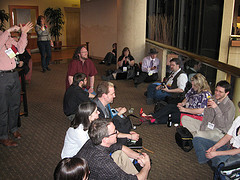
The really interesting thing, for me, was that I left this conference feeling like it had been the most productive conference I’ve ever attended… only I didn’t attend this conference. I just hung out in the lobby (or on the floor when our LobbyCon ran out of chairs and so we invented CarpetCon). And yet, I had all kinds of interesting conversations with other librarians about merging IT and research service points, unconferences, taking what we can from unconference philosophy and applying it to instruction (this Catherine’s idea, which she blogged about here), academic media librarianship, the death of Second Life as a viable experiment, Open Source library catalogs and how many people are seriously considering them now, to what extent it’s a good idea to shift our information to the cloud, benefits and drawbacks of WorldCat Local, … and whatever else came to mind. It was so much fun to sit there among these incredibly smart and talented people for two days and two nights, soaking in their ideas, feeding off their energy, and doing a healthy amount of joking around in the process.

I wish I’d had a little more energy to participate in everything while I was there. A couple of times I hit that “it hurts to be alive” level of tired and had to sit out some really interesting conversations. But other than that, there’s nothing I would have changed about this trip. I loved having the actual conference right there, with all the people going to actual sessions buzzing about the things they’d heard, what they thought had been interesting, and what they thought hadn’t worked out quite so well. It was like having the blogosphere happening in real life right there in front of me.

Oh! And since every conference must have at least one “Wow, it’s a small world” moment, here’s mine from this trip. Jessamyn and Laura Crossett and I stayed up far too late Tuesday night talking in full middle school sleep-over mode. Part way through the conversation, Jessamyn mentioned the town where she lived when she was young, and it turns out that for several years I drove right past her house every single week, at least once, on my way to the church where my dad was the assistant pastor. From there I moved to a suburb of Chicago and lived less than a mile from the Dominican, where Laura Crossett was at the time. So there the three of us were, in that room, and I’d spent years and years so near each of them. Weird.

P.S. The picture above was taken by baldgeekinmd and features me (or, the half of me that didn’t spill off the right hand side of the picture… yep, that’s me in the white sweater and jeans) and a healthy chunk of the lobbycon regulars.

1 Comment

I’m Leaving on a Jet Plane

At the very last minute, I decided to fly out to DC (well, Crystal City, actually, which is the travel equivalent of buying a vinyl rather than a leather couch). The chance to hang out with a whole bunch of incredibly cool librarians, talk about whatever comes to mind, and do so without registering for an actual conference just doesn’t come around all that often for me, so I’m pretty thrilled.

Actually, in my better moments I’m thrilled. I think of seeing some of my best friends in the world, of joking and being serious, of eating out, and of generally doing whatever seems best to do at the time, and these things seem very very good. Then I remember that doing this requires that I do unpleasant things like pack and figure out logistics and in many other small ways step beyond my comfort zone, my routine. These things feel much less good. In my worse moments these things are nearly enough to make me question the whole prospect of the trip.

This is a pretty typical set of emotions before I travel, though, so I’m not surprised. The day before the trip I always wish I’d just decided to stay home. But then I get to the airport, through security, and up to the gate. I sit down to wait for boarding, and suddenly everything seems better. At that point all the preparations over which I have any control are done and all I have to do is go with the flow. At that point, I can blend into an anonymous crowd and watch people or daydream or read or do whatever comes to mind. At that point, the trip finally starts to feel like a good idea.

I’m looking forward to that moment. And this time I’m particularly looking forward to what comes after I reach Crystal City since I’ll get to meet some new people and reunite with some of the people who know me best. And I can’t wait to experience my very first LobbyCon.

So all in all, things are going well. And now I’ll concentrate on the glorious potential of this trip as I go out and run some errands and then pack.

2 Comments

Charitable Writing

A couple of years ago Meredith Farkas wrote a post in which she introduced Josh Neff’s phrase “charitable reading” to the library blogosphere. The phrase is a good one, so it has bubbled up from time to time over the years. Essentially it means “read what people write and assume that those people meant well and that they are not stupid.” Granted, occasionally people don’t mean well, and sometimes they are stupid, but the idea is not to have those as your baseline assumptions.

I’ve been thinking a lot about this in the last several months (two years is an eternity in blog years but not very long in human years, so I’m allowed to still be thinking about this, right?), and I think that this is only half of what makes for productive written discussion. The other half is Charitable Writing: assume that your audience is not stupid, that they mean well, that they are probably trying to do the best they can or think carefully or otherwise conduct themselves well, and that they wouldn’t be reading and interacting with you if they didn’t want to.

Lately I’ve found myself unsubscribing from blogs and twitter feeds that, even though they have potentially useful content, present ideas in ways that sound condescending. Somehow that tone of writing screams “I’m pretty sure I’m smarter than you!” so loudly that it drowns out the calm murmur of the authors’ interesting ideas. This tone forces to me to work far harder at Charitable Reading than feels fair. It eventually wears me out. And so I unsubscribe and trust that others will point me toward the truly important posts.

Charitable Reading is hard. I fail at it frequently. But I think Charitable Writing is even harder because it it requires that authors see beyond the facts that they’re conveying, step into somebody else’s head, and hear from that other person’s perspective the tone that they probably didn’t know they were conveying… and then to do this from multiple potential readers’ perspectives. With so many potential ways of failing at this kind of writing, it’s a good thing that readers will be trying to read charitably!

3 Comments

Mini Rant About Gtalk’s Idle Status

Part of the reason I love IM and dislike the phone is that I have a better chance of telling if the person on the other end is interruptable before I interrupt them when we’re talking via IM. Phones don’t have statuses, so I get shy.

Most the time IM statuses make sense. People are either available or away. It’s not rocket science. But Google just had to mess with a good thing and use an “Idle” status that every other chat client I’ve used interprets as “Away.” Not only that, but if you were once available but haven’t done anything for a couple of minutes, it sets you to Idle. If you were once busy but haven’t done anything for a while, it sets you to Idle. Both look exactly the same, and both look like you’re “Away” from any other chat client. This means that I now have no clue if you’re available, and that the only ways I might have a chance at guessing are if I remember that you tend to use Google Talk through the Gmail page or the Gtalk client or if you add clarifying text to your status.

Dear Google, if you’re going to do Idle statuses, you should really stick to something that means “I used to be available but I haven’t chatted in a while,” and this should not look like an Away status to every other client out there. If people were Away and have been for a long time, chances are they’re still Away, so switching to Idle doesn’t make a whole lot of sense. If it makes a difference, though, you could have another status that means “I used to be away but I haven’t checked in for a while.” This way we’re return to a land of less confusion.

2 Comments

Shoving and Making in 2009


The first annual (I hope) LSW Shovers & Makers awards are being announced as we speak, and I’ve got to say, it’s inspiring.

We all know that we do a lot of good work in this profession, and that it takes a village, and all that. This is tangible expression that these things we know must be true in theory really are true. I’ve been sitting here refreshing the site and getting inspired anew by what I’ve read there, and I hope that each of you will take the time to write up a little bit about what you’ve done lately that you’re proud of. I know a few of you and can’t wait to see you post about the work that you do, and I’d like to hear what those of you I don’t know so well have been up to.

P.S. Here is my profile on the site.

Leave a Comment

Reflecting on ACRL

This time around, ACRL was a better experience than last time, thanks in a large part to those of you who introduced yourselves to me, and to several of my LSW friends who spent a great evening together on Saturday. As I sat in the closing keynote (with IRA GLASS, people!!! Now that’s how to close out a conference!), Ira’s performance reinforced what I love about this profession, what made the sessions that worked work, and what had been missing from the sessions that failed to live up to my expectations.

He sat on that stage, surrounded by drapery, potted trees, two giant screens, an ACRL logo-bedecked podium, and stage lights. He sat there in a hoodie behind a tangle of cords, a mixing board, two high-powered CD players, and a large microphone. And in the midst of all this, there in that stark contrast of the majestic and the mundane, he explained that facts and their presentation can either be surprising and joyful, or they can be confining and boring. Story telling depends on suspense and on the story-teller’s ability to couple facts with ideas. Plot isn’t enough to hold our interest. Plots become stories when the story-teller can zoom out, so to speak, and show the broader landscape that gives these factual details their context. Story is all about how facts — so local, so specific — apply to something larger, something more meaningful.

Most of the sessions I attended were chock-full of facts. Several had organized those facts into a cohesive plot. Only a couple, though, managed to make those facts interesting and broadly applicable. Only a couple managed to zoom out and perform that first level of abstraction that would lodge in their listeners’ minds, prime them for that level of anticipation and surprise that makes learning enjoyable.

Even beyond explicating my own enjoyment and my own learning at this particular conference (or lack thereof), I hope I can work a healthy respect for surprise, suspense, joy — story — into my teaching. Research is the quintessential environment for coupling facts and ideas, and it can be presented in ways that either stifle interest or expand it, ways that either bore or surprise. If my students learn nothing more than that what they find can interest people, I will consider that they have learned something important (and that they should come back to me to learn how to actually go about mimicking the research habits of scholars in their fields).

Ira may have covered this in the 20 minutes after I had to leave to catch my flight home, but I think the musical pauses he works into his show (and which he worked into his performance at ACRL) are also key elements of story telling. If his structure is plot, plot, plot, plot, idea, plot, plot, idea, then I think the pauses exist to give people space to comprehend. It’s the serious version of comic timing, and it’s just as important to the overall effect. And if there’s one thing that I learned from watching both Ira and Sherman Alexie (another incredible speaker that I truly enjoyed listening to at this conference), it is that these pauses are carefully planned. There is nothing accidental about them, just as there’s nothing accidental about the ideas that these story-tellers present to give their plots meaning.

I am very bad at pausing.

Little by little I will become a better teacher and presenter. And in a strange way, both the successful presentations at this conference and the presentations that failed to deliver served to illustrate just where I want to concentrate my efforts this coming term.

1 Comment

Basking in the Reflected Glow

I was busy recruiting ACRL attendees for the Library Society of the World this past week, which involved several conversations about how it got started (a funny story that can be told with more or less snark depending on the situation… I love snark-flexible stories). My favorite part to tell, though, is the “you are here” part. If you decide to take up with this crew, you’ll find yourself surrounded by smart, thoughtful, innovative, energetic, inspiring, and just plain wonderful library people.

There have always been anecdotes of useful conversations and interesting ideas to share when trying to explain why I think the group does good work, but as the group and individuals within it continue to work hard to improve the profession, it’s getting easier and easier to point to things that non-LSW members will have heard of and say “Look at this, and this, and this. See? These people really are cool!” Take, for example, yesterday’s announcement of the Library Journal’s list of Movers and Shakers. That list includes so many people that I know from LSW: Dorothea Salo, Jenica Rogers-Urbanek, Jason Griffey, Karen Coombs, Michael Porter, Rachel Walden, Dave Pattern, Lauren Pressley. Then there are a few other people listed that I know but am not quite sure if they’ve declared themselves LSW members (one of the fun things about the LSW is that there is no comprehensive roster of members): Chad Boeninger, Melissa Rethlefsen, Sarah Houghton-Jan, and the “Dutch Boys” (Erik Boekesteijn, Jaap van de Geer, and Geert van den Boogaard). That’s a quarter of the LJ list, folks. That’s nothing to sneeze at!

On top of that, there are all the other cool things that LSW members play huge roles in, like LCOW, Library Camp Kansas, the ALA unconference, the Lib2.0 Unconference (in Australia, since this is “of the world,” remember), BIGWIG programming, setting up all kinds of conversation spaces online (the LSW Meebo room, the LSW forum, the LSW LinkedIn group, the LSW FriendFeed room)… the list goes on and on and on. And now, the LSW is coming up with a way to recognize all the amazing things that its members do day in and day out. If you haven’t seen it yet, check out the Shover & Maker award site which appears to be gearing up for something big.

What started as a joke has become an actual force in the library world, and I, for one, am honored to bask in the glow of these truly inspiring people

2 Comments

Settling in for ACRL in Seattle

I love Seattle. This is only my second time here, but it’s just such a pretty city. And seriously, the entire down-town area smells of coffee, which strikes me as the perfect smell for a city.

I’m sitting here listening to announcements before the opening keynote and hoping that this conference will strike that tricky balance of being both fun and informative. My last ACRL (which was also my first) wasn’t such a great experience, so I’m on a mission to make this one different. Last time I think I chose my sessions poorly, and I had no idea how to meet up with people, so I ended up feeling like the most anonymous person in a sea of potential friends. This time I hope to choose better sessions to attend, and I’m hoping that I’ll manage to connect with some great people and re-connect with previous acquaintances. Part of this depends on you! If you’re here and see me (mostly recognizable by my olive green back-pack, which complements my jeans nicely) please introduce yourself! As a hint, I’ll probably be near a power outlet, and yes, I’m happy to share my extension cord with you.

So here goes. Keynote, then dinner, then hanging out, then back to the hotel (which is right across the street from the Seattle Public Library!). Here’s hoping for a useful, engaging, and fun conference. See you there!

Leave a Comment
css.php