Skip to content

Pegasus Librarian* Posts

The Importance of Endings

Things that never end are boring. It’s not that you have to know when, specifically, something will end, but knowing that it will or can at some point changes our engagement with whatever-it-is.

I’ve always thought I wished my favorite books would never end, but that’s not actually true. The prospect of an ending catches me in between the desire to swallow a good book in one sitting and the desire to ration my reading to stave off the inevitability of reaching that last period. I’ve also slogged through my share of books that felt like they’d never end. I’d keep a running tally in my head of chapters and pages left between me and the sweet release of that back cover. That back cover became the dominant experience of the book for me. Even the cycle of having books come in and out of print makes owning copies of precious books that much more special. And imagine how life would have been if The Never Ending Story actually never had ended? It hardly bears contemplating!

A few weeks ago, I thought I had nearly recovered from the mysterious health issues that have been my constant companions for well over a year and a half now. With an end finally in sight, I suddenly found myself willing to talk about this stuff for the first time with people outside my closest circle of friends. Maybe having an end point waiting in the wings made me less afraid of either boring people or of sounding whiny or pathetic. I don’t know. All I know is that the ability to stick mostly to the past tense unlocked the topic, made it palatable. (Now, though, I think I’ll relegate it back to “most boring topic I’m obsessed with” status and hope that an end point creeps back into view sometime soon.)

All this makes me wonder about times when ends or lacks of ends may have influenced the kinds of discussions we’ve had in librarianship, and the levels of enthusiasm we were able to feel for those discussions. I wonder if implying the end of the mostly un-named Library 1.0 reinvigorated interest and discussion in libraries in general no matter which side of the Library 2.0 debate you fell on. And I wonder if the liberating concept of “perpetual beta” has, after all, sapped some of the life out of discussions of new services and tools these days. I read a line in a zine* this week that implied that it’s hard to write a story when you don’t feel you know its ending, and if everything from interfaces to service points are constantly and rapidly evolving, it can be hard to think of stories to tell that feel more cohesive than a brief status update.

*Joe Biel. “In Sickness and in Health.” The Perfect Mix Tape Segue. Number 5.

Leave a Comment
What’s In a Term?

One of the things I love about language is how inexact it is. I went through a phase of bemoaning that very quality (“Life would be so much simpler if language were more more exact,” or even “Life would be so much simpler if all the rest of you people would use language more precisely”). When this seemed like it could become one of those fruitless grudges that I could harbor for the rest of my life, I decided to like it instead, and then discovered that I’d always liked it. I love learning what words mean to other people and comparing that to what they mean to me.

I apparently also like digressions.

On Sunday, Lori Reed asked the denizens of the LSW FriendFeed room whether they preferred the term Patron or Customer. People expressed preferences, some gave reasons for these preferences, and some proposed alternatives to both terms (with “user” being the most often mentioned).

Most of the time, I talk about “students” or “faculty,” but every once in a while, I need a good collective term. When that happens, I prefer “patron.” I appreciate the mutual respect that it implies, with my services being worthy of patronage and with patrons making the whole existence of the library possible. It may be a rather elderly term (the OED says it originated in the 12th century, after all), but the term “cottage” is even more hoary and hasn’t lost its vigor yet.

I tend not to like “customer” and “user.” When I worked in a bookstore, I sold things to customers, and I don’t enjoy selling stuff. For me, it muddies the waters, and makes me worry that the people I’m working with wonder if I’d even care if they didn’t have money. And while “user” is part of my library vocabulary (“user needs assessment” being a familiar and meaningful phrase for me), if I had to chose one term to the exclusion of all others, I’d stick with patron over user. Aside from sounding like “user” could mean “drug addict,” I mostly prefer my environment to feel less one-sided. A user is one who uses the library’s collections and services. I am one of the library’s services. A user uses me. Two of my favorite things about the work that we do is that it’s so collaborative with other members of our campus community and how much I get out of our interactions, and so I rarely think of our faculty and staff as using me.

For me, “patron” means mutual respect, and so every time I use it, I remind myself that I respect our faculty and students, and that they (ideally) respect me. If “patron” feels like disrespect to you, please don’t use it, but please don’t assume I mean disrespect when I use it.

10 Comments

Let the Adventures Begin

So, I did a semi-impulsive thing: I registered a domain name and set up some server space. Now, when I say “I” I actually mean the amazing people at LIShost. I haven’t actually lifted a finger yet because I’m a little intimidated by the whole thing. (By the way, Blake has already blown me away with his customer service and it’s only been a day since I asked him to put things in motion for me. He’s incredibly tolerant of stupid questions, too.) Also, when I say “semi-impulsive” I mean “been thinking about it for 2 years but was too scared until now.”

Imagine my excitement this morning when I opened the email that announced the birth of my very own web space. So cute! So full of potential (and nothing else). So…. and then I actually read the email. It started off just fine. I reproduce all but the sensitive parts here:

Welcome aboard LISHost!
Here are the details for your new domain, [my domain, which I’ll reveal when there’s anything to reveal]:

You are on the server named [server name], with an IP address of [IP address]

Me: Oh yay! … Hmmm… I wonder why it’s important that I know that IP address. WHAT HAVE I DONE??? Ok, calm down. Keep reading.

Answers to many of your questions can be found at:
http://www.lishost.net/support/

Me: good, good, I’m sure I’ll have questions. I sure hope those answers aren’t written in Geek. Moving on…

When you are ready to go live with your domain on this server, make sure you have changed your DNS entry with your registrar to use our DNS servers:
[information about something called a Name Server…Hmmm]

Me: DNS? I’ll have to look that up later. “Name Server” too. So things aren’t live yet. Ok. That makes sense. I assume it’ll be apparent when I arrive at this “go live” point. I’ll worry about DNSs then. For now, just make it through this email…

Your domain will NOT go live until the DNS is updated. DNS takes time to update, so your domain may not be live for several hours Directions on how to test your domain before you go live can be found here: [URL]

Me: So much about this DNS thing. It must be important. [makes notes to look it up when I get home] And testing? Before going live? Makes sense. Also seems to indicate that things might not work. THINGS MIGHT NOT WORK? WHAT HAVE I GOTTEN MYSELF INTO??? Ok, breathe. You have friends to help you. Just keep reading for now.

**After you have made those changes to your DNS settings, BE SURE to let us know so we can add you to our DNS server.**

Me: ENOUGH WITH THE DNS THING ALREADY. SAYING IT MORE OFTEN WON’T HELP ME UNDERSTAND! Ok, Here’s some username and temporary password information. Now that language I’m familiar with. [sighs at the relief of seeing words strung together that make sense] Then…

To change your password for your username, connect using SSH to either [server name], or your domain, or the IP address: [IP address]

Me: All of this makes sense except for the “connect using SSH” part. I’ve heard of SSH, and I’m pretty sure it’s not animal, mineral, or vegetable, but that’s about all I’m sure of. [gives up on taking notes of vocabulary to learn … tears up previously taken notes, balls them up, and flings them despondently toward the recycling bin .. skims over the next few lines which list the directories I have … wonders what “log files” are, and figures that “cgi-bin” has little to do with trash bins … scrolls till the end]

Something to keep in mind, your domain name may not be live right now. The DNS system can make up to 48 hours to update. You can NOW login to the server, but your domain will most likely take a little while to be live.

Me: After all that, DNS has a surprisingly familiar ring to it. Comforting, even.

Again, welcome aboard, don’t be afraid to ask any questions
-The LISHost team
LISHost.org

Me: Heheheheh… “don’t be afraid to ask questions” … they’ll rue the day…

So yeah, I procrastinated for a while by making all my lunches for the week, and chatting with a couple of friends, and writing most of this blog post. And then I sat down to the task of changing my password (the least I should do before publishing a blog post saying that I probably have a password sitting there, all hack-enticing, in my email). An hour later, I’ve finally conquered the password-changing task and have given myself the rest of the night off. I think this warm glow of victory will be nicely complemented by chocolate ice cream.

I sincerely hope there’s a more graphical way to navigate other basic tasks. I am not an SSH lover, and suddenly all those directory addresses that Blake told me about feel a lot less friendly than they did at first read. After all, what does a directory even LOOK like without windows and files and folders and things?? (On the other hand, maybe this is good for me. After all, I said I wanted to learn how this stuff works, right? RIGHT??)

8 Comments

The Ebb and Flow of My Online Communities

Online communities, like those in the face-to-face world, are fascinating to watch. They coalesce, wrap in on themselves, fray around the edges, unwrap a little, shift, possibly acquire new members or even glom onto a new core group of members, coalesce, wrap in on themselves, fray around the edges… and on and on.

Take my own history as an example. I started this blog and started reading other people’s blogs, and in the space of a few months found myself squarely in the middle of a vibrant community of librarian bloggers. A year or so later, Twitter and the LSW Meebo room started up. Conversations started in any of those places and bled over into our blogs, but there were also new people in the group — people who didn’t have blogs at all, or didn’t blog about libraries. And slowly the LSW Meebo room group became my center. A year or so later, the librarian Twitterati started shifting to FriendFeed, so I followed them (kicking and screaming, I might add — I had a bunch of problems with FriendFeed, some of which still bother me even though that’s become my social network of choice now). FriendFeed is slightly different in that conversations can happen within or across several “rooms,” and I’ve seen communities coalesce, wrap in on themselves, and then fray about the edges in several of these spaces within FriendFeed. Meanwhile, the blogging community had frayed about the edges (Meredith also just wrote about this).

Each time I’ve found myself in the midst of a new coalescing community I’ve met new people who inspire me, question me, encourage me, and generally be good friends to me. But each time it’s meant that people who used to represent the core of my network have shifted to peripheral status. Not unimportant, just less present.

And now I find myself on the fraying edges again. Almost certainly, this means that I’m about to find a new home, or re-find an old home, but at the moment things feel a little foundationless for me. Luckily, I have a couple of really interesting projects I’m working on (which I’ll probably write about soon-ish), so that should sustain me until my new center coalesces for me.

7 Comments

Citation Visualizations

A couple of people here on campus asked if there were any tools out there that would allow them to visualize the relationships between citations that they gathered over time in the course of a research project. Turns out, the options are limited and not at all user friendly. Here they are (thanks to Christina!):

  • There is CiteSpace. The demo video that you get when you click “webstart” and then go to “help” and “demo video” makes the whole thing look rather intimidating. It seems to run off of the same exports that we’d use to get information out of databases and into EndNote. The trick is, it appears to only work if you import stuff from ISI. I don’t see any way to manually enter a citation, though I’m certainly no expert on the software yet, so it may be there, just hidden. Here’s the User Guide (you may have to click through some server security stuff to see it).
  • The other option is Sitkis. This involves downloading ISI citations (again) and importing them into MS Access. I’m on a Mac at work, so I’ll have to see how this works when I get home to a PC with Access on it. Anyway, here’s Christina’s blog post about it.

Pretty limited options, eh? I sure hope there are more out there, but the People Who Should Know generally agree that there aren’t, at least, not yet. You know what I’d really love? If Zotero would take this project on.

3 Comments

Midsummer

I know it’s not technically midsummer. We passed that a while back. But here at work, it’s the middle of our institution’s summer. Whole weeks can pass with only one or two meetings scheduled. Whole days can pass without any student asking me anything (we don’t have summer sessions for our students, though we do have summer programs for other people’s students). Whole hours can pass while I concentrate on one project without interruption. Everything feels different.

One thing I’ve enjoyed about this summer at the library is that the various research assistants on campus seem to have decided to congregate every day and work side-by-side in the main computer area of the reference room. Each student works on his or her assigned projects, chatting occasionally with whomever is sitting at the next computer, and generally keeping each other company through the long hours of research. This may have happened in previous years, but I don’t remember it, and it warms my heart every time I see the group hard at work together.

People always ask me what I do all summer without students, and I rarely have a good answer. In fact, I usually just pick whichever project I’m working on at the moment and say, “well, right now I’m working on [whatever it is]” and hope they don’t say “but that won’t take all summer, will it?” Because it won’t. There are a million other projects to do, but very little that can be synthesized down to “in the summer I work on this kind of thing and that kind of thing” conversation snippet. For some reason, it’s rarely seems to be enough to say, like those students can say, that my colleagues and I gather every day to work in proximity on the various projects that can’t happen during the school year’s crush of interruptions, classes, consultations, and meetings.

So what am I working on during this week in the middle of our summer? Well, I need to get acquainted with our (brand new to us) instance of LibGuides (which we’ve been wanting for years and finally have). I’m putting together my piece of a presentation on learning-centric library instruction for a professional development day that’s coming up in a couple of weeks at Gustavus Adolphus. I’m figuring out what needs to change in EndNote to bring the MLA style up to date now that we have our 7th edition copies in hand (and I need to figure out how to handle their pesky restrictions surrounding the online version). I’m also trying to re-start the effort to make Metalib work the way we need it to work. And I’m drafting a proposal to assess our Research/IT service point.

Sometime soon (once I’ve figured out LibGuides) I need to embark on my summer schedule of updating all my departmental research guides. (This is when being the librarian for 10 departments becomes time consuming in the summer.) Then there are a couple of complicated course-specific guides I should start working on. I have some Moodle/eReserves documentation to overhaul, some instructional material to create and some projects to assess in my capacity as a member of the campus’ copyright committee, and some planning to do for a new project in which I will coordinate a continual environmental scan for our library.

At least, those are the bigger projects that I hope I’ll get to before the most active prepare-for-fall-term portion of summer arrives. I hope my brain and work life cooperate to make that possible.

Leave a Comment

Clinical Reader Train Wreck Just Keeps Going

Some day I’ll get bored of watching this train wreck in progress. But not yet. If you are, you can skip right over this post and rest in the knowledge that you’re more mature than I am.

Remember last week when Clinical Reader had only threatened a blogger, been exposed as having made up endorsements, started making up bogus Retweets, deleted incriminating tweets from their account, fired the pesky Canadians, and generally convinced thousands of people that they weren’t trustworthy? Since then, thing haven’t improved. Since then:

  • Whoever is trying to sanitize Clinical Reader’s online reputation (I assume it’s co-founder Allan Marks, but who knows) has been switching the original twitter account’s name at the speed of light. This breaks links that people had used in blog posts, but it unfortunately doesn’t erase the history from the deep dark recesses of the Internet, or delete people’s screenshots from their hard drives. Most of the good stuff is still live on the links in my previous post, and even more lives in this post on the Disruptive Library Technology Jester. (Moral of the story: Don’t be stupid online because the stupid never dies.) As of this writing the account has moved from @clinicalreader to @clinical_tweets to @amarks7 to @amarks14 to @amarks_ to @a_marks1 to @allan_marks (See below for explanation of the change in the first two names. And don’t expect @allan_marks to be valid for more than, say, an hour. As of 7pm, the name has changed 4 times since 9am today.)

  • Somebody took over the name @clinicalreader and posted a brief history of the debacle there.

  • Somebody else took over @clinical_tweets (they claim to be the fired Canadians) and started cockily claiming that they’d done the job they were hired to do because just look at how many people now know about Clinical Reader. Their claim in a nutshell: “You’ve All Been Used. Bwahahahah.” They’ve now killed the account.

  • A new twitter account went live: @clinical_reader. This had all sorts of tweets about how the real Clinical Reader wasn’t yet “officially” on Twitter but will let us all know when they are (this screencast from the Google Cache shows that if you hovered over an older version of the Clinical Reader site, it clearly linked to the original @clinicalreader twitter account). Then tweeted several rather official looking tweets about what a great service they are. Then denounced the other now-bogus accounts. And all of this while not officially tweeting! This morning, all their tweets had disappeared except for the ones saying that the tweets from @cliniclareader are not coming from the Clinical Reader service (which even whoever-it-is at @clinicalreader says, quite plainly).

  • Another new twitter account went live: @clinical_tweet. This seems to be the new, new, new official twitter account. Or something. We’ll see how long it lasts.

  • And now, the sockpuppetry really gets started. “Sally Jones” started a twitter account as @kensingtonlib in order to alternately level accusations at @lukelibrarian and laud Clinical Reader. I wonder who could possibly be using the name Sally Jones??

This is just too much fun. I’ll update this post if necessary (and add screenshots that I have on a different computer, later).

[Edit: 7pm on July 20th. I think I’m done now. If you haven’t had enough, search FriendFeed for “Clinical Reader” and see if more drama has surfaced. I’ll just add that I’ve been almost equally fascinated by the complexity of piecing together a coherent story when that story is playing out in so many social networks, by the flailing about of Clinical Reader, by the lessons this teaches about marketing online, and by the implications of this story in my own teaching. I think I’ll have to work some discussion of this parable into sessions I teach about evaluating web content.]

9 Comments

Best Bad Marketing EVER

I thought I could resist jumping into the fray on this one, but this story just keeps getting better and better.

Have you ever heard of the service called Clinical Reader? Apparently it’s a new service that acts kind of like a feed reader, only they decide which feeds you read, and it’s aimed at the medical community. The salient facts here being: 1) it’s new, and 2) nobody had heard of it. Until this week.

This week they used twitter to threaten legal action against a blogger, explain that they’d overstepped and let some unknown junior colleague too close to the keyboard, argue with the blogger and her ever-growing posse, apologize to the blogger, and now send out bogus retweets.* (See the chronology below for the gory details.)

What fascinates me is how quickly (in the space of four days) hundreds of people have gone from knowing nothing about this service to being pretty sure that everyone at Clinical Reader is completely insane. The social web can be an incredibly rich marketing arena, but it has zero patience for companies that get stuff wrong, and it rather delights in calling out this kind of behavior. This is the flip-side of crowd-sourcing, and companies and libraries hoping to harness online social networks would do well to watch this real-life parable unfold.

Chronology:

The story is way more interesting if you see it unfolding, so here are the best places to get it in kind of chronological order. This blog-version of the summary is necessary because Twitter itself is kind of difficult to reconfigure in a way that makes sense after the fact, and because Clinical Reader has started deleting tweets. Oops.

  1. Nikki noticed some less than ethical aspects of Clinical Reader’s site (which now includes edits linking to the apology she received)
  2. Steve summarized day one of the saga
  3. Nikki gathered together links to a bunch of stuff that happened after Steve’s post.
  4. The RT shenanigans begin, but these need more space, and screenshots, so here we go…

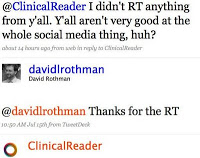
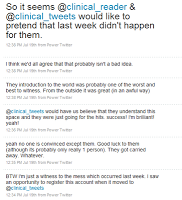
Clinical Reader went wrong in two completely wrong ways with the retweeting. (By the way, read each of the screenshots from the bottom up, because I forgot I should reverse the order and don’t feel like fixing it now.)


First, they thanked people for retweets even if the people had never retweeted them.


Then they seem to have completely made up tweets to retweet.

Amazing. Pardon me while I go pop some popcorn and settle in for the amusing ride. You can follow along on FriendFeed if you want.

P.S. The founder of Clinical Reader now says: “I have taken control of this account & parted company with former acquaintances in Canada whose behaviour I can only describe as schoolboy” (cite), and he is now apologizing to people. [The following sentence is apparently no longer true… which is ironic, since I was poking fun at Clinical Reader for misunderstanding how it works: “The problem is, he doesn’t realize that if he starts with one person’s name, there’s no guarantee that everyone else will be able to see what he writes, since Twitter only lets you see messages directed at mutual friends.” Further testing reveals that the other people would be able to see this message if they clicked on their @[username] page but not in their main Twitter feed. So, still weird, but not as egregious.]

* For those who don’t use Twitter, RT means “retweet” and is a way to redistribute something somebody else said, complete with attribution. It’s very much like a cited quote in a paper, only with links. So if I say “Something Clever” on Twitter, somebody else could say “RT @ijastram – Something Clever” which means “retweeting Iris Jastram who said ‘Something Clever,'” and the “@ijastram” part automatically turns into a link to my tweets. Quotation and citation in 140 characters or less. Pretty slick.

14 Comments

An Interesting Thing Happened on the Internet

Yesterday, somebody pointed me to a FriendFeed thread in which an artist and a FriendFeed user were working through issues of intellectual property and Internet etiquette.

The FriendFeed user, Kol, had bookmarked an image that he found on a site that allows artists to share their work with each other. In typical FriendFeed fashion, this bookmark appeared in FriendFeed with a thumbnail of the image he had bookmarked and with places for other FriendFeed users to comment on, “like,” or re-share the bookmark and its related thumbnail image with their own sets of FriendFeed friends. The artist objected strenuously (and not at all politely) to the fact that this thumbnail appeared on FriendFeed. Kol and other FriendFeed users tried explaining that Kol had not, in fact, infringed on the artist’s rights by bookmarking her image since thumbnails do not violate copyright and since the image was licensed under Creative Commons Attribution-Noncommercial 3.0 License (though the artist has since removed that license). In short, the artist was well within her rights to ask (politely) to have her image removed from FriendFeed as a matter of courtesy, but she was probably not within her rights to accuse the original poster of wrong-doing. That’s the sanitized version, at least, which I reproduced here at some length because of difficulties with the original material.*

So, except for the attendant drama, the issues seem to be garden-variety intellectual property confusion. But all the drama involved in this particular exchange was actually kind of illuminating.

First, it reminded me that as an information consumer, I’m used to the feelings of frustration involved in finding out that I can’t freely use other people’s stuff however I want to even if I cite my sources. I run up against the flip-side of these frustrations only very rarely, however, and they’re good to bear in mind. I happily slap Creative Commons licenses on lots of the stuff I produce, but I remember all too well the first time I found my work being reproduced and shared in a way that I didn’t particularly appreciate but that fell squarely within the parameters of the license I’d chosen. There’s nothing like working up a good head of righteous indignation only to remember that they’re doing exactly what I said they could do and no more.

This particular discussion might also be less straight-forward than it at first appeared. Licenses always trump copyright, and the original image** has license-like language attached to it that prohibits “use” of the work outside of a specific community. The artist clearly thought that this applied to bookmarking and sharing via FriendFeed, though that’s not at all clear from the term “use.” Kol either didn’t read those instructions, or read them but didn’t think they applied to bookmarking, or read them but didn’t think they constituted a license. (To be fair, I’m not completely sure they are a license, either, but I think good etiquette would be to assume that they do.) And where does all of this leave the artist’s fans? If they want to share bookmarks with other fans or potential fans, they can’t turn off the “suck in a thumbnail” feature of these social networks. The only way that gets turned off is if the originating site has lock-down features like Flickr does for the images its users make private.

Little did Kol know when he bookmarked this image that he’d bring down the wrath of the artist, spark a huge debate on FriendFeed (and a ton of re-shares of Kol’s post), and set this librarian to musing about the incredibly intertangled worlds of intellectual property, etiquette, and the Internet.

* I don’t like talking about things without linking to them, but this one has me on the fence for two reason: 1) the link may die suddenly since there was a promise to delete the thread as soon as someone from FriendFeed had seen and responded to the original poster, and 2) the language in this thread is decidedly not safe for work, or for kids, or for me. Still want to see it? Here you go. [Edit: yep, the original post is gone now.] I may or may not screen-grab the post for posterity. I haven’t decided yet if that’s fair to all involved, or if I want to have that kind of language saved anywhere associated with me. Call me a prude, if you want, but them’s my boundaries and it’s up to me if I want to cross them.

** I’m aware that by linking to that image, the artist may find my post, so I’ll just say right up front that while I welcome constructive comments and discussion, I reserve the right to delete any crude or abusive comments. And I get to decide what constitutes “crude” or “abusive.”

1 Comment

Well Hello, Blog

Yesterday, I had reason to point someone toward a couple of old blog posts I’d written. Popping over here to collect the links brought me up against a sobering realization, though: I posted once last month. Once. And that was a post I’d outlined weeks ahead of time. I’ve had dry spells before, but never like this.

It crossed my mind that maybe I should just put this thing out of its misery, but I don’t think I’m ready to follow in CavLec’s footsteps yet. So here I am again, and here’s a bit of what I’ve been up to since last I thought much about blogging.

We had an unusually busy Spring term at Carleton. Budgetary adventures, a new initiative to archive digital versions of all senior capstone projects, revising our strategic plan, and some internal restructuring took up a lot of time and brain space.

My sister got married, my cousin got married, and my youngest brother graduated from college (with honors!), all in the space of a month.

Then I took two weeks off of work to do as much of Nothing At All as I could. In case you missed it, that was TWO WHOLE WEEKS off. In a row. Bliss. During that time, I became a big fan of sitting on the porch with a book, a laptop, and some iced tea. (In fact, I’m reprising my role as a porch-sitter right now, thanks to early observance of Independence Day.) Coming back to work was kind of a shock to the system after that, let me tell you.

It’s been a weird few months in which many individual good things happened but the whole felt kind of awful. I was tired. I am tired. But I think things are starting to turn around. And while I’m not sure how frequently I’ll post or what I’ll write about, it’s nice to see this space sitting here and waiting for me.

Leave a Comment
css.php