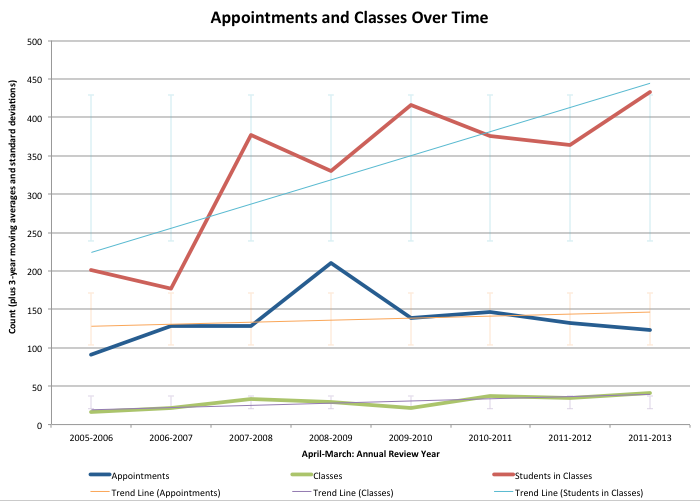
I’m currently writing my annual review document… or rather, procrastinating on writing my annual review document. In the process I made a graph:
For the last three years we’ve been making a concerted effort to help students understand that they can ask many of their questions at the reference desk (especially students in first year seminars). We’ve also gotten more involved in curricular initiatives on campus, using more of our time to work on curricular-level projects than we used to. I think both of those changes are reflected in the downward trend in appointments. (And really, not a ton of change over time if you disregard that one weird year where apparently EVERYONE needed me.)
I think that curricular-level work, plus slow but steady relationship building with the faculty in my departments accounts for the upward trend in classes. This year I’m more than a standard deviation above the mean.
I’m sure my colleagues have very different graphs since our departments fluctuate in different ways. But I found my graph interesting, so I thought I’d share it.
So, you’re assigned a 20-page paper when really you’re only used to 5-page papers. That’s pretty daunting. It’s a lot of space to fill. Therefore you’ll have to fill it with a lot of stuff. Four times as much stuff. Four times as large a topic. Four times as significant a claim!
Except that that’s not right at all. That’s the wrong multiplier. Go down that road and you’ll start trying to develop new theories of renaissance post-modernism, or a comprehensive description of the minority female healer in the modern consciousness.
A better multiplier is nuance or detail. Four times as much nuance is a wonderful thing.
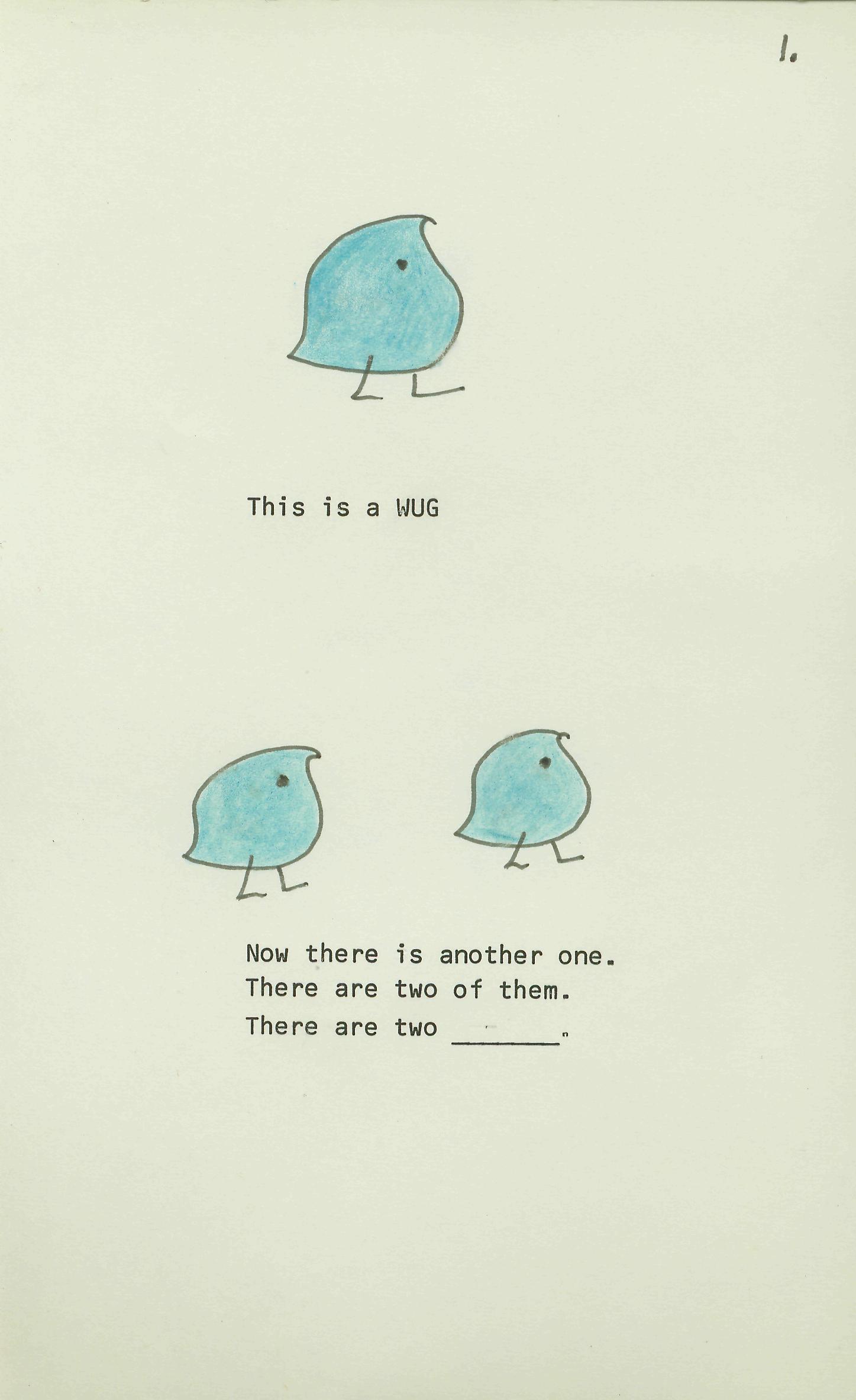
Sometimes when I ask profs “what will your students have read recently, and can I have a copy” in preparation for classes, I get best answers. “We’ll have been reading about Wugs!”
If I could only be un-nervous and fully supported in my geekery in every class (by profs and students), they could all be as fun as last Tuesday’s class was. I’ve done similar things in other classes, but I often come out feeling like people were just kind of baffled by the crazy librarian who seemed really excited about… something.
Exploding a Reading
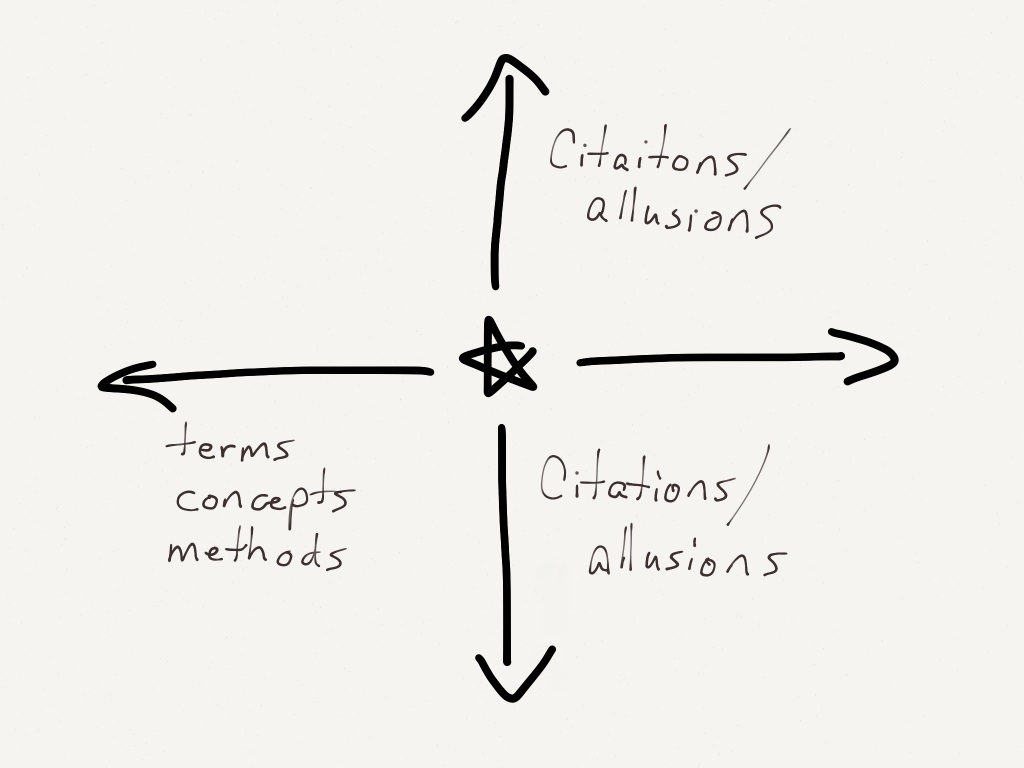
So last week was based on what I think of as a fairly standard class: exploding the article. Basically, you take any given reading. You figure out who the author builds upon (citations and allusions) to move backwards in time. You figure out who has cited the work (technically citations and allusions, but really the allusions are pretty hard to search for so you’re left with cited reference searches in Web of Science or Google Scholar) to move forwards in time. And you Read Instrumentally to figure out the language and methodology of this community of inquiry so that you can search for more people using similar language or methodologies.
For this class, the professor and I chose to explode the least explode-able of the day’s readings: and excerpted portion of a book theorizing the silences in history.* There weren’t any citations included, and the piece was difficult to begin with, so we thought this approach might help us all figure out his argument a bit by figuring out who he’s talking to and what his base set of information is.
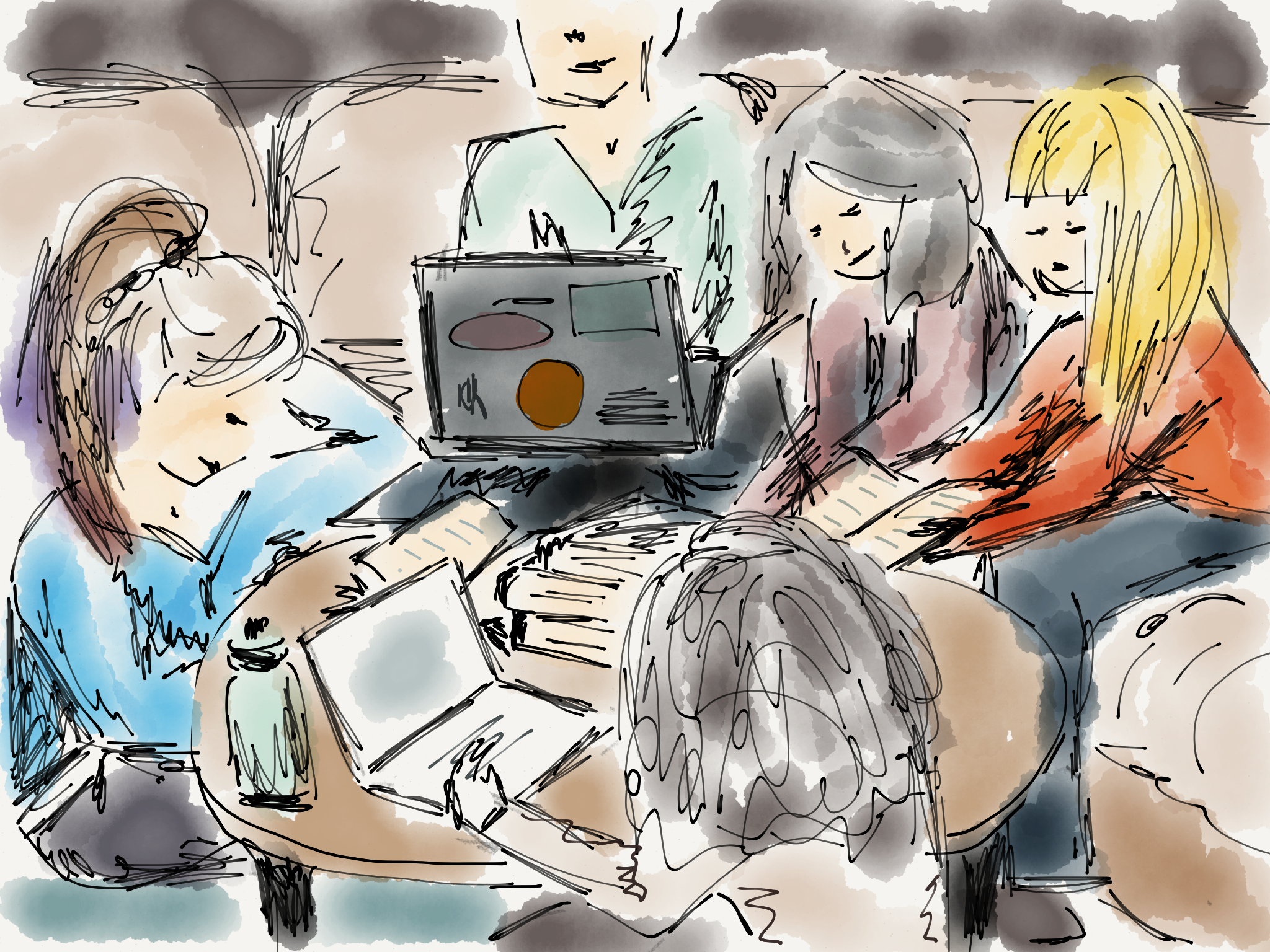
Our class that day, held in the student union.
We started out discussing what outside voices the author included in his argument (and I’d brought the un-excerpted version from the stacks just in case we wanted to track down any actual citations), but very quickly started talking about how hard the piece was to read. We agreed (heartily) that this had not been written for OUR discourse community. In fact, it seemed bent on keeping us at arm’s length.
Talking over what made us feel unwelcome in this author’s world helped us think about conventions that we’re used to in American Studies papers that help us understand what’s going on. Some of that is vocabulary, some of that is topic, some of that is the dreaded citation (which everybody hates but which everybody really missed in this work because they felt like he was just name-dropping or referencing things and then leaving us without context). Basically, we talked about how discourse is situated within a community, and that following the conventions (of vocabulary, method, acceptable evidence, and yes, even citation) makes readers in your community more at ease — more ready to think through your thoughts with you rather than write you off or give up in frustration. Every piece of the work, from vocabulary to argument, has to work together to move your reader from thinking what they already thinking to agreeing that your way of thinking is interesting and useful. Every piece should help your reader trust that what you’re saying is reasonable. If you don’t pay attention to the rhetoric, your message risks being discounted or simply lost.
* Trouillot, Michel-Rolph, “Silencing the Past: Power and the Production of History,” American Studies: an Anthology, Malden, MA: Wiley-Blackwell, 2009. 558-566.
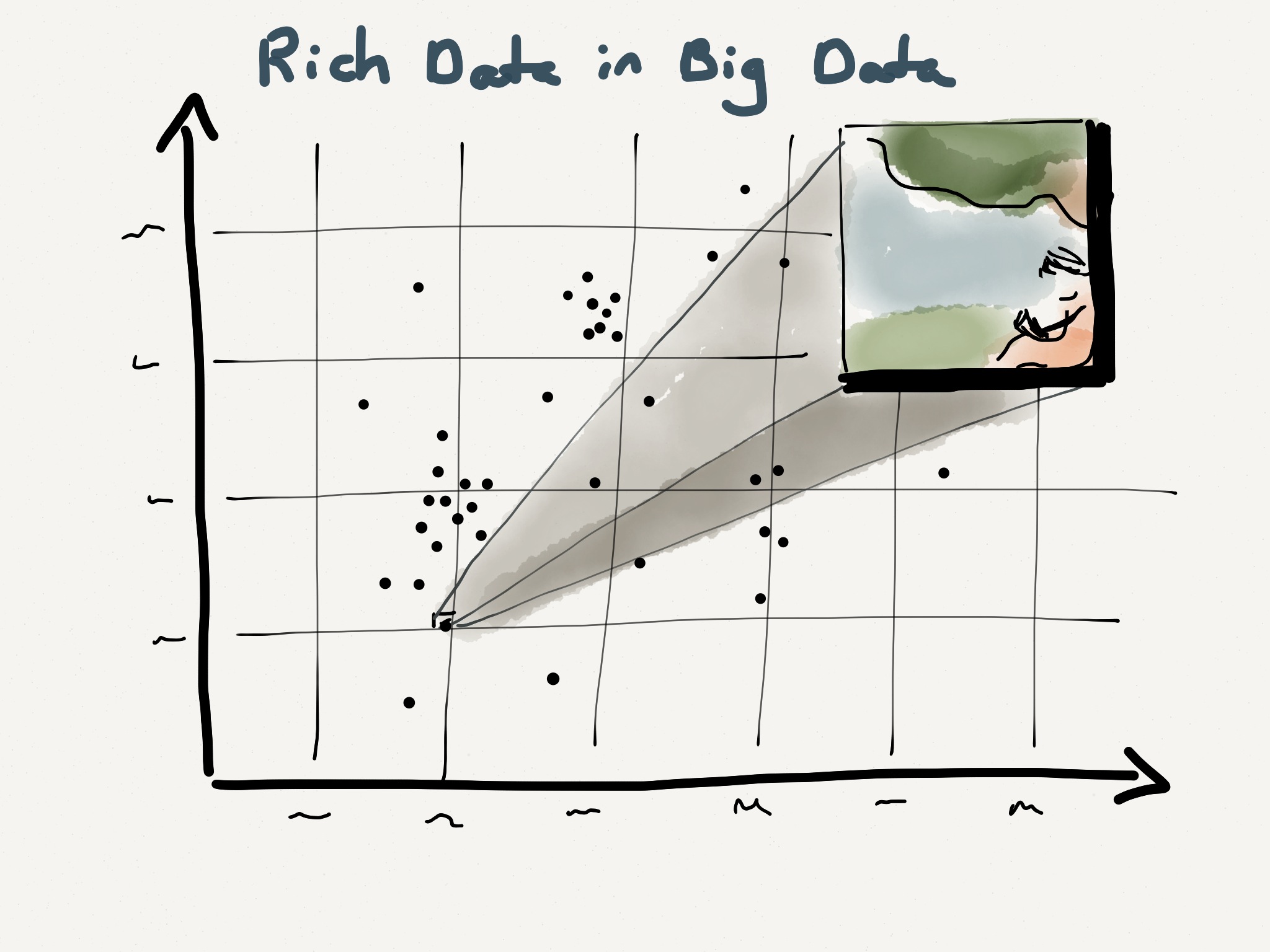
I find I often think of the digital humanities as a discipline in which scholars work with digital stuff to answer questions about texts. I know that’s not the full scope of the field, but that’s how I’ve most often interacted with it. And when I do this, I subconsciously apply only a Big Data connotation to the word “digital” — querying and analyzing massive datasets of all the words written by an author, for example, or publishing wiki-style so that the masses can contribute or change what exists. And this habit of defining the digital in these terms alone leads, I think, to Stanley Fish’s worries that the digital humanities are a dehumanizing field. He wrote an opinion piece called “The Digital Humanities and the Transcending of Mortality” in which he talks about the blurring of the individual into the digital collective, resulting in a concept of the individual that is no longer “an entity that can be said to have ownership of either its intentions or its effects.”
Perhaps dissociation from the human — the particular, the subject — is part of the post-postmodern project. But perhaps this worry about dehumanization is an early stage of understanding the digital humanities. One of the greatest changes that happens when you work with digital information is that you gain the capacity to perform large scale computation. That’s what the human brain is less good at, but that’s what computers do without breaking a sweat. So it’s only natural for many of us to subconsciously or consciously define “digital humanities” as highly computational and as primarily preoccupied with massive aggregates even when this definition does not describe all that is going on in the field.
Timothy Burke rejects Fish’s dehumanizing view of the digital humanities in his wonderful essay, The Author is Human. “In DH, authors are not dead, just brought down to human scale,” he writes. Authors aren’t the cultural monoliths of the pre-digital humanities — great minds that dominated the minds and imaginations of their times or ours. Authors are just… authors. In a sea of other authors, each one authoring away, any one author is uniquely that author. It’s just that that author’s intentions and effects do not completely overshadow other authors’ intentions and effects. In a way, I think Burke is saying something similar to what I said about focal flexibility.
So maybe the object of study is still fundamentally human, or at least not necessarily dehumanized, but maybe the praxis itself is less authorish than it was before. Maybe there’s often too much resistance in the materials, or too much of the wrong sort of resistance, making the whole enterprise feel less like communing with other minds over time and space and more like fighting with computer code and mechanics. Of course, the real work of human-computer interaction draws on the complementary strengths of mind and algorithm. Shyam Sankar’s TED talk on human computer cooperation demonstrates this beautifully leaves no doubt that even highly computational work still relies heavily on human intelligence and design.
Perhaps the very nature of the work itself, relying as it so often does on teamwork rather than a lone thinker, reduces the sense that the scholarship is as purely Authored. So much of the ethos and identity of the humanities is wrapped up in the idea (the myth?) of individual scholars thinking deeply and carefully about their subjects. With that as the backdrop, assertions like Beth Nowviski’s, that “the great project of humanities computing is the development of a hermeneutic—a concept and practice of interpretation—parallel to that of the dominant, postwar, theory driven humanities: a way of performing cultural and aesthetic criticism less through solitary points of view expressed in language, and more in teambased acts of building” sounds uncomfortably de-centering (Said in the Chronicle of Higher Education, and on her blog). It’s easy to feel as if this type of work places less value on the self of authorship and scholarship.
And in this case, any individual’s ownership of intentions and effects really is open to more disruption and dilution by the very nature of working as part of a team. Traditional humanities relied on more than one scholar as well, of course. Acknowledgements sections attest to this, but even without them we know from experience that knowledge doesn’t spring full formed from a brilliant mind in a vacuum. But more and more projects, particularly in the digital humanities promote team members from the acknowledgements to the author line both in form and in deed. The selfhood of individual authors can no longer be seen (in fact or in myth) as fully owning their intentions and effects.
Even so, truly collaborative projects rely heavily on the spark of individuality that each partner brings, the rich tapestry of backgrounds, experiences, and predispositions that allow one partner to see facets of a project that the other partner would never have seen, or seen too late. This is what we wanted to spark off in our Digital Humanities Speed Dating event.
The human, it seems, is anything but an amorphous digital collective in the world of digital humanities. Both the subject and object of scholarship in the field rely on and celebrate the individual. This does not mean that things are the same, though. Authors are less monolithic things now, it seems, less singular. And right now that feels unsettling, particularly as we’re getting used to the whole idea and while the digital piece is so relatively new that it needs modify the term “humanities.” Perhaps as things settle into normalcy the word “digital” in the name won’t feel so inhuman, or perhaps we’ll dispense with the modifier altogether. However things evolve, though, it will be fascinating to watch the role of the self, the author, the human as it navigates the space of the digital humanities.
The director of our Humanities Center instituted a First Fridays informal gathering at our local pub geared toward people who are interested in digital humanities. It’s only met three or four times so far, and I had to miss the first one, but it’s been really great to sit around and listen to people say what projects they’re working on.
At the December gathering one of the profs there said what I think a lot of people were thinking when she admitted that she wasn’t speaking up because she didn’t know enough about the digital side of things to envision what she might do for a digital humanities project. She’s well aware of great digitization projects in her area, and web archives, but beyond digitizing things, what kinds of questions would she want to ask that computers could help her with? On the other side, the CS types said that they knew that computers could be great thesauri, but they didn’t really know enough about what keeps humanists awake at night to really suggest projects.
This seemed like such a fundamental question that we hatched a plan. We set up a “digital humanities speed dating” session. Humanists would come with some description of their own research, and CS-types would listen with their CS-perspective and would also talk about what they were working on. And maybe the more we knew about each other the more we would be able to see collaboration potential.
So this evening we conducted our Speed Dating session, and whatdyaknow, some CS profs and students had highly humanistic interests, and some humanists got really helpful ideas from the CS profs and students. My favorite moment was when one of our classicists was telling us about a set of fragmentary Roman documents that she is really interested in. They’re documents that record the auction prices of quite a few people’s property (they’d been convicted of something or other, and the proceeds were to be in some way presented to whichever god they’d offended). And people were discussing what she might or might not be able to learn from the fragments she has, and one CS prof said it’d be interesting to see if they could infer something about the data that’s missing. You could use each sale as a kind of user rating of the item, he said, and the missing items would be something like the things in Amazon or Netflix that haven’t yet been rated, and you could infer something about their potential value based on what had been rated/priced already. Well, that blew our humanist minds.
So after the gathering the CS prof went to talk to the Classicist a bit more, and then I happened to be there in the hall when he debriefed another CS prof. “Yeah,” he said, “I’m just going to take her spreadsheet and run a ……” and here he and the other guy went into a dialog that I assume wasn’t actually in Greek, but it might have been.
I love it when I come face to face with expertise I can’t even parse. And also, I think that’s part of the point of this whole thing.
So, in the bad old days, we shuttled books and articles back and forth between libraries.
Now, in the days of ILL2.0, where much of our collection is electronic and governed by license agreements, we shuttle people back and forth between libraries. “We’re sorry, you’ll have to actually go to St. Olaf to read that. No, we can’t have them print and send a copy. Yes, I know it’s sitting there online, and we have access to the internet from here, too. And yes, I know we’re a consortium with cooperative borrowing privileges. Even so…”
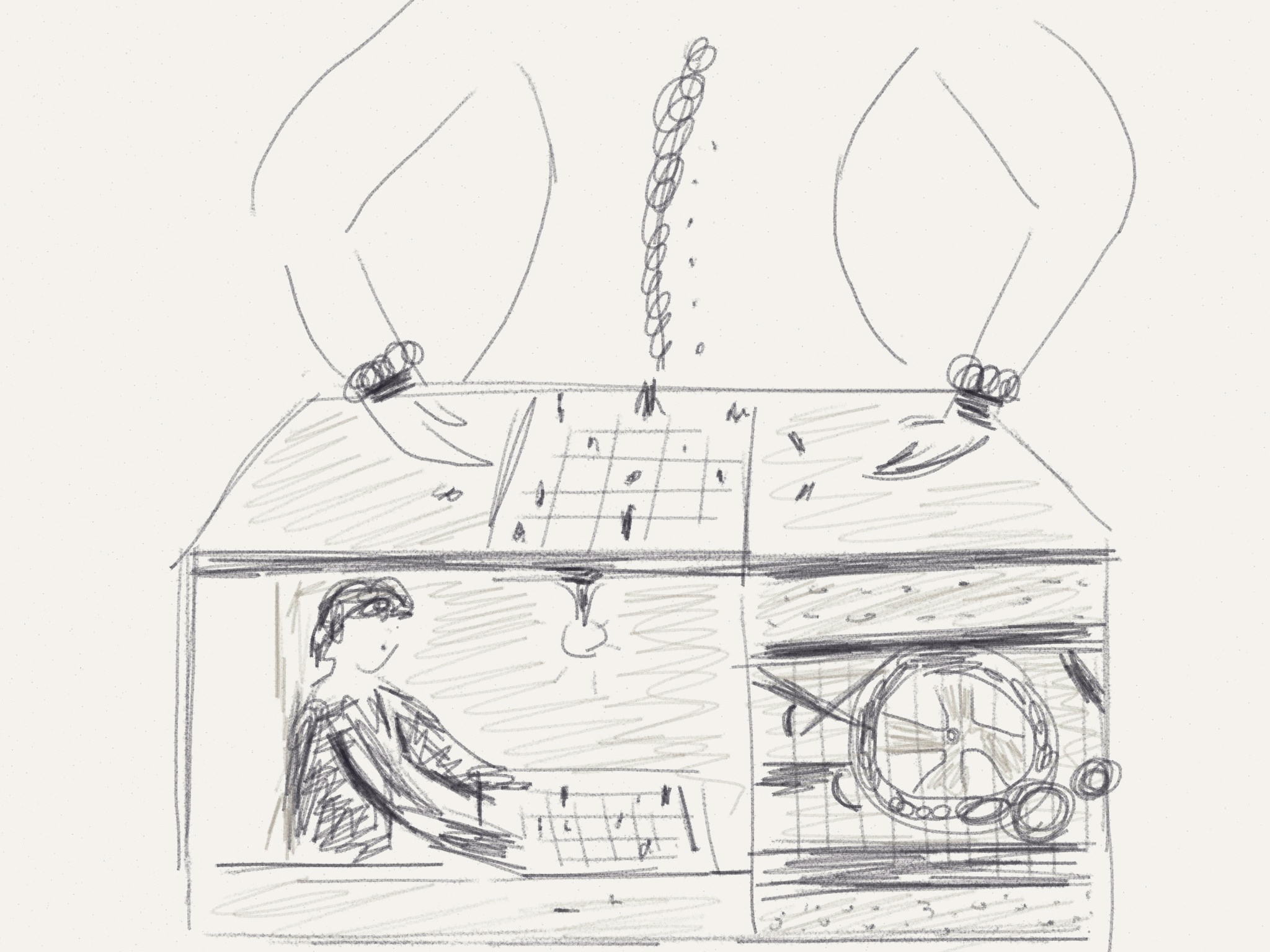
One of my favorite metaphors for humanistic inquiry is “unpacking.” Sometimes it feels like an over-full suite case springing open, scattering previously unseen clothing and toiletries all over the place and revealing that present that grandma brought for you nestled there in the center. Sometimes it feels like carefully and laboriously picking the infinitely delicate locks on a briefcase, not knowing if what you’ll find inside will be precious or just some long-forgotten trash.
Unpacking means finding and reveling in richness and awe-inspring reality. Facility with unpacking is a tantalizing scholarly goal.
Little wonder, then, that my students balk a bit when I force them away from that goal. During one session where the professor and I were trying to get students to plot the interrelationships of some articles by finding their commonalities (either topic or approach or theoretical underpinnings), one student complained that “it seems like we’re reducing these articles down to their least interesting, most simplistic components.”
And we were, in a way. We were doing the opposite of unpacking. We were packing them carefully into suitcases, shirts on one side and pants on another, with no thought to the color, weave, or provenance of the individual pieces.
Focal Flexibility – by Iris Jastram
It hadn’t occurred to me before that moment how important focal flexibility is — the ability to see a given work in all its richness and unpackable complexity, and also see it as one of a constellation of other works — to be able to plot it dispassionately amongst its peers, and also gaze at its internal universes.
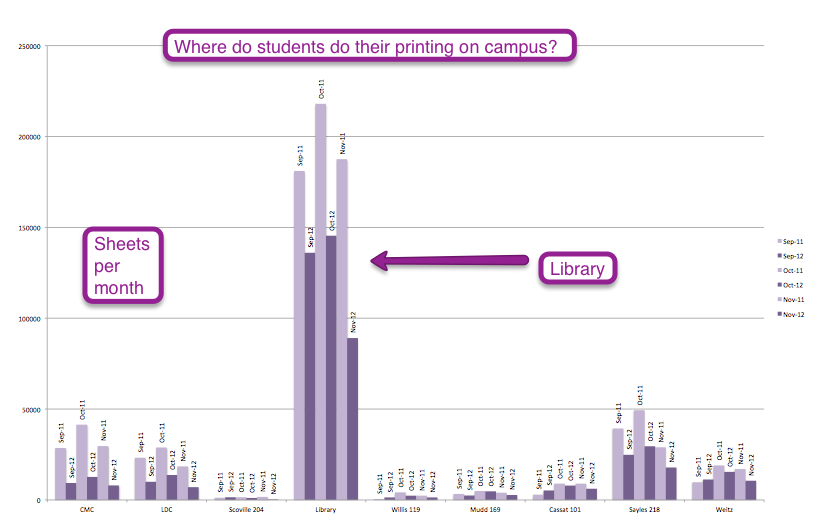
The care and feeding of the library’s public printers takes a lot of our time, both in the library and in ITS. We have a special load-balancing set-up designed to keep individual printers from melting or going up in smoke. We have students who devote the bulk of their time to watching over the printers and emptying case after case of paper into them. A good portion of the meetings I attend and lead have printing somewhere on the agenda. Basically, printing is a big deal.
And now there are graphs to prove it.
There’s a lot of extraneous information in that chart for my purposes since it’s lifted from another report on Fall term printing. But I think the GIGANTIC MOUNTAIN OF PRINTED SHEETS in the middle pretty much speaks for itself.
Where do students print on campus? In the library, that’s where
(p.s. If you’re curious, that’s about 5,300 pages every day of the term, or about 7 pages every minute the library is open, which was a 36% reduction over last year.)
This morning I got an email from a librarian wondering what kinds of concepts I teach, particularly in 300-level courses, beyond how to search. As it turns out, that’s something I think about a lot! Here is what I wrote:
Well, I’m not sure I have much to add that isn’t on my blog already, so I’ll include a bunch of links here, but contextualize them a bit. And probably the closest I can come to telling you about 300-level courses is a four-part post on highest level course I teach before their thesis. Another class that I’ve written up is Critical Methods. These are both for the English department, but I’ve done very similar things for American Studies and languages. The concepts are pretty flexible, and I’m coming to think of them as some of the core info lit concepts for most non-laboratory research. They probably aren’t the ONLY concepts, but they may give you some ideas. Essentially, I have come to think of Information Literacy as being highly related to rhetoric, where the point is to participate as an expert insider within a discourse community, using evidence that makes sense within that community in ways that resonate with the community in order to add to the community’s understanding in some way.
Also, a concept that I flesh out and emphasize differently depending on the level (but which I teach more and more often due to the feedback I get and the researchwe’ve done) is a circular research process that appears in the middle of this post.
With upper level courses I emphasize that there is a ton of actual reading involved because they’re developing a sense of the scholarly conversation, mapping in out (here’s where mindmapping can come in), feeling out its boundaries, and learning its vocabulary. Sometimes we practice what I call Instrumental Reading and what Booth breaks down into three types of reading (in his Craft of Research, pages 91-96 of the 2003 edition).
And finally, I should say that I teach an awful lot about searching, but I frame it as if I’m not teaching searching, but teaching something more conceptual. Boolean and limiters and all those things come up with the examples we do together in class or examples I’m showing when I’m actually teaching them something else, and I’ll digress briefly to make sure everyone understands why I just wrote OR there before moving on. I say this just because when I first started moving away from “how to” teaching I felt guilty whenever I ended up showing those things, but now I think it’s the best way. The “how to” serves the higher order concepts, and they need both.
So that’s where I am right now in my teaching. I didn’t arrive here all at once, and I hope I’ll keep evolving and learning how to teach because there are a whole lot of rough edges yet. But for me it has been liberating and satisfying to think more and more about information literacy’s relationship to rhetoric and about the deep concepts that interest ME about information literacy. If I’m interested in what I’m teaching, I have a much better chance of interesting my students, and a FAR better chance of feeling fulfilled in my work.
~Iris
And since I’m a librarian at heart, here is a bibliography of my current favorite/formative readings on the topic.
Bean, John. Engaging Ideas. 2nd ed. San Francisco: Jossey-Bass, 2011.
Bennett, Scott. “Libraries and Learning: A History of Paradigm Change.” Portal: Libraries and the Academy 9, no. 2 (2009): 181–197.
Bizup, Joseph. “BEAM: A Rhetorical Vocabulary for Teaching Research-Based Writing.” Rhetoric Review 27, no. 1 (January 4, 2008): 72–86.
Elmborg, James. “Critical Information Literacy: Implications for Instructional Practice.” Journal of Academic Librarianship 32, no. 2 (2006): 192–199.
Elmborg, James K. “Libraries in the Contact Zone: On the Creation of Educational Space.” English 46, no. 1 (2006): 56–64.
Fister, Barbara. “Teaching the Rhetorical Dimensions of Research.” Research Strategies 11, no. 4 (1993): 211–219.
Harris, Joseph. Rewriting: How to Do Things with Texts. Logan: Utah State University Press, 2006.
Head, Alison J. Learning Curve: How College Graduates Solve Information Problems Once They Join the Workplace, 2012. http://projectinfolit.org/pdfs/PIL_fall2012_workplaceStudy_FullReport.pdf.
Kapitzke, Cushla. “Information Literacy : A Review and Poststructural Critique.” Australian Journal of Language and Literacy no. July (2001).
Kruger, Justin, and David Dunning. “Unskilled and Unaware of It: How Difficulties in Recognizing One’s Own Incompetence Lead to Inflated Self-assessments.” Journal of Personality and Social Psychology 77, no. 6 (1999): 1121–1134.
Leckie, Gloria J. “Desperately Seeking Citations: Uncovering Faculty Assumptions About the Undergraduate Research.” Journal of Academic Librarianship 22, no. 3 (1996): 201.
Lloyd, Annemaree. Information Literacy Landscapes: Information Literacy in Education, Workplace, and Everyday Contexts. Oxford: Chandos Publishing, 2010.
Norgaard, Rolf. “Writing Information Literacy in the Classroom: Pedagogical Enactments and Implications.” Reference and User Services Quarterly 43, no. 3 (2004): 220–226.
———. “Writing Information Literacy: Contributions to a Concept.” Reference and User Services Quarterly 43, no. 2 (2003): 124–130.
Oakleaf, Megan. The Value of Academic Libraries: A Comprehensive Research Review and Report. Review Literature And Arts Of The Americas. Chicago, 2010.
Saunders, Laura. “The Future of Information Literacy in Academic Libraries : A Delphi Study.” Portal: Libraries and the Academy 9, no. 1 (2009): 99–114.
Shannon, Claude E., and Warren Weaver. “Communication Problems at Level A.” In Mathematical Theory of Communication, 9–12. U of Illinois P, n.d.
Simmons, Michelle Holschuh. “Librarians as Disciplinary Discourse Mediators: Using Genre Theory to Move Toward Critical Information Literacy.” Portal: Libraries and the Academy 5, no. 3 (2005): 297–311.
Wiggins, Grant P. Assessing Student Performance. Vol. 15. San Francisco: Jossey-Bass Publishers, 1993.