Skip to content

Category: Libraries and Librarians

An ebook plan by Iris Jastram and Steve Lawson

Reposted from 5/9/2011*

For obvious reasons, we have been thinking about ebooks recently. We thought that the new HarperCollins policy of setting an arbitrary limit of 26 checkouts was absurd. Librarians have lost no time in pointing out just how absurd it is, showing that most books can withstand scores or even hundreds of circulations without wearing out.

But that can be a dangerous argument to make. Twenty-six circulations is unacceptable, but you say some books can go for a hundred circulations? So it should be fine if HarperCollins sets a 100 checkout limit, right? Honestly, this is not the conversation we want to have. The problem is not that the number of circulations set by the publisher is too small; the problem is that no publisher should be able to control these aspects–really any aspects–of the library’s workings.

Many librarians say they want the library to own the ebook, not simply lease or license it from the publisher. If we are to do this, we need to recognize that it’s hard to own something that lives on a for-profit corporation’s servers, whether that corporation be the publisher or Overdrive or some other vendor. Yes, there are publishers who currently sell ebook or ejournal content outright, but how many of us host those books on our own servers? If those companies went under, how long would it take us to get access for our users up and running again? Libraries cannot afford to enter into licenses that leave publishers and vendors holding all the cards. How many books in an average library are out of print, or printed by publishers that no longer exist? We believe that the publisher should publish, and the library should own, lend, and preserve.

We also understand that most libraries aren’t interested in creating their own digital “stacks” to hold all the files that make up their ebook collections. For those libraries–probably most libraries–ebook files could be hosted by a trusted not-for-profit service. The important thing is that the books would be hosted by the library or by a site or service that is working for the library, not for a publisher or vendor.

Neither of us love the current state of copyright in the United States. We believe that copyright lasts too long, protects the rights of the creator way out of proportion to the rights of the user, and leads people to limit their uses of copyrighted material far more than necessary. The solution, however, is not even more restrictive licenses. We envision a system, like the one under which paper books are bought and sold today, that does not depend on licenses. Instead, publishers would have recourse to the same protection they have had for years: copyright.

Lastly, we think that publishers have a right and a reason to be scared that libraries lending ebooks will lead to rampant and uncontrolled unauthorized copying. (And even if we didn’t believe it, it seems that they are, and it seems that we need to address that.) Accordingly, we think there is a place for digital rights management technology (DRM) to keep users from casually making unauthorized copies of ebooks. However, this, too, we believe needs to be under the control of libraries. Libraries will be likely to use the least DRM necessary to accomplish the goal of preventing unauthorized copies–in fact, it wouldn’t “manage” “digital rights,” it would simply be copy protection. Patrons could trust that there would be no library “rootkits” on library-loaned ebooks. The current state of DRM for library loans is incoherent and confusing for librarians and patrons alike. Imagine having separate loan and photocopying policies for the different print books in a library’s collection.

Phew.

Those are our main ideas. The result is a plan for libraries to buy, lend, and preserve ebooks which looks like this:

  • Libraries will purchase e books from publishers or other sources. Libraries will not license ebooks.
  • Licenses are not necessary. The entire process will be based on copyright. The publishers’ control over the ebook ends the moment it is sold to the library. This does not mean that the publisher loses the same rights it has today to sue for copyright infringement and damages.
  • Most libraries will employ a third party to be responsible for both access to and preservation of ebooks. Some libraries–probably very large public libraries or research libraries–may prefer to go it alone rather than contracting with such a service. In either case, the entity that actually keeps the files, the loan policies, the patron information, and so on, is either the library or a group working only for the library, and not for a publisher or vendor.
  • Most libraries will choose to add DRM to ebooks in the form of copy protection in order to satisfy publishers’ desires not to see unauthorized copies proliferate. Copy protection that is acceptable to libraries will be largely invisible, platform-independent, and will serve only to prevent the creation of additional complete unauthorized copies.
  • Copy protection must not interfere with readers’ rights to fair use.
  • Copy protection will never be applied by the publisher, but by the library, or by a third party hosting the ebooks under contract from the library. When dealing with paper books, we don’t allow each publisher to determine different check-out and photocopying policies for each book. We set a single policy to encourage copyright compliance for all books in the collection.

We can’t pretend this is the final word on ebooks; we aren’t even sure we are the first to propose such an idea. We know that embracing copy protection–however limited, however under library control–will be unacceptable to some librarians and activists. While we have tried to look at things from the publishers’ point of view, we realize they might find a plan such as this to be laughable.

This plan isn’t perfect. But we think it’s progress.

[Thanks to Marianne Aldrich for suggesting that it is “copy protection” rather than “digital rights management” that we are talking about.]

*Originally published on March 9th, 2011 over on Steve Lawson’s blog, See Also. Since that blog is now gone, I’m republishing the post here.
2 Comments

THATcamp Denver Takeaways

I’ve been watching blog posts trickle out of THATcamps for years, and this fall I finally got a chance to attend one. As luck would have it, just as Carleton signed onto a Mellon Digital Humanities planning grant with Macalester and St. Olaf, a THATcamp popped up focused specifically on Digital Humanities and Libraries.

What a rich experience. It was populated by such a range of participants: people from large research universities, university presses, centers for digital humanities, OCLC research, major digital libraries, regular old librarians like me, and some disciplinary faculty, and some graduate students. It was a great opportunity to hear from people who are a few years ahead of where we are, to hear what questions they have now, what confusions exist that maybe we can head off before they become issues here, what workflows they’ve arrived at, what kinds of projects may be coming down the pike.

It was also an exhausting experience because the whole time I had to listen not so much to what, exactly, people were saying (since that was usually mostly irrelevant to me) but to patterns underlying the conversations: what kinds of services do institutions provide, are people mostly working in teams or alone, are the teams institutionalized or ad hoc, how do they negotiate the class differences between disciplinary faculty and library or IT partners, where do student research assistants fit into current work, what terminology do people use and where do confusions in terms exist… So many things to listen for and translate into my own context. And often I’d realize that information I’d dismissed earlier as totally irrelevant to me suddenly fit into a new pattern I was noticing, so by the end of the day I was pretty fried.

So what were some of the things that stood out as interesting or important themes or patterns? Well…

Have a Process — Allow for Exceptions

One session was about libraries becoming more involved as publishers since they often house the tools or manage the preservation and access to digital humanities projects. In my case, those tools would probably come from our IT department rather than the library. It was still really interesting, though, to hear the conversation slowly gravitate toward the consensus that in an ideal world institutions would have both a formal publication/preservation process and then also a sort of sandbox publishing process. This second process would accommodate projects that didn’t fit well into the formal containers (journals, books, wikis) or that couldn’t be evaluated in the same way prior to publication (peer review, for example). As one person said, often you have to build a thing before you know if it’s going to be worth anything, so the before-hand evaluation for publication process is largely impossible in these cases.

And in fact this became one of the major themes of the day for me. It seems that in order to support digital humanities projects, the goal is always to have the project based in tools, support structures, and data that are already present and ready for that kind of project. But there are also a lot of projects that simply won’t fit into existing structures, and so many programs provided capacity to work on these “boutique” projects. One woman had a phrase I really liked, saying that she looked at these as “first of a kind projects, rather than one of a kind projects.” The idea is to use these boutique projects to develop tools or services that the become part of the standard suite of support options, therefore taking less effort the next time.

Collaboration is Difficult and Necessary

This has been a theme not just of this gathering, but of every digital-humanities-related gathering I’ve attended or heard of. One humanist at St. Olaf said point blank that the humanities have traditionally been a realm of solo work so humanists don’t really know how to play well with others. They lose control of the process, the timeline, and the outcome, and the conclusions aren’t necessarily fully their own. Another humanist at a conference hosted this fall at Carleton spoke bluntly about how this “go it alone” attitude can easily translated into almost a master/servant relationship when collaborations mix faculty and staff because this relationship fits more easily into disciplinary practices that privilege solo work. “This is my project. Please make this thing happen in the way I want.”

Library Disciplinarity

While I was at THATcamp, I started thinking that one way to think about these projects so that they maintained their collaborative nature would be to think of it almost as interdisciplinary work, where the library is a discipline more than it is a service. The library has hundreds of years of disciplinary experience with finding, organizing, using, preserving, and making accessible digital and physical items. We study the rich complexity of the interstitial spaces between discrete pieces of instantiated knowledge. We study the socio-cultural practices that develop in these spaces and that draw dynamic connections between the items. To think of ourselves as “just” a service organization is to sell ourselves short and to relegate ourselves to perpetual outsiders in these ideally collaborative pursuits.

For this reason, I also really appreciated the ways that some institutions have “Digital Scholarship” programs rather than “Digital Humanities” programs. From the CS and Library perspectives, we bring very similar portions of our disciplinary training to projects from the Humanities and the Social Sciences, so there is really no need to have separate programs to support the various disciplines. (No need, that is, after the humanities have had a chance to acclimatize themselves to this new realm of scholarship. I can absolutely see how having dedicated energies directed to the humanities is important when first getting digital humanities off the ground.)

Some Practicalities

People at THATcamp were justifiably concerned about the sustainability and scalability of their programs. Some had decided that they would provide consulting support only or that they would cap the number of active digital humanities projects they could support at any given time (with a wait list for people once an active project graduated or died). Several found that they were in high demand to help scholars develop data management plans now that humanities scholars were applying for grants that require those, and that this had been an unanticipated and heavy demand on their time. And other libraries pointed out that rather than being all things to all projects, they would specialize — so Library A might specialize in text analysis and Library B might specialize in GIS applications for humanities. Most make use of graduate student work (we intend to employ undergraduates here).

It also became clear that initial conversations in the planning stages for a project should include some discussion of how permanent the end result is intended to be. Is this something closer to an item in our “circulating collection” that can be weeded when use dwindles and space gets tight? Or is this more like an item in “special collections” that requires greater commitment to long-term care? Who will be responsible for the server space and upgrades? Who is the intended audience and how will we get it to them? If it is interactive, how much of a change log should be available, and how much control do we exert over the kind and type of interactivity? Questions like this are not just procedural, it turns out, but can actually shape the project itself on a fundamental level.

And finally, it turns out that most projects need (but do not have) good graphic design. This is especially important for projects that involve crowdsourcing. And if you’re after interactivity, you’d best have thought about how to get people to participate (I’m reminded of Riedl’s research for this problem).

Leave a Comment

Becoming a Linguistics Librarian

When I started here I had degrees in English and a degree in Library and Information Science. But I was also the librarian for languages, music, linguistics, and American Studies. A while ago I wrote about important things I learned about being a music librarian (part 1 and part 2), and about being a librarian for language departments. Well, for the last week or so, I’ve been sitting in on a linguistics class, and over the last year or so I’ve been working more closely with their upper division classes, and here are a few things I’ve learned in the process.

The Field

From the perspective of the interested outsider and the helper of undergraduates, the field is easiest for me to think of if I liken each branch of it to other fields. So there are the neuroscience-linguists, and the psychologist-linguists, and the sociologist-linguists. And lo and behold, that helps when picking databases and search terms. Happy librarian! PsycINFO and Sociological Abstracts can come in really handy to flesh out the Primary Duo (i.e. Linguistics & Language Behavior Abstracts and the MLA International Bibliography).

Linguistic Data

Linguists talk all the time about data and about datasets. When they do this, they mean “example sentences” or “example sounds.” So a grammar of Turkish is full of data on the Turkish language (which is distinct from a book on the grammar of Turkish, which may or may not be all that full of data). So if students want data on Turkish, I’d look for a grammar, I’d look for articles on a particular construction or sound in Turkish, and I’d look for researcher websites (using the “site:.edu” limiter in google, usually) where researchers put up their linguistic datasets.

If I were going after a much lesser known/studied language, SIL and researcher websites are probably the best bet. I find SIL’s website hard to navigate, so I search it using Google.

If there’s “nothing on my topic” I’d use Ethnologue and find related languages and see if they can be useful by analogy.

Currency Oddity

Linguistics is odd in that some of the sources need to be very current indeed, particularly the parts having to do with brain science. Meanwhile, other parts of the field rely heavily on books that are 50, 60, or 80 years old. Typically, complete descriptions of languages are only done once and then amended in the literature, so it shouldn’t be very surprising if the primary source of primary data comes from a well worn book written by some African explorer in the 1920s.

Navigating the Jargon (with undergrads)

Linguistics is jargon-heavy. I often can’t even make out the wikipedia articles on the topics I’m supporting. But just like being a librarian for foreign languages, this is a good reminder for me to keep my consultations highly collaborative with the student. They supply the terms, I suggest ways to come up with terms (“what kind of a thing is a genitive? a Case? Ok, so what if we look for Russian cases if we’re not finding what we want when searching for Russian Genitives?”). They interpret the results while I give them pointers about categories of things to watch for in the results.

Jargon is also your friend because it makes keyword searching so much easier than in the humanities. “Ergative-Absolutive” is far more likely to return accurate results than “performance of self” regardless of my level of understanding.

My next steps

I’ve been pretty happy with my research guide for Linguistics, and they’ve said that it’s very useful. But now that I’ve sat in on a couple of class sessions I think I’ll add a tab on gathering linguistic data. And if I can, I’ll try to sit in on some different classes next term.

4 Comments

MindMapping for Research

It’s the beginning of a new academic year, and this year’s thesis students are starting to come see me in panicked waves. The meetings are intense and exciting and full of possibility and fear and anticipation. Right now we’re mostly trying to come up with a Plan rather than specific sources. Given your interests and given the kinds of resources we each know of, what would be both stimulating and researchable here and now.*

Lately, I’ve been mentioning mindmapping more and more often as students wonder how to figure out if they’re original enough, or how to figure out if they’ve created a stable enough grounding in the relevant literature. I teach it sometimes as a way to build good searches with useful terms, but this is different. Sometimes the student has a clear question in mind, and we can draw in supporting bodies of research. Sometimes the student doesn’t have a clear question in mind yet, and we can draw in the supporting topics first — the things where they say “I’m kind of interested in x and y and want to see if they’re connected with z,” and then fill in the spaces between the topics to find the question.

After a session this morning, I’ve realized that I teach four distinct forms of mindmapping to move students from the very preliminary topic questing through to the production of the final product.

Types of mapping

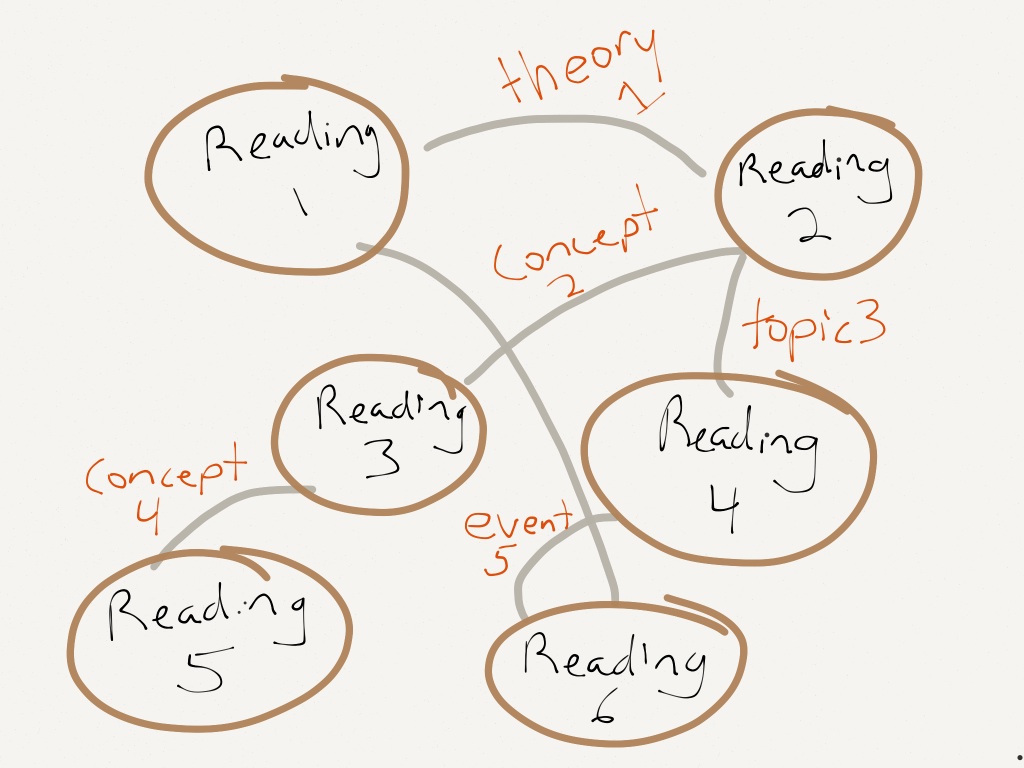
1) Mapping sources to find concepts (early stage of work)

For the early stages in topic selection, students often have vague ideas about topics but haven’t yet come to a point where they’re able to say what piece of the topic they’re going to concentrate on. They know they want to do something with the implications of fictional characters’ names, for example, but haven’t really figured out exactly what about the names to pursue or maybe even what fiction to use as foundational examples. But they’re really interested in race and culture, and they know that fictional characters have names chosen for them by authors, so there’s got to be something they can do that combines the two.

For this, some students find it very helpful to keep their broad topic in mind while reading/skimming several readings. Each reading becomes a node, potentially related to other readings, but not necessarily. The students can then draw connections between readings, using this process to discover the concepts that may be key to their own work.

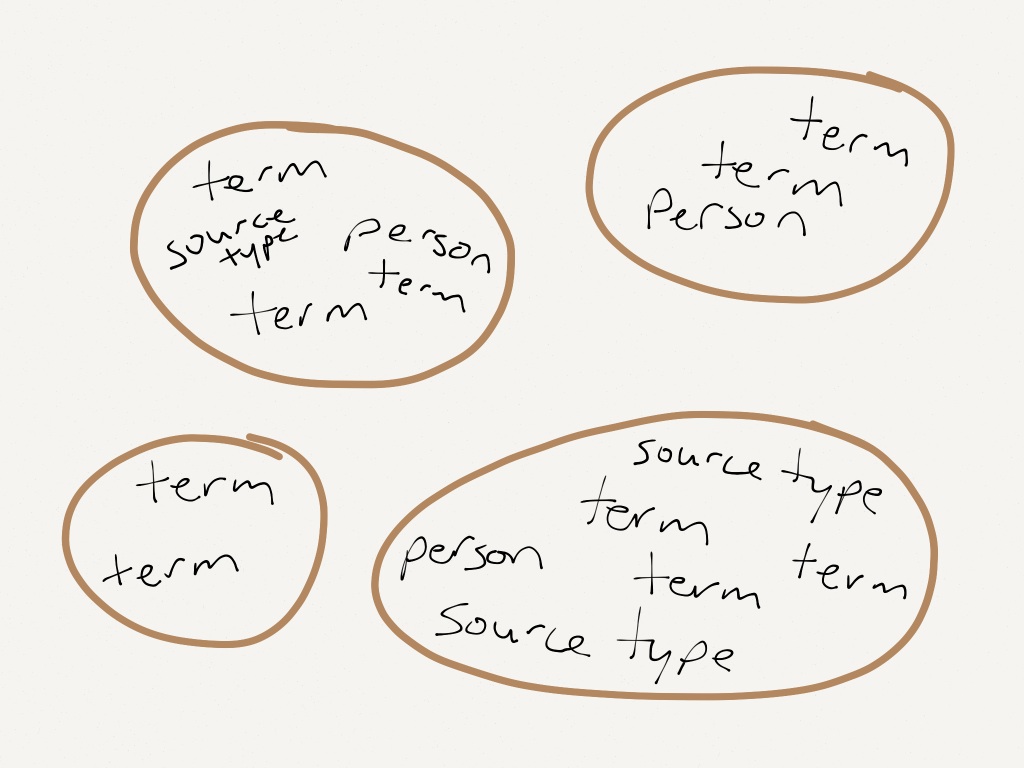
2) Collecting search terms and source type strategies

Another tricky part of early stage research, particularly in the humanities, is learning the vocabulary of your topic and learning what counts as evidence to the community of inquiry that you’re planning to enter. Unless you do these things, searching can be pretty impossible since it’s just term matching. If you’re using “self-concept” and your community of inquiry is using “identity” you’ll never retrieve the sources you need.

Similarly, if you produce an argument based on evidence that your community scoffs at, or if you need ideas for what kinds of sources would help you make explore your topic, watching what kinds of evidence show up in the literature can be a great strategy.

And of course, following up on people or institutions mentioned in the literature is another great way to build future searches based on readings you’ve found.

So for this kind of map, I have students think about their major concepts, and then fill in those concepts with terms, source type ideas, and people/institutions associated with that concept. These all become fodder for future searches.

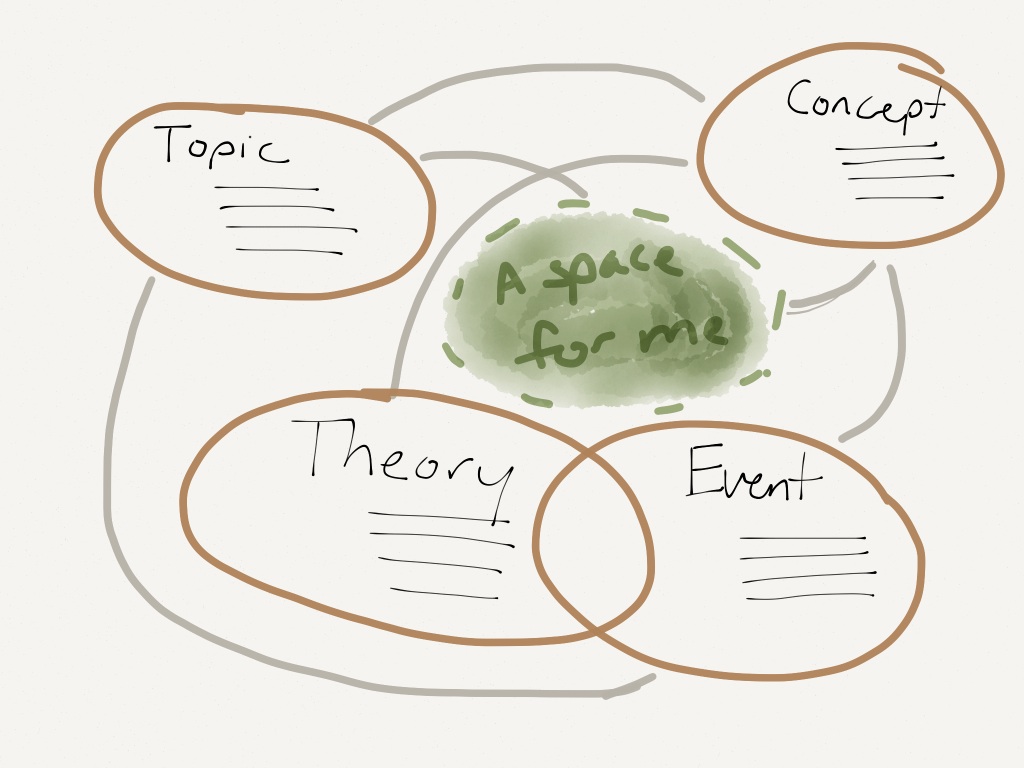
3) Mapping concepts to find your own question

Once students have solidified the core concepts of their work a bit more, they still need to figure out how to assimilate the source material into something that original rather than duplicating others’ work or simply patching together quotes from here and there. For this, a pretty traditional mindmap can help.

I have students plot out their key concepts and list the key sources for each concept (for students to did option 1, these can often be the labels they assigned to the connecting lines between sources — in fact, the whole map is like the inverse of option 1). This time we pay close attention to the spaces between concepts. Students can then see what has and what has not been covered by their source material and figure out what they’re adding to the conversation. “People have covered x, y, and z, but I’m going to take these parts of what they have said and add this new idea.”

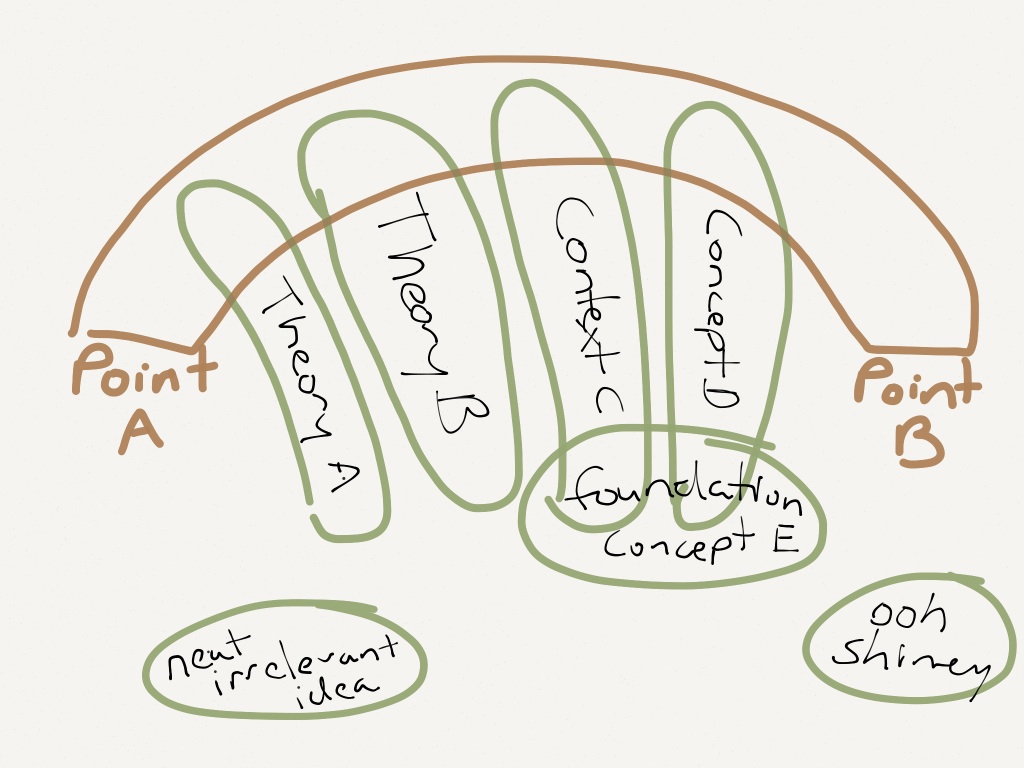
4) Mapping to test the completeness of your evidence

And finally, for students who are thinking critically about their work and want to be sure they’ve made a rock-solid case for their position, I have them think about building a bridge between themselves and their readers. Their paper is supposed to walk their readers from Belief A (the reader’s start point) to Belief B (what the student hopes the reader will believe after reading the paper). We start thinking “Well, they’d have to be on board with the assumption that x, and know about y event…”

Each of these concepts contributes a bit of itself to the students’ goals, forming one of the planks in the bridge the student is building.

It’s also a way to think about potentially interesting ideas that aren’t actually necessary to the paper.

Tools I use

Generally, if I’m working with students in a class setting or in my office, we do one of these types of mindmaps and we do it using whiteboards. Low-tech and potentially messy, but it gets the point across.

For myself and my own thinking, I do this kind of thing on paper if I’m thinking on the fly or if I’m not intending to use it as the basis for a long-term project. It’s faster and there’s something helpful in the tactile and kinesthetic activity itself — the sketchiness. (Now that I’m getting used to drawing on my iPad, I can imagine the pencil/paper version moving to the iPad from now on. Incidentally, I did the sample maps for this post using the iPad.)

If I’m doing a long project (where I know the map will get pretty big and where I’ll probably be rearranging nodes as my thinking becomes more nuanced and clearer), I use MindNode.

* Over the years, these meetings have grown from being (literally) introductions to the catalog and one major database in their field to being highly collaborative sessions where each of us brings our own expertise to the project of finding an interesting, original, and researchable topic. What a relief! There was nothing more demoralizing than covering such basics with thesis students.

3 Comments

ENGL 395: Latin@Bodies on the (Poetry) Line [session 4]

You’ve made it to the final installment of this four-part Information Literacy curriculum that I’ve used now, with some content tweaks, in two senior seminars in two different departments. Both times, it resulted in far more productive one-on-one meetings between me and the students, and both times that faculty members said that they thought it paid off for them as well. For me, the research consultations I had with students from these classes felt far more collaborative, far more like the students were bringing their own subject expertise to the table and their own critical thinking and problem solving. They had almost always done more preparation and solo work before seeking me out, but had made good choices about coming to see me before wasting a whole bunch of time and getting overly frustrated with their work. And in both cases, the students greeted me cheerfully in hallways and the students center, updating me on their progress and generally behaving as if I was a trusted and welcome partner in their disciplinary work.

I will definitely keep working to integrate similar information literacy interventions in as many departments as I can. Granted, scheduling 4 sessions can seem daunting, but I have found multiple sessions alleviate many of the time-consuming and frustrating aspects of research support, making the scheduling a wonderful investment in a happier and more productive term for me.

Here, one last time, is the over view of the whole mini-curriculum:

  1. Presearch — identifying and preparing to join scholarly conversations
  2. Bibliography as an intellectual product
  3. The Literature Review — mapping your scholarly conversation
  4. Creativity in Constraint (You Are Here)

Session 4: Creativity in Constraint (10 minutes, generously)

This was my final chance to meet the group as a whole. They were getting ready to write their papers, and we had already showed them ways that the nearly unlimited sources can be relevant to their work. But we didn’t want to leave them with the paralysis of topics that were too massive or that tried to account for too many branchings in the literature. We wanted them to once again see their work as creative and intellectual work over which they have authority.

After taking a few minutes to get a sense for how they were feeling about their progress and if there were any questions they had for me, I talked briefly about the glories and challenges of creativity in constraint. This is a phrase I picked up from Eric Celeste, who comes back to that theme over and over in his writing. And for upper division students especially, it seems to be a concept that helps them move past the temptation to summarize everything rather than make a focused contribution in one area.

I talk about cropping photographs, and how the images gesture toward vast amounts of information that are left out of the frame, but that viewers can easily imagine. Similarly, papers gesture towards whole swaths of the literature that they don’t deal with directly. And that isn’t a sign of weakness — of not managing to fit everything in. Rather it’s a sign of careful decision making, of thinking “what do my readers most need to focus on and what can they fill in for themselves” and “what do I most want them to see that they may not have seen in this way before.”

And with that, I renew my invitation to come visit me in my office as they finish up their papers.

3 Comments

ENGL 395: Latin@Bodies on the (Poetry) Line [session 3]

As I mentioned earlier, last spring an English professor and I repeated an experiment that I’d conducted with American Studies juniors the year before, wherein we integrated information literacy concepts into several key points in their seminar. In each case, I met with the students 4 times, sometimes for as little as 10 or 15 minutes, and sometimes as long as the full class period. In every case, I worked with the students on concepts that were simultaneously part of an advanced information literacy “curriculum” of sorts as well as timed to help them accomplish an upcoming assignment.

Here’s the overview:

  1. Presearch — identifying and preparing to join scholarly conversations
  2. Bibliography as an intellectual product
  3. The Literature Review — mapping your scholarly conversation (You Are Here)
  4. Creativity in Constraint

Session 3: The Literature Review

In talking about this session with the professor beforehand, she stressed that she wanted the students to “see their own authority” within the scholarly conversation. We were building on the theme of bibliographies being more than just lists and hoping to move the students toward thinking about the function of sources in scholarly work. Sources that function as background, evidence, arguments from other scholars writing on the same topic, and methodological/theoretical foundations.*

The previous week, the professor had asked students to bring in outside reading that complemented or augmented their understandings of the poetry they were reading that week, and she’d been pretty disappointed with the results. We had hoped to push students beyond finding things “on my topic” toward finding things that had intellectual and thematic resonance with their poetry, especially since there’s just not a whole lot of criticism out there that’s specifically about the poetry they were reading.

Based on that experience, she and I decided to ask them to try again and bring an article with them to class that was not about the assigned poetry, but that helped illuminate some key aspect of the poetry. She and I would guide them through mapping their supplemental readings to each other and to the poetry on the big blackboards in the classroom to help the students imagine how readings could be related when they weren’t about the same thing, and then we’d move from there to talking about the various levels on which the sources functioned and how they might function in a literature review.

Thematic Mapping (1 hour)

We started well enough, reading an article together that the professor had assigned for that day, talking through the article in fairly standard ways, and also talking through the kinds of sources the author invoked, and the functions that those sources played in her argument. Some sources were just barely related in topic, but contributed theoretical approaches that the author could apply, or arguments that applied by analogy. Other sources were clearly directly related to the poetry the author was writing about.

Then we transitioned to the exercise using the articles the students had found and brought to class.

Things were a little shaky at first. The students first seemed confused by and then resistant to the exercise of mapping their articles to one another. We asked them to write their article’s citation on the board and then list underneath it several key themes that it helped illuminate (things like “body,” “Other,” “self,” “national identity” etc, were some of the broad themes that the poetry dealt with, for example). Then we could start drawing connecting (literally) between the articles using these themes as connection points, even when the articles were about drastically different specific topics. All along, we tried to draw the students out a bit, getting them to talk through how other students’ articles augmented their readings of their own articles, and how the growing collection of sources they were creating all helped illuminate aspects of the poetry.

The push-back was fascinating. One student, after making skeptical noises for some time, finally articulated what she didn’t like about the process. She said, “It seems like we’re reducing these articles down to their least interesting, most simplistic components.” This, it seemed to her, was the opposite of what they should rightly be doing in a college class. It’s in many ways the opposite of everything English Lit majors are all about — unpacking, reading between the lines, finding the subtext. This was packing, skimming the lines, and hanging as many articles from the same category marker as we could.

Another student countered that no, this was something she really needed — some discussion of how to read on multiple levels at once, simultaneously unpacking and packing, as it were. And this started a conversation between all of us (including the professor and myself) about the multiple levels of reading that go into literary criticism, and particularly criticism that draws on other criticism or theory.

The Literature Review (half an hour)

The second part of the class was far more straight forward. We talked about how literature reviews look in other fields (often as a somewhat stand-alone thing) and how in the humanities, the epistemology is all based on a conversation paradigm, so literature reviews mirror this by integrating sources throughout the paper rather dealing with them primarily in one discrete section.

We talked about how the literature can function in a variety of ways (again riffing loosely off of Bizup’s BEAM model). It also performs a variety of services to the readers of the finished writing, allowing readers to use one text as a jumping-off point into related areas, lending credibility, and mapping out common ground between the writer and the reader (as if the writer is saying, “You know Foucault, and I know Foucault, so let me skip through all the summarizing and just point out why I think his work is important to what I’m saying, which will help you understand what I’m saying, and also signal that I’m not just pulling this idea from nowhere”).

* This is the BEAM model articulated in Bizup, Joseph. “BEAM: A Rhetorical Vocabulary for Teaching Research-Based Writing.” Rhetoric Review 27.1 (2008): 72-86.

3 Comments

ENGL 395: Latin@Bodies on the (Poetry) Line [session 2]

As I mentioned earlier, this past term an English professor and I repeated an experiment that I’d conducted with American Studies juniors last year, wherein we integrated information literacy concepts into several key points in their seminar. By the end of the term, I met with this seminar 4 times, sometimes for as little as 10 or 15 minutes, and sometimes as long as the full class period. In every case, I worked with the students on concepts that were simultaneously part of an advanced information literacy “curriculum” of sorts as well as timed to help them accomplish an upcoming assignment.

Here’s the overview:

  1. Presearch — identifying and preparing to join scholarly conversations
  2. Bibliography as an intellectual product (Your are here)
  3. The Literature Review — mapping your scholarly conversation
  4. Creativity in Constraint

Session 2: Bibliography as an Intellectual Product

This session lasted about 15 or 20 minutes. I arrived at the beginning of the class, and participated in a discussion about readings they (and I) had done, and then transitioned into a brief discussion about bibliographies. After this session, students would be preparing an annotated bibliography as one of the initial stages working up to their final paper.

We started by looking at the bibliography in one of their readings, pulling out examples of entries there that illustrated the building blocks on which the author had built the article. Some entries gave us background information, some gave us a theoretical grounding, some pointed us to other scholars who were part of the same critical conversation about the topic.*

From there, we expanded on our notion of what bibliographies do. They are not lists, and they’re not incidental. They’re also not busy-work. Rather, they’re just as much an intellectual and rhetorical product of the author as is the prose of the argument. They map out the boundaries and the interlocutors that are part of a given scholarly conversation. They provide citations for key theoretical works that undergrads have trouble finding on their own (or knowing which will be useful for their projects). For undergrads especially, they also point toward important works that are part of the conversation but that would never come up in the search process because their titles and descriptions don’t share vocabulary (and since search is just about term matching, branching out into new vocabulary is incredibly important, particularly in the humanities where the jargon isn’t as stable or codified as it is in the sciences). “These scholars know each other,” I point out to the students. “They’ve heard each other at conferences, gone to graduate school together, talked with each other over email and Facebook… As they’re conceiving of their articles, they have all these other people’s work in their heads, so they know to cite so-and-so’s work even though there’s no shared vocabulary. Or else they know that so-and-so talks about the topic using this other vocabulary, so they can search on that vocabulary. Or else they know that so-and-so’s work on a completely different topic is relevant to their own work on this topic and can show you those connections and open up a whole new scholarly conversation to you.” This has usually never occurred undergrads. I encourage students to look at bibliographies as they would look at conversational clumps at a party — seeing who is talking to whom, then seeing what they’re saying and how they interact with each other, then joining a conversation and adding to it while referring back to the people whose points you’re expanding on or countering.

To tap into my own geekiness and the readiness of many Carleton students to revel in an honest-to-goodness intellectual geek out moment, I then pointed out that citation styles themselves, far from being arbitrary and complex hoop courses invented to make student’s hoop-jumping lives difficult, in fact reveal the epistemologies of the disciplines they serve. The styles are jargon, meant to communicate complex ideas in predictable, short, human-readable (everyone laughs) bursts of information. APA, for example, privileges dates and really only needs a primary investigator’s last name. This, speaking in generalities, reveals much about the way that science research is conducted (often a lab run by one or two stable scientists and several more temporary post-docs and research assistants, often working on sequential stages of a complex research question, publishing as they go). Providing last name and date lets readers know very quickly which major research question, and at what point along the timeline of an epistemology in which new research either test or build upon older research. MLA, on the other hand, works well for disciplines that are primarily discursive and subjective rather than sequential and objective.  It privileges peoples names and their words, and leaves dates for later primarily for people who need to know precisely what edition you were using or orient themselves in the much less granular timeline of developments in critical theory.

So, with all this in mind, the professor and I encouraged the students to see their annotated bibliographies as their chance to map out the boundaries of the conversation they’d be entering, selecting key works for theoretical foundations, background information, and the main voices in the conversation their papers will be adding to. The annotations should point out why and how each source functions in the context of their papers. And all of this will help them and their professor see the major landmarks on the emerging landscape of their topic.

* Incidentally, John Bean talks about the four kinds of sources found in bibligraphies in his book Engaging Ideas, adapting Bizup’s ideas published in Rhetoric Review in 2008. I didn’t explicitly build my work off of this at the time, but in the future I’ll work Bizup’s BEAM concept more firmly into my instruction.

Bean, John. 2011. Engaging Ideas. 2nd ed. San Francisco: Jossey-Bass. pp 236-241.

Bizup, Joseph. 2008. “BEAM: A Rhetorical Vocabulary for Teaching Research-Based Writing.” Rhetoric Review 27 (1) (January 4): 72-86.

7 Comments

Inflammatory Statement: Transliteracy is Information Literacy for latecomers

I’ve been reading and listening to the discussions about Transliteracy, and last week went to a one-day conference on the topic. And I’ve come to a conclusion. “Transliteracy” is what people who’ve been doing Bibliographic Instruction and calling it Information Literacy have started calling Information Literacy now that they’re finally on board with Information Literacy’s goals.

Generalization? Admittedly. But try as I might, I can’t see how aiming for transferable skills is any different from what we’ve been doing for years.

Here’s how I see it. Years ago, library instruction was called “Bibliographic Instruction.” Typically, when people think of Bibliographic Instruction, they think of librarians teaching students “here is how you use an index, and here are the 4 best indexes for your topic, and here is the library catalog and here are the important parts of the library catalog.” Typically, people think of it as being very much about teaching the few, finite ways to find sources.

Then about 20 years ago a bunch of us said “enough of this, let’s do Information Literacy, which is about teaching students how to recognize that they need information, find it, evaluate it, and use it well. And we want them to grapple with the politics of information production and publication, and we want them to be able to apply these skills to all kinds of tasks. We want them learn to be life-long learners!” Now, some people were more on board with this than others, so some people or institutions have really continued to do something much closer to Bibliographic Instruction while adopting the name Information Literacy. Meanwhile, other people have almost entirely dispensed with teaching specific databases and catalogs in favor of teaching concepts and processes. And, of course, there’s everything in between.

Then last year or the year before, some people coined the term Transliteracy, which focuses on transferable skills and (they say) does this rather than teaching tools. I contend, however, that Information Literacy was never primarily about teaching the tools and always about transferable skills. Telling me that I should stop doing that stuffy old Information Literacy, with its emphasis on where exactly to click in which databases, tells me that you never really understood Information Literacy in the first place. It’s not called Database Literacy for a reason, you know.

9 Comments

Librarians: confusing process for product on a regular basis

I was complaining to some friends about a propensity for articles in the scholarly literature of librarianship to include a “literature review” which mostly consists of “A search of x database on the query [insert query here] revealed y results.” As I said to my friends, THIS IS NOT A LITERATURE REVIEW. And one friend responded that this is what you do but should not be what you report. At which point something clicked for me.

A lot of what I find frustrating about some of the expectations that float across our professional lives has to do with confusing process for product. The stereotype of boring library instruction, all about exactly where to click in order to be a good researcher, is one of these. The assumption that good organization equals good customer service is another. And let’s not forget collaboration and curricular integration equalling library success.

And this thing with the literature review is incredibly tied in with issues I’ve been working through in my teaching, where “teach students about literature reviews” is partially about locating and accessing sources but a lot more about understanding why you’re even doing that in the first place and then constructing a claim that’s grounded in those sources but reaches beyond them. Quantifying results is only one of many many evaluative actions, and it’s only good for certain kinds of arguments, and even then it’s usually the least interesting and least informative option.

4 Comments
css.php