Skip to content

Category: Libraries and Librarians

The User is Not Broken

Published on Upworthy

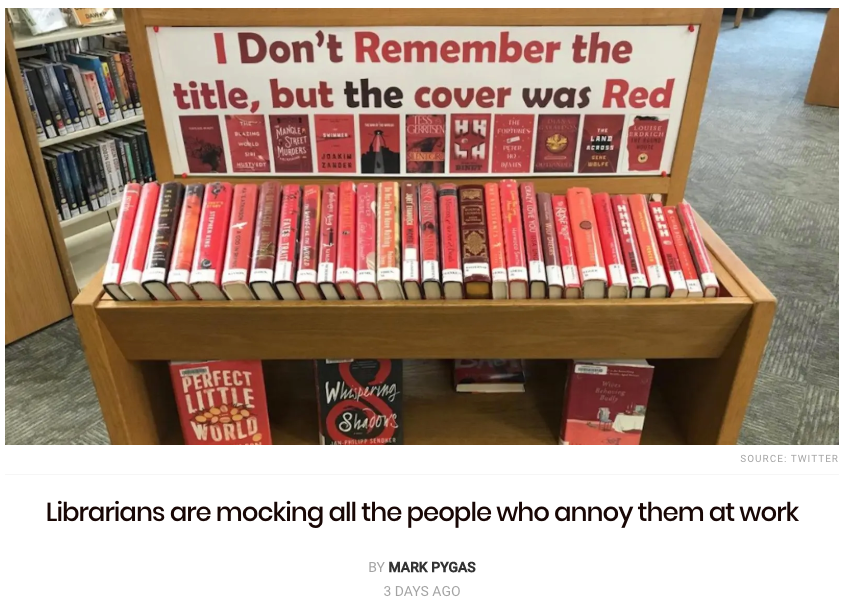
Every few years this picture makes the rounds on the internet, and every time it does the booksellers and librarians of the world nod in understanding. Public librarians and booksellers get this question day in and day out – academic librarians less so. (Most of our books in academic libraries don’t have their fancy covers on anymore, so this question would be pretty much impossible here anyway.)

Here’s the thing, though. It’s not that “people annoy us” with this question. It looks to me like there was some frustration behind this particular display, sure, and the result is wording that pokes fun at patrons in a way that makes me squirm, but that’s not the norm for people I’ve talked to. Most librarians and booksellers I’ve encountered are proud to know their collections and clients well enough to be able to match people with the books they want!

No, the thing that’s frustrating is that it’s hard for us when we can’t figure out the answer to the question (we’re very all-in on the identity of being able to answer questions), and our systems don’t let us search by cover design features. That mantra of librarianship, The User Is Not Broken, means that if we’re getting tons and tons of the same question, that means that the system isn’t set up right.

Of course, another piece of the frustration is that we often don’t have a ton of control over our search systems. Don’t get me started on the refrain from vendors about “what users want” that almost never matches what the people I work with every day ask me about… And, sure, often what people want and need aren’t technically feasible, or aren’t feasible within shrinking budgets, or aren’t feasible with reduced staff or with staff that gets less and less training.

But if we actually can’t change the systems, we can embrace the fact that we can foster humans who can say “Oh, maybe you’re thinking of this red book?” Humans are pretty incredible!

Leave a Comment

2020 Census: the demo software, data, and more on the debate about differential privacy

Since last I wrote, I’ve been able to learn more about a question that had plagued me: what of IPUMS, that unparalleled resource for census micro-data? For one thing, I was sure they must be thinking about privacy already – micro-data must be handled with care. For another, the 2020 Census “Privacy Budget” work is likely to make IPUMS’s work pretty complicated or even impossible.

Turns out, they are of course way ahead of me. Here’s their page on the topic, which also links to the Census’ released software and documentation, as well as to data available from IPUMS that researchers can use to test that software.

I also happen to know someone who works at IPUMS, and he says they’ve already been doing record swapping and injecting “noise” into their data to protect unique cases.

I certainly hope that everyone involved can figure out how to protect people’s privacy while still allowing vital research. This seems like an impossibly tangled knot to me.

Leave a Comment

It’s all coming up data

Image by Gerd Altmann from Pixabay

My roots are about as humanistic/artsy as they come. I majored in English and minored in Art. Then I got a masters in literary studies. Then I got my masters in library and information science. That last degree was first time the word “science” was part of my life in any way more substantial than checking the box next to required credits for graduation. (It took me a long time, actually, to figure out why “library science” was a pair of words that go together, but be that as it may, my official degree is Master of Library and Information Science, which sounds very scientific to me.) From there I became the Librarian for Languages and Literature here at Carleton. All my previous passions neatly packaged in a single job.

This week I’ve been thinking a lot about an almost-decade-old paper by dana boyd and Kate Crawford. “Six Povocations for Big Data” made a big impression on me back in 2011 purely because epistemology and ways of knowing are my stock in trade, and this paper felt somehow Very True to me at the time. (Plus I’d just heard dana boyd talk at a library conference and was pretty much determined to listen to anything she ever said from then on.) This week I pulled it out of my Zotero library for a refresher, and it felt even more Very True to me now.

Part of my current re-fascination with this piece is that my liaison departments have taken a decided turn toward data. It has become increasingly clear to me that a major role I can play for my new liaison department (Computer Science — hey look! a second science in my life!) is to become a Data Librarian Lite(TM). Not a huge surprise there, and something I’m greatly enjoying learning. But they’re definitely not the only department I serve that’s turning to data. I’ve gotten more and more requests for linguistics corpora (spawning a new page on my Linguistics Research Guide just this weekend). And multiple faculty in the English department are working with digital textual analysis and literature corpora.

So yes, the phrases that stood out to me 8 years ago from boyd and Crawford’s piece stood out again: “Big Data is no longer just the domain of actuaries and scientists. … Big Data creates a radical shift in how we think about research … about the constitution of knowledge, the process of research, how we should engage with information, and the nature and categorization of reality” (pages 2-3).

But then there was this gem: “Claims to objectivity and accuracy are misleading” (boyd and Crawford, page 4). That meant one thing to me in 2011, but a lot has happened since then that has made me understand this statement in new ways. First there’s all the research into bias in algorithms (e.g. Safiya Noble). Then last week there was a talk presented in the Computer Science department here about “differential privacy” and (tangentially in the talk, but centrally to my world) the 2020 census’ plan to add deliberate small inaccuracies into reported results in order to protect respondents’ privacy. So not only are claims to objectivity and accuracy misleading, but too much accuracy has become harmful enough that we’re backing away from it in key areas.

Meanwhile, as epistemologies shift and the world of research continues to remake itself, I’ll be over here learning to be a librarian who navigates the various worlds of data in addition to being a librarian who absolutely values close reading and minute observation. And I’m loving it.

Leave a Comment

Enabling, in a good way

One of the things I love about my job is that my overarching function is to make things possible. I love making things possible.

Sometimes this means pointing people toward a resource that fits their information need, but more often it means helping them think about what would make their work possible. Helping them translate their questions into the language and mechanisms of search systems and information pathways, helping them think about what part of their overwhelmingly large research question might make for a manageable project while still feeling meaningful, helping them think about what broader concepts might give context to a frustratingly specific question, validating their curiosities, validating their sense that the process isn’t necessarily easy or straightforward, and on and on. At the very least, we’re always looking for concrete next steps while keeping our eyes on some (hopefully) meaningful and interesting goal. Honestly, a lot of the work is making things that feel scary and uncertain and anxiety-provoking feel manageable and actionable.

I’m really lucky that this kind of enabling can be my role in life.

Leave a Comment

Learning to Support Indigenous Studies

Image from https://native-land.ca/

As the librarian for American Studies, I’ve supported a few relatively minor Indigenous Studies projects. Now, though, I’m supporting a class that’s just enough outside of my comfort zone that it’s forcing me to slow down and really think differently about what I’m doing. And I’m realizing that a) my past approaches aren’t going to work with this class, and b) I might have been wrong all along.

Just as a couple of examples, I hadn’t come to grips with the challenges of reconciling the essence of something as simple and work-a-day (for me) as a research guide (with all its implied and overt messages about Proper Research in Academia) with the realities of the harm that colonial epistemologies have done and continue to do. I hadn’t realized or grappled with the importance of foregrounding indigenous voices or ways of knowing, or of not relying on academic sources to legitimize observations and analysis (which is such a reflexive move in Western academia). I hadn’t ever coached students to recognize authority clues in contexts and constructions so far outside of my own background and training.

Of course, I haven’t solved these issues, and I’m sure I haven’t even recognized a whole world of similar issues. And on the one hand, one of my primary roles in the lives of these undergraduates is and should be to mentor them through academic ways of knowing. But on the other hand, I’m hoping to learn ways of doing this that don’t also do harm — ways that promote ethical, respectful, thoughtful approaches to research in general and to cultural research in particular.

As I start grappling with these questions, I’m reading. So far I highly recommend:

There’s so much to say about these readings, but here’s a quote that helped me come to terms with the uncertainties I was feeling.

“Because these culturally based hierarchies of access to certain domains of cultural knowledge are often determined by an individual’s gender, age, ancestry, clan, and status, they are directly in tension with some of the underlying principles of librarianship that place a high value on free and equitable access to information.”

Becvar and Srinivasan, page 422

The simple act of naming these tensions helped me sit more comfortably with the new-to-me epistemologies and their implications for my work, and it helped me begin the process of first recognizing and then integrating unfamiliar epistemologies. (From here, moving on to Christen’s article was quite lovely.)

And one last quote that stuck with me:

Can the imagination and technological prowess that promoted open access publishing, open source software, and Creative Commons licenses exist side-by-side with those alternative systems of knowledge production that rely instead on social relations maintained and forged through negotiated interdependencies, which have as their goal the mutual gain between stakeholders in social, economic, and cultural terms?

Christen, page 2880

Christen thinks this is possible, with work. I’m on board for the work.

Leave a Comment

Libraries Are About Connections

Image by geralt

People tend to see libraries as houses for collections. Sometimes they also see that we’re full of other things, too. People often see librarians as people who know how to navigate the various systems associated with the library. Sometimes they also see that we navigate other things, too.

I see librarians as people primarily attuned to the gossamer threads that connect people, connect information, connect artifacts. What makes those connections vibrant? What kills them? We cultivate our awareness of various kinds of connections, and we study how to pull on the right threads at the right time to foster new connections. We see that these connections mean more than the information bits themselves.

Discrete bits of information are worthless, but they come alive when connected to other information and to a person’s curiosity or need. I don’t want to say that a person without information or social connection is worthless, but I’m also not sure what that existence would actually look like. I can’t imagine it, so I can’t say anything useful about it.

I’ve been thinking a lot about these gossamer threads — where I see them, what they mean — and the more I think about it the more I see the care and feeding of these connections as the foundation of all that we do in libraries. Sure, I connect patrons with books, articles, and artifacts of various kinds, but I also encourage them to see the connections between that work and other works, that author and other authors, that system and other systems. And when I read an article, it turns out that I read it primarily for the ways in which it maps out its connections for me: which words are in the “dialect” of this community of practice? which mechanisms help us name and follow established connections (keywords, subjects, bibliographies, etc)? which works/creators (credited or assumed) form the work’s foundations? which works carried on the conversation afterwards, does this creator know these other creators personally? do they go out for drinks together? do they subtweet about each other? which connections build up the authority of this thing? which connections are ossified into fact or convention and which vibrate with potential for new exploration or embodiment?

And what happens when you put this undulating set of connections next to another set of connections? What gets remapped? What blossoms? What fades?

As a librarian, I know a lot about our search systems, our collections, collections available elsewhere, information flow in an academic context, my community…. But what I really see and tend and navigate all day every day are these gossamer threads. The connections that give everything meaning.

Leave a Comment

Information Has Value – Computer Science edition

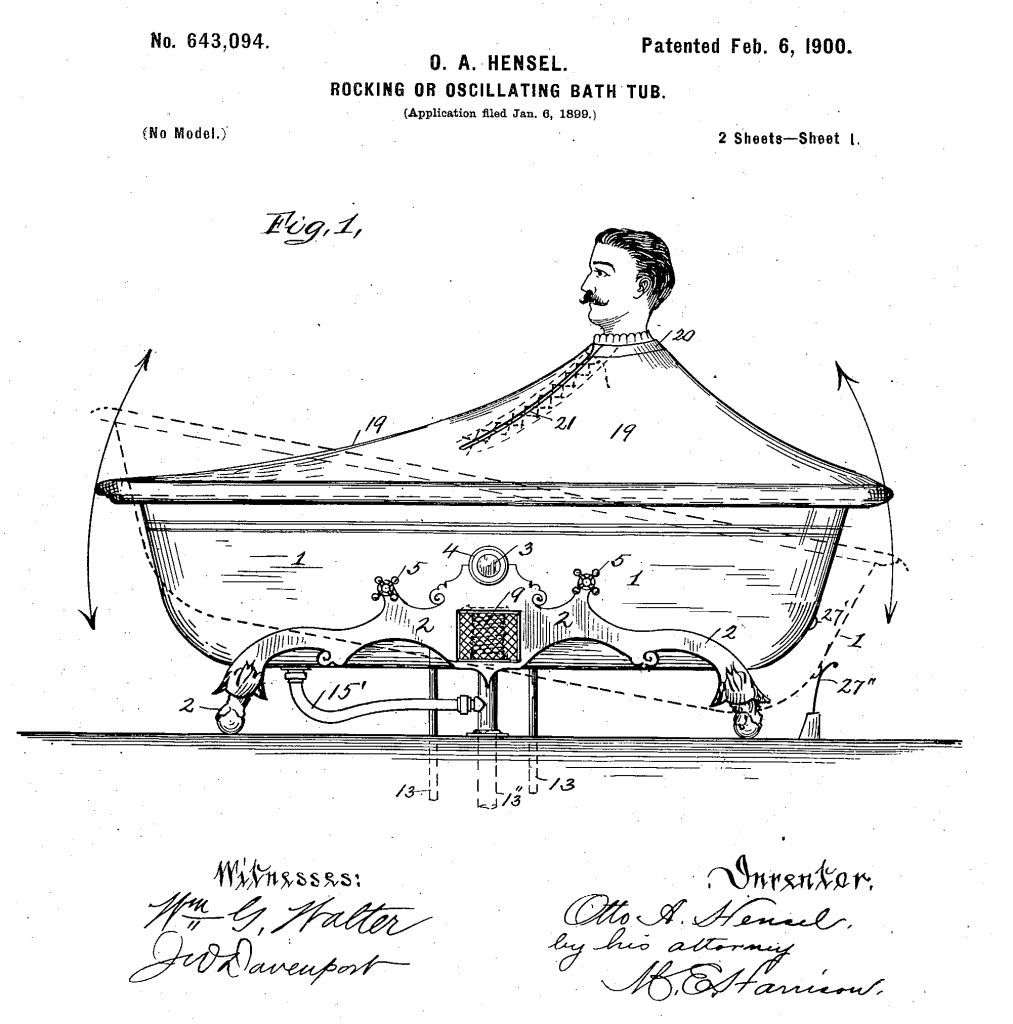
After yesterday’s post I had a fascinating discussion with someone who codes for a living about whether patents were a viable research resource in CS. First off, they’re extremely hard to understand. And yes, I definitely agree, and it’s a good reminder that when I talk about this with students I also talk explicitly about what I expect they’ll be able to learn from the exercise.

Hensel, Otto A. 1900. Rocking or oscillating bath-tub. United States US643094A, filed January 6, 1899, and issued February 6, 1900.
  1. If you find a patent that you think is related to your topic, look at other similarly classified patents to see what problems people are tackling in the field and who is tackling them.
  2. As you look through similarly classified patents, collect vocabulary that you can use in future searches. After all, most search systems simply match letters in a row rather than semantics, so if people are talking about the same thing but using different words to do so, you won’t find that whole side of the conversation.

While reading in order to understand the patented process is probably not feasible for most people, reading instrumentally has been super useful for me when exploring CS topics.

So far so good, but what really set me thinking was this industry coder’s take on the disadvantages of reading patents. Apparently he’s told not to read patents because knowingly infringing on someone else’s IP brings worse penalties than unknowingly infringing. In order to mitigate penalties, they don’t look at patents. So now I’m wondering how to guide students as they prepare for a world in which, at least some of the time, lack of information has value. And how do I square that with the idea of the very real costs involved in having a bunch of people reinventing wheels and falling into the same pitfalls, all so that if they get sued it won’t be quite so bad? And how do I square that with how this upends the progress narrative of the sciences in general, a set of disciplines which so carefully finds gaps in knowledge and then fills them, or finds the limits of current knowledge and then pushes those limits back bit by bit?

I wonder if it matters what sector you’re in, or even what specific companies you’re working for. And I wonder how liberal arts students might engage with this conundrum in a way that prepares them for life after graduation, whether that life involves CS careers or not.

Leave a Comment

Becoming a librarian for Computer Science

For 14 years, I’ve been a librarian for a pretty cohesive set of language and literature departments. My BA and MA are both in literary criticism, and I studied a few languages (not fluent in any of them any more, sadly), so my core departments have felt very much like home to me.

Photo by Jorge Jesus from Pexels

As you probably know, I also love computer stuff. I’ve never been formally trained in any of it, but I’m a huge fan and an intrepid experimenter. Plus the CS faculty here are awesome and many of them were friends of mine already, so when the chance came for me to be their liaison I said YES. Besides, I could draw parallels from some of the strategies of language research to the strategies of CS research.

But there’s also a lot that’s very very new to me, starting with exactly how information literacy works in CS… You know, just a small thing. Where does information literacy fit into a curriculum that’s full of coding and not a whole lot of traditional literature searching?

Thankfully the faculty here and the absolutely outstanding CS and STEM librarians at the Library Society of the World have been great partners and resources for me in my first year of being the CS librarian. I’ve also made a point of attending as many presentations and functions in that department as I can, listening for how information literacy works in CS. Here’s what I’ve found so far.

Information literacy in CS – Early observations

  • You’re going to need a good, well-evaluated corpus to train your AI.
    You kind of have to know what gets included in a corpus, and how, and where that stuff originated from in order to understand what your AI can or should do with the stuff, or to interpret what it spits out. Misunderstanding your corpus can result in wonky AI results. Luckily, librarians happen to have a long history of working with the kinds of things that get included in large text or metadata corpus-type-thingies — finding, evaluating, and using them!
  • You’re going to need good data to develop your visualizations.
    I’m learning a lot from our data librarian here. The one thing I found most interesting this past year is that CS students here have high confidence that they can knit datasets together to get what they want, but they have low levels of experience in determining if the datasets in question are built on compatible methodologies and variables. Next year I’ll spend a lot more time emphasizing that I’m not cautioning against combining datasets because the combining is hard — I’m cautioning against it because the thing you create might be the worst kind of chimera.
  • You’re going to need to think about license agreements and copyright if you’re using stuff that other people built, including APIs.
    Luckily, librarians have a long history of working with intellectual property topics!
  • You’re probably going to need to find libraries (the code kind, not the institution kind) or algorithms or code bases to work with.
    I haven’t really dipped my toes into this water yet, but what I have noticed is that students talk about this process differently than faculty do. Students talk about “looking online” and evaluating for speed, memory needs, and functions. Faculty talk about finding something that will be stable over time, with good documentation and a track record. There are undertones of publisher/author credibility, reliability, and stability threaded throughout. Definitely something for me to think about.
  • If you want to build something new, you’ll have to know the state of the art, past and present.
    This is where I’m learning more… and it needs more than a sentence or two, so I’ll give it a couple whole sections.

Finding The Current State of the Art

How do you know that what you’re building is new? And how do you make sure you’re building constructively on what’s already known? Translated into library-speak: What’s the conversation on this topic, and how does this project move that conversation forward? The information need is familiar to me, but the places to find that information are … not. CS has traditional scholarly publication venues, sure, but unlike my other fields, CS draws heavily on conference papers, research and technical reports, and patents. Not only that, but a bunch of stuff is proprietary — decidedly not the case for the latest interpretations of Hamlet.

So I’ve been trying to build up my skills in the grey literature area. Current strategies include using more familiar library databases to find out the names of people, associations, or institutions that are active in an area, and taking that knowledge over to Google for some advanced googling. I’m curious to see if Inspec Analytics turns out to be helpful with this, too, to help me figure out which institutions are active in an area and might have repositories of research and technical reports.

Patents are playing a larger and larger role in my work because that’s one of the only ways I’ve found of peeking into the proprietary research. That’s where company secrets comes right up against the desire to protect IP for future profit. So I’ve been exploring ways of navigating patents and analyzing publication and citation patterns to help me figure out the past and present of a process or topic. Are there key people or companies at play in a particular area? Do those people or companies have other reports available to the public?

Delving into the past to improve the future

There was a fascinating talk here last spring by an engineer working on Non-Volatile Memory. One of her many useful insights during the talk was that back in the 1960s people were working on Mmap, and in the 1980s “Bubble Memory” was set to be the memory of the future. It didn’t become the memory of the future, so most people now don’t know the term or remember the concept, but there are a lot of things about Bubble Memory that are the same as NVM. There’s also a nearly 40-year conversation about developing persistent languages (apparently called “persistent foo,” which is awesome) vs persistent databases. One of the speaker’s points was that finding out these kinds of histories can save people from reinventing wheels, falling into the old pitfalls, and basically repeating history in the worst way.

Of course this set me to wondering how a librarian could coach students in a research strategy to find things that are the similar but not necessarily the same, and that don’t share a lot of keywords. And how would you map out and synthesize what you find in meaningful ways, but as efficiently as possible? So next I think I’ll explore the literature around persistent memory, starting with the specifics this speaker mentioned in her talk, and see which search tools give students a good way to discover this kind of overlap with historical avenues of research. Strategy suggestions welcome!

So much more to learn

Soon we’ll launch into my second school year as the CS liaison, and I have a long way to go before I’ll feel like I really know how information works in this field. What do YOU think I should know in order to be the best librarian I can be for this field?

3 Comments

The Interstitial Curriculum

It occurred to me recently that we in higher education talk about the curriculum and the co-curriculum, and there are departments and offices and structures involved in making those parallel structures work (hopefully) to the benefit of our students. But there’s another curriculum at play as well — a curriculum that is every bit as fundamental to our institutional learning outcomes as the formal curriculum but that isn’t “owned” by any department and isn’t administered in any systematic way across the institution. I’ve started thinking of this as the “interstitial curriculum.”

The interstitial curriculum is where students learn the intellectual habits and skills that cut across curricular and co-curricular lines. It doesn’t have a home in the formal curriculum, and it can’t happen exclusively in the co-curriculum, either. Instead, it lives in the multiple and cumulative experiences that individual students have as they live out their college experiences through, among, and between the intertwinings of the curriculum and the co-curriculum. Depending on the institution, these are probably things like writing (never something that any single department can teach fully), metacognition, project management, time management, interpersonal “soft” skills, and yes, information literacy.

These are things that might even be named in mission statements or in institutional and departmental learning objectives, or that tons of faculty say are critical … but there’s often no course or formal home for them in the institutional structures that ensure other learning objectives. Everyone relies on students building these intellectual muscles by working with someone else somewhere else in the institution. They may not be sure who or where or when this work happens or should happen, but they really hope that does happen because otherwise their own goals for students in their courses or majors can’t happen, or can’t happen well.

In my own work, I live in the tension between the deeply rewarding, mission-critical work that I get to do with students every day, and the dismissal of some who assume that the work I want to do with their students has surely already been done by someone else at some other time — probably in their first year seminar. I live in a liminal space, where literally dozens of departments on campus list learning outcomes directly related to information literacy, the campus mission and learning goals invoke information literacy, and yet no department has a formal plan to ensure that their students get intentional, scaffolded practice with the intellectual habits of information literacy. And I’m not saying that this is a bad place to be! There are many good reasons at play in this state of affairs. But it does mean that my entire existence feels similar to the work of the fascia in the human body: necessary, often invisible, existing between the better-known structures of the body, not well understood, but instrumental in encouraging and even allowing the intellectual work of the disciplines. I live in the spaces between.

It’s a very, very interesting space to inhabit. Not easy, but interesting.

1 Comment

Wrestling with Reference

In the last few weeks I’ve been part of several conversations with other librarians about reference services. And now that I’m at an academic librarian conference (Hello ACRL!), I’m having even more of these conversations. Some people talk about moving away from the reference desk model entirely, others are conflicted, or shifting the service in various ways. All have very good reasons for making the decisions they’re making.

Like so many things in life, though, I find that there are a lot of unstated assumptions and values at play in these conversations. This morning I attended a great talk about navigating change, and one of the biggest assertions in that presentation was that we have to unpack the words we use when we state our values because our working definitions and the behaviors associated with those working definitions can vary significantly. People may think they’re talking about the same thing because they both say “Openness” or “Respect,” but they’re actually not. And if people think that there are gaps between their experience of your stated values and your working, behavioral definitions of those values, that’s when trust erodes.

This connected in my connection-seeking brain with all the librarian conversations where people decide what kind of librarian you are based on your stance on staffing models for reference desks. Are you That Kind of Librarian who wants to staff the desk “just in case” there are questions, or are you That Kind Of Librarian who “doesn’t value reference?” Whole identities can be decided in a moment on this one issue.

But here’s the thing, if we start to unpack what we actually mean when we talk about “the desk” — just like we use the reference interview to unpack patron needs — I think it uncovers a much more fundamental set of values. These values may or may not be served by a reference service at any given institution, but where a reference desk is not the option, these values still need to be enacted by some other service model somehow.

So here are three of the things that have bubbled to the surface during these conversations I’ve been having in the last few weeks. None of these were true 100% of the time at desks, of course, and none of them will be true 100% of the time in any model. But they are values that I think are key to building and sustaining a research/reference service.

Visible Demonstration of Function (Especially Interest)

Even if patrons aren’t actively seeking out the service or actively learning about support options, they should be able to see you being kind and welcoming and helpful and engaged and excited about other patrons’ information needs. Maybe your patrons will walk past you a million times on the way to and from the printers, or the bathrooms, or whatever, but they become passively aware of the service and its function. And they become passively aware that librarians love the act of information seeking, love the hunt, love the puzzle, and love more than anything else the opportunity to engage with people who are curious or confused and who will have their lives made easier by access to some information or a more nuanced ability to evaluate and use what they have found.

We’re nerds at heart, and pathologically helpful, and we find our reason for existing in the ability to both help people and geek out at the same time. But our “brand” on campus is often much blander than this – much more tied to the mechanics of access. And the only way to help people see that we’re good for more than “My professor said I needed 3 peer reviewed articles…” is for people to see that we’re broadly interested in information seeking and use, information-based rhetoric, and information structures. Without this, we run the real risk of having ever fewer questions, and then cutting services back further, and then having fewer questions… in a vicious cycle to oblivion. And all this not because we’re no longer relevant or whatever, but because people can’t see what we actually do and care about.

Low Barriers to Use

Barriers come in all shapes and sizes, of course, and different people find different things to be barriers. This is one reason to have multiple methods of getting and receiving help.

At least one of these methods should allow people to somewhat randomly get drop-in help without doing a lot of information seeking to find out how to get help or to formally schedule things. Predictable drop-in hours and locations (physical or virtual) that are well matched with people’s existing habits help tremendously with this. So does shared language and modes of engagement that match existing cultures and contexts.

For the librarians: Access to a broad cross-section of questions – especially “basic” questions

We know better what’s working and what’s not, what instruction worked and what didn’t, what tools work and what tools are confusing, etc, by being exposed to as many questions as possible from as broad a cross-section of a community as possible. The questions from just the people who know you already or just the people who specialize in the same things you do are good and important and useful, but more than that is even better.

In a lot of ways, the “easy” questions are more telling than the complex ones if your goal is to keep tabs on what your population finds easy or hard. These “basic” questions may be accommodated by a variety of service models, but they are decidedly not unimportant questions. If anything, they may be the most important questions — the questions that tell us valuable things about tools or services that we haven’t set up right. It’s not the patron’s fault for asking the “wrong” questions — The User Is Not Broken. It’s on us to make it so that, wherever possible, “easy” things are easy for our users, too. Or if we make the decision to opt for a set-up that isn’t strictly the easiest option, we should have well-considered reasons for this choice. In academic libraries, for example, there are times when the better solution is one that helps our students learn things even if it means an extra click or two. But these decisions should be weighed carefully, and monitoring the tenor of these most basic questions is one way of figuring out if you’ve struck the right balance for your context.


These are some of the things that I think lurk beneath the surface for people who “value the desk.” And for people who have moved away from the desk, these are some of things that they have to recreate in their new service models.

What else is lurking? What else do we value in a reference service, no matter that service’s model? What are effective modes of enacting those values so that they are apparent and transparent to our communities? Let’s build an actually articulated definition, and then test our services against that definition.
1 Comment
css.php