Skip to content

Category: Libraries and Librarians

Being a Library User

Several people blogged recently about the irony of being a librarian but not liking to use their local public libraries. Meredith, Nicole, and Jennifer all point out that while we’ve been merrily complaining away about the state of the catalog, our physical holdings are still stuck within (often) less than ideal buildings and, just like in any business, it’s possible that the librarian on duty might be anything from wonderful to scary (though the optimist in me hopes that most librarians are at least helpful, if nothing else).

In my mind, it comes back to the basic foundation of all libraries. Libraries are not just repositories for books. They have to fill a function in their users’ lives, and this function varies from region to region, community to community, and person to person. For example, I have always been a library user. The first library I remember was our local public library in Dorchester, Massachusetts (not even remotely comparable to even a decent branch library, I’m sure, but what did my 5-year-old self know?). From then on, every time my family has moved one of the first things we’ve done is scope out the library. When I moved here, I knew and had used my public library long before I knew where the post office was, or city hall. None of the libraries I’ve frequented have been beautiful or perfectly laid out, and only one librarian stands out in my mind as being particularly wonderful. But then, only one librarian stands out as being particularly scary, so I guess it evens out.

But through it all, the libraries have served a basic function in my life. They have fed me the majority of information and entertainment in my life. (And since I was home schooled and relied heavily on the library to make that possible, I can say that last statement with confidence.) Even now, working as I do in a well-stocked academic library, I make at least one trip to my local public library every week to get movies, audio books, and even real paper books. These are not things that I could afford to buy if the library didn’t exist (or at least not in the quantities I consume them), nor could I justify shelling out that much cash for my daily entertainment or finding storage for it all once I’d finished with it even if I were rich beyond imagining.

But then, this is my life and my need. If I were less inclined to read fiction, listen to audio books in the car, or watch old movies and BBC sitcoms on the weekends, I’d be able to fill my needs at the library where I work, and then I’d never set foot in my public library because it is small and dark.

So, just to emphasize my favorite part of the arguments in the three blog posts above, it’s not about keeping up with the Joneses and it’s not about the looks. It’s about functioning in the lives of our users. And the lives of our users have changed in the past 25 or 50 years. Maybe some of what functioned before doesn’t any more, but then again maybe some of it still does. In our quest to serve our communities and yes, even compete with big box book stores, figuring out the difference between the good and the not so great habits we’ve developed, policies we’ve enacted, floor plans we’ve preferred, and services we’ve offered will be an ongoing but important struggle.

Not all that is old, small, or dark is bad. The trick is figuring out the difference. The challenge is acting on the difference to improve the roles we play in people’s lives.

2 Comments

Gould Goes Multi-Media

At the very beginning of Fall term here at Carleton, two other librarians and I recorded our first podcast: an audio tour of the library. But then the term hit with such force that we didn’t have time to figure out the technicalities of putting it up on the library’s web site. Turns out, we had to get the college’s web team to turn on a media page type in our CMS and then everything worked great, but it takes a certain amount of futzing to figure out what we aren’t able to do and then ask to have that done. It only took the web team a matter of seconds to fix the problem, but what with one thing and another, it took us until this week to get things figured out.

You can go here to listen to a tour of our library (and follow along on the tour map found in the blue “Related Documents” box). I take you through the bottom two floors (First and Second), so for those of you dying to know what I sound like when I talk… have at it. I kind of hope that’s not what I sound like in real life, but I’m afraid it probably is.

We’ve also loaded our “Library Survival Guide” onto that page, as well as a video we made just before graduation last year. It’s a really big file, but there are some pretty funny bits.

2 Comments

eReserves: Blessing or Curse?

Blessing. Definitely a blessing to our users and database vendors, but a blessing with a curse-ish aftertaste.

Everyone is familiar with the blessing part. Users get 24/7 access to their course readings, and database vendors get a more accurate picture of the amount of usage they’re getting for their license fees. (Without eReserves we’d have to print out a copy of an article and put it on paper reserve, where it would be read by a class of students, photocopied by most of them, etc. But there’d only be one hit on the vendor’s server.)

But on our campus eReserves is an easy target for all sorts of campus ills. For example, it’s common knowledge around campus that eReserves is the cause of our horrible printing problem, with reams and reams of paper filing through our printers every day. And I’m sure that classes that depend more and more on journal readings and less on text-book compilations do make for more use of eReserves and more printing. But what nobody seems to realize is that all the requests for electronic access to journals means that more and more of our journal collection is e-only. And even if we have electronic access and print access, guess which one will be used most often? And what do people do with journal articles they find online? They print them to mark up over lunch or a midnight snack.

Not only that, but there’s more and more good, authoritative, quality research available on the free web, and you can bet that students print these pages by the ream. This is especially true because printing is free on our campus, so everything from email to research to homework spills from the two printers in the reference area at the rate of 7.06 pages every minute the library is open. (The the two reference area printers account for more printing than every other printer on campus… combined.)

I’ve also seen more and more students lately who prefer to scan print journal articles slowly, page by page, and then convert the images into PDFs all so that they could print (for free) rather than photocopy (for a fee). In related news, the use of photocopiers in the library has dropped so much in recent years that our printing department is considering removing a few of the copiers from the library entirely.

So the upshot is that printing is a definite problem, but the answer isn’t as simple as, “Well, with the advent of eReserves printing went through the roof….” The information universe is changing, not just one section of it. All of it. eReserves, journal subscription, database licensing, online publishing, assignments and pedagogical approaches to information, everything.

Oh, and eReserves is also not a devious plot to keep professors from ordering text books or paying copyright fees or anything else like that. Moodle can do all that so much more easily. 😉

Technorati tags: , , , ,

2 Comments

Libraries in 2006

It’s hard to believe that 2006 is almost over. I was just getting used to writing that number on my checks, or when I sign important papers. There’s nothing quite like signing a VIP (Very Important Paper), dating it, crossing out the date, writing the correct date, and then contemplating all the various people who will grab your file and chuckle at the girl who doesn’t even know what year it is.

These are the thoughts that flitted through my head as I signed various (routine) medical forms yesterday, and then life continued all around me as I wondered how 2006 would be remembered in library circles. (And yes, I really am that crazy sometimes.) So what do you think are some of the salient features and overarching questions in libraries this year? I don’t pretend to have a clue, but I know that a couple of themes were important in my small part of the library world. In no order whatsoever, they are:

  • Space: everything, physical or electronic, takes up space. Ideas are cheep but space isn’t.
  • OPAC/Catalog/Discovery System Bruhaha: I have no idea if this was a theme in previous years because I wasn’t paying attention, but I know for sure it was a theme this year. People are pretty sure that what we have now isn’t cutting it for our users, but opinions are rather more divided on what should be done about the whole situation.
  • The Pedagogy of Information Literacy: what do our users need to know, and how will they learn these skills best? Active learning, gaming, virtual experiences, embedded information literacy… so many options.
  • The De-Scarification of Technology: Web Apps make doing stuff online, either privately or with networks of other people, easy and portable. This year (many) librarians started using web-based tools to work and play, and the amount of really great and authoritative information available online exploded… again.
  • The User Experience: There’s been a trend toward measuring every product and service by it’s effect on the user experience. (This one is very far-reaching and basis of many, many other topics)
  • Data: It’s not just about books any more.
  • Books: It’s still about the books. And how do you convince students that every once in a while there’s just no substitute.
  • Sustainability: This is especially important to my library, where printing is free. With more and more journals available only online, there’s a whole lot more printing than can be good for any planet. There’s also the problem of sustainability in terms of workload. It seems like there’s always enough work for twice the number of staff.
  • Doing vs. Collaborating: what with wikies and tagging and other such wonderful things, we can collaborate with each other and our users to create content where we used to have to do everything in isolation.
  • Metadata: We have the computing power, bandwidth, and massive aggregations of data to make metadata exploitation possible like never before.

I’m sure there’s more, but I wanted to put down some thoughts so that when I’m teaching library school classes 50 years from now I can tell my students with some authority what issues were interesting me and my compatriots back when users actually had to type their queries into crazy things called “search boxes” rather than simply think them while inhabiting a virtual discovery environment, and when we had to search three entirely different kinds of systems depending on whether we were looking for books, journal articles that might be indexed online, or journal articles that are too old to be indexed online.

Ok, so the thought-driven discovery environment is a little ambitious for 50 years… but you get the idea.

What would you add as a driving theme of 2006? Lets put our heads together and write the bird’s eye view of lib06.

2 Comments

Responding to Student Writing and the Power of the Line

This past week I participated in a faculty workshop entitled “Responding to Student Writing.” In preparation for this workshop, each participant was asked to email the coordinator with the most vexing problems they have when responding to student writing. Most faculty members wrote about the problems of balancing the time it takes to write good comments on papers with their other duties, figuring out how to respond constructively, wondering if students ever read the comments, and wondering whether or not to write extensive comments on end-of-term papers.

I had to “interpret” the assignment since I don’t ever read or grade student papers. Here’s what I wrote:

I’m in the odd position of responding to writing without ever seeing the entire picture or reading the entire paper. I’m most often responding to the student’s interpretation of the assignment and the initial phases of topic selection. In the instances where students come back with a semi-finished product, I generally respond to the bibliography or the student’s summation of the argument and the types of evidence he or she has found to support that argument. In some ways, it’s much easier to respond to students about their thought processes and progress towards their goals when I only get these verbal summaries since it frees me from all the minute details that might overwhelm me if I saw the project in it entirety. But it’s also difficult to give feedback that will support the project as a whole when I only see distilled sections and versions of the project.

I also have to respond on the spot without the benefit of time to compose my thoughts and write something down. I’m often more comfortable writing than speaking, so I usually feel like I’m floundering to put my thoughts in order, communicate clearly, and keep the student’s ultimate needs firmly in mind all at the same time. I often wonder if my tone is appropriate, if they’re hearing what I think I’m saying, and if what I’m saying is effective. (When I’m really worried about this, I’ll often send a follow-up email that reiterates my main points, but then I run into the problem of time, especially when I have days that are packed full of back-to-back appointments with students.)

Like the first assignment, much of the workshop didn’t directly relate to me and my job, but it was nevertheless an incredibly beneficial and enjoyable workshop. I met some wonderful professors and had stimulating conversations about everything from art to assignments.

One of the most interesting conversations was with a studio art professor who, like me, had to interpret many of the activities to fit his teaching activities. He talked with such passion about the history of the line: how The Line started with the urge to represent and communicate and how it has diversified over time to include everything from representation art to writing. He talked about how creating art is always a way to possess, whether it be to capture an image you don’t want to forget or to articulate and keep hold of an idea, and that there is always an element of transaction involved, either literally or via communication.

What a beautiful thought. When we teach students to do research, we give them the keys to this act of possession and transaction. We help them to allow the originators of the work they study to complete this timeless transaction, this fulfillment of the original act of creation, of setting down representations of things and ideas via the eternal Line. And then the students, in turn, set down their ideas, using the same Line, waiting with eager anticipation for their readers to complete this new transaction.

And when readers comment on student writing, they grant that writing weight by taking partial ownership of the work via new instances of the Line, because the Line gains rather than loses power when more people own it, use it, and proffer it to others.

Leave a Comment

Of Socks and Writing

For the past three days I’ve been attending one of the many December workshops offered by faculty for faculty on our campus. This particular workshop was put on by our Writing Across the Curriculum program and was a fabulous opportunity to learn more about what good pedagogy looks like, think carefully about what we want our students to get out of their college experience, and get to know faculty from all over the curriculum. I don’t directly teach writing, but I do support those who do, and I almost never get three days in which to talk over the underlying goals of writing assignments with my faculty. What fun!

But everyone always looks forward to the last day of the workshop because on that day the Dean of the College presides over the annual outrageous sock contest. And this year… I WON! Last year I was deemed “almost tasteful” and was therefore disqualified. This year my fur-lined santa socks earned me a Sock Monkey grand prize.

Leave a Comment

Link Resolvers and Education

Looking back over the last two weeks, I can’t believe I’ve only posted twice! That’s got to be some kind of record for me. But I had car issues, and then vacation (which was WONDERFUL and long), and then I spent all day yesterday trying to catch up from being away. I didn’t succeed, of course, but I made a healthy dent.

Anyway, I’ve become curious about link resolvers and how academic institutions set theirs up. We use SFX, and so far I’m absolutely thrilled with it. I think of it in terms of eras: I graduated from library school in 1B.SFX (one year Before SFX), and it is now the year 2A.SFX (two After SFX). My library implemented it the first term that I was working here, so I never had to teach the tedious methods of hunting through databases, using Ulrich’s, interlibrary loaning, having the loan request rejected because we have the article (somewhere), looking again, searching Google, and then resorting to cursing and pulling out hair when trying to find the full text of an article. Instead, all I had to teach was “click on this handy little button and it will search all our databases for you.” Who wouldn’t be thrilled?

But there were all sorts of decisions that went into setting up our instance of SFX, decisions I wasn’t a part of, but that I need to think about now as we go through the endless cycle of evaluating our service, tweaking it, and evaluating it again. At issue right now is the question of whether or not we made the correct decision when we chose to have an SFX menu pop up every time a user clicks on the Find It button, or whether we should switch to having it deliver full text (if available) from a preferred database.

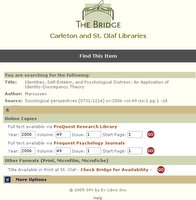
For those of you who don’t have SFX, or who have it configured differently, here’s what I mean. Let’s say I search and find a citation for an article from the journal Sociological Perspectives. Click “Find It” and I’ll discover that we have two subscriptions from two different databases, and St. Olaf also has the print. Click on either of the database options and I’ll get the full text; click on the print option and you’ll be taken to the catalog record for location and holdings information.

This system has three distinct advantages. First, it helps students figure out which databases they should be searching other than the database they’re currently searching. I teach my students to keep notes on databases that come up often when they’re looking for full text because those databases obviously have a collection of journals on your topic. This technique is especially useful for upper class students when they’re beginning to do research for their comprehensive projects. But it can also work the other way. I’ve mentioned before that unlike my co-workers, I mainly teach freshmen. And consequently, I also teach the less specific databases more often than my co-workers do (my co-workers rarely have to deal with students who just have to write “a research paper” on any topic). So I tell my students to watch the Find It menu to see if there’s a more specific database on their topic.

Another reason for providing choice, beyond simply my love of letting people choose what works best for them, is that over time students develop familiarity with the databases they use most often, so they may prefer to click on a link to their favorite CSA database, Ebsco database, or ProQuest database when it appears in the list of choices. I know I default to certain databases over others because I know that I can manipulate some vendors’ databases more easily than others.

And finally, some poor, young students dealing with requirements for “print” sources handed down from professors who haven’t explained that you can get “print” sources online from these databases, would really just prefer to click on that “available in print” link and go photocopy the article for themselves.

On the other hand… there’s value in immediate delivery whenever possible. I’m torn. Is delivery more important than education and discovery? Possibly. But I’d hate to give up the information I’m given when I’m presented with choices.

Carleton and St. Olaf will be deliberating on this issue soon, and I’m comforted that we can’t make a “bad” decision. I just wish I knew which was the better decision.

Technorati tags: , ,

10 Comments

Freakishly Personalized

We talk a lot about personalization, and about how personalization improves the user’s experiences, and about how personalization makes the user feel appreciated. Well, I’ve just found out that you can take personalization too far. My dad got a birthday card from the dealer that sold him his car several years ago. This is freaky.

It’s funny because we give dealers all sorts of information about ourselves when we apply for loans, but there’s a level of politeness which assumes that the dealer will a) only use the information for the purpose we intended when we handed over that information, and b) pretend not to know the information when they’re in situations outside of that originally intended information exchange.

I remember learning this lesson when working at a small, independent bookstore for several years. We were expected to watch what our regulars bought so that we could recommend books to them that they would like, but we had to pretend not to know that one regular was reading up on divorce after having spent a year or so buying “fix my relationship” books. And we were certainly never to know why that same person later bought the books on managing finances after divorce…

We also collected phone numbers of the customers who signed up for our charity program (buy a book and 1% of the sale goes to a charity of your choice). But we weren’t supposed to “know” their phone numbers even when, after years of ringing up purchases and entering the phone number which served as their account numbers, we could rattle off the names and numbers of several dozen of our regular customers.

There is decency in asking our patrons to provide us directly with information we use for their accounts, or let them know what information we collect about them. But I think there is even greater decency in “forgetting” even readily remembered personal information when we’re interacting with our patrons in contexts outside of the personalized services we provide.

Technorati tags: , ,

3 Comments

Tagging

Have you ever noticed that librarians often tag things using plurals for countable nouns, just as if we’re creating subject headings? I’ve noticed this in my own tagging, in other librarians’ Flickr tagging, and on Technorati. I smile every time I see other people who have the same habit I have. It’s so … cute. 🙂

Technorati tags:

Leave a Comment

Bundled Collections

A question was implied during my library’s recent exploration of the functions and implications of a catalog that actually works as a discovery system. It came up during the hour-long question and answer period with Roy Tennant (have I mentioned what a good idea it was to set aside that much time for questions?!?) when he made the comment that we should build the search skills of reference librarians into the catalog interface. That’s great, but then what will reference librarians do?

I’ll tell you what we’ll do. We’ll have time to coach students in more than keyword searching, we’ll be able to explore the exploding realm of quality, authoritative information available online, and we’ll be able to develop ways of feeding this rich content to our users when they need it. “Googling” things is great, but as more and more information gets uploaded for public consumption, the relevant hits will become increasingly diluted in a sea of irrelevant hits. This means that we’ll have to teach better search strategies for web search engines, and we’ll have to develop tools that will help our users get to the information they need. We’ll also have to spend more and more time teaching students to distinguish between the useful and the bogus in their result lists.

People are already creating tools to aid in the quest for authoritative information. The first one that springs to mind is, of course, the Librarian’s Internet Index. But on a much smaller scale, librarians are beginning to create rich troves of web-based sources using del.icio.us, Furl, and now Google Custom Search Engine.

I adopted del.icio.us earlier this year and have decided to make mine first and foremost a curricular collection that will be useful to students in my liaison areas as well as to students on our campus in general (you can see my account here). It’s still a growing collection, but it’s a great place for me to “remember” the image repositories I find while helping one student with her research, the web sites I choose for students in a class on globalization, and so on.

But I have high hopes for tools like the Google Custom Search Engine. This is what reference librarians could do with all the “free” time gained from not helping students navigate the catalog. (And I’ll believe in the theory that we’d have free time when I see evidence of it… but that’s another whole topic.) A few other bloggers have noted some of the bundled searches that are being developed already. And now there’s a budding directory of GoogleCSE forms here. I’m also keeping track of any custom search forms that look particularly useful to the library world and adding them to my del.icio.us account. So far, here’s what I’ve found:

I still haven’t ventured into the water myself, but I think it’s only a matter of time before I start creating custom search portals that I know will return authoritative information to my students. I think one of our directives in the coming years will be “go forth and bundle” because without it our poor users will stumble around in an increasingly expansive conglomeration of more-or-less random information.

Technorati tags: , , , , ,

2 Comments
css.php