Skip to content

Category: Libraries and Librarians

The Reference Desk Under Fire

Every so often, I hear variations on the theme of “Why sit behind a reference desk? What are you — scared of the students?” I’ve heard everything from wearing uniforms so that we’d be recognizable while we were “out doing our work in the stacks,” to carrying a cell phone, to simply “walking around” and being available. I’ve heard eloquent deconstructions of the barriers we put between ourselves and the students when we sit at a reference desk. And I’ve sensed unspoken assumptions that if we’re “just sitting there” we aren’t actually busy or working.

Now, I completely agree that desks can pose barriers, especially when they’re the podium type that raises the librarian on high and requires timid students to crane their necks just to see us. I am also a huge proponent of making myself not only be available and approachable, but also seem available and approachable. Not only that, but I’ve seen wonderful and creative examples from other institutions who have abandoned their desks altogether.


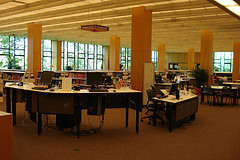
Why, then, do I steadfastly argue for my desk shift? Because I can’t think of any way to make myself be or seem more available and approachable to my user population. Of course, our particular desk configuration helps. We sit at a very low desk that is no more substantial than any of the work tables in the reference area (and it’s on wheels, though we haven’t moved it in a while). We also have a chair next to us for students to sit in while we work with them. We’re also directly across from both of the public printers for the main floor of the library and right next to the main floor’s computer area (which is in this room and just off the upper right side of my picture).

But simply having a non-scary desk in the highest-traffic area of the busiest building on campus isn’t enough (though it helps). That simply means that we’re visible, not that we’re approachable. Rather, having a predictable place where we can be found at predictable times, making the most efficient use of space in our somewhat unwieldy library, and playing off of the culture of our campus all contribute to my sense that our desk, or something like it, is necessary.

The physical library space needs little elaboration. There is simply very little space for anything other than books on the lower three floors of the library (remember, people enter our library on the fourth floor and work their way down). Not only that, but there’s no predictable traffic pattern on the lower floors, and the discussions that happen at the desk would disrupt the quiet levels on the lower floors. Of course the argument could made (and has, in fact, been made) that we would simply walking around down there, so traffic patterns and, to some extent, noise levels needn’t be an issue. But the fact is that the other librarians and I are rarely called upon to do work that would involve wandering in and out of the stacks. We go there to collect books in preparation for our classes, or with students when we’re in the midst of an appointment or reference interaction. But that’s about it. Then there’s the problem of the computer. Most questions need at least some computer interaction, and the computers in the library are usually all in use by students. It’s far easier to know that while librarians may be wandering around, there’s also one who’s scheduled to be either at the desk or who will be returning to the desk shortly.

No, the strongest argument in favor of the desk as a physical, predictable, and intuitive space lies in customer service. There’s nothing more frustrating than wandering 4 floors without any long sight-lines, looking in and out of stacks, climbing up and down 6 stair cases, just trying to find somebody who can answer a question.

What’s more, the librarians function in an analogous way to professors when we sit at the desk. Just as students can make appointments with their professors but can just drop in during office hours, they can also make appointments with us or simply drop in on our desk hours. Culturally, this meshes well with campus culture and student expectations.

I’ve wondered for over a year now if I’m simply defensive and stuck in the mud when I baulk at challenges to our service model. But I’ve come to the conclusion that there are very good reasons for having a reference desk, as long as that desk is positioned and designed with approachability and usability in mind, and as long as the people sitting at the desk make sure to look up, take their hands away from the keyboard, and smile whenever they’re approached. After all, approachability has at least as much to do with the person as it does with the furniture.

Technorati tags: , ,

4 Comments

The ILS Futures Forum: Catalogs and Discovery of the Future


Yesterday librarians from several small institutions in the area gathered to hear Roy Tennant and May Chang (of the University of St. Thomas) talk to us about the future of the catalog and the ILS, and a good time was had by all. The Carleton and St. Olaf librarians were all energized and inspired by what they heard. (And the surroundings couldn’t have been prettier.)

In terms of concepts, I didn’t hear anything that I haven’t heard or read before (thanks to all the amazing bloggers out there working hard to keep me up to date). But Roy was so much fun to listen to, and he spoke with so much enthusiasm and good humor that the whole thing sounded new. For those few of you who want the 4-page version of my notes on Roy’s talk, I’ve put them up here (PDF Word document), but I didn’t want to inflict them on the rest of you.

So what resonated so much? What was it that caused one of the librarians to say, “I was actually, dare I say it, excited,” and that rallied all of us around tagging in the catalog? I think it was a combination of a couple of things. First Roy couched his whole talk in terms of assisting user discovery. Our two libraries have heard a lot recently about workflow redesign because we’ve got a grant to help us do just that. So we’ve been steeped in the rhetoric of “you’ve got to change” and “you’ve got to catch up with those millennials.” What we haven’t heard so much of is what we heard yesterday: “look at all the cool stuff we could do with the metadata you’ve created” and “look at all the cool ways computers can exploit that metadata on behalf of the user.” Roy put the focus squarely on serving the user as the motivation for change rather than on change for the sake of modernization.

Another thing that resonated strongly with our group was the way he placed this change into historical context. First we automated circulation, acquisitions, and cataloging. Then we figured that as long as we had all this stuff computerized, we may as well let the public search through that information, too. Now we’re thinking of ways to create an actual public search interface rather than inflicting our workhorse on an unsuspecting public.

Placed in this context, and delivered with an attitude of “onward and upward” rather than accusations that librarians are digging in their heals, even the most conservative librarians in our group started talking about the possibilities. One person came up with the brilliant idea of finding commonly used tags and reverse-engineering subject headings to match, thus increasing number and usefulness of formal access points. I think tagging would also be a flexible and nimble way to create “scopes” for collections that aren’t actually shelved together.

I’m still not sold on sucking Amazon information and book covers into the catalog (mentioned several times throughout the day). I’m all for images of book covers, but I wish that if you clicked on them you wouldn’t get pulled over to Amazon and into the world of buying rather than borrowing. I wouldn’t baulk at having options show up to interlibrary loan or buy a book that is checked out, and I like having reviews handy… I guess I just want to have my cake and eat it too. Call me a stogy librarian who’s digging in her heals over change… 🙂

p.s. A big thank you to the chef at the conservatory for making me the best special-order lunch I’ve EVER had. It’s the first time I’ve ended up with better food than everyone else because of my allergy.

p.p.s. Another big thank you to the people who came up with the idea of having an hour-long question-and-answer session with Roy. What a good idea!

Technorati tags: , , ,

2 Comments

Food and Beverage Policy


One item on the library’s new strategic plan (draft PDF here) is to explore the possibility of putting a cafe in our library. Rolled into this point is the assumption that we will be evaluating our current food and beverage policy.

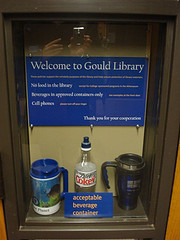
Currently, no food is allowed in the library, and beverages are allowed only if they are in containers with lids that don’t have to come off for you to drink out of them. We even have a huge bowl of water-bottle-like pop-up lids in the entry way so that you can make un-approved containers (like soda bottles) into approved containers. Though I gotta say, sipping soda through a pop-up lid is … odd.

One amusing consequence of this policy is a daily silent feud that goes on around the garbage cans. Nobody knows who put signs on each of them saying that you’re not allowed to throw food wrappers or other food-related garbage into them, but each garbage can has one, and there is a difference of opinion about the value of this type of approach. So every day somebody goes around and turns the signs so that they face the wall. And every day somebody else goes around and turns them back so that everyone can see the signs. It’s one of those mysteries that sits at the back of your head, not important enough to investigate, but interesting all the same.

Anyway, we had our open forum to discuss the drafted strategic plan, and quite a large part of the forum time was taken up over debates about the food and beverage policy. Some students were vehement that they’d prefer to walk to the student union (about 100 yards away) than to introduce aggressive, pest-killing chemicals into the library, burden the custodial staff, and make us face replacing ruined books. Other students talked about the need to be trusted not to put their caramel rolls into reference books, and about how difficult it is to unplug a laptop, pack it and your books up, walk to the student union, come back, unpack everything, plug in the laptop, and continue working. It was fascinating to see students debating amongst themselves about trust and responsibility and how far the library’s should go in either way.

And what does the library think? Well, we have a working group assigned to look into the matter, but they haven’t reported back to us yet. Some librarians are passionate about the need to maintain our policy, while others are in favor of liberalizing it, at least a little.

As usual, I’m conflicted. On the one hand, I can totally see the benefits of keeping fumigation, cleaning, and replacement costs down. We also house three computer labs, and the IT people on campus love it that they don’t have to clean food out of keyboards over here. But on the other hand I have a very hard time enforcing the policy as it is now. This isn’t because I lack the gumption to walk up and make people take their ice cream cones outside. I’ve done that. I’ve also turned away a pizza delivery, suggesting that they eat it in the entry-way and providing napkins.

But I’m also working very, very hard to make the library a welcoming place, and to seem approachable to every student. I remember being a student lugging books and laptops everywhere and spending hours and hours on end in the library. It’s a fact that students are spending longer and longer in the library, and the library is the busiest building on campus. I’d like to keep it that way. It also puts the liaison librarians in a very tricky position to charge them with being everybody’s friend but also to put them on the front lines of enforcing this policy. As a student, if I’d been “caught” eating in the library I’d be too embarrassed to go to that librarian and reveal my ignorance and inadequacy as a researcher. It takes guts to go to the reference desk, and that would have been enough to keep me from making eye contact, let alone approaching the desk.

So for now we’re considering whimsical table tents (along the lines of “Dude, that’s gross” next to a picture of pizza on a book). And we’re still suggesting that people finish their dinners in the entry way rather than at the computers. But I, for one, will be happy when the library comes to a consensus and can put all of our efforts behind a policy that balances trust, responsibility, consequences, and stakeholders’ interests. I’m just glad I’m not on the working group that’s trying to strike this delicate balance.

Technorati tags: , , ,

2 Comments

Information Literacy 2.0

I’ve been reading an absolutely fantastic article (Elmborg’s “Information Literacy and Writing Across the Curriculum”) and a slightly less fantastic article (Shapiro’s “Information Literacy as a Liberal Art”). And it’s gotten me thinking back to my first months as a librarian here, when my supervisor brought James Elmborg here to talk to us for an afternoon about being new librarians. We were full of questions about how to talk to faculty when we couldn’t be subject specialists in every subject we served, how we could advance the library’s goal of integrating information literacy more fully into the curriculum, and how to talk to faculty about information literacy in a way that would communicate that we were talking about more than boolean operators and controlled vocabulary.

In the course of that afternoon, Elmborg gave us lots of tips and solid advice, but he also challenged us to think more broadly. I’ll never forget when he urged us forward, saying, “You need to articulate your epistemology.” As a group, he said, librarians have a hard time coming to grips with precisely how we fit into students’ educational development. We have a hard time selling ourselves to faculty when we can’t describe what it is that we do. And just two months out of library school, I was flabbergasted to learn that I didn’t actually know what it was that I did or where I fit into students’ development.

Just this last week week I revisited Elmborg’s article in a new context. It was included in a packet of articles that served as the background for a meeting, and the Shapiro article was also in that packet. The contrast between the two was startling.

While the Shapiro article talks a lot about “information literacy,” it foregrounds information technology in almost every example. It also says that the facet of the proposed information literacy curriculum termed “Resource Literacy” is “practically identical with librarians’ conceptions of information literacy, and includes concepts of the classification and organization of such resources” (see the section entitled “An Information Literacy Curriculum”). This facet, by the way, falls second after “Tool Literacy” which is “the ability to understand and use the practical and conceptual tools of current information technology, including software, hardware and multimedia.”

While these concepts are certainly not outside the realm of information literacy, I don’t think that they are the primary goals, either. Instead, they are tools working in aid of true information literacy, just as punctuation and grammar are tools in aid of good writing. Nobody would argue that anyone with a perfect command of the grammatical rules of writing is automatically a good writer. Nor would they argue that the teachers of writing should hold grammatical rules as their primary instructional goals.

After reading the Shapiro article it was such a relief to read Elmborg saying exactly that. “There is a ‘grammar’ of information….” he says, “Like sentence-level grammar, these are isolated skills that separate research from the making of meaning” (72-73). And when skills are isolated from the process of making meaning it “breeds cynicism and a view of writing [and research] as busy-work” in students (Elmborg 72).

Making meaning, then, is a fundamental part of information literacy. Without this as the ultimate goal, information literacy becomes a task, a chore more akin to Hercules’ Labors than to anything else. Helping students construct meaning should be our primary goal. Along the way we may have to help them develop specific skills, including the “grammar” of searching, recognizing what constitutes evidence in their disciplines, and evaluating the information they find against the measure of their information need.

With this as the primary goal, competency standards (such as those drafted by ACRL) and “resource literacy” are just the important intermediary steps on the path toward the ability to grapple with a subject, interrogate it, recognize the voices that contribute to its discussion, and contribute one’s own voice to that discussion. Information Literacy is not a skill to be tacked on to a syllabus. It is one in a collage of abilities that enhance students’ capacity to access course content and participate in the discourses of their chosen disciplines. This is my epistemology and the foundation of my theory of pedagogy.

References:

  • ACRL “Information Literacy Competency Standards for Higher Education.” 2000.
  • Elmborg, James K. “Information Literacy and Writing Across the Curriculum: Sharing the Vision.” Reference Services Review 31.1 (2003): 68-80
  • Shapiro, Jeremy J. and Shelley K. Hughes. “Information Literacy [or Technology] as a Liberal Art.” Educom Review 31.2 (1996): 31-34 — I noted the possible change in title because I can’t determine definitively which is correct. The “Literacy” version appears on the Educom web site, but the “Technology” version is indexed in Academic Search Premier, and is cited by other articles I’ve read.

Technorati tags: , , ,

Leave a Comment

IM Reference at Carleton: A Low-Key Affair


Last year, sitting at our Research/IT desk, we started noticing that the SCIC workers sitting next to us were often engaged in lively conversation via IM. At about the same time, a few of us got started on Google Talk and it quickly spread through the rest of us as a way to ask quick questions of each other throughout the day without actually interrupting each other as completely as we had been by popping into each others’ offices. (Personally, I think this was mostly a strategy to keep me in my office because I was new and doing a lot of popping in to ask questions… but nobody’s admitting to that ulterior motive.)

We really took to this as a method of communication. We still do a lot of popping in, but now we have communication choices. Not only that, but every once in a while we’ll be fielding a tough question during the night or weekend desk shift and end up IMing a co-worker for help. This isn’t frequent, but I’ve benefited once and I’ve helped out once, and both times there’s no way the reference interaction could have been successful otherwise. We’re also keeping in social contact after work, which I really enjoy.

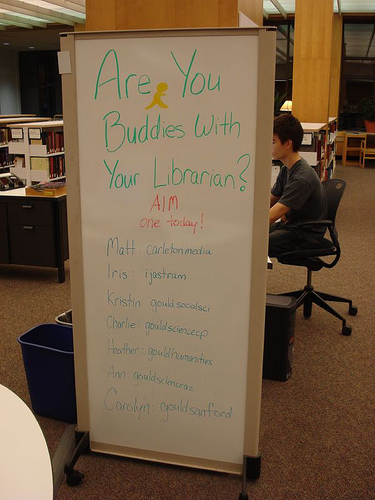
So after we’d played with this for one school year, we decided we wouldn’t mind creating AIM accounts to give out to students. We each have our own account, and we can each be online when we’re able to answer questions and offline or “Away” when we’d rather not answer questions, so we completely sidestepped all of the staffing and coverage issues that comes with “real” IM reference. On the other hand, this relies heavily on our liaison model, with students encouraged to meet with the librarian for their classes and major for anything more than general reference help. So in this sense, it’s more an extension of our individual consultation service than of our reference service. But it provided a no-risk method of trying a new service this term, so we decided to go this route.

So far, the response has been mixed. One of my co-workers has answered a couple of IM questions (and we all rejoiced), but the rest of us haven’t yet. [Update: It appears I’m wrong. One more of my co-workers has answered a couple of questions, and she is even one student’s very first IM buddy!} We’re also running up against a strong culture of face-to-face interaction here at Carleton, and some students have voiced the opinion that it’s “sad” when people can’t stand up, walk over, and ask us questions.

So I wouldn’t call our experience a rousing success if you look at it as a stand-alone service. And yet, there are three reasons that I’m glad we’re doing it and that we don’t have any plans to discontinue it.

First, it gives us a chance to experiment with a new “toy.” This is always valuable, especially when there’s no cost associated with that experimentation.

Second, it contributes to our efforts to not only BE approachable and accessible to students, but also to APPEAR to be approachable and accessible. I’ve been thinking a lot lately (as I experiment with Ask.com vs. Google or worry that my laptop is dying and notice how that changes what I think about putting into it) about the appearance vs. the reality of usefulness and trustworthiness. And basically I’ve come to the conclusion that the appearance of trustworthiness is more important than the actuality. If I trust something, it takes a lot to get me to go back on that trust, and the converse is also true. In the same way, I think building the appearance of accessibility, expertise, and usefulness to our students is at least as important as actually providing accessible, expert, and useful assistance. And our new AIM handles are helping with this… I think.

Third, I don’t care if I only receive one IM question. That’s one question that may not have come to the desk. And it’s not costing me anything in time or money to have AIM running in the background on my desktop. Even with a culture of face-to-face interaction on campus, there will always be someone who is shy about approaching the desk, or simply communicates better through the written word than the spoken word. There are lots of students that I only hear from via email, and I can foresee a time when these students will make me a buddy rather than putting me into their email address book.

Of course, I’m still waiting for that first IM question… but it’ll come. I’m nothing if not optimistic.

Technorati tags: , ,

3 Comments

The Research/IT Desk

Sitting here at the reference desk for my Monday afternoon shift, I’m reminded of one reason that I no longer dread my desk shifts. Well, one obvious reason is that now I have a lot more reference experience, so I no longer tremble whenever a student asks, “Do you have a minute?” But experience aside, I prefer desk shifts here because I rarely have to answer any technical questions, un-jam copiers and printers, recover lost papers, teach graph making in Excel, or trouble-shoot any other computer problem. At my previous library, this is mostly what I did during desk shifts.

It’s not that our students are more computer-savvy than the students at my previous library. If anything, there are more computer questions here because we have three computer labs here instead of one. No, this bliss is all because someone a couple of years ago (in September of 2004, to be precise) came up with the brilliant idea of providing a joint service point merging research help with technical help, transforming our reference desk into the Research/IT desk. So, to alleviate my sadness about not being at Internet Librarian, I thought I’d amuse myself by writing this all down before we forget what the first few years of this service were like.

The Progression

Before I begin, I should mention that I am NOT the authority on this subject. I just work here. My co-worker, Heather, is the point person for this and has presented on it several times and done a poster on it at ALA.

Anyway, For many years, now, Carleton has had IT support for students. They call this place the SCIC (pronounced “skick”), and it’s a pretty full-service joint. A whole battalion of geekish students (affectionately called “SCICers”), headed up by two full-time staff (“the SCICitator” and another guy without a nickname… we’ll have to work on that), troubleshoot software and even repair some hardware and clean up virus infestations.

Well, two years ago the decision was made that the SCIC would start sending some of the student workers over to the library to sit next to the librarian on duty at the reference desk. I wasn’t working here then, so all I know about these early experiments is second hand. Basically, everyone could see that it was valuable… except the student workers. They didn’t like being away from the SCIC because here they’re on their own, their fellow student workers are a building away, they are more visible so they can’t play games or wear headphones, and there’s different technology to learn. The biggest thing that year, though, was communication. The librarians weren’t these students’ supervisors, and we didn’t even really get to know them very well because there were 40 of them rotating through the library, and the librarians’ desk shifts weren’t consistent. So any SCICer could quite possibly work an entire term without working next to the same librarian more than once or twice.

Last year things got more formalized. SCICers staffed the desk for the entire time the library was open (even when there weren’t librarians on duty), and the SCICitator worked with the librarians to provide formal training in the special types of service and support issues that come with working in the library (microfilm reader/scanner/printers, SMART board issues, referring research questions, etc.). What’s more the SCICitator decided to schedule only second-year SCICers in the library, so they wouldn’t be learning the basics while cut off from their fellow student workers and their supervisor/mentor. On the librarians’ side, we regularized our reference desk shifts so that we would always be sitting next to the same students (except in the case of substitutions). Most importantly, though, we formalized the communication that happens between the librarians and the SCICitator. One of the librarians acts as the liaison to the SCIC and meets with the SCICitator briefly every week. She also coordinates training for the students. We’ve also worked on developing a habit of emailing the SCICitator if a student does really well or goes above and beyond, or if they miss shifts or in other ways slack off.

And slowly but surely, we’re seeing an attitude shift among the SCICers. It’s now a rare thing for them to show up with the attitude that this service point it “extra” or less cool. Some of them even try to shift their schedules so that they work only at the library.

The Benefits

Librarians immediately saw a significant drop in the number of “short” reference questions we answer. By itself, this is just interesting to us. But it become significant in terms of the service we provide when you pair this trend with the steady increase in the number of “long” reference transactions we have. Students are finding us available for in-depth research assistance now that we aren’t running after paper and re-starting computers. Now only that, but students are starting to seek out the technical assistance at our desk that they would previously have taken to the main SCIC, so there has been a significant increase in the number of questions handled by the SCIC side of the Research/IT desk over the course of the past two years. (The library is the busiest building on campus, so it makes sense to have this service here rather than sending everyone to another building.)

The Challenges

There are two main challenges that we’ve faced: communication/reporting and statistics collection. Formalizing the communication channels has really helped, and now that at least half of the SCICers don’t remember working when there wasn’t a library service point, they don’t balk at librarians stepping in to give them duties or brainstorm about solutions to problems. And this year we’ve gone to online statistics collection, which seems to feel more legitimate to these students. We know that they were under-reporting last year because many of them couldn’t be bothered to fill in little hash marks on a piece of paper. This year they’re still probably under-reporting, but making entries into an online database just FEELS more important, so they’re making the effort.

So we haven’t completely worked through all the ins and outs of this service point, but I’ve gotta say, I really like it. It frees us up significantly, and we get to develop relationships with a whole new set of students that we never really saw before.

Technorati technorati tags: , ,

2 Comments

Our Library’s Watch List

I’ve heard from people who want to know what our library has on it’s “Watch List,” so I thought I’d post them here.

But first, a little bit of the back story. If you remember, at the end of last year we had a series of surprisingly interesting and stimulating meetings about out library’s strategic plan (my posts about these meetings are here and here, and now a draft of the plan is available online as a pdf). Part of this plan involves watching trends and developments in the library world outside of our college. So each department made up a list of the things that they either are or would like to be watching, and then the full library staff met to pare the list down to those items that seemed interesting and important to the library as a whole and that meshed well with our strategic plan. Now we have a blog (visible only to library staff, and which I wrote about here) in which we track what we’re seeing, and we use WordPress’ category function to label each post according to the watch list item or items it covers. We can also use the blog space to suggest new items for the watch list, or to discuss taking items off the main list if those topics have stopped being of interest.

And here’s what we’re watching.

Collections:

  • Collection development with interlibrary loan
  • Storage/archival/retention issues: what to save, where to keep it
  • Preservation (print and electronic)

Electronic, new and emerging formats:

  • Licensing (Licensed streaming video as an alternative to videotape and DVD, and flexible copyright and licensing agreements
  • Statistics
  • Collection and management of websites
  • Electronic Resource Management
  • Digital Library: streaming videos, ebooks
  • Open Access publications: cataloging and including in collection
  • Image and multimedia management applications.

Access to our collections:

  • Aggregator neutral records (MarcIt)
  • Record enrichment (table of contents, dust jackets, reviews, comments, tagging)
  • New search interfaces, non-text search (visual, audio), and displays of search results
  • Metadata (Non-MARC, integrated from a variety of sources)
  • RSS feedsfor new book info, e.g.
  • Outsourcing cataloging and shelf-ready materials

Services:

  • Interlibrary loan (international, unmediated, costs, ILLPOD, etc)
  • Delivery systems (CC/StO) expansion
  • Self-checkout
  • Reference models at peer libraries, virtual reference and appointment models
  • Data & GIS in a liberal arts library setting
  • Students’ use of new web publishing models for research (wikipedia, mashups, web 2.0).
  • Social Software and other applications that help users organize their research and information (personal information management, bibliographic management tools, etc).

Digitization:

  • Who, what, how
  • Scanning and OCR service points
  • Institutional repositories

Equipment (hardware & software):

  • Printing
  • Touch screen computer monitors
  • RFID
  • Ares (Atlas course reserves product)
  • “Print/bind on demand” in-house or from publisher (not warehousing titles)
  • Open source software for libraries

Space:

  • Cafes/Coffee Shops
  • Space needs for Collection

Campus Initiatives:

  • Copyright
  • One card checkout technology

Other:

  • Government Documents
  • Workflow design
1 Comment

The Research/Writing Connection and Why There Shouldn’t be Turf

Head on over to See Also, where Steve Lawson writes thoughtfully (as usual) about the connection between research and writing, information literacy, and the differences and similarities between librarians and disciplinary faculty.

To what extent should librarians help students see multiple sides of the scholarly conversation, develop their own arguments, or give other advice about constructing effective presentations? The only answer I have is “it depends.” It depends on a lot of things, but one of the most important is the librarian’s relationship with the professor. I know one professor, for example, who encourages her students to meet with me as they’re deciding on a topic, as they’re writing their papers, or at any other time in the iterative writing process. She and I in effect double team the students, pushing them to think not only about the answers to their research questions, but also about what makes a good research question in the first place. On the other hand, I know professors who bristle if I do anything more than teach the difference between keyword and subject searching. One professor would prefer me not to talk about evaluation of sources because that’s something properly done during office hours and by “struggling through” drafts.

While I would never suggest that librarians should usurp the professor’s role, I think that there are three specific ways in which we are uniquely placed to help students as they learn to engage with sources. First and most obviously, we are trained to think in terms of sources. We can make educated guesses about whether the information sought would be collected in a compilation, submitted to academic journals, explored in depth in a monograph, reported on in the news, or entered into an encyclopedia. We are adept at jumping straight to the questions “who would publish about this and where would they publish it?” Over the last few weeks, I’ve become acutely aware that most students cannot make educated guesses about these sorts of things. They just guess.

Second, we do not grade students. I’ve had students express confusion to me when they wouldn’t have jeopardized their standing in class to ask a “stupid” question. And I’ve had a couple of good responses from professors who, when I alerted them to a pattern of confusion in their classes, took steps to alleviate that confusion.

Third and most important, librarians are not usually as deeply immersed in the particular subject matter at hand as are the faculty. This often seems like a liability since we can’t simply pull related facts and theories out of our memories and construct searches from this base of knowledge. But far from being a liability, this is actually our greatest advantage. Because we don’t simply “know” the topic at hand, we get to model learning about the topic with the student. The hardest part about this is remembering to narrate our thought processes to students as we work together. I was reminded of this earlier this week when a student asked me how I knew which record in a result list to open. I explained that I didn’t and then consciously narrated through scanning the result list, picking up on clues from publication types and titles, looking at years of publication, and so on. Then I’d click on the record and narrate what I was seeing: title, author, publication name, subject headings, abstract. All this is new to students (especially first year students, though some seniors are almost here), but after a few minutes of this type of modeling most students will begin to take ownership of the search, suggesting new directions, pointing out records to open, and eventually running off to continue on their own. When we model learning, taking notes, going back and modifying old searches, picking up on clues, and getting excited when we find a juicy article, we’re not only helping students locate the information they need, but we’re also helping them learn the art of research.

On a related note, I would add that in addition to negotiating where librarians’ skills overlap with and complement disciplinary faculty’s skills, we should also consider how our skills overlap with those of the writing professionals on our campuses. Last spring I was invited to attend a meeting of writing professionals in our region, and it was eye-opening for all of us to realize that we both think about our jobs in similar ways, and that we both work with students on the same projects. And yet, students are trained not to expect too much help with mechanics and “proof reading” at the writing center. Writing professionals and faculty both expect students to learn about constructing effective arguments when they work with writing tutors. Why should it be so different for librarians? Just as writing tutors work with writers more than with papers, so also academic librarians are in the business of working with researchers, not simply of providing research.

Leave a Comment

“But Why Didn’t They Archive Their pre-1990 Web Pages?”

Most of my co-workers spend most of their time working with juniors and seniors. They teach classes for these more advanced students, and their appointment slots fill up with students needing complex data, high-level scientific research, or rare primary sources.

I, on the other hand, have spent my time this fall almost exclusively with freshmen. In fact, so far this term I’ve only had two appointments with seniors. And because I’m the liaison to the English department, and because most freshmen take various incarnations of English 109, I end up teaching classes mostly for freshmen. Consequently, I find myself teaching an entirely different genre of class than my co-workers do.

In some ways, I have it easier. I don’t have to worry about those left-field questions about SciFinder Scholar, and I don’t have to worry about my status as a non-expert in whatever field the students are studying. Hey, they haven’t even chosen majors yet!

On the other hand, though, these are hard classes to teach. The research topics range far and wide when the only requirement is to “write a research paper,” so it’s hard to choose a resource for them to learn that will benefit everyone in the class. The students are also inundated with introductory sessions for academic services, so they often come in prepared to be bored. And besides, what do you leave out when they need to learn about database searching and catalog searching and finding encyclopedia articles and evaluate web pages… All this and they don’t know how to read a call number, let alone understand that you can’t look up journal articles in the catalog. I also don’t get to delve into the really fun stuff – the advanced searching techniques, the specialized bibliographies, the thrill of the hunt.

Not only that, but the “everything’s on the web” attitude is now compounded with a new assumption: everything has always been on the web. Last week I had a student looking for government information from 1985-1990. The state government agency in question had digitized documents back to 1993, but not to 1990. “Why didn’t they archive their older web pages?” the girl asked me, bewildered. It took me a minute to realize that she was asking why all the wonderful documents that they’d put up online prior to 1990 had been taken down! As I explained that Google has only been around since 1997, and that the web was pretty much unusable by the general public before 1995, this poor freshman’s eyes got bigger and bigger.

In the face of such confusion, I’ve decided that I have a new mission at work. I’ve stopped being jealous that my co-workers get to prepare their students for complex research projects, and I’ve begun to realize that I have a special place in the library: not only am I perfectly positioned to reach more freshmen than my colleagues, but I actually enjoy the special challenge that these students present. So I will focus on reaching absolutely as many freshmen as I can. I will prepare them so that by the time my co-workers teach them in their advanced classes, these students will not only know the basics, but they will be empowered to experiment freely and ask for help unabashedly. These freshmen won’t know what hit them.

Or maybe I just like to play god. Bwa-ha-ha-ha.

3 Comments
css.php