Skip to content

Category: Libraries and Librarians

A Little More on Stats

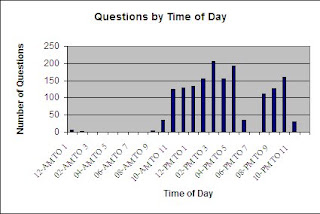
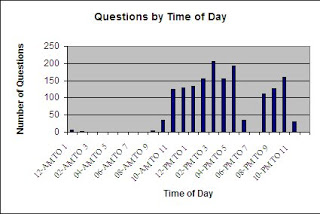
After writing that last post, I did some more analysis of our reference desk stats (I do love having data dumps from our online knowledge base into Excel!). Did you know that over 7% of the questions we’ve fielded were answered while there was no scheduled desk coverage? Almost 2% of all questions were answered between 10 and 11 at night, and reference service ends at 10 on Sundays and Monday through Thursday. Another 2% were answered in the hour before reference services begin Monday through Friday.

These I can understand. But what’s with the average of one question per term week answered between midnight and 9AM? 9 of these 14 questions occurred between midnight and 4AM. I can tell you right now, those weren’t answered by me!

Leave a Comment

Reviewing Stats: Revealing Insecurities


Like most libraries, we keep reference desk stats. These are more or less unenlightening. Numbers of transactions… sortable by date and time, length of transaction, type of question (reference, directional, technical), type of patron (student, faculty, staff, community), how the question came to us (at the desk, by phone, by IM, etc), and even who answered the question. We even go that extra mile and type in the question and a sketch of our answer. …Still mostly unenlightening for most purposes.

The way I see it, we’re driven by a quadruple motivation: we’re used collecting statistics, our administrations want statistics that’ll help them justify the money it takes to run a library, and we want to figure out what we do all day, and we want to figure out what our users need.

And before you discount the first motivation, consider some of the statistics you keep. Are these useful? Be honest.

And not so sure that a primary motivation is to figure out what we do? Maybe this isn’t a ubiquitous motivation, but I know that I have a really hard time articulating what it is to be a librarian. It’s not just about the number of people that ask me questions. In fact, I’d go so far as to say that the number of questions is somewhat incidental, kind of like the fact that the number of flowers in a garden has little direct correlation to the quality of the garden. Still, when I lack any other explanation for why I put in extra hours of work last week, or why I have to be selective about the new tools I’d like to play with, or the new initiatives I’d like to be a part of, I grasp at these statistics as a concrete way of quantifying my workload.

Unfortunately, this usually leaves me even more confused about how I spent my time. Yesterday night, as I tried to figure out why I’d run completely dry of imagination and energy in the last couple of weeks, my stats weren’t very enlightening, so I looked even farther back. Since September 12th (so, in exactly 5 months) I’ve answered 383 reference questions and conducted 109 individual consultations. Add to this the two library committees and the campus committee I’m on, and even the special projects I’ve been a part of… and I still don’t know what I’ve been doing. (Along the way I noticed that I had reference consultations with many freshmen and only 5 seniors in fall term, and with many seniors and so far only 1 freshman in winter term… interesting.)

So here’s the problem as I see it. We’re collecting a lot of numbers in a desperate attempt to tell a story about what we’re doing. That story may be something like “Look at the benefits your money has allowed,” or it may be “look at what our users are doing, now what more can we do to support that?” But what’s harder to do is to come up with the stories we think will best capture what we do and how we support our users, and then collecting stats that will help us tell those stories.

I’m not saying we need to predefine the stories. I’m saying that maybe gate counts and reference stats, as we keep them now, may not actually give an accurate picture of the services we provide, and I wish it were easier to come up with stats to keep that would more accurately reflect the stories we see around us every day. And I also think that the stats that help us coordinate our services may not be the same stats that we use to communicate with people outside the library.

We’ve begun to make a stab at it at my library, but I’m sure that as soon as we’ve got some time to devote to it we’ll want to continue rethinking what we collect and how we collect it. So far we’ve discovered that it would be nice to flag reference questions so that we can get a count of how many of them are complex research issues compared to the number that are fundamentally skill-based (“how do I find this call number,” “how do I find the text that goes with this citation,” etc). This will help us talk to faculty members who have a hard time comprehending both how lost their students can be in an academic library, and the exciting stuff we can do with students who have really complex research needs.

We’ve also been collecting information about where students hang out in the reference area, where they do their group work, where they work alone, and where they use their laptops. It would a lot of fun to map these activities using GIS or something (…says I, who have no idea how GIS works…), or use this information to inform later reorganization of other spaces in our library.

But I’m still frustrated with two things: how difficult it is to capture the story of the library (especially if you’re collecting numbers without planning the type of stories that would be meaningful to our audiences and ourselves), and how dependent I am on these types of numbers to define what I do. Why am I so unsure about my purpose on campus that I resort to counting the number of times people come to my office or the desk? Why is the campus so unsure of our value that they ask for these numbers, or do we give them the numbers because we can’t think of anything else to give? Is there a more meaningful way to tell our story? And would administration buy into a new narrative structure now that we’ve made them so accustomed to gate counts? What would the new narrative even look like?
4 Comments

Feeding the Free Web

As more and more rich, wonderful, authoritative sources go up on the free web, the trick becomes finding it, organizing it, and making it available. And I’m sorry, but I’m not going to bug our catalogers every time I run across a great site online, no matter how accommodating they are whenever I’ve decided to go that route. But handing them anywhere from 5 to 50 links per week would be a prohibitive pain in the neck, even if formal classification in the catalog would provide the best access, or even if we could be sure that the URLs would be stable. I just wouldn’t do it. I’d spend more time than I have to spare agonizing over whether or not it was “worth it” for each site, and in the end they’d just pile up and become one of the looming projects that I always know I should be getting to but never seem to actually do.

So I’ve been trying to keep track of these things in my del.icio.us library, and now that I’ve got a mini curricular and professional library building up, I’ve started feeding the annotated links to web pages attached to my research guides.

So far I only have two up and running. One is on my subject guide for Art and Art History here, which encourages students to see recent items here, or just play around on my del.icio.us library for themselves.

It’s not a perfect solution, and I’m still having trouble standardizing my tagging practices… And I’m not sure if students will ever actually USE the links. But in my imaginary world they’ve all (even the pre-majors) flocked to the newly updated pages and are gazing in wonder at the amazing-ness that is an RSS-fed page of annotated links.

Hey, a girl can dream.

2 Comments

Being on the Other Side of Chat Reference

Yesterday I was asked if I could help someone find the first known translation of a Russian short story (from the early 17th century) into German. In no time flat I’d found a bibliography and was composing my email response when I realized she’d asked for first translation into German… not English, and no bibliographies we have would record such a date.

Scrapping that email I wrote another one about using WorldCat to find bibliographies of this author’s works, and then limiting the language to German, because a German bibliography might just record the date she needed. (I don’t think she quite understood my response, though, but that’s another story.)

Anyway, then one of my co-workers pointed out that the University of Illinois has a whole library devoted to modern languages, and they might have such a bibliography. And sure enough, their catalog returned a record for something that looked promising, if only I could read the German. But I didn’t really want to ILL the enter book on the off chance that it contained the date I needed, so I hopped onto their As A Librarian page and, on a whim, chose the chat option. I’ve never been on this end of chat reference, so I was curious to see it in action.

I explained who I was and what I needed, and the librarian was very friendly and helpful, but in the end had me email my request so that she could give it to someone with an actual command of the languages in question.

This more specialized librarian found what I needed in a Russian-language bibliography, even scanning the page from the bibliography (which I still can’t read) so that my patron could see all the information.

What helpful people! And I’ve got to say, I really enjoyed starting out my quest via chat so that I could clarify myself when the librarian didn’t understand what I needed without having to play email tag. By the time I composed the email I was much more confident that I’d be able to write a question that the librarian on the other end would understand.

I’ve always been hesitant to ask for help from people I don’t know. Before library school I had never in my life asked a librarian for help. But every time I have an interaction like this a little more of that old hesitancy dies. World, beware.

4 Comments

Know Your Results Before You Search

Imagine going, money in hand, to a storefront that gives no clue as to it’s merchandise. Will this store sell shoes, food, antiques, or pets? Lined up next this blank storefront are about 50 others, each with a more or less obtuse name, and each with a microphone protruding from it’s door, ready to receive you requests. What would you do?

This is what students face when they first delve into online searching. From long familiarity, most students have a pretty good idea that they’re searching the author’s text of web sites when they choose to request information from Google. Some might even know that authors can supply metadata, but many do not. And most are familiar with the result list as it is presented, and what they can expect to see when they click into a result.

But what about library databases? Some allow full-text searching, some only include citation, abstract, and controlled vocabulary. As the librarian for languages and literature, my primary tool is the MLA International Bibliography (Chadwyck Healey), and this database doesn’t even include an abstract, and the controlled vocabulary is not very evenly applied. (What I would give for MeSH-like terms!) But my students also need to know how to manipulate catalogs and several other databases, including JSTOR, which replaces MLA’s subjects with fully searchable full text. There is almost nothing similar about searching these two databases because everything inside the storefront is fundamentally different. The words you choose, the care with which you construct searches, the results you get… everything changes.

So I’ve begun teaching databases backwards. I start with a record and get the students to understand what’s there and what’s being searched. Then we move back to the result lists and figure out how to leverage a “messy” keyword search by analyzing the results, quickly opening anything that looks remotely relevant, and gleaning search terms that way. Then and only then do we move back to the search interface and I’ve found it takes very little time for the students to understand what’s going on now that they know what they’re searching and what they can conceivably expect to see when they click “Go.”

My favorite question from a student came part way through one of these backwards searching experiences. “Can I use these same ideas in ProQuest?” I answered that she could use exactly this technique to learn at least the basics of any of our databases. But I knew she still had more to ask… “Can I use these same ideas in Google?” She asked. Yes — yes you can.

I need to plant that kid in all my classes.

[Update: Thanks to Mark for pointing out that as I’ve laid this scheme out here, it works best in class situations. But with a little tweaking it also works in “real life” when you confront a new database. See the comments section beginning here for that exchange.]

10 Comments

Possibly Impossible Idea

Walking in to work this morning, musing on staffing and service models for liaison librarians and fumbling for my keys with mitten-encased hands, I decided that our liaison model is doing just about precisely half of what it could do (time, money, and staffing aside). Currently, there is a liaison for each major on campus. Freshmen and Sophomores are encouraged to meet with the liaisons as well, but before they declare a major they may have to figure out new people for every class they take.

Now I’m not saying that it’s bad for students to go to the person most suited to answer their questions. Far from it. But I remember being too intimidated to figure out who the people were who could answer my basic questions when I was a pre-major, let alone re-figure for each class.

But what if each freshman were assigned a librarian at the same time that they’re assigned a faculty adviser. This librarian could be “their” librarian who could do anything from answer basic questions to directing them (and personally introducing them) to the liaison most suited to answer specific questions.

Here’s the major hitch in my plan: 500 freshmen… 7 librarians… Not a good ratio, especially if any of them still needed their personal library adviser by the time they got to sophomore year. We could end up with as many as 1000 students per librarian, plus our students who have already declared majors.

Of course, many students wouldn’t sit down with us more than once (and they’d only come that once if we required it). So it might not be that much more work. And it might be a nice way to personalize the library.

I just don’t know. It was an interesting thought, if nothing else.

Leave a Comment

Exploring Cooperative Collection Development

As part of MPOW’s strategic plan for this and the next three years, we are exploring the idea of cooperative collection development with St. Olaf. Situated as we are, just a couple of miles apart and having a shared catalog, we’ve decided that it makes a lot of sense to look carefully at our collections, our ordering, and our processing to see if there’s any way that we can capitalize on our proximity and general good will. We’re wondering if and to what extent it’s possible to pool our resources, provide the best possible access to the widest range of resources, and yet not jeopardize any of the current customization we offer our communities.

So for almost exactly a year, we’ve been analyzing our collections to find overlap, learning about other libraries that have gone the cooperative collection development route, and worked with R2 to evaluate and recommend a redesigned acquisitions and technical services workflow. Needless to say, this has been a little bit of a strain. I think we all harbor a little corner of fear that our jobs will change and we’ll have to give up something we love.

Personally, I’m feeling better about the process the farther we go. We’ve learned a lot that makes me think we’re already doing a pretty darn good job, which is always nice to hear. Of course, I’m not working in one of the departments that’s being thoroughly studied, so the stakes are lower for me. But even so, we’ve been able to norm ourselves against other libraries (and find that we’re generally doing well), and we’ve been forced to take the time to reconnect with what we do and why we do it that way. We’ve found that we have relatively little collection overlap already, and that we’re both pretty well in sync with our user communities.

But in this context of exploring the benefits and challenges of local, semi-local, aggregate, and singular collections, I’ve been interested in the analogous discussions about aggregate collections and aggregate data about collections. For example, there’s Walt Crawford’s piece in Google’s Library Center newsletter or his revisitation of the topic in his January issue of Cites & Insights (pages 3-4). In these pieces he states that “every good library is a local library,” but that aggregate collections can help us serve our communities. He specifies that a local library is not just a collection; it is also a space. And while I’m not going to get into the “library as place” issue here, I think that this intersects with collection development in important ways.

No matter how much we feel like “two libraries acting as one” (which is the catch phrase of this whole operation), we won’t have succeeded unless our user communities think of us as two libraries working as one. We’re only two and a half miles apart, and some libraries on university campuses are farther apart than that, but we can’t start to think of that as an insignificant distance to our students. Not only does it require that they request books ahead of their deadlines (and good luck getting people to do that, but that’s another topic entirely), but it also requires that we think carefully about the research impact of having a semi-split collection.

If we could reach every one of our students through instruction, the research implications might be slightly less important. But we don’t reach all students, and I can’t foresee a time when we will. So what happens when students browse the shelves and don’t see whole sections of the larger collection? This is especially important to literature and history students who might be faced with less than informative catalog records, titles, or even titles of chapters. We humanities people are not given to providing informative titles to things. We like style. Flare. Allusion. We don’t like to actually tell people what they’ll be reading about until they open up to the introductions, conclusions, and indices.

People have argued that virtual browsing will solve these problems, but I’m not convinced. We haven’t caught all students in our instruction nets, so how will they know that browsing is even possible, or that they should do this by subject and by call number? But more importantly, virtual browsing is just not up to par, especially for literature collections and especially with our current catalog. Virtual browsing would require intuitive and transparent browsing functions, deep indexing that goes well beyond LCSH to include such things as protagonists and geographical settings (and probably tagging), easy access to introductions, conclusions, and indices, and probably a whole host of other functions. In our particular catalog the situation is complicated by the fact that there was a space of time when cataloging policy didn’t include adding contents notes, which pretty much kills the findability for short stories or essays held within larger volumes.

This doesn’t mean that I’m against the project we’ve undertaken. I wholeheartedly agree that we shouldn’t haphazardly buy the same books at two libraries that are within (long) walking distance. I’m entirely behind the idea that we should make sure that we’re serving our user communities as efficiently (money-wise and space-wise) as possible. But through it all we need to make sure that our patrons see the benefit. We need to figure out how to maximize benefit without jeopardizing all the work we’ve done to make each of these libraries our users’ libraries, our users’ spaces for learning, research, socializing, and yes… even browsing.

The best possible outcome would be for our faculty (who do much of the book selecting) to come to a nuanced understanding of whether a particular book should be in one or both places, for our two libraries to focus on collecting browse-able and useful collections with an eye toward sharing, and for the librarians and both places to increase our collaborative relationship so that we develop even better working relationships as a side effect of learning how to negotiate between our two collections. Oh yeah, and for our faculty and students to recognize the decisions we’ve made and agree with those decisions.

Leave a Comment

An Argument Against Library Greeters

A while ago Laura blogged about her idea of putting WalMart-like greeters in the library. When I read it I remember thinking that this might work for some people. I imagined someone (other than myself) feeling all warm and fuzzy that somebody had bothered to smile and say “hi.”

Then I imagined me… I’d be trying to figure out if there was a back entrance or an open window I could use to get in without having to walk past a greeter. Then I’d have all my routes mapped out in the library in such a way that I’d be able to avoid all eye-contact with that poor greeter. On the up side (from a library statistics point of view), once I was in the building I’d be loathe to leave because I’d have to pass through the dreaded front entrance if I wanted to check out any materials. I imagined myself timing my departure to be on the far edge of a group of other people, buffers between me and certain greeting. This could be a devious strategy for increasing the length of time patrons spend in the library.

But now I’ve just heard another argument against implementing this idea at our library. My student worker was just in a discussion with some of his friends about WalMart greeters and how it’s obvious that they’re only there to keep people from running out of the doors without paying for their merchandise. “Why else would they pay somebody to stand there all day? They obviously don’t trust anyone,” was the comment one student made a couple of times. This was seconded by the group in general.

So it’s not the strongest evidence, but since I have a pathological aversion to greeting people who are paid to smile and say “hi,” I’ll take whatever falls in my lap. “No,” I affirm to myself as I twist this conversation to fit my ends, “I don’t want to seem distrustful. I don’t want my students to think that I only see them as book thieves. And heaven help me, I really, really don’t want to have to sneak in and out of my own library.”

5 Comments

Licenses, e-Access… Are They Diminishing Information Distribution?

Just before the new year, I was talking to one of the people on our copyright committee and he brought up a very interesting question. Is it possible that we will run into an information shortage as we move toward more and more e-access for everything from music to journal articles to books? Here is his reasoning.

First there’s the problem of disappearing fair use. E-access comes with license agreements which trump fair use, and it immediately flips the switch from copyright/fair use to DMCA, which radically reduces user rights. So what happens if a larger and larger portion of our collections are ebooks, ejournals, emusic, etc.? Will our faculty be able to employ these works in their instruction to the same extent? This is largely dependent on the licenses we sign, so as more and more of our collection is electronic we will have to be more and more careful what rights we sign away.

Secondly, what happens if the major, larger, richer libraries stop receiving print versions of books and journals and instead subscribe to e-access for those things? And what if their license agreements restrict those libraries’ abilities to lend via interlibrary loan? The smaller libraries that have benefited from interlibrary loan arrangements may not have access at all any more.

I’d never thought of this before. I love e-access to information, and it would be hard to serve our students without it (and we don’t even have a traditional distance education program, so I can’t imagine what a boon e-access is for those libraries). But I think we’ll have to be careful when balancing growing collections with static amounts of available space, or when we’re eager to give 24/7 access to patrons near and far. If we aren’t careful we may end up like stranded sailors dying of thirst in the middle of an ocean of water. We may end up having access to only our own subscription resources while wading through a flood of information flowing all around us, but denied to us.

It’s a thought to give me pause, and it reinforces that while libraries “aren’t just about books any more” we still need to be about books. It also reinforces that laws and license agreements need to change to the point that we can make use of e-versions of information in the same way that we can make use of analog versions.

2 Comments
css.php