Skip to content

Category: Libraries and Librarians

A Class I’d Love to Teach

Wouldn’t it be fun if a professor teaching late 19th or early 20th century philosophy, literature, or any other expression of thought and culture would let me come and help the students see how the library’s classification system grew out of that world view? That way library instruction wouldn’t be an “extra” class session. It would be course content and preparation for research projects, all at the same time.

2 Comments

Great Digital Collections

I just got out of a meeting where we learned about the benefits we get from being a CRL member library. I had no idea. And now I’ve got another whole collection to learn because the CRL library acts, in effect, like off-site storage for us. Who knew?!?

Anyway, they’ve got some incredible digital collections (growing all the time, of course) that are open to all:

Now I’ve got to start thinking how I can educate my faculty about borrowing from CRL, ordering purchase on demand materials from there, and generally putting our membership dollars to as much work as possible.

Leave a Comment

Which is better? One or Two… Two or Three…

There’s nothing quite like an eye exam. It’s not nearly as uncomfortable as other regular appointments that come to mind (dentist…. ghaaaa). But it’s no fun either.

I sat in that heavy chair today when I would normally have been eating lunch, and had pictures taken of parts of my eye I’ll never see, bright lights aimed directly at the most light-sensitive receptors in my eye, and drops of all kinds and colors splashed about quite liberally. But the worst part is always… “Which is better? One, or two. … Two, or three… Any change 4, or 5? How does that compare to 5, or 6?” I swear, they don’t actually change anything. And to add to the frustration, I always have the sinking feeling that my choices are wrong and that I’ll end up living with a prescription that puts glowing wavy edges around everything I see.

Then I returned to work and continued fixing the utterly messed up research guide for French and Francophone Studies only to realize that what I’m doing by pulling out 4 or 5 databases and explaining why my students would want those rather than the other 50 or so in the library’s collection is reducing the “One… or Two” effect. I’m trying to make the differences apparent and important. “One” has French language newspapers while “Two” has French language culture studies journals. Meanwhile, “Four” and “Five” have English Language articles on Language and French Literature. I sure hope this helps students answer with confidence “One is better!” and never have to worry that they’ve chosen poorly.

Well, that’s the ideal anyway.

4 Comments

The Problem of “Print” Resources in Research Assignments

We’ve all heard it before. A student comes to the desk and announces that although she already has almost all the sources she needs for a paper, her assignment specifies that she must include at least one “print” source.

In an interesting twist, I’m starting to hear this from students who’ve done everything right. They’ve consulted our databases and found the full text of scholarly articles online. But they get very nervous when I tell them that these full text articles online “count” as “print” sources. How in the world could they have known? It makes perfect sense to me and to their professors, but there’s no way a student could know that “print” simply means “formally published” in all but a small minority of cases.

So I’ve begun to teach Ulrich’s whenever I think this might come up. So far I’ve only done it twice, but each time was completely surprised by the reaction I got. The students ate it up, and of all the things we went over in class, this was the thing they’d come up afterwards to get even more information about. Finally, there’s a way for them to tell without a shadow of a doubt if the PDF they found on Google or via one of our databases is a “print source” or just some paper up online. Here’s the rule: if it’s in Ulrich’s, it’s a “print” source, even if it’s an e-only publication. As an added bonus, you can also tell right off the bat if a source is refereed, knew or established, some places it’s indexed, and whether or not it’s an e-only publication. (Added bonus for me, in order to teach Ulrich’s I have to check to make sure students are adept at finding the periodical’s name, which I always like to squeeze into library sessions.)

So that’s all well and good as a stop-gap measure, but what I’d really like to do is get away from requiring “at least three print sources.” Why not require at least three “formally published” sources, or ask students to determine if their sources were scholarly or not and then justify their choice? “Print” sources will only make less sense as we go along, not more.

4 Comments

“Extra” Metadata: Two Roads in that Yellow Wood

And while I’m in a musing mood… I think there are two directions you can go when faced with metadata (be it AACR2, Dublin Core, or what have you) that’s populated with a whole bunch of information.

You could say, “Hey, we’re putting more information into this record than our patrons use, so let’s not work so hard.” (Better study your patrons good and hard, though, before assuming you know this for a fact.)

Or you could say, “Hey, we’ve got all this stuff. What could we do with it that we aren’t doing yet?” (But be aware that this could range from the simple to the we’d-need-to-hire-programmers complex.)

The path you choose will depend on your circumstances, your patrons, and your ability to dream up ways to exploit metadata. But the path you choose will make all the difference.

Leave a Comment

Print vs Electronic Workflows

I’ve been kind of immersed in workflows recently. Our workflow consultants delivered their much-anticipated, much-talked-about, and much-feared reports yesterday. And today I’m musing about a few of their recommendations. Some I don’t think will fly at our library, or at least not to the extent they propose, but that’s a topic for another day or another lifetime. Tonight I’m mostly interested in the question of the relative workload of a print collection vs. an electronic collection. (Notice, I’m not talking access, relative value, or any of that. Just workflow and time commitment.)

I’m all for e-access. I love love love e-access to journals. Nothing makes me happier than to click our link resolver button and find that I don’t have to walk the 100 feet or so to our print journal collection. And I’m cautiously in favor or transitioning to e-access where ever that is warranted.

But… when I hear that we should consider reducing our print periodical holdings at every opportunity, I worry a little bit that only one part of our workflow would see a benefit while other areas might see increased time commitment. Granted, print periodicals take up a lot of space, a lot of packing and unpacking, a lot of binding, and countless other processes. But what might the process be in an e-only or e-mostly environment?

  • Acquisition decisions will take more time because suddenly we’ll be deciding on costly bundles of journals rather than single journals. We’ll have to think even more carefully about the benefit of groups of journals because we may not want every journal in the collection, and it’s a hefty chunk of change.
  • How much time will it take for ILL and eReserves staff to wade through license agreements to see what they can lend or copy from an e-collection rather than relying on more standardized (though not necessarily easier) copyright law? (I’ve talked about the other possible effects of e-resources on ILL before.)
  • Keeping up with links and holdings and access issues and changes in subscriptions won’t go away any time soon.
  • And there may be other unforeseen processes that we don’t know about because we’re still learning what an e-mostly world would feel like at our library.

I don’t know if these increased time commitments would or wouldn’t be worth the savings in the periodicals department of technical services, but these and other repercussions should be taken into account if efficiency is the name of the game.

And I haven’t mentioned archiving. It goes without saying that this is an important issue that has to be considered every time we cancel print subscriptions. But everyone knows that, and it’s not up for debate at the moment.

5 Comments

Gimme Gimme Gimme

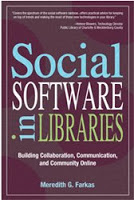
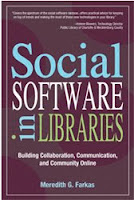
Yeah. Big ol’ “Me Too!” on this one. Cuz why? Cuz Meredith rocks, that’s why. Oh, and the book looks good, too.

There’s a section in the first chapter (a much better teaser than most introductions, btw) that I think asks the essential question: Why should librarians care about social software? Answer it for you and your library, adopt Meredith’s answers, or do whatever else it takes, but don’t leave this question on the back burner.

My answers? Well, they map very closely onto Meredith’s, and they’re constantly evolving, but here’s a sketch of their current state. I have not found that my students are very familiar with many of the social software we talk about all the time. I’ve had students ask me why I’d want to IM, diss Facebook and MySpace, give me blank stares when I mention social bookmarks, wonder what Flickr is and point out that I’ve left of the “e.” And don’t even get me started on RSS. But that doesn’t mean that social software isn’t important to me in my library with my user community.

No, social software is still important for many reasons, but foremost in my environment is that it’s a way for me to provide value-added, nimble, real-time, personalized access to online resources and research support, learn from and collaborate with colleagues near and far, and improve my own workflow and my students’ workflows. Six months from now, these reasons will have evolved again, I’m sure. But through it all Meredith’s last paragraph says it all. These things are, above all, tools. They’re tools that help libraries stop being faceless institutions and start being teams of people helping people.

Leave a Comment

The Value of Book Reviews

Yesterday I taught a class on finding book reviews. The professor had specifically asked for this topic, and I was happy to comply, but I was a little at a loss to figure out what I could do other than pointing out the “document type” limiters in different databases, and show the differences between book reviews published in scholarly journals as opposed to trade publications and newspapers. Luckily, one of my colleagues has thought more about this than I have and taught several classes on book reviews, so I shamelessly cribbed her materials and even mooched some of her examples. And although I can take very little credit, the class we built together seemed to go over very well with the students and this faculty member.

Warning: Extreme examples of my inexperience as a librarian and researcher are about to be revealed. Read on at your own risk. I cannot be held responsible for injuries to eyes that have rolled too far back into your head and can no longer be retrieved, or for bruises to heads that have been beaten against computers. Nor can I be held responsible for damage to hardware or software of said computers.

. . .

I learned a whole heck of a lot teaching this class. First of all, I’d never taught for American Studies before, so I spent quite a bit of time simply familiarizing myself with the publications in that field and where their journals get indexed (Academic Search Premier and ProQuest each index the major American Studies journals, in case you’re interested). But the real breakthrough for me came when my colleague and I were working to answer the question: so what? Why would you spend time looking for book reviews given the fact that the vast majority are positive, a good percentage are neutral, and only a tiny fraction are negative? What use could writing governed by such a ritualized style and publication process be other than to give a summary of the work?

Well, it turns, book reviews can be extraordinarily useful. So useful, in fact, that I will be incorporating them into as many classes as possible in the future.

  • These short essays can give clues about where a particular book fits into the field and niches of that field because it’s one of the reviewer’s tasks to say how well or poorly the book works for people in that field.
  • Reviews can also provide clues about the major players in that field. It’s not uncommon for reviewers to compare the author or book to other authors or books in the field or having similar theoretical perspectives. You can find valuable primary and secondary sources this way. You can also look for other things written by the reviewer, since he or she might also be a player in the field.
  • Reviews may highlight was evidence counts as good evidence in the field. Does the reviewer wish so-and-so had consulted census data? Bingo, you know that statistical information holds cache with this group of scholars. Does the reviewer applaud the use of images, or hint that the author should have explored the intersections between this topic and, say, cinematic history? That’s more information for you to consider as you think about your own topic.
  • And you can also find out what disciplines might be interested in a topic by seeing where reviews for the book appear. Mary C Waters’ book Black Identities was reviewed in the year 2000 by Black Issues Book Review (Vickerman 2000) and by the Journal of Economic Literature (McKinnish 2000), just as an example.

But the fun doesn’t stop there. Book reviews are chock full of the important buzz words in the field. In my class yesterday we looked at reviews for Hope in a Jar: The Making of America’s Beauty Culture. We found one from the Journal of American Culture (Kay 1999), one from Publisher’s Weekly (“Forecasts” 1998), and one from Entertainment Weekly (Jacobs 1998). Reading from those reviews, we not only came up with lists of disciplines, related topics, and related concepts, but we also came up with a substantial list of search terms which yield really beautiful results about the social history of the beauty culture in America. What fun!
References:

Forecasts: Nonfiction. Publishers Weekly. 245.16 (1998): 57.

Jacobs, Alexandra. “Hope In a Jar.” Entertainment Weekly. 440 (1998): 68.

Kay, Gwen. “Hope in a Jar (Book Review).” Journal of American Culture (01911813). 22.2 (1999): 106.

McKinnish, Terra G. “The New Race Question: How the Census Counts Multiracial Individuals (Book).” Journal of Economic Literature. 42.1 (2004): 201-202.

Peiss, Kathy. Hope in a jar : the making of America’s beauty culture . 1st ed., New York: Metropolitan Books, 1998.

Waters, Mary. Black identities : West Indian immigrant dreams and American realities . New York ;Cambridge Mass.: Russell Sage Foundation ;Harvard University Press, 1999.

Vickerman, Milton. “nonfiction reviews.” Black Issues Book Review. 2.4 (2000): 54.

8 Comments

The Futility of Search; or, Why Librarians Will Always Be Important

A colleague of mine recently asked what search strategies or terms I use when I’m looking for image collections online. My answer? I don’t search. I monitor sites that point toward collections, I ask colleagues, I keep my eyes open when I’m wandering, more or less lost, through the interwebs. Everything I trip over, I bookmark. Strange as it may sound, I don’t think I’ve ever actually searched for a collection. Even stranger, I never realized that I never search for these things until my colleague asked me about it.

Coming to this realization for the first time, I wondered if I’m not really a librarian. Aren’t librarians about search? Isn’t that what we do for our patrons? Isn’t that our unique contribution to the world? And then a wise man wrote unto me, “Search is for losers. Personal networks and contacts are where it’s at.” (Yes, email quoted with permission.)

While I’m not saying that search is dead (Nitzsche and Barthes are much better at such absolutes than I am), and while I know that’s not what Steve was saying either, I’m starting to re-imagine my purpose as a librarian. I’ve just realized that I’m working to become one of those people in the social network that other people go to when they don’t want to search for image collections and other such resources.

And I think this speaks to that perennial question: what role will librarians play in this evolving information world? Expert searcher? Yes. Expert selector? Of course. Key player in social networks? Absolutely. As more and more goes online and as search results get more and more unwieldy, those of us who make it their life’s work to collect, save, and make available the resources we discover will serve a crucial role in the research lives of our patrons.

6 Comments
css.php