Skip to content

Category: Random Thoughts

Prioritize or fail

thinkingGreg McKeown was recently on NPR talking about the importance of prioritizing in leadership. He’s been obsessed with the question of why capable people plateau in their fields, and he’s decided that the answer is: success. Success leads to increased opportunity. Increased opportunities lead to diluted focus. Ultimately, he says, “Success can become a catalyst for failure because it leads to the undisciplined pursuit of more.”

After spending a couple of months helping to draft our strategic plan, spending a summer helping to update our mission, vision, and values, and having ongoing conversations about sustainability within my department, McKeown’s ideas seem at once brilliant and impossible.

The fact is, we have been successful, and this has lead to increased opportunities. And personally, my work has broadened in focus from direct reference and instruction about library resources to a myriad of activities aimed at improving teaching and learning on campus as it relates to information literacy. What’s more, I think this broader focus is far healthier and more realistic if my goal is to play a role in graduating information literate seniors (I only ever get to teach a tiny percentage of students, so more systemic information literacy infusions are necessary to my goal). But depending on how I look at it, perhaps I do have a pretty singular goal (graduating information literate seniors), or perhaps I have a plethora of great opportunities that dilute my focus. Where up the hierarchy from the very granular to the very high-level should these focused goals exist?

Comments closed

Being Negative is Safe

It struck me recently that those people who fixate on the flaws in every plan are in safe territory all the time. There are no perfect plans. There are no perfect interfaces. So these people will be right every single time — there are ALWAYS flaws.

But you can’t actually live like that, getting bogged down under the weight of life’s many flaws. And you certainly can’t provide a service or run a business like that. At some point you have to choose a direction and move forward, imperfections and all. This choice to move forward isn’t naiveté, it’s life.

9 Comments

Judging a book by its cover

booksSo here’s a question: If you make your digital humanities project so that the product is a gorgeous website with swoopy interactive capabilities and lush soundscapes, will people engage with it on a deep scholarly level, or will they get stuck in the flash and glam?
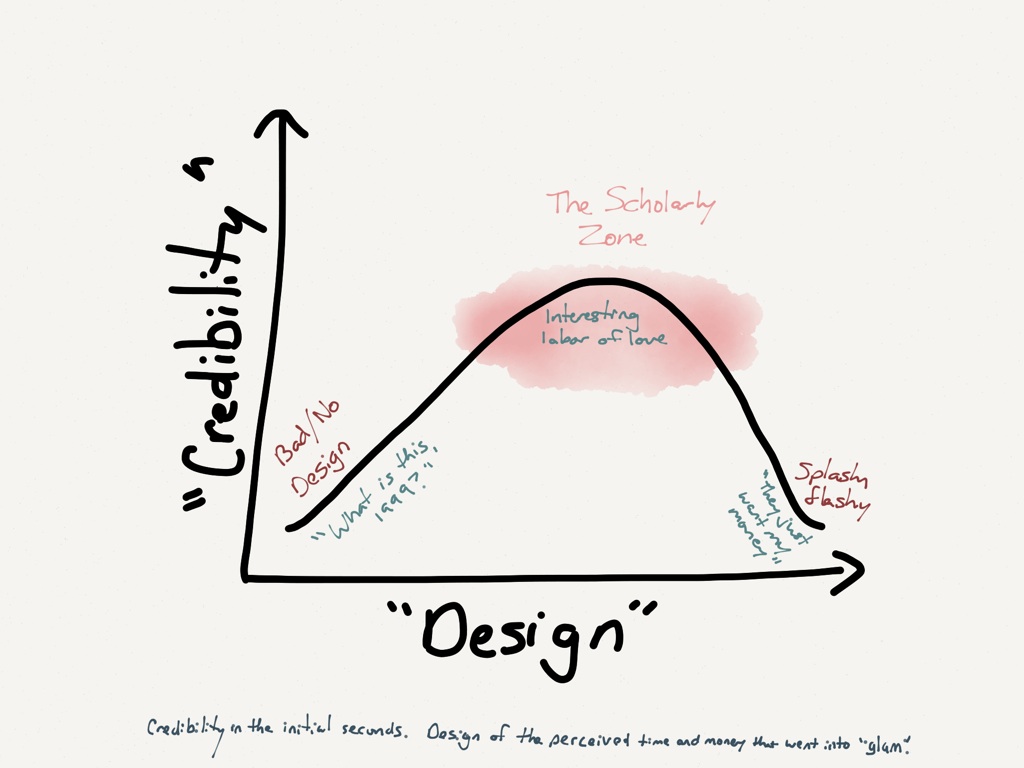
This was a question that came up today at a DH workshop on campus, and it got me to thinking about a similar question that had come up at THATcamp in Denver last year — how much web design do you need before people will pay any attention to your site?

People make snap decisions about website credibility, and they do so largely unconsciously, so research suggests that if you make your site look nice, people will stay on it rather than move on to look for something “better.” This is what people at THATcamp were talking about last year — the need to have enough web design built into their DH projects that their projects will be taken seriously.

On the other end of the spectrum, if a site is TOO beautiful, I start thinking it’s likely to be trying to get money from me. All the money for the custom designing and maintenance has to come from somewhere, right? Likewise, I’m not at all used to seeing scholarly books come out with incredibly designed covers, glossy pages, and custom illustrations.

So maybe there’s some spot part way between “grungy” and “flashy” that would appear the most credible for scholarly DH work. The question is, where along that continuum is the sweet spot?

thoughtgraph

11 Comments

Thesis writing as method acting

theater masks
by Iris


Most of my seniors are in the midst of writing their senior theses at the moment. For some, this is their first time doing any major library research (no kidding). For most, if not all of them, this is the biggest, longest, scariest paper they’ve ever had to write, and they can’t graduate until they’ve successfully completed it.

For students going on to graduate school, this is fantastic practice for their futures as scholars. For everyone else, it’s a really really big paper. And yet everyone is expected to produce work that demonstrates the student’s ability to behave like a young scholar — an almost-expert insider in the community of inquiry that is their major field.

This business of becoming an expert inside in a field is hard enough if you’re aware that that’s your task — it’s harder still if nobody has explained that this is what they want of you. And in my world of information literacy, it’s probably the single most important concept to get across. No evidence that they examine is intrinsically “good” or “bad” evidence. The question is, good or bad for what and for whom and in what context?

“To become an insider requires access to information that is valued and sanctioned with that [conversation] space…. This requires knowing about the sources of information that will inform practice, why they are valued and sanctioned by the community, how they are nuanced and the ways in which they can be accessed” (Lloyd 2010, 10).

I can teach advanced searching of the MLA International Bibliography until I’m blue in the face, but if my students don’t realize they they must first become aware of the norms and conventions of the conversation they’re entering, they have no functional way of selecting appropriate evidence, asking questions of it that are valued within the community, and asserting credible claims for their community.

In essence, I’m teaching these students, many of whom will not become PhDs in their chosen fields, to be method actors. See the scholar; be the scholar. Take on the tweed coat, revel in it, and take on the values, characteristics, and moods of that scholar as if they were your own. Only then will they be able to find, select, interrogate, and make appropriate use of the information that surrounds them.

——–

Lloyd, Annemaree. 2010. Information Literacy Landscapes: Information Literacy in Education, Workplace, and Everyday Contexts. Oxford: Chandos Publishing.

Leave a Comment

Having Survived Fall Term

And now, back to your irregularly scheduled librarian mundanity…

The last finals have be given, so Fall term is officially over. Fall terms are always intense, and this one was no exception. The difference this time is that I now have a couple of years of data all in LibAnalytics to look at. Turns out, I do over a third of all my teaching for the whole year in a two-week period in October. Yeow.

This year was also the year of “I wrote the paper, so now I just need some sources,” which is wrenching for both me and the student (particularly because the answer is often “there is no source that says that, so you’ll have to re-write your paper).

I’m also branching out in my projects, helping to run the new Emergency Planning task force. That probably deserves its own post at some point — it’s been a wild ride so far and I now know more than I thought I ever would about our electrical system and the Clery Act.

I ran through my limited energy a couple of weeks ago, so I’m really looking forward to the long weekend this week and the Christmas holidays coming up. I need some quality couch time!

Happy Thanksgiving, everyone. See you in December, most likely.

Leave a Comment

Motivation Follows Action

This has really been my first week of “summer.” School runs through mid-June here, and then there’s Reunion to keep us busy, and then sophomore portfolios to read and annual reports to write. Then I always need a week of down time before my brain can shift gears from Interruption Mode to Project Mode, so I spend that week sweeping up the crumbs from the school year, reading things, filing things, tossing things, and generally resetting my brain and my work space. Then comes the equally important week of vacation with my family during which my goal is to be as boring as possible.

Which brings us to this week. This week kicks off the summer projects. Some are really interesting and some are just necessary, but somehow I have to motivate myself to get through them all. So this year I’m trying a new approach: Motivation Follows Action. I say that all the time, and I find it’s true for me, so now I’m trying to put it into practice in a more systematized way.

Here’s the plan. I’ve posted my list of big summer projects on my wall in big letters. Each day, I have to touch at least two of them, no matter how minor the touch. There will be other things that crop up (there always are) so this leaves me plenty of wiggle room, but at least I’ll be making progress for sure.

So far, this is working well. So far I’ve pretty consistently thought, “I don’t really want to work on x but if all I do is figure out where the old file is on the server so that I can update it later, that’ll be a step,” and then find myself doing a morning’s worth of work on the project.

Motivation follows action so far. Fingers crossed that it continues!

1 Comment

Reasonable Expectation of Privacy, the NSA, and the value of metadata

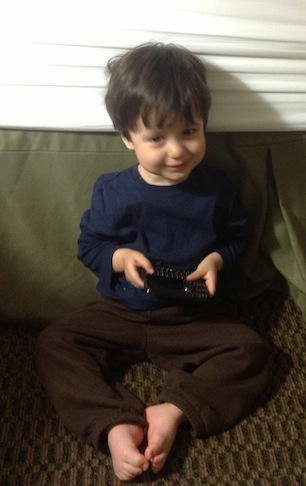
My nephew still likes phones.
My almost-two-year-old nephew still likes phones.


A week ago, the general public didn’t know or care about metadata. Now, thanks to the NSA, it’s all anyone talks about. Meanwhile, the Supreme Court has already said that this kind of information collection without a warrant is fine because there’s no reasonable expectation of privacy attached to this type of metadata.

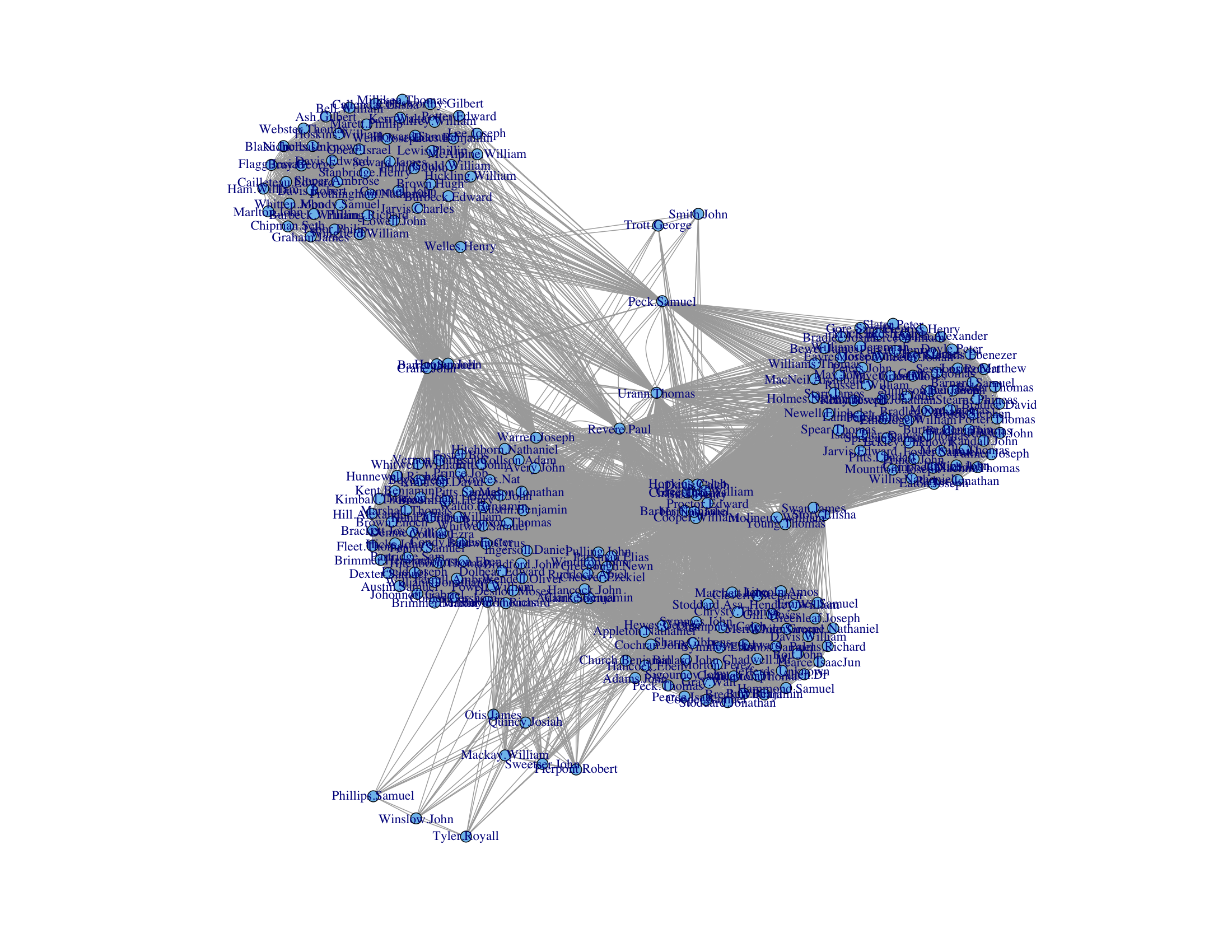
Using Metadata to Find Paul Revere

How much do people value information about the calls we make — the numbers we dial and the length of our calls? Quite a lot, it seems, even when they (supposedly) aren’t able or allowed to listen to the calls. You can do cool things with metadata about who contacts whom.

In libraries, we’ve know the power of metadata for a really long time. We’re in the business of creating, buying, licensing, and using metadata. And library vendors are in the business of charging us an arm and a leg for metadata, and of forbidding us from sharing their metadata. Their metadata is powerful. And above all, their metadata is theirs. Do not mess with their metadata.

Granted, cataloging and indexing produce rich, multi-facetted metadata, and the NSA is looking at “thin” metadata — nobody’s gone through the calls and classified them according to topic (we assume). This is the equivalent of author, title, and publication information. But perhaps telephone and internet companies will now be looking to library vendors for some pointers on making a tidy profit on all their metadata, especially now that we all know it’s not legally private after all.

It’s probably too much to hope that libraries will get better deals from vendors on the strength of an argument about how metadata isn’t private. The ultimate Open Access: nothing is private.

p.s. To any non-librarian readers: Libraries complete destroy your check-out records on purpose so that the government can’t ask us for it. Just FYI.

Leave a Comment

Email

If feel like I must get less email than pretty much everyone I know. Like most of the time when people talk about how much email they get in a day I nod and commiserate and hope they don’t notice that I don’t say “Oh me too!” Maybe something’s wrong with me? Maybe I’m not on enough projects? MAYBE MY STUDENTS DON’T NEED ME??

email

Not that I want more email, of course. Then I’d never be able to keep up.

Basically, I’m impossible to please.

4 Comments

An amateur anthropologist walks into a MOOC

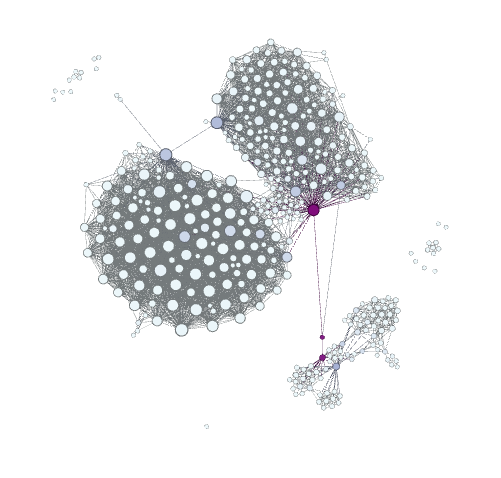
My Facebook Network
My Facebook Network

The first week of this MOOC I’m taking has been fascinating. I’m in a class of about 1,000 people from all over the world and (it seems) all levels of experience with Social Networking Analysis, with computers, and with standard English. We watch short video lectures, complete homework assignments (graded by computer programs), and talk to each other on the class forum (where there are also “Community TAs” — I’m not sure how one becomes a Community TA).

Nothing about this format or topic is anything like previous college or graduate school experiences for me. I’ve never done online courses before, I’ve never done computer science or social sciences, I’ve never taken a class with more than 30 people in it, and I’ve never been in a situation where I couldn’t just ask my professor for clarification or help. As it turns out, all of these put together mean that I spent a good portion of the week feeling pretty lost. The lectures and homework were fine. I’ve done those two things before. But really, if I weren’t very used to self-directed learning (I was home schooled until college) and very used to the way college courses work, I’d be really at sea. And, indeed, it looks like several people in the forums are very much at sea.

It seems like this course, at least, requires some pretty firm previous knowledge about how to navigate a course. Knowing to look at the syllabus (and find useful things like the existence of homework, for example…), knowing to pay close attention not just to the blurb instructions of the assignment but to read the entire full assignment, reading about how the assignment was going to be graded, etc.

It also seems to assume quite a bit of technical knowledge, most of it pretty basic, but not all of it. Knowing that it’s possible to change file extensions, or that the “#” sign at a beginning of machine-readable text means that the machine isn’t reading those lines, knowing that if you don’t know how to change config files Google will probably be able to tell you, etc. As great as the Community TAs are, they haven’t been very attuned so far to the differing levels of the people asking them questions.

And finally, it turns out that I answer questions for a living, and that I can’t seem to turn that off. If someone’s lost and gets “you’ll need to update the config file to fix that bug”* and the person is still lost, I swing into full librarian mode and write out all the steps in layman’s terms. If they’re still confused, I make a little Jing video. It’s pathological, I know, a hazard of the trade.

*All of us Mac users are having real problems running the software that does the network analysis. We’ve labeled it the Grey Screen of Death, and I spent a couple of hours today trying to figure out what causes it so that we can stop having it happen.

Leave a Comment
css.php