Skip to content

Category: Random Thoughts

Midsummer

I know it’s not technically midsummer. We passed that a while back. But here at work, it’s the middle of our institution’s summer. Whole weeks can pass with only one or two meetings scheduled. Whole days can pass without any student asking me anything (we don’t have summer sessions for our students, though we do have summer programs for other people’s students). Whole hours can pass while I concentrate on one project without interruption. Everything feels different.

One thing I’ve enjoyed about this summer at the library is that the various research assistants on campus seem to have decided to congregate every day and work side-by-side in the main computer area of the reference room. Each student works on his or her assigned projects, chatting occasionally with whomever is sitting at the next computer, and generally keeping each other company through the long hours of research. This may have happened in previous years, but I don’t remember it, and it warms my heart every time I see the group hard at work together.

People always ask me what I do all summer without students, and I rarely have a good answer. In fact, I usually just pick whichever project I’m working on at the moment and say, “well, right now I’m working on [whatever it is]” and hope they don’t say “but that won’t take all summer, will it?” Because it won’t. There are a million other projects to do, but very little that can be synthesized down to “in the summer I work on this kind of thing and that kind of thing” conversation snippet. For some reason, it’s rarely seems to be enough to say, like those students can say, that my colleagues and I gather every day to work in proximity on the various projects that can’t happen during the school year’s crush of interruptions, classes, consultations, and meetings.

So what am I working on during this week in the middle of our summer? Well, I need to get acquainted with our (brand new to us) instance of LibGuides (which we’ve been wanting for years and finally have). I’m putting together my piece of a presentation on learning-centric library instruction for a professional development day that’s coming up in a couple of weeks at Gustavus Adolphus. I’m figuring out what needs to change in EndNote to bring the MLA style up to date now that we have our 7th edition copies in hand (and I need to figure out how to handle their pesky restrictions surrounding the online version). I’m also trying to re-start the effort to make Metalib work the way we need it to work. And I’m drafting a proposal to assess our Research/IT service point.

Sometime soon (once I’ve figured out LibGuides) I need to embark on my summer schedule of updating all my departmental research guides. (This is when being the librarian for 10 departments becomes time consuming in the summer.) Then there are a couple of complicated course-specific guides I should start working on. I have some Moodle/eReserves documentation to overhaul, some instructional material to create and some projects to assess in my capacity as a member of the campus’ copyright committee, and some planning to do for a new project in which I will coordinate a continual environmental scan for our library.

At least, those are the bigger projects that I hope I’ll get to before the most active prepare-for-fall-term portion of summer arrives. I hope my brain and work life cooperate to make that possible.

Leave a Comment
And So They Burned It

As I drove in to work this evening the familiar voice of a piano professor here spilled out of the car speakers that generally only bring me voices of people like Steve Inskeep, Michele Norris, Scott Simon and the other body-less NPR friends that follow me through my days. She was explaining that Annea Lockwood composed an avant-garde piece in which a piano is burned. It’s called “Piano Burning” (which strikes me as a not very avant-garde name for such a piece), and tonight they’re performing it on campus.

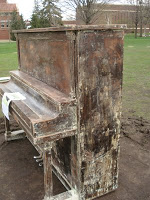
Arriving on campus, there was the dilapidated piano standing alone in the middle of the Bald Spot, waiting to be burned.


Pianos I’ve known have always lived in warm, homey spaces, or stood in state on a stage. They’ve always felt like they calmly conceal the potential to thrill you tomorrow or next year or when your grandchildren come to visit. They’ve always promised great things for the people who can touch them with care and skill, and for the people those artists know.

This piano, though, is just sitting in the middle of its rectangle of cleared earth in the middle of a wide, blank field, hunched under the gathering clouds, and waiting to be burned. I’ve never seen such a starkly alone piano.

And then they burned it.

4 Comments

It’s Been Quite A Week

Last Tuesday we hosted one of the periodic meetings of the reference and instruction librarians that work at the five Oberlin Group libraries in Minnesota. At least once a year we have a “Round Robin” session where we basically sit down, eat lunch, and then talk all afternoon about what each of our libraries are doing. We’ll set a theme for the day, but the themes are broad and nobody really cares if the conversation runs off on tangents. I love these days. This time the theme was about “Looking Forward” and included discussions of everything from mobile technologies to budgets. We also learned that we had about a week to decide if we wanted to purchase LibGuides.

That same day, the steering committee for that group of librarians met to begin planning what I’m now thinking of as the Coolest Project Ever: a day-long mini-Immersion just for us. We’ll meet, we’ll learn, we’ll teach each other pieces of the best instruction we know how to do, and we’ll remember again how much we can learn from each other. I can’t wait.

Wednesday was full, and neatly bookended by dentist and doctor appointments.

Thursday was a more-than-12-hour day that started with an un-fun budget meeting and finished with evening reference.

Friday I taught two classes and had two meetings before lunch, picked up Laura Crossett at the airport, made her hang out for a while so I could get a complicated research guide published, and then began the Weekend Of Fun. I have a very small handful of “best friends,” and two of them spent the weekend visiting me. Martha Hardy came down from the cities and joined me and Laura in what she called The Library Camp of Iris’ Living Room. Wonderful.

Monday morning, it was back to the airport and a fond farewell to Laura, followed by probably the hardest class I’ve ever had to teach, followed by a reference shift.

Which brings us to today. Today we got word that we have rooms and everything for MnObe Immersion, and I filled out paperwork that makes our imminent acquisition of LibGuides official! (I think that makes this the fastest library-related non-book acquisition I’ve ever been a part of, by the way.) I also started seeing some of the 60 students I’ve taught in the last 2 work-days, plus some of the students in another class that, yet again, cannot seem to make American Memory work for them. The professor and I have tried so many different ways over the last couple of years to make this particular class understand this particular resource, but for some reason it never seems to work out. I’m flummoxed.

In amongst all of this, in the last few days my cousin gave birth to a baby with Hypoplastic Left Heart Syndrome, a friend of a friend’s husband killed himself, another friend’s father tried in earnest to kill that friend’s brother, and my cousin spent all day today waiting for her baby girl to make it through the surgery that will begin the long process of constructing a functioning heart. I was feeling a little sorry for myself last week because of over-long work days full of too many things to do. Perspective gained. I have it pretty good.

1 Comment

LSW’s Growing Pains

An interesting thing happened. This little group of friends decided, mostly as a joke, to call themselves the Library Society of the World. Then that Society got big.

The amateur anthropologist in me has been watching the group negotiate this phenomenon for a while now, and it’s fascinating. Here’s a short sketch.

Two years ago, Josh created a wiki and basically told his friends “Wouldn’t it be fun if we called ourselves the Library Society of the World? Sign up, give yourself a silly title, and have fun.” At that point, we mostly communicated via Twitter and a Meebo chat room. At that point, we talked just like we’d been talking before. The only difference was that we’d adopted a group name.

Fast forward about a year as friends of friends started joining in the discussion. We still hung out in the Meebo chat room, though Twitter had blown up one too many times and most people had jumped ship for FriendFeed. I now no longer knew everyone I was talking to if I posted to the LSW FriendFeed room, which was pretty cool. My core group of friends was still my core group of friends because we’d been friends for a while now (of course there were a few new friends in the mix, because that’s how friendships work over time), but the LSW was bigger and broader than that core group, and there were even whole social networks of LSW members that I hadn’t joined (like LinkedIn for example).

Then an interesting thing happened. People started joining the LSW never having known it in its infancy. People started hearing about it at conferences and workshops. Big Names started declaring allegiance. New members figured they were joining A Group, something substantial, something with heft and momentum and growing name recognition (albeit, a Group with a pretty lose sign-up mechanism). Joining and participating in A Group comes with a whole different set of expectations than joining and participating in a circle of friends.

And at this point, with membership estimates topping 800, it’s entirely reasonable for new members to expect the thing to feel like A Group rather than just a group. Protesting that it’s “just a group” is becoming less and less productive. At the same time, the thing is a grassroots collection of librarians doing stuff and sharing information, which means that there’s really no formalized set of processes, governance, or oversight that people might expect from a Group. I’m not even sure I know where all the social networks are that have been created in the name of the LSW. The whole idea is for people to jump in and just do stuff, kind of like we did when we were just librarians doing stuff who also happened to be friends.

I’m fascinated to watch this Group (for it is undeniably too big to protest that it’s not A Group) and see how it weathers these growing pains. For my part, if I hear “I wish the LSW were more [fill in the blank] than it is,” I hope I’ll answer with an encouraging “Then help make it that way! Or at least make your corner of it that way,” rather than with something along the lines of “But that’s irrelevant because it’s really not a formal Group.”

Personally, I think this is an exciting development. It means that things are different, sure, and that we should probably take a step back and decide what will have to change and what can and should stay the same. But if more and more people start doing stuff in the name of the LSW, developing friendships, and forming their corners of the LSW into whatever it is that they need it to be, I think this can only be a good thing.

2 Comments

Notes from One Who Aspires to Great Public Speaking

Catherine Pellegrino talks quite well about how active learning could be as much a part of conference presentations as it is a part of our classrooms. I won’t recreate her arguments here (go read them!), but they got me to thinking about my own presentation style, the styles of presenters I’ve seen recently that kept me engaged. I will simply add that active learning may not scale to suit large audiences, or suit every topic, or fit every audience. If, for whatever reason, I decide not to include active learning in my future presentations, it will be by choice, and I will remember that this choice comes with the same huge consequence that I face in similar circumstances in my own classroom: I will have to work even harder to make sure that my presentation is engaging in the absence of mandatory engagement.

While I’m at it, I will remember how comfortable I’ve become in my own classroom not using PowerPoint, or using it very sparingly. And I won’t feel cowed into using it simply by nerves or a false sense of serving future audiences. Back in the day (by which I mean, “I’ve heard of such things but only seen them in disciplines other than mine these days”) people used to present papers, which meant that the actual paper was available for perusing later. Pretty handy if you weren’t able to attend the actual session, but unfortunately you have to have a pretty stupendously amazing paper in order to be engaging as you stood in front of everyone and read it. I can’t imagine ever having such an amazing paper that I’d be comfortable delivering this type of presentation. My style is much more pseudo-extemporaneous: me, a few notes and an outline, careful rehearsal, and maybe a handout or a PowerPoint. And for me, this PowerPoint does not substitute for a presented paper because that entire genre of presentation is foreign to me. No, if I’m worried about future audiences I’ll make a handout or a summary or a blog post or a video or anything that will make sense to that audience without saddling my present audience with stuff they don’t need.

It’s too bad that knowing and doing are such completely separate acts. I guess the best remedy will be practice… which would mean submitting proposals… and, you know, actually presenting.

Leave a Comment

Best Conference Ever… In An Odd Way

I’ve been lying here on the couch for most of the day, too tired to move, or read, or get up to put on a CD. I feel like I’ve been extruded, or beaten about the head, or like I’ve given blood twice in one day. But you know what? It was totally worth it to spend time in DC with so many of my favorite people.


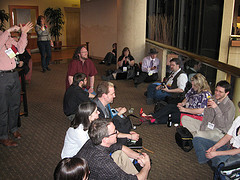
The really interesting thing, for me, was that I left this conference feeling like it had been the most productive conference I’ve ever attended… only I didn’t attend this conference. I just hung out in the lobby (or on the floor when our LobbyCon ran out of chairs and so we invented CarpetCon). And yet, I had all kinds of interesting conversations with other librarians about merging IT and research service points, unconferences, taking what we can from unconference philosophy and applying it to instruction (this Catherine’s idea, which she blogged about here), academic media librarianship, the death of Second Life as a viable experiment, Open Source library catalogs and how many people are seriously considering them now, to what extent it’s a good idea to shift our information to the cloud, benefits and drawbacks of WorldCat Local, … and whatever else came to mind. It was so much fun to sit there among these incredibly smart and talented people for two days and two nights, soaking in their ideas, feeding off their energy, and doing a healthy amount of joking around in the process.

I wish I’d had a little more energy to participate in everything while I was there. A couple of times I hit that “it hurts to be alive” level of tired and had to sit out some really interesting conversations. But other than that, there’s nothing I would have changed about this trip. I loved having the actual conference right there, with all the people going to actual sessions buzzing about the things they’d heard, what they thought had been interesting, and what they thought hadn’t worked out quite so well. It was like having the blogosphere happening in real life right there in front of me.

Oh! And since every conference must have at least one “Wow, it’s a small world” moment, here’s mine from this trip. Jessamyn and Laura Crossett and I stayed up far too late Tuesday night talking in full middle school sleep-over mode. Part way through the conversation, Jessamyn mentioned the town where she lived when she was young, and it turns out that for several years I drove right past her house every single week, at least once, on my way to the church where my dad was the assistant pastor. From there I moved to a suburb of Chicago and lived less than a mile from the Dominican, where Laura Crossett was at the time. So there the three of us were, in that room, and I’d spent years and years so near each of them. Weird.

P.S. The picture above was taken by baldgeekinmd and features me (or, the half of me that didn’t spill off the right hand side of the picture… yep, that’s me in the white sweater and jeans) and a healthy chunk of the lobbycon regulars.

1 Comment

I’m Leaving on a Jet Plane

At the very last minute, I decided to fly out to DC (well, Crystal City, actually, which is the travel equivalent of buying a vinyl rather than a leather couch). The chance to hang out with a whole bunch of incredibly cool librarians, talk about whatever comes to mind, and do so without registering for an actual conference just doesn’t come around all that often for me, so I’m pretty thrilled.

Actually, in my better moments I’m thrilled. I think of seeing some of my best friends in the world, of joking and being serious, of eating out, and of generally doing whatever seems best to do at the time, and these things seem very very good. Then I remember that doing this requires that I do unpleasant things like pack and figure out logistics and in many other small ways step beyond my comfort zone, my routine. These things feel much less good. In my worse moments these things are nearly enough to make me question the whole prospect of the trip.

This is a pretty typical set of emotions before I travel, though, so I’m not surprised. The day before the trip I always wish I’d just decided to stay home. But then I get to the airport, through security, and up to the gate. I sit down to wait for boarding, and suddenly everything seems better. At that point all the preparations over which I have any control are done and all I have to do is go with the flow. At that point, I can blend into an anonymous crowd and watch people or daydream or read or do whatever comes to mind. At that point, the trip finally starts to feel like a good idea.

I’m looking forward to that moment. And this time I’m particularly looking forward to what comes after I reach Crystal City since I’ll get to meet some new people and reunite with some of the people who know me best. And I can’t wait to experience my very first LobbyCon.

So all in all, things are going well. And now I’ll concentrate on the glorious potential of this trip as I go out and run some errands and then pack.

2 Comments

Charitable Writing

A couple of years ago Meredith Farkas wrote a post in which she introduced Josh Neff’s phrase “charitable reading” to the library blogosphere. The phrase is a good one, so it has bubbled up from time to time over the years. Essentially it means “read what people write and assume that those people meant well and that they are not stupid.” Granted, occasionally people don’t mean well, and sometimes they are stupid, but the idea is not to have those as your baseline assumptions.

I’ve been thinking a lot about this in the last several months (two years is an eternity in blog years but not very long in human years, so I’m allowed to still be thinking about this, right?), and I think that this is only half of what makes for productive written discussion. The other half is Charitable Writing: assume that your audience is not stupid, that they mean well, that they are probably trying to do the best they can or think carefully or otherwise conduct themselves well, and that they wouldn’t be reading and interacting with you if they didn’t want to.

Lately I’ve found myself unsubscribing from blogs and twitter feeds that, even though they have potentially useful content, present ideas in ways that sound condescending. Somehow that tone of writing screams “I’m pretty sure I’m smarter than you!” so loudly that it drowns out the calm murmur of the authors’ interesting ideas. This tone forces to me to work far harder at Charitable Reading than feels fair. It eventually wears me out. And so I unsubscribe and trust that others will point me toward the truly important posts.

Charitable Reading is hard. I fail at it frequently. But I think Charitable Writing is even harder because it it requires that authors see beyond the facts that they’re conveying, step into somebody else’s head, and hear from that other person’s perspective the tone that they probably didn’t know they were conveying… and then to do this from multiple potential readers’ perspectives. With so many potential ways of failing at this kind of writing, it’s a good thing that readers will be trying to read charitably!

3 Comments

Shoving and Making in 2009


The first annual (I hope) LSW Shovers & Makers awards are being announced as we speak, and I’ve got to say, it’s inspiring.

We all know that we do a lot of good work in this profession, and that it takes a village, and all that. This is tangible expression that these things we know must be true in theory really are true. I’ve been sitting here refreshing the site and getting inspired anew by what I’ve read there, and I hope that each of you will take the time to write up a little bit about what you’ve done lately that you’re proud of. I know a few of you and can’t wait to see you post about the work that you do, and I’d like to hear what those of you I don’t know so well have been up to.

P.S. Here is my profile on the site.

Leave a Comment

Digital Humanities and Digital Collections

If you’ve been following the work and discussion that’s come out of Project Bamboo, you will have noticed a few sticking points: there are the IT folks, there are the humanities faculty, and there is the original proposal, and so far there is not a whole lot of fundamental consensus between the three about an ideal path for this project.

You’ll notice I didn’t include librarians in that list, because for the most part they’ve been marginalized or absent from the discussions I’ve heard. When librarianship does make an appearance, it has mostly been in the context of finding stuff or of bridging the gap between the IT folks and the faculty. (There could be another whole blog post about why I think librarians could play a much larger role and how we do more than find things, but I don’t think that’s actually the fundamental sticking point. At least not yet.) But I digress. As I was saying, I hear one of three distinct voices whenever I hear about Project Bamboo, and this was never more clear to me than yesterday afternoon.

Yesterday afternoon one of our three representatives to Project Bamboo, an art historian, explained to a small group of humanities faculty that she wanted to collect their research stories so that she could report back to her subgroup in the Project. She said the IT folks kept talking about building things, but her subgroup was sure that the people who wanted to build things didn’t understand the research practices of humanities faculty well enough to build anything that would suit these practices well. She pointed out that each humanities professor’s practice is quite different because each person’s area of research requires different kinds of evidence, and that she wasn’t sure that “a tool” would help a wide enough group of people to be worth it.

I agree, for the most part. I also agree with Dorothea who has pointed out that there are already good tools out there just waiting to be used. Several times in this meeting yesterday, faculty members would say that they wished for a tool that would do x or y, and I’d think “oh, you need del.icio.us” or “oh, you need a wiki.”

What I hadn’t anticipated, though, and what seemed to surprise most of the people in the room, was the amount of commonality between the research practices of every single faculty member in the room. To a person, they all talked about going somewhere to look at a bunch of related stuff and use this exploration to find connections and draw conclusions. One will go to archives in Italy, another to an art library in the Hague, another to TV broadcast stations in Lebanon, another to a specific library in France… and the list goes on. Each one talked about travel and working within the constraints of the place they visited as their major hurdles. But each and every one of them said that there was no way to know exactly what was there before they got there, no way to predict in advance what insights they would draw, and no way to conduct their better research without this process of going and looking at heaps and heaps of stuff. Each one said that it wouldn’t solve all their problems, but what they really wanted were digital collections from which to work, or comprehensive highly detailed finding aides at the very least.

When I first heard hints, way back before the first workshop last year, that this would be the direction of the project, I was kind of disappointed. “You have all the power and money of the Mellon foundation and these massive groups of skilled people, and you want digital collections?” I screamed silently to myself. But the more I think about it, the more I realize that building the perfect marriage between digital collections of this scope and intuitive interfaces could be a very good goal for this group. If these interfaces could be built on careful metadata and powerful yet flexible indexing, and if they could mimic the best parts of spreading a box of photographs out on a desk while stripping away the clumsiness… that would be a thing of wonder. Just because it’s a thing that people have been trying to build for years doesn’t mean that it couldn’t be a “new” project for by this amalgam of participants. And in fact, this amalgam could possibly move farther toward accomplishing such a goal than any other group I’ve seen.

2 Comments
css.php