Skip to content

Category: Teaching and Learning

Responding to Student Writing and the Power of the Line

This past week I participated in a faculty workshop entitled “Responding to Student Writing.” In preparation for this workshop, each participant was asked to email the coordinator with the most vexing problems they have when responding to student writing. Most faculty members wrote about the problems of balancing the time it takes to write good comments on papers with their other duties, figuring out how to respond constructively, wondering if students ever read the comments, and wondering whether or not to write extensive comments on end-of-term papers.

I had to “interpret” the assignment since I don’t ever read or grade student papers. Here’s what I wrote:

I’m in the odd position of responding to writing without ever seeing the entire picture or reading the entire paper. I’m most often responding to the student’s interpretation of the assignment and the initial phases of topic selection. In the instances where students come back with a semi-finished product, I generally respond to the bibliography or the student’s summation of the argument and the types of evidence he or she has found to support that argument. In some ways, it’s much easier to respond to students about their thought processes and progress towards their goals when I only get these verbal summaries since it frees me from all the minute details that might overwhelm me if I saw the project in it entirety. But it’s also difficult to give feedback that will support the project as a whole when I only see distilled sections and versions of the project.

I also have to respond on the spot without the benefit of time to compose my thoughts and write something down. I’m often more comfortable writing than speaking, so I usually feel like I’m floundering to put my thoughts in order, communicate clearly, and keep the student’s ultimate needs firmly in mind all at the same time. I often wonder if my tone is appropriate, if they’re hearing what I think I’m saying, and if what I’m saying is effective. (When I’m really worried about this, I’ll often send a follow-up email that reiterates my main points, but then I run into the problem of time, especially when I have days that are packed full of back-to-back appointments with students.)

Like the first assignment, much of the workshop didn’t directly relate to me and my job, but it was nevertheless an incredibly beneficial and enjoyable workshop. I met some wonderful professors and had stimulating conversations about everything from art to assignments.

One of the most interesting conversations was with a studio art professor who, like me, had to interpret many of the activities to fit his teaching activities. He talked with such passion about the history of the line: how The Line started with the urge to represent and communicate and how it has diversified over time to include everything from representation art to writing. He talked about how creating art is always a way to possess, whether it be to capture an image you don’t want to forget or to articulate and keep hold of an idea, and that there is always an element of transaction involved, either literally or via communication.

What a beautiful thought. When we teach students to do research, we give them the keys to this act of possession and transaction. We help them to allow the originators of the work they study to complete this timeless transaction, this fulfillment of the original act of creation, of setting down representations of things and ideas via the eternal Line. And then the students, in turn, set down their ideas, using the same Line, waiting with eager anticipation for their readers to complete this new transaction.

And when readers comment on student writing, they grant that writing weight by taking partial ownership of the work via new instances of the Line, because the Line gains rather than loses power when more people own it, use it, and proffer it to others.

Leave a Comment

Of Socks and Writing

For the past three days I’ve been attending one of the many December workshops offered by faculty for faculty on our campus. This particular workshop was put on by our Writing Across the Curriculum program and was a fabulous opportunity to learn more about what good pedagogy looks like, think carefully about what we want our students to get out of their college experience, and get to know faculty from all over the curriculum. I don’t directly teach writing, but I do support those who do, and I almost never get three days in which to talk over the underlying goals of writing assignments with my faculty. What fun!

But everyone always looks forward to the last day of the workshop because on that day the Dean of the College presides over the annual outrageous sock contest. And this year… I WON! Last year I was deemed “almost tasteful” and was therefore disqualified. This year my fur-lined santa socks earned me a Sock Monkey grand prize.

Leave a Comment

Link Resolvers and Education

Looking back over the last two weeks, I can’t believe I’ve only posted twice! That’s got to be some kind of record for me. But I had car issues, and then vacation (which was WONDERFUL and long), and then I spent all day yesterday trying to catch up from being away. I didn’t succeed, of course, but I made a healthy dent.

Anyway, I’ve become curious about link resolvers and how academic institutions set theirs up. We use SFX, and so far I’m absolutely thrilled with it. I think of it in terms of eras: I graduated from library school in 1B.SFX (one year Before SFX), and it is now the year 2A.SFX (two After SFX). My library implemented it the first term that I was working here, so I never had to teach the tedious methods of hunting through databases, using Ulrich’s, interlibrary loaning, having the loan request rejected because we have the article (somewhere), looking again, searching Google, and then resorting to cursing and pulling out hair when trying to find the full text of an article. Instead, all I had to teach was “click on this handy little button and it will search all our databases for you.” Who wouldn’t be thrilled?

But there were all sorts of decisions that went into setting up our instance of SFX, decisions I wasn’t a part of, but that I need to think about now as we go through the endless cycle of evaluating our service, tweaking it, and evaluating it again. At issue right now is the question of whether or not we made the correct decision when we chose to have an SFX menu pop up every time a user clicks on the Find It button, or whether we should switch to having it deliver full text (if available) from a preferred database.

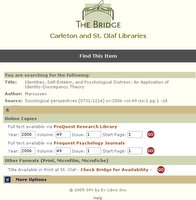
For those of you who don’t have SFX, or who have it configured differently, here’s what I mean. Let’s say I search and find a citation for an article from the journal Sociological Perspectives. Click “Find It” and I’ll discover that we have two subscriptions from two different databases, and St. Olaf also has the print. Click on either of the database options and I’ll get the full text; click on the print option and you’ll be taken to the catalog record for location and holdings information.

This system has three distinct advantages. First, it helps students figure out which databases they should be searching other than the database they’re currently searching. I teach my students to keep notes on databases that come up often when they’re looking for full text because those databases obviously have a collection of journals on your topic. This technique is especially useful for upper class students when they’re beginning to do research for their comprehensive projects. But it can also work the other way. I’ve mentioned before that unlike my co-workers, I mainly teach freshmen. And consequently, I also teach the less specific databases more often than my co-workers do (my co-workers rarely have to deal with students who just have to write “a research paper” on any topic). So I tell my students to watch the Find It menu to see if there’s a more specific database on their topic.

Another reason for providing choice, beyond simply my love of letting people choose what works best for them, is that over time students develop familiarity with the databases they use most often, so they may prefer to click on a link to their favorite CSA database, Ebsco database, or ProQuest database when it appears in the list of choices. I know I default to certain databases over others because I know that I can manipulate some vendors’ databases more easily than others.

And finally, some poor, young students dealing with requirements for “print” sources handed down from professors who haven’t explained that you can get “print” sources online from these databases, would really just prefer to click on that “available in print” link and go photocopy the article for themselves.

On the other hand… there’s value in immediate delivery whenever possible. I’m torn. Is delivery more important than education and discovery? Possibly. But I’d hate to give up the information I’m given when I’m presented with choices.

Carleton and St. Olaf will be deliberating on this issue soon, and I’m comforted that we can’t make a “bad” decision. I just wish I knew which was the better decision.

Technorati tags: , ,

10 Comments

The Research/Writing Connection and Why There Shouldn’t be Turf

Head on over to See Also, where Steve Lawson writes thoughtfully (as usual) about the connection between research and writing, information literacy, and the differences and similarities between librarians and disciplinary faculty.

To what extent should librarians help students see multiple sides of the scholarly conversation, develop their own arguments, or give other advice about constructing effective presentations? The only answer I have is “it depends.” It depends on a lot of things, but one of the most important is the librarian’s relationship with the professor. I know one professor, for example, who encourages her students to meet with me as they’re deciding on a topic, as they’re writing their papers, or at any other time in the iterative writing process. She and I in effect double team the students, pushing them to think not only about the answers to their research questions, but also about what makes a good research question in the first place. On the other hand, I know professors who bristle if I do anything more than teach the difference between keyword and subject searching. One professor would prefer me not to talk about evaluation of sources because that’s something properly done during office hours and by “struggling through” drafts.

While I would never suggest that librarians should usurp the professor’s role, I think that there are three specific ways in which we are uniquely placed to help students as they learn to engage with sources. First and most obviously, we are trained to think in terms of sources. We can make educated guesses about whether the information sought would be collected in a compilation, submitted to academic journals, explored in depth in a monograph, reported on in the news, or entered into an encyclopedia. We are adept at jumping straight to the questions “who would publish about this and where would they publish it?” Over the last few weeks, I’ve become acutely aware that most students cannot make educated guesses about these sorts of things. They just guess.

Second, we do not grade students. I’ve had students express confusion to me when they wouldn’t have jeopardized their standing in class to ask a “stupid” question. And I’ve had a couple of good responses from professors who, when I alerted them to a pattern of confusion in their classes, took steps to alleviate that confusion.

Third and most important, librarians are not usually as deeply immersed in the particular subject matter at hand as are the faculty. This often seems like a liability since we can’t simply pull related facts and theories out of our memories and construct searches from this base of knowledge. But far from being a liability, this is actually our greatest advantage. Because we don’t simply “know” the topic at hand, we get to model learning about the topic with the student. The hardest part about this is remembering to narrate our thought processes to students as we work together. I was reminded of this earlier this week when a student asked me how I knew which record in a result list to open. I explained that I didn’t and then consciously narrated through scanning the result list, picking up on clues from publication types and titles, looking at years of publication, and so on. Then I’d click on the record and narrate what I was seeing: title, author, publication name, subject headings, abstract. All this is new to students (especially first year students, though some seniors are almost here), but after a few minutes of this type of modeling most students will begin to take ownership of the search, suggesting new directions, pointing out records to open, and eventually running off to continue on their own. When we model learning, taking notes, going back and modifying old searches, picking up on clues, and getting excited when we find a juicy article, we’re not only helping students locate the information they need, but we’re also helping them learn the art of research.

On a related note, I would add that in addition to negotiating where librarians’ skills overlap with and complement disciplinary faculty’s skills, we should also consider how our skills overlap with those of the writing professionals on our campuses. Last spring I was invited to attend a meeting of writing professionals in our region, and it was eye-opening for all of us to realize that we both think about our jobs in similar ways, and that we both work with students on the same projects. And yet, students are trained not to expect too much help with mechanics and “proof reading” at the writing center. Writing professionals and faculty both expect students to learn about constructing effective arguments when they work with writing tutors. Why should it be so different for librarians? Just as writing tutors work with writers more than with papers, so also academic librarians are in the business of working with researchers, not simply of providing research.

Leave a Comment

Here’s Hoping

Yesterday was rather a trying day.

It all started during the night. You see, I was up half of it worrying about the apartment building burning down because one of my neighbors decided to throw one of her all-night parties, complete with banshee-like screaming (which is really her trademark). Anyway, this time she terrified me by setting fire to her kids’ art work which had been hanging on her apartment door. I could imagine her and her drunken friends using lighters on all sorts of other things, many of which could smolder for hours before bursting into flames. So I couldn’t sleep. (And yes, police were involved.)

Then I dragged myself to work to finish preparing for the classes I was supposed to teach. They were particularly challenging for two reasons: almost all of my preparation time during the week had been eaten up by impossible questions (which ate up hours of time and generally turned out to be unanswerable), and they were both for groups rather than classes, so there was no assignment to help motivate them to pay attention. I was also competing with their natural sense that paying attention to a library session on a Saturday was optional at best. So I had to come up with brilliantly exciting classes without the benefit of much preparation. Great.

To make matters worse, the organizer of the harder of the two classes (for the 20 new TRIO students) insisted that they be introduced to EndNote (along with getting a “general library introduction” and a tour of the library). Did I mention that all this was to take place in the space of an hour?

Well, I sat down and started listing all the things you need to know before you can use EndNote. You need the know the difference between a journal, an article, a book, and an essay in a book. You need know now that citation is important. You need to know which fields in the EndNote records are necessary and which are optional. And the list went on and on. So I decided to structure the whole class around citation as a way to introduce all this stuff, make them familiar with articles and books, and use the catalog and a database (since we could capture citations from those places into EndNote). By the end of the class, they’d be able to understand what EndNote does, but more importantly, they’d know what’s available to them at the library and some of the major distinctions between types of sources.

So here’s what I did. I took them on a whirlwind tour (which started 8 minutes late because they didn’t show up on time), then we got to work. We discussed Scholarly Communication and I highlighted citation as the key to following and joining in the conversation of scholars. Then we collectively came up with the goals of citation (which they figured was “to point readers to the words and ideas you respond to in your piece of the scholarly conversation”). I then handed out 3 books and 3 journals and charged each group of students with coming up with their own citation style and with justifying why they included the information they used in their citation and why they excluded the information they left out. Then we compared each of their citations with MLA, APA, and Chicago Manual of Style citations.

All of this took a lot longer than I’d figured (which I should have expected, but I’m only a baby instructor), and we were running late to begin with, so we were left with only 15 minutes for EndNote introductions (including the database and catalog searches so that we could capture citations). But all in all, I’m thrilled with the discussions I overheard while the students were creating their citation styles. They were arguing for and against including ISSN and ISBN numbers, discussing whether or not including the publisher’s name and the place of publication had anything to do with following the words and ideas of the authors, and generally teaching themselves a lot about the books and articles I’d handed out. What fun!

So maybe we didn’t cover very much in the grand scope of library research skills, but I kept remembering back to Randy telling me that students remember the experience first and the skills second. These students had a good experience. They were questioning me and each other, they were joking with me (about my status as the murderer in the Murder Mystery the library puts on for freshmen), and a few of them thanked me more sincerely than I’m used to at the end of a class.

So for next time, I’ll plan less. But I think I’ll include database searching as part of the process of looking at citations to figure out what you’re actually seeing in a result list. MLA International Bibliography would be good for this because it included book chapters as well as articles. I will also remember that this whole exercise (from discussing scholarly communication to discussing and comparing citations) takes 25 minutes if you’ve got 20 kids and 6 items to be cited.

Leave a Comment

Experiencing Competence Theory

Most of you probably weren’t reading this blog back when I talked about an article I read about Competence Theory. Well, now I’ve experienced it. I know it’s not the first time I’ve experienced it, and there’s absolutely no way it’ll be the last time unless I decide to give up being a thinking, breathing, learning being. (For those of you who didn’t follow the link I provided above, shame on you, and here’s the deal: those who are incompetent are incapable of telling when they do things poorly, are incapable of seeing the differences between their poor work and the work of experts, and are generally overconfident.)

Anyway, I’ve been happily building up my first web site and learning CSS and generally having a grand ol’ time mucking about with code. And in my defense, it’s not too shabby for a first try. (It’s also fun to have a space where I can experiment with cool new things like Meebo Me.) But I’ve learned two very important lessons: I don’t know what I’m doing (yet), and stealing borrowing code and learning from it is dangerous when you don’t know what good code looks like. You may very well “learn” to do some things that aren’t kosher.

Since I’m sure I’m not the only one out there who doesn’t know the rules of the HTML road, here’s one for you. You can only use standard tags. This is true even if the tags you make up seem to work just fine, and even if you see other people making up tags right and left. I still haven’t wrapped my head around why made-up tags are taboo even if they work, but I also remember wondering what the big deal was with Boolean searching when Google seemed to understand me just fine… so I won’t argue. I assume it has to do with the fact that some unenlightened people don’t use Firefox (yet).

I’ve looked through my code again, and I can’t see any more “non-standard” tags (non-standards sounds so much better than “fake”). I’ve come to terms with using the <'span'> tag with a defined class, even thought that’s so much uglier. And I’ve learned that whenever I learn a new, cool trick from someone, I need to run it past a known and identified expert in the field because I obviously can’t tell what’s what.

This is what I love about blogging. How would I ever have learned this stuff otherwise? I should be getting continuing education credits for this.

And thanks, Steve, for your help. You’re the best.

2 Comments

I’m Not Blogging

I promised myself that I wouldn’t blog tonight. I need more sleep than I’ve been getting. So this is just to say that I’m not blogging tonight. I’m really not.

While I’m not blogging, here are some random bits of nothingness that are running around in my head:

  • Don’t keep telling me there’s no one right answer. I’m tired of it, and usually that’s obvious anyway. It’s sort of like “um” while waiting for students to respond.
  • At IDEO they say “fail frequently so you can succeed more often.” I likey…
  • I’m apparently not a “feeling” learner (according to the learning styles assessment we did today). I’m a converger/assimilator. Don’t make me role-play or expect me to learn too much from the emotion-centric experiences of others. (But somehow I’ve got to figure out how to integrate this type of thing into my instruction or I’ll alienate all the Divergers out there who don’t care a wit for my thinking/doing/thinking method of learning.)
  • Randy Rocks! Can we get him to come to Carleton and talk to us? Please? Pretty please? Though it’d be a pretty penny to fly him in from Hawaii, I imagine… (I’m so excited that I get to be in two sessions led by him tomorrow…. I get all school-girlish-happy to be in his classes and be allowed to have fun while learning.)

Tomorrow morning we present our 5-minute chunks of a class and get critiqued by the group. Wish me luck!

Okay, no more blogging. Must do homework and then SLEEP.

2 Comments

Tired, but Doing Fine

It’s been a good day. We all met for the opening plenary session (8:30 till noon!), and plunked ourselves down at tables kind of willy-nilly. I ended up at the “kid’s” table in the back of the room… not quite sure how that happened, but we had a blast and (kind of by accident) ended up doing quite well on all the exercises together. We were in danger of being split up by the Jigsaw activity (where each of us “teaches” one of five articles to the rest of us), but it turned out that four of the five of us had read different articles, so we pretty much all stayed at our table.

In the afternoon we had part one of two or three sessions on assessment. I’ve really got to get a handle on how I can use this in my instruction. I’ve been experimenting with giving the students more control of the class period, but then I’m always worried that they aren’t learning. So these concepts should be good for me. As in the first session, the ideas weren’t really anything I hadn’t heard elsewhere, but it’s good for me to have concentrated time to reflect on my year’s teaching, evaluate what I’ve done, and figure out how to move forward from here.

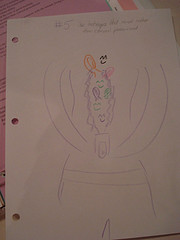
The third session was AWESOME. Randy Hensley is an amazing teacher. I admit, I was skeptical. He’d been writing all sorts of crazy uber-teacherish emails to us. Like, for example, the response he wrote to my posted introduction asking me “If you could do your first year of librarianship over, what would you do differently?” Uh, I don’t know. I had a pretty unbeatable first year, as far as I’m concerned. Anyway, I was all set to be annoyed and turned off by gimmicky exercises, but it wasn’t that way at all. Hey, I even drew a picture for the guy. That’s how amazing he was. I don’t draw concepts. I just don’t. Especially not with crayons.

(In case you can’t tell, that’s me using a zipper to open myself up and let out a bunch of smiley faces and balloons, which at the time seemed like a perfectly rational picture of using tools to reveal my personality… It’d been a long day. Stop laughing. STOP IT. And don’t go telling me my picture-woman has no head. I know that. I deliberately avoided drawing a head.)

Anyway, at one point I ended up on a stack of crates (which almost fell over, but didn’t, so I’m not dead). Don’t know quite what that had to do with anything. But he invited me up, so I went.

Which brings me to the other really weird thing about Immersion. I’ve learned to become an extrovert. Seriously. People here think I’m always like this! HAH!!! And who knows, maybe I am like this now. Computers in Libraries brought it out of me a little, but now I OWN this new person I am. And I like it. I love it that I no longer avoid introducing myself to people, or shake while doing it.

There’s lots more to write (I’ve been keeping a list… yeah, I’m a librarian), but it’s 11:30 here, and morning comes EARLY in Boston. I’d best call it a night. But there are a few more photos (still without titles or descriptions, sorry) up on my flicker site.

Just two things before I turn my brain off for the night: A pox on convention centers without wireless, and boo to long personal stories that should have been short and on topic responses to the presenter’s question. Nuf said.

Leave a Comment

What Writing Can Teach Us

This morning was the first of three consecutive mornings that I’ll be spending reading the sophomore writing portfolios at my college. This is my first time reading such things, and I must say that it’s kind of daunting.

You see, each year, all the sophomores turn in three to five examples of their writing from their first two years of college. Each year, some time soon after school gets out, a whole bunch of faculty and some staff (all volunteers) gather to read hundreds and hundreds of portfolios over the course of three mornings. And this year, I’m included in this bunch of readers.

Readers volunteer for a number of reasons. They want to see examples of assignments from other professors. They want to re-calibrate their own grading by reading masses and masses of writing. They want to intervene with students who need help. And the list goes on. It’s really fun to see a bunch of people taking on a task that just has to get done, but rather than just do it they reinvent it as a powerful professional development tool.

I’m there because my college is thinking of coming up with information literacy benchmarks for first- and second-year students. So another librarian and I are helping to read the portfolios not only to help make it through the boxes and boxes of papers, but also to find examples of information literacy at work and see if we can generalize our observations to help us develop an assessment matrix or a first-year info-lit initiative.

So far, after reading only a couple of portfolios, I’ve learned that:

  • underclassmen don’t understand citation, but that they can do it if guided
  • they are happy to use outside sources, but the sources control the writer rather than the other way around
  • that they think of “fact” and “interpretation” as much more distinct categories than they really are
  • and that I’m a very slow portfolio reader (I’ll really have to pick up the pace tomorrow… it’s been a long time since I was a regular writing tutor and could do this in my sleep.)

On a somewhat separate note, I’m quite happy that I can walk into a room full of faculty members and not only greet and be greeted by name, but also carry on conversations with them about everything from libraries to pedagogy to gardening and not feel out of place. I’ve worked hard this past year to build this kind of relationship, and it’s finally feeling less I’m “just staff.” In fact, all the librarians have been working at getting involved in all sorts of things across campus, and now we’re beginning to be invited to meetings as less of an afterthought. Slowly but surely…

(The Pinky and the Brain song comes to mind…) Tee hee hee.

1 Comment

Search Motivation and the Expert/Novice

I’ve been doing a lot of thinking and reading, lately, about what makes an expert and what makes a novice, especially when it comes to information seeking. There are all sorts of theories out there, but today I ran across one that really makes sense to me. There’s a discussion happening on the ngc4lib listserv at the moment called “What’s Better? Dumbed Down or Loaded with Functionality” (don’t get me started on the ideology of “either-or” that’s inherent in this question). Anyway, one responder made a comment that completely resonated with me. It’s a teeny little comment of just a couple of lines, but packed with implications. This person mentioned that even when he fails at a Google search, he continues looking and tweaking his search string because he’s “pretty darn sure” the answer’s there somewhere. This motivates him to keep looking.

And there you have it: one more piece in the expert/novice discussion. Novices have less knowledge of what’s out there to begin with, so they have less motivation to keep tweaking search strategies, so they are less likely to find what they’re looking for. This would also hinder their efforts to come up with viable research topics.

I don’t know how many students have come to me frustrated because they’re having trouble finding good stuff on depression in PsychInfo, and yet they’re unable to narrow their searches to a workable sub-topic because they don’t know what they’ll be able to find. To make matters worse, when they have spent 15 or 20 minutes not finding what they want, they ask if maybe they should change their topics, by which they do NOT mean refine… they actually mean CHANGE to a completely different topic. And then the cycle is repeated.

So file this away in the “how can I help with this” section of your brains. I don’t know how I’m going to help develop experts, yet, but I’m going to give it the old college try (just as soon as all the students get back from their summer vacations…[insert some pining for a summer vacation here]).

Leave a Comment
css.php