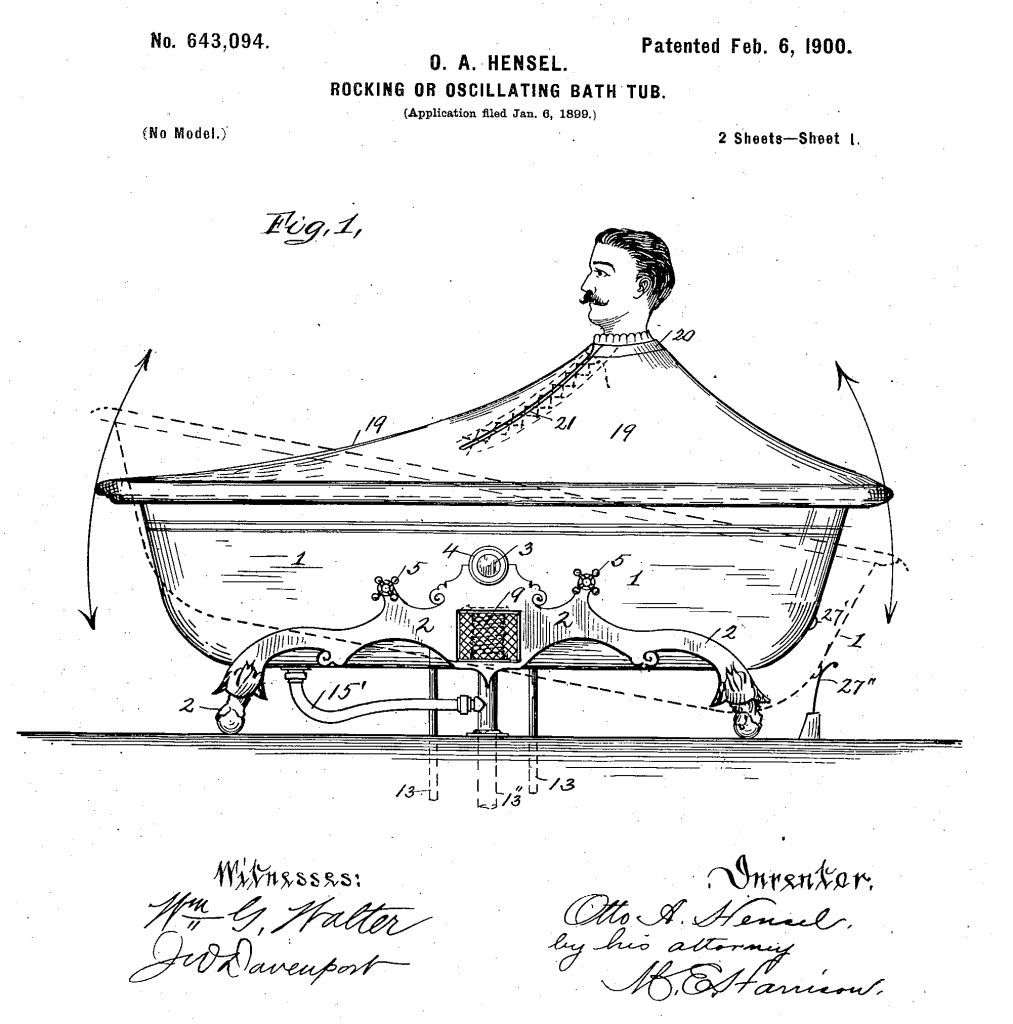
After yesterday’s post I had a fascinating discussion with someone who codes for a living about whether patents were a viable research resource in CS. First off, they’re extremely hard to understand. And yes, I definitely agree, and it’s a good reminder that when I talk about this with students I also talk explicitly about what I expect they’ll be able to learn from the exercise.
Hensel, Otto A. 1900. Rocking or oscillating bath-tub. United States US643094A, filed January 6, 1899, and issued February 6, 1900.
If you find a patent that you think is related to your topic, look at other similarly classified patents to see what problems people are tackling in the field and who is tackling them.
As you look through similarly classified patents, collect vocabulary that you can use in future searches. After all, most search systems simply match letters in a row rather than semantics, so if people are talking about the same thing but using different words to do so, you won’t find that whole side of the conversation.
While reading in order to understand the patented process is probably not feasible for most people, reading instrumentally has been super useful for me when exploring CS topics.
So far so good, but what really set me thinking was this industry coder’s take on the disadvantages of reading patents. Apparently he’s told not to read patents because knowingly infringing on someone else’s IP brings worse penalties than unknowingly infringing. In order to mitigate penalties, they don’t look at patents. So now I’m wondering how to guide students as they prepare for a world in which, at least some of the time, lack of information has value. And how do I square that with the idea of the very real costs involved in having a bunch of people reinventing wheels and falling into the same pitfalls, all so that if they get sued it won’t be quite so bad? And how do I square that with how this upends the progress narrative of the sciences in general, a set of disciplines which so carefully finds gaps in knowledge and then fills them, or finds the limits of current knowledge and then pushes those limits back bit by bit?
I wonder if it matters what sector you’re in, or even what specific companies you’re working for. And I wonder how liberal arts students might engage with this conundrum in a way that prepares them for life after graduation, whether that life involves CS careers or not.
For 14 years, I’ve been a librarian for a pretty cohesive set of language and literature departments. My BA and MA are both in literary criticism, and I studied a few languages (not fluent in any of them any more, sadly), so my core departments have felt very much like home to me.
As you probably know, I also love computer stuff. I’ve never been formally trained in any of it, but I’m a huge fan and an intrepid experimenter. Plus the CS faculty here are awesome and many of them were friends of mine already, so when the chance came for me to be their liaison I said YES. Besides, I could draw parallels from some of the strategies of language research to the strategies of CS research.
But there’s also a lot that’s very very new to me, starting with exactly how information literacy works in CS… You know, just a small thing. Where does information literacy fit into a curriculum that’s full of coding and not a whole lot of traditional literature searching?
Thankfully the faculty here and the absolutely outstanding CS and STEM librarians at the Library Society of the World have been great partners and resources for me in my first year of being the CS librarian. I’ve also made a point of attending as many presentations and functions in that department as I can, listening for how information literacy works in CS. Here’s what I’ve found so far.
Information literacy in CS – Early observations
You’re going to need a good, well-evaluated corpus to train your AI. You kind of have to know what gets included in a corpus, and how, and where that stuff originated from in order to understand what your AI can or should do with the stuff, or to interpret what it spits out. Misunderstanding your corpus can result in wonky AI results. Luckily, librarians happen to have a long history of working with the kinds of things that get included in large text or metadata corpus-type-thingies — finding, evaluating, and using them!
You’re going to need good data to develop your visualizations. I’m learning a lot from our data librarian here. The one thing I found most interesting this past year is that CS students here have high confidence that they can knit datasets together to get what they want, but they have low levels of experience in determining if the datasets in question are built on compatible methodologies and variables. Next year I’ll spend a lot more time emphasizing that I’m not cautioning against combining datasets because the combining is hard — I’m cautioning against it because the thing you create might be the worst kind of chimera.
You’re going to need to think about license agreements and copyright if you’re using stuff that other people built, including APIs. Luckily, librarians have a long history of working with intellectual property topics!
You’re probably going to need to find libraries (the code kind, not the institution kind) or algorithms or code bases to work with. I haven’t really dipped my toes into this water yet, but what I have noticed is that students talk about this process differently than faculty do. Students talk about “looking online” and evaluating for speed, memory needs, and functions. Faculty talk about finding something that will be stable over time, with good documentation and a track record. There are undertones of publisher/author credibility, reliability, and stability threaded throughout. Definitely something for me to think about.
If you want to build something new, you’ll have to know the state of the art, past and present. This is where I’m learning more… and it needs more than a sentence or two, so I’ll give it a couple whole sections.
Finding The Current State of the Art
How do you know that what you’re building is new? And how do you make sure you’re building constructively on what’s already known? Translated into library-speak: What’s the conversation on this topic, and how does this project move that conversation forward? The information need is familiar to me, but the places to find that information are … not. CS has traditional scholarly publication venues, sure, but unlike my other fields, CS draws heavily on conference papers, research and technical reports, and patents. Not only that, but a bunch of stuff is proprietary — decidedly not the case for the latest interpretations of Hamlet.
So I’ve been trying to build up my skills in the grey literature area. Current strategies include using more familiar library databases to find out the names of people, associations, or institutions that are active in an area, and taking that knowledge over to Google for some advanced googling. I’m curious to see if Inspec Analytics turns out to be helpful with this, too, to help me figure out which institutions are active in an area and might have repositories of research and technical reports.
Patents are playing a larger and larger role in my work because that’s one of the only ways I’ve found of peeking into the proprietary research. That’s where company secrets comes right up against the desire to protect IP for future profit. So I’ve been exploring ways of navigating patents and analyzing publication and citation patterns to help me figure out the past and present of a process or topic. Are there key people or companies at play in a particular area? Do those people or companies have other reports available to the public?
Delving into the past to improve the future
There was a fascinating talk here last spring by an engineer working on Non-Volatile Memory. One of her many useful insights during the talk was that back in the 1960s people were working on Mmap, and in the 1980s “Bubble Memory” was set to be the memory of the future. It didn’t become the memory of the future, so most people now don’t know the term or remember the concept, but there are a lot of things about Bubble Memory that are the same as NVM. There’s also a nearly 40-year conversation about developing persistent languages (apparently called “persistent foo,” which is awesome) vs persistent databases. One of the speaker’s points was that finding out these kinds of histories can save people from reinventing wheels, falling into the old pitfalls, and basically repeating history in the worst way.
Of course this set me to wondering how a librarian could coach students in a research strategy to find things that are the similar but not necessarily the same, and that don’t share a lot of keywords. And how would you map out and synthesize what you find in meaningful ways, but as efficiently as possible? So next I think I’ll explore the literature around persistent memory, starting with the specifics this speaker mentioned in her talk, and see which search tools give students a good way to discover this kind of overlap with historical avenues of research. Strategy suggestions welcome!
So much more to learn
Soon we’ll launch into my second school year as the CS liaison, and I have a long way to go before I’ll feel like I really know how information works in this field. What do YOU think I should know in order to be the best librarian I can be for this field?
It occurred to me recently that we in higher education talk about the curriculum and the co-curriculum, and there are departments and offices and structures involved in making those parallel structures work (hopefully) to the benefit of our students. But there’s another curriculum at play as well — a curriculum that is every bit as fundamental to our institutional learning outcomes as the formal curriculum but that isn’t “owned” by any department and isn’t administered in any systematic way across the institution. I’ve started thinking of this as the “interstitial curriculum.”
The interstitial curriculum is where students learn the intellectual habits and skills that cut across curricular and co-curricular lines. It doesn’t have a home in the formal curriculum, and it can’t happen exclusively in the co-curriculum, either. Instead, it lives in the multiple and cumulative experiences that individual students have as they live out their college experiences through, among, and between the intertwinings of the curriculum and the co-curriculum. Depending on the institution, these are probably things like writing (never something that any single department can teach fully), metacognition, project management, time management, interpersonal “soft” skills, and yes, information literacy.
These are things that might even be named in mission statements or in institutional and departmental learning objectives, or that tons of faculty say are critical … but there’s often no course or formal home for them in the institutional structures that ensure other learning objectives. Everyone relies on students building these intellectual muscles by working with someone else somewhere else in the institution. They may not be sure who or where or when this work happens or should happen, but they really hope that does happen because otherwise their own goals for students in their courses or majors can’t happen, or can’t happen well.
In my own work, I live in the tension between the deeply rewarding, mission-critical work that I get to do with students every day, and the dismissal of some who assume that the work I want to do with their students has surely already been done by someone else at some other time — probably in their first year seminar. I live in a liminal space, where literally dozens of departments on campus list learning outcomes directly related to information literacy, the campus mission and learning goals invoke information literacy, and yet no department has a formal plan to ensure that their students get intentional, scaffolded practice with the intellectual habits of information literacy. And I’m not saying that this is a bad place to be! There are many good reasons at play in this state of affairs. But it does mean that my entire existence feels similar to the work of the fascia in the human body: necessary, often invisible, existing between the better-known structures of the body, not well understood, but instrumental in encouraging and even allowing the intellectual work of the disciplines. I live in the spaces between.
It’s a very, very interesting space to inhabit. Not easy, but interesting.
A student recently spent some time tearing his hair out in my office because he was really really worried about the possibility that he might inadvertently plagiarize his sources and therefore fail his course. Meanwhile, a group of faculty in a recent workshop worried that their students routinely failed to quote, summarize, synthesize, and cite in proper measure. And every year our Information Literacy in Student Writing assessment project reveals that our sophomores do a good but not great job of knowing when their readers could use some more clues about their sources.
And on the one hand, everyone kind of nods and says, “Yeah, students these days.” But I think that we’re at least as much of the problem.
Lots of academic librarians (and disciplinary faculty) deal heavily in the world of plagiarism detection and anti-plagiarism instruction, but I think long habit and acculturation has made a lot of us feel like plagiarism is an objective thing with rules that everyone agrees on. You don’t use passages in your writing that other people have already used; you don’t pass off other people’s ideas as your own. If you do these things you are either ignorant or bad, or both. Done.
While college policies make it sound like a concrete thing called plagiarism is forbidden, in real life there are a whole lot of circumstances where those rules just don’t seem to fit very well, or where they’re applied one way in one classroom and another way in another classroom. What do you do about writing that results from thoughts developed over the course of class discussion or long conversations? What about the world outside of academic writing, where sharing and re-purposing may be the rule rather than the crime? What about all the genres of writing assigned in classrooms that mimic genres outside of academia and that therefore don’t have the same norms built around them?
Similarly, librarians and faculty either “care about citation” or “don’t care about citation,” but we also tend to link plagiarism and citation as almost one-to-one topics when really citation is about so very much more than just the presence or absence of plagiarism. The complex interplay between what counts as evidence and what counts as proper community participation lead to different norms even within academia. For example, in Lit studies, individual words are the evidence, so quoting individual words is every bit like reporting the response rates on a survey in the social sciences. In other disciplines this kind of quoting is frowned on as “over-citation” and a lack of synthesis. In computer science, there’ll be different rules for your classroom work and your industry work because using other people’s code functions fundamentally differently in an individual competence environment than it does in a development team. Anthropologists tend not to cite each other very much, and historians tend to value rich tapestries of citation functioning as almost a parallel narrative to the author’s work. These rules are not self-evident or consistent, but they are vitally important in their own contexts. Is it any wonder that students are confused?
So my job as a Disciplinary Discourse Mediator is to figure out what the rules are in my departments, why they are that way, and then to help students see the norms that they will be expected to conform to. More than that, my job is to alert students to the importance of figuring out what the rules are for any community they participate in, because the community will value these norms deeply but may express them vaguely (if at all), and when they do talk about they they’ll probably do so as if these are self-evident practices or even a matter of basic human decency.
Right now my strategy has been pretty subtle for the most part, framing any conversations about citation or academic honesty in terms of community norms and (when the situation seems to call for it) explaining some aspect of the connection between the norm and its community. For the rare people who are actually interested, I point them toward the work of Ken Hyland and all the various studies he did on disciplinary practices of quotation and attribution. But I always wonder if there’s something better I could do to usefully problematize the monolithic definition of plagiarism and its strangle-hold on the topic of citation while at the same time actually improving students’ abilities to detect and mimic the practices of the communities they participate in.
I’ve been having a bit of an up-and-down teaching term this Fall — some classes going really well and some falling flat — but one thing that I’ve really enjoyed is that so many of the classes I’m working with are in new subject areas for me, or are taking different approaches than I’ve taken before. It’s felt like everything is new, an experiment, and if I look at it in that light I feel just a little better about the term as a whole.
One recent experiment consisted of actually speaking words in a lower level class that I’ve been mulling over off and on for years but have only ever uttered once in an advanced seminar several years ago. And I think it was ok. I think it was worth the few minutes of time it took, and I’ll think about where I can work it into other teaching I do.
The words? “Result lists are a genre like any other genre of reading. They may look different from tool to tool, but they all conform to certain conventions, and you can read a result list like a type of document, applying genre-specific reading strategies just like you’d approach an article differently than a mystery novel.”
The class I was teaching was of a type that I generally really enjoy: teaching students how to read instrumentally in order to do better research. And we talk about different kinds of reading: skimming, deep reading, and reading instrumentally. In lower level classes this generally involves me passing out a short reading (usually a newspaper or magazine article) and having students work together to generate lists of topics, key terms, and names associated with those topics by reading the article carefully. Sometimes I have them do this with the aid of a worksheet and sometimes I just do it with them on the chalk board.
And this time I added reading result lists as a type of reading that has its own specific place in a research strategy. Result lists come in many forms, but they will all help reveal the range of questions authors seek to answer that involve the search terms you use, patterns in authors or publications that revolve around the terms you used, and clues about the vocabulary of your topic which you can then take note of and use to revise your searches. They are highly condensed, jargonized reference “entries” that teach you a lot about patterns of publication, about vocabulary, and about where you can go next with your searching.
In this particular class I didn’t elaborate on speech genres in general, or explain that they’re “relatively stable types of utterances” that operate within a particular context and reflect “specific conditions and goals” (Bahktin 60). I didn’t even indulge in a geeky digression into the ways that “secondary” speech genres “arise in more complex and comparatively highly developed and organized cultural communication” (Bahktin 61-62). Does this remind you of scholarly communication pathways and norms? Disciplinary discourse conventions? Yeah, me too. But in a 45 minute class with first year, first term students I thought maybe Bahktin was a bridge too far.
Even so, understanding result lists in this way has really helped me, over the years, to get away from the frustration of “failed searches” and become far more comfortable with the idea that spending time opening results here and there and quickly gathering vocabulary and a sense of publishing patterns is one of the quickest ways to arrive at useful results, even if it at first feels like taking detours through a swamp full of weeds. I hope it will help those students, too.
Bakhtin, Mikhail. 1987. “The Problem of Speech Genres.” Speech Genres and Other Late Essays. Edited by Caryl Emerson and Michael Holquist. Translated by Vern W. McGee. Slavic Series. Austin: University of Texas Press. pp. 60-102.
I was recently asked to write up some best practices for groups using Zotero, and I thought I’d share them here. While the language and specifics of these practices are all Zotero-centric, I’ve done very similar things with Mendeley and EndNote as well, though they don’t have standalone notes, so you have to make a well-named citation and use its notes fields to fulfill similar functions.
First off, it is worth it to pay for storage from Zotero. There are work-arounds using Box, but that adds a layer of complexity that I have seen go wrong when, for example, you have collaborators spread all over the place and not everyone is tech savvy or has library or IT support.
I’ve also seen people register a Zotero account and then share login credentials to that account with a group. This is not a good idea for a bunch of reasons. Everyone should have their own account and then be added to a group library.
With those two things as ground work, here are some things to consider as you launch a group project using Zotero. The larger your group or longer-term your project, the more these practices will matter.
Setting up the structure
Create a space that serves as your “inbox” for new stuff, before it’s processed/corrected/tagged/whatever. That way you can go merrily along collecting collecting collecting, but not mess up the organizational structure or lose your unprocessed stuff in the giant pool of processed stuff. If it were me, I’d make my own personal zotero library into my inbox area, and only move things to the Group library once it had its PDF associated, metadata cleaned up, etc. Alternatively, you could have a tag that you associate with new stuff so that you can gather it all together and process it.
In the main Group library, have a standalone note that describes the workflow of the group and defines how you are using tags, folders, and “related” items in this group. For example, some people use folders for procedural steps and tags for topic categorization, some people do the opposite, and some people do something else entirely. But this note will make it clear to the whole group how folders, tags, and “related” items function in this space.
In the main Group library, have a standalone note for tag definitions. Name it something that will guarantee it’s at the top of an alphabetical list (like _TagDefs). Apply every tag to this note (so that it comes up whenever any tag is selected). In that note, list each of your tags and a brief definition so that everyone on the project knows what it means and how to apply it. Whenever you create a new tag, be sure to update this tag definitions note and then add that tag to the note as well.
In each sub-folder in the Group Library, have a standalone note that describes what that folder is meant for.
If you’re going to use tags systematically, I suggest UNCHECKING the preference that automatically gathers subject headings from databases, because these are all over the place and will clutter up your tag list. All the other check boxes on that main screen of the preferences help, but this one doesn’t unless you really only use one database/catalog and it has good set of subject terms.
Plan on not having too many tags/folders. “Too many” is subjective, of course, but once you get scores of them they become very difficult to scan through and select. They should hit that sweet spot of functioning to gather together useful chunks of items rather than having only 1 or 2 items per tag/folder or having nearly all your items in a tag/folder. Novices to tagging tend to come up with too many, and constantly add new ones, which really doesn’t help with organizing a group library.
It can be useful to have a way of tracking procedures, either using tags or folders. These would be like “needs ILL” or “follow up” (which I use for things where there’s a gold mine of a bibliography that I know I’m going to want to go back to and start looking up and saving relevant items from the references).
Saving/organizing items
Save into your “inbox” space, however you’ve set that up. (Be aware that whatever folder is selected in Zotero, that’s where all your new saved items will go, so check this before going on a saving spree.)
Check all the metadata Zotero pulled in when you save an item. Frequently there are capitalization/spelling/data errors that need to be corrected manually.
If Zotero wasn’t able to pull in the PDF automatically, download and then drag the PDF in (and having the OpenURL resolver set up in preferences can help you with this — and if that didn’t sound like English to you, check out the instructions under “Making the “Library Lookup” option work like the library’s “Find It” button” in the top left-hand box on this guide for an example, though of course Carleton’s URL won’t work for other colleges).
Once you’ve saved and cleaned up your item information, open the list of sub-items (the little triangle next to the item citation in Zotero) and right-click on the PDF, and then select “Rename File from Parent Metadata.” That way the PDF itself will have citation information in its file name, which saves headaches if you download it later on and end up with a million “out.pdf” or “1957ty3593.pdf” files on your computer.
A single item can be saved to more than one sub-folder, which is far better than having multiple copies/versions of a single item.
An often-overlooked function is the “related” function. This can link together versions of the same work, or an item with items it cites/is cited by, etc. In group work this helps other people see the connections that you’ve found between works. (It can be helpful to have a written definition of how people think of “related” so that, for example, someone doesn’t put all the books on cats together as “related” rather than just tagging them with the subject “cats.”)
So basically, the theme of all of this is to make it so that there’s explicit shared understanding of how to use the various functions, and then give every new item the TLC it needs in order to coexist with all the other items.
Have a favorite tip or practice? Leave it in the comments here!
I think we often hear that “sharing the stuff of my research with the world” isn’t a huge motivator in the humanities. I’m not sure how broadly true that is, but it’s true enough with enough people that it bears thinking about. And I have heard skepticism, usually in the form of “nobody else will care about this stuff I’ve collected,” so how do we address that?
Sometimes I think maybe it’s a matter of vocabulary, so talking about creating “an archive” or “a digital collection” might capture imaginations where “manage/share your data” won’t. Even talking about how a bibliography is a described dataset can be useful because humanists are very familiar with practices of collecting, organizing, and sharing bibliographic information, usually at the ends of articles, books, and syllabi, but sometimes independently. Humanists have actually been doing data management since forever when you think about bibliographies. In this context, we care about versions (editions), standardized and encoded “data fields” (so that other researchers know if you’re referring to a title of a chapter, article, or book, for example), durable URLs whenever possible… Bibliographies are rich with descriptive and preservationist practices that can help inform management and sharing of files and information more broadly.
I think another aspect of why Humanists might care involves thinking about sharing with the sympathetic collaborator that is your future self. Your future self will forget the ins and outs of where you put or how you named your image files, or what the columns on your spreadsheet actually mean. Our computers are chalk full of the stuff of our research — PDFs, draft versions, images, audio, video. Knowing where all of those things are requires management of all of that data just so that you can find things again later.
Learn through analogy with the known
Kristin talks about how the monograph is largely self-describing. It has title, author, and publisher information in predictable spaces. There’s the table of contents, often an index and bibliography, and things like introductions and conclusions that describe the book for you.
Then there are style guides and formal or informal glossaries that people adopt, and these serve to help make your data (“data” writ large) understandable and consistent for other readers.
These are things that are familiar, so it’s easier to point to these things and remind ourselves that we’ve already seen the usefulness of self-describing units of scholarship and of somewhat standardized best practices. Now we just need to apply it to the digital stuff we’re working with more and more these days.
And in the past, libraries and archives were the main places that managed the sharing of shareable humanities data (primary and secondary sources), but the sharing involved researchers traveling to those collections (humanities “datasets”) to use them. Now individual researchers can create collections, or use collections without physically traveling from dataset to dataset. But this also means that researchers now have more responsibility to do some of the description and standardization that libraries, archives, and publishers formerly did a lot of. So yes, the work feels different, but it’s built on the same principles that humanists already value.
Formal vs informal data management
One of the interesting themes of our session and all the other data-related sessions I attended is that people talk a lot about the data management requirements of grant-funded projects. Meanwhile, I haven’t supported that work at all, but I have helped quite a few people manage their own individual or collaborative non-grant-funded projects. And I really think that data management becomes much more alive and broadly useful if I think about how the best practices identified and codified by grant funding agencies help us think about best practices for regular, every-day digital life, right down to the daily action of naming and putting a file into a folder on my computer. For me and for the people I’ve worked with so far, formal DMPs are alien things that don’t intersect with my life and research. But the spirit and practices reflected in those DMPs? THOSE I care deeply about. So perhaps shifting language from compliance to best practices, and shifting focus from grants to every day organizational practices, perhaps these things can help make data management less of an alien object that only scientists and social scientists ever touch.
One of the professors I work with a lot on campus has me join her American Studies Methods course a couple of times each term she teaches the course. The first time centers around three main questions:
Where does your research question sit within the theory of the field?
Where does the information you’ll need to explore your question sit within the archive of the field? (“Archive” here means the universe of sources useful within the field.)
And how much of the archive of the field is necessary for your purposes?
Last year we had them mind-map their research questions onto the blackboard in among the major topics of American Studies research that they’ve been studying. Then we used these mindmaps as the basis for search strategies for primary and secondary sources.
This year for various reasons we didn’t do a full class on the information literacy of American Studies. Instead, I visited their class for the full class period and participated in their conversations about the two readings assigned for that day, pitching my participation to help draw out the patterns of information use in each of the readings.
What can we tell about the theoretical foundations of the author’s claim based on the bibliography? Who are the major voices the author claims as theoretical kin? What kinds of primary sources appear and how does the author use them? Why these sources and not others?
To help us grapple with the archive of these readings, I spent the morning hunting down every single primary and secondary source that Amy Kaplan used in her article “Manifest Domesticity” (American Literature 70.3 (1998): 581–606) and piled them up on the classroom tables. We had print copies of many of the early 19th century monographs and periodicals that Kaplan marshaled in her readings of the overlap between the rhetoric of empire building and of domesticity. What we didn’t have in print we had in digitized primary source collections, so I could print off a few pages of each. And of the secondary sources we had ready access to all but 2 of the books, one of which could have come over from St. Olaf if I’d planned ahead a little more.
So there we sat, exploring Kaplans scholarship while her archive lay there in front of us for direct exploration, manipulation, and interrogation.
I’m not sure what the students got out of the exercise. I hope they sensed the possibilities for their own research – that writing from 190 years ago is not exotic and out of reach and that the major voices in their field are represented here in our library’s collection. I hope they enjoyed holding paper and ink from the 1830s in their own hands. I especially hope that they sensed the vital research practice of mining other scholars’ bibliographies.
For me, I experienced wonder at just how much is accessible these days even in a curricular collection on a small liberal arts college campus. And I admit that it was a thrill to open those pages and see what other scholars saw, exactly as they saw it.
It certainly wasn’t a traditional library session, but I hope it was as useful. It was certainly fun.
A librarian emailed me to ask what I teach when I teach seniors who are starting to write their senior theses. I realized that I haven’t written some of this here, yet, so here’s my answer to that librarian only slightly edited.
The pre-thesis session changes a bit every time because I start it with time to go around the table, have each student tell me and the group their thesis topic, and also tell us at least one thing about the research process that they’re concerned about. (This wouldn’t work for majors in departments with departmental cultures that prevent revealing weaknesses, but it works quite well for my English and American Studies and Language students.) For American Studies students I also ask them what they remember from our session the previous spring, since I get to see them at the end of their Junior year and the beginning of their Senior year. If they look at me blankly, I’ll cover that stuff again only more quickly, and if they remember a lot, I’ll add in some razzle dazzle advanced resource that will be new to them.
Basically, based on that conversation, I prioritize the rest of the hour.
There are always a few things I want to get to, of course, but luckily the students nearly always bring these things up, so the whole session usually feels like their idea even though I can usually predict at least 75% of the content.
I also make sure that they either hear or remember conversations we’ve had about how bibliography is not just an alphabetical list. Instead, it’s a mind map of the scholarly conversation that the author was joining. They should get used to looking for clues about major players and how claims can be built and what counts as evidence in this conversation, etc.
Two things that come up a lot are appropriate topic scope and how to know when you’re done researching. For the first I often use the analogy of a cropped photograph for a good topic: focused in on the important parts and only gesturing toward the rest of the things that you mentally know are part of the original scene but are cut out of the cropped image. We’ll also talk about how to combine related bodies of scholarship into your new, combined topic (students often aren’t very good at thinking about related research as useful to their new claims). And as far as when you know you’re done? Being true to your cropped image and then running continually into bibliographies that list people you’ve already read.
I will always take them through the advanced research features and search strategies of the one or two databases most likely to be core to their disciplinary work. If there’s time, I’ll show them how to do cited reference searching using both Web of Science and Google Scholar. Depending on the group I’ll also do a more in-depth look at either Zotero or Mendeley, whichever the group votes up.
I also give them a “Subversive Handout” which lists questions they can come talk to me about later, and I take them through scheduling an appointment with me and give them some hints about what might be good points in the research process to sit down with me (i.e. when they’re testing topic feasibility, when their just starting to explore, just before their proposals are due, and any time they feel stuck).
Clearly, I don’t to every piece of this! But these are the things that I’m prepared to do and that I choose from during that initial conversation with the group.
Two students have come to me in the last week saying that they listened and understood while taught how to navigate the MLA International Bibliography, but then when they tried it themselves, nothing seemed to work.
This tells me two things. First, MLA is hard. Second, I’m teaching it wrong.
There are caveats, of course. One of them being that my “research for compsing seniors” instruction session is rapid-fire review of things they’ve hopefully learned in lower level courses, plus advanced techniques they’ll need now more than every before. This is the one class where covering a bunch of stuff quickly matters to me (rather than experimenting and playing with a thing or two in class).
On the one hand, perhaps these and similar caveats really do mean that I should be doing lecture/demo, having them do the “workshop” portion of a hands-on class outside of class, and then wrap up with me one-on-one, just as they’re doing. On the other hand, maybe I’m using this as permission to rely on the less difficult instruction format of lecture/demo when really I should be working at finding an efficient hands-on approach to that session. Or maybe I need to rethink the approach of my lecture/demo.
So many options, so little clarity. All I know is that these students didn’t learn what I wanted them to learn, and that’s got to be at least partly my fault.