Skip to content

Category: Teaching and Learning

Becoming a Music Librarian, Part 2

Tomorrow I teach my first real music research class, so I’ve spent the last couple of days putting together what I’ve affectionately termed the Longest Research Guide Ever (link will be live until Dec. 2007, after which time you can contact me if, for some strange reason, you really want to see this monstrous thing). On the one hand, I’m really proud of this guide. It represents the sum total of what I know about finding sources for music research (except that it doesn’t list a couple of important bibliographic databases… Sad that this would be the sum total, but there you have it. After all, I only learned this stuff myself 10 days ago…). On the other hand, it also represents all that I try to avoid in a course research guide, and so I feel kind of guilty even showing it to my students tomorrow.

Here’s what I don’t like about the guide: it’s long. It’s a long block of text. There’s nothing to lessen the unrelenting, overwhelming length of the thing. I’ve tried to mitigate this by including a sort of table of contents at the beginning, blockish indents, and bulleted lists. But still, the thing is just plain long, and the whole point of a course research guide as opposed to a subject research guide is that it’s supposed to be neatly tailored to the needs of a specific course or even a specific assignment. … This is no neatly tailored piece of writing; it’s a dissertation on how to find specific content in the library.

But this particular course guide is long for three very good reasons.

  • First and probably most important, I’m not yet familiar enough with the subject, its research methods, or the students in that department to know what kind of detail is appropriate or helpful. When this happens, my nature is to write lots and then cut back later. This may not be the best method of attack, but it’s the only way I can wrap my head around the subject myself. So really, this is the guide that I need rather than the guide my students need.
  • Second, the teacher wanted the students to be able to “see the possibilities” that exist for music research (including access editions, manuscripts, (auto)biography, recordings, reviews, criticism, etc.). For their final oral presentation, the students will then be asked to take a piece of music and demonstrate to the class the kinds of artifacts that could be used to learn more about that piece.
  • Which leads to the third reason: the only commonality between the possible student topics will be that they’re pieces composed for piano, and there are a lot of pieces composed for piano… quite a lot. So I felt I had to somehow cover all the bases that would be possible for any piece, any composer.

Whether this ends up being a success or not, I hope that at the very least the students learn as much by using the guide as I learned to create it. I also anticipate stealing most of the content from this thing to work into the research guide for the whole department, and probably 4 or 5 littler handouts for the music faculty.

4 Comments

On the Value of Feedback

Every fall one of my co-workers and I teach a class for a bunch of students in a rather unique situation. They’re freshmen who are taking two “linked” courses, meaning that all students in each course have to take the other course as well. One is a history course and the other is a writing course, and between the two classes, there are between 5 and 6 assignments that our library session must prepare the students to accomplish.

Well, this past spring and summer, the library acquired several rich resources that seemed tailor-made for these classes. The problem is, there was simply not enough time to introduce all four of the resources that we considered most important. (There are LOTS of other resources that we gathered on a research guide for them, but we’d pared the class down to four and couldn’t in good conscience pare it down any farther.) So we thought we’d try something new.

Operating under the assumption that because these students see each other every single day they’d have plenty of time to help each other out, we split them into four groups, each of which had a set of tasks designed to teach them their particular resource. Then we spent the last part of class having each group teach a couple of important points to their classmates. And overall, we thought it went alright. We were crunched for time even as it was, but we were hopeful that we’d started discussions that could continue on the course’ Moodle forum and in subsequent classes.

Then the writing professor did something for which I am very grateful. She had each student write one thing they thought worked well in our session and one thing they thought didn’t work so well. To a person, every single student listed the splitting up into groups as the one and only thing they did not appreciate about the session. Wow! When do you EVER get 100% consistent results from a survey? Never, that’s when. Almost every student listed the time they had to work with their resources as one of the most valuable things about the class, but every single one of them wanted a chance to try the other resources, and most worried that they won’t learn what they need to know from their classmates.

This doesn’t mean that they might not end up being just fine, or that they might not be able to learn from their peers. But it does point out that maybe freshmen, overwhelmed by the prospect of their first college-level research paper, might appreciate a little bit more direction, a little bit more explicit instruction.

So next year, we’ll have to think up another creative solution. The writing professor has suggested that perhaps expanding to two library sessions is in order… we’ll have to see.

Leave a Comment

Moodle, One Year Later

Tomorrow I’m joining a panel made up of me, our resident web-app coder guru, a faculty member, and academic technologist, and a student to talk about how things have changed one year into our adoption of Moodle as our campus’ course management system. We’re presenting this as the first of the term’s LTC lunches (generally a weekly gathering at which someone or some group presents on a topic relevant to learning and teaching while the audience munches away). I’ve only presented at two other LTC events, so I’m a little nervous, but apparently not nervous enough to have carved time out of the last week to actually prepare. I mean, I’ve thought about it a little bit, but not actually prepared.

And now, tonight, I find myself a little on the burned out side. Fall term is just not a good time for sustained or creative thinking. Fall term is a time to put out fires as quickly as possible and not look back. So, sitting here, thinking to myself how much I’d prefer reading or writing blog posts to planning this 8 minute spiel, it suddenly occurred to me that I could con myself into preparing for tomorrow if I wrote it up as a blog post!

So, here are my thoughts about how Moodle has affected the library, one year into implementation:

Moodle and Teaching

  • Preparing for classes: For those classes where the instructor makes use of Moodle, we librarians can now supplement the information the professor gives us about the class with direct observation of the readings students have been assigned, the context into which our sessions fall, and even the over-arching themes and questions that are important to the class. There are a lot of ways to tie our sessions to the course content, with the goal that they will interrupt the flow of the course content as little as possible. Everything from the examples we pick to the discussions we lead to the actual content of our sessions can be tailored to fit into the themes and goals of the course. When this happens, library sessions can actually augment rather than simply supplement course content.
  • Class logistics: Moodle makes it easy to find the exact course title, the number of students enrolled, and what students have been told about where to meet us, and other such useful information. I’ve also been able to compare lists of registered students to see if any in next week’s class already heard me speak last week. And if so, I work extra hard to make sure they’ll get as much out of the second session as they did out of the first.
  • Interacting with Students: Including contact information on a course’s sidebar (now made easier due to some custom coding which allows professors to simply turn on their librarian’s contact information), setting up shop in a class’ forum, or (though this hasn’t been tried) joining the class’ skype buddy list are all good ways of meeting our students where they are when they’re doing their assignments. Now, if I could just get my MeeboMe widget in there… but that’s probably asking a lot.

Moodle and My Other Work

  • Hey look, it’s an easy intranet! Whether it’s collecting useful information and links or hosting departmental discussions and schedules, Moodle has offered an easy way to set up quick and dirty intranets. The liaisons have one, the Library Leadership Group has one, the SCIC workers have one… and that means that we can manage our work easily. It’s made the biggest difference in the case of the SCIC site because now the SCIC students and the librarians they work with all have a common place to communicate, norm our expectations, and gather information.
  • Working with librarians at St. Olaf: Since we share a catalog but do not share network space, we and the St. Olaf librarians really benefit from an online space where we can house our meeting minutes, operational records, and other such useful stuff.
  • Project Management: We’re using our Moodle spaces to manage fairly complex projects. Not only are all the standard features (forums, places to keep documents, wikis, calendars, etc) important, but a couple of less standard features have come in very useful. One example is our newly formed eResources group. They’ve realized that very few people in the library operate with the same terminology when they’re thinking and talking about eResources, so one of their first projects this year is to create and define a uniform eResources vocabulary. To do this, they’re using Moodle’s glossary feature. They’ve divided the key terms among themselves, assigning themselves those terms in the glossary by categorizing the glossary entries according to their initials. And once the terms are defined, anywhere they’re used in that Moodle site they’ll appear highlighted with available definitions if you hover over the word.

So I think that’s what I’m going to talk about tomorrow, unless inspiration hits at the 11th hour. It seems like a representative sampling of the key ways that Moodle has impacted our librarian-ish existences in the past year.

2 Comments

Introducing High School Students to a College Library

Every summer a group of high school students, gleaned from high schools all over the United States, comes to campus for a week-long program called CLAE (the Carleton Liberal Arts Experience). There are various courses they can take (everything from “how to apply to college” to “the Harlem Renaissance”) with the dual purpose of introducing them to the idea of a liberal arts college and giving them a little bit of experience living and studying on a college campus. The emphasis is really on empowering them to think that college is possible, doable, interesting, intense, and fun.

And every year, one of the classes brings all the kids to the library. For the past three summers I’ve worked with the history librarian to prepare the students to engage in a modernized Washington/Du Bois debate. But this year the class and professor changed, so the history librarian and I started from scratch to build a class for students studying the Harlem Renaissance.

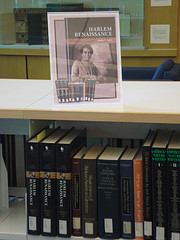
My part of the class preparations was to develop an exercise that would introduce the students to the 5 reference sets they’d need to navigate as they prepared for their final presentations. But the big question was how to make it easy for them to pick their sets out from the shelves and shelves of unfamiliar reference books, while still letting them see the sets in context rather than pulled out and put on a cart just for this assignment. Well, to ease this particular rub, I made signs for each set that had a full scan of the cover of the one of the set’s volumes, and then a cut-out image of the set’s place on the shelf.

Then I put these signs up on the shelves above each reference set.

That way, when the students came back to do their research after all of the librarians had gone home for the night, they’d be able to go back to the sets we’d shown them in class. I hope it worked for them.

Oh, and the exercise itself sounded great on paper, but would need more clarification next year. I still like the idea of it, but there were some recurring questions I should have anticipated.

Leave a Comment

What Do We Teach? Information Literacy and Information Technology in an Academic Setting

A few times a term, librarians from Carleton and St. Olaf meet to discuss an article that is either about some aspect of information literacy and IL instruction, or can be discussed from the perspective of people teaching information literacy. This morning, for example, we talked for about 45 minutes about Ann Grafstein’s new article in portal (which I highly recommend, by the way).*

On each of our campuses we’ve heard rumblings from time to time that what we do and what the IT people do is really fundamentally the same thing. When we say, “Uh, no, it’s really not,” they respond with, “I mean, if you forget the fact that they work in the IT department and you work in the library… just leave that out of the equation, what’s left is really fundamentally the same thing.” This is only true if by “fundamentally the same” you mean “help people do what they’re doing,” in which case almost everybody on campus fits that description.

The next argument is that we teach people how to get stuff out of databases just like IT teaches people how to manipulate spreadsheets. Well, I know our IT department does a whole lot more than that, and while I do indeed teach people how to get stuff out of databases, I do so much more than that. And a lot of what I do would be important even if there were no technology at all, or if the technology changed drastically.

So what do I do? What do I offer students that goes beyond a basic knowledge of subject headings, catalogs and databases, and the mechanics of search?

We Work with Content, Regardless of Format
When we teach database searching, catalog searching, search engine searching, and even *gasp* print index navigation, the format is simply a vehicle. Our true focus is on the content beyond the vehicle. This is why library sessions that aren’t tied closely to an assignment often result in zoned out students. If you’re simply teaching “this is a database… this is a subject heading” and the students aren’t trying to get at any content, everything feels unimportant and arbitrary. If the students are actively trying to find content to work with, and are finding the process frustrating, that’s when they pay close attention.

This is also why I’m against wholesale moves from print to electronic. Some sources simply work better in print. Some work better online. I would prefer to figure out which vehicle best suites the content and the students’ uses of that content than to squeeze all content into one format. Granted, electronic is a wonderful vehicle for many, many kinds of content, but not all kinds, and not all instances of each kind.

Evaluation of Sources
Probably more than any other component of this nebulous thing we call “information literacy,” evaluation of sources has taken hold as The skill that librarians are trained to perform and teach and that goes beyond simple location of sources. And while this task has become more tricky as more and more stuff floods the Internet, it is and always has been important even in the print-only world. I’m not convinced that it was ever easy, no matter how many people tell me it was so much easier when you had the print in front of you. I tend to think we simply haven’t honed our teaching skills in the newer formats to the same extent that we had before. But what do I know? I’ve never known an academic library that didn’t have JSTOR.

But I propose, as a topic for discussion, that while evaluating sources is definitely important, it has gained it’s current widespread status as almost synonymous with “information literacy” primarily because it’s taught in library school and because it has steps to follow. We’ve grown so used to saying that we don’t just teach “how to” any more, we also teach evaluation, that we don’t often look beyond that to the other things we can and do teach. And I’d propose that these other things are as interesting and as important, but that they don’t have clearly defined steps to follow and that they are not taught in library school (at least, not at the library school I went to).

What are these other things? Well, I think teaching research strategies falls into this camp even though these strategies do get lip service in library school, and we do mention them occasionally in classes, and we work a lot with them at the reference desk and in individual research consultations. And sussing out what counts as evidence for a particular discipline, sub-discipline, and audience is also a major component of information literacy.

Research Strategies
When I was in library school, we spent one day on information seeking behaviors and strategies (which mostly turned into a discussion about how we could get people to come to the library first rather than consult their friends), and about two weeks (with accompanying group projects and presentations) on evaluating sources. I am extremely grateful to have had evaluation beaten into my head with that kind of force because it has stood me in good stead. But I am still figuring out how to quickly and effectively help my students devise workable research strategies. It is not enough simply to know that they’ll consult friends and trusted professors, or to say that research is an iterative process. I want to default to thinking about helping my students navigate this thing that really frustrates them in the same way that I default to helping them think about how trustworthy their sources are.

What’s more, I don’t think students have a realistic sense of how much time research can take. I know… that’s not a radical thought… but here’s why it’s important. Someone might argue that we have to help them evaluate sources because they don’t think of asking for help with that because they don’t know that they don’t know evaluation, so they don’t know to be frustrated. They are often frustrated with the progress of their research, though, so it’s not as important to remind them that they will need help with this. Not so. They often get frustrated too late, when there’s no more time for interlibrary loan or restructuring arguments so that they can actually support what they’re saying with real evidence.

Matching Evidence to Audience
And this brings us to real evidence. “Real” evidence is the stuff that bridges the gap between your topic and your audience. If there is no gap, you need no evidence (and then it’s not really worth researching, is it?). So what counts as evidence to your field? What counts as evidence to the people in your field who would be interested in this particular topic? Will you need a traditional lit review or anecdotes? Will popular publications or snapshots of wikis on a particular days support what you’re saying and be credible witnesses for your case in the court of your audience’s opinion? Will you need statistical data or interviews with experts? Will your opinion count or will you have to cite others’ thoughts? None of these can be assumed to be important across the board. And I had no training whatsoever in thinking about these questions.

And yet, I would argue that this is the single most fundamental cornerstone of information literacy. Without this, everything else crumbles. And the closest we usually come to teaching this is to walk students through “what counts as a scholarly source.” That is a great start, and for some students in some classes that’s all they need. But it just doesn’t cut it for everyone in every situation.

So that is the beginning of my credo. I’m just starting to figure out what I my role is on my campus, and what I’d like it to be, and this is where I’ve gotten so far. I’m not done, and I’m sure I never will be done defining my job. But I’ve made a start. Sure, I also teach the mechanics of search and the steps for getting your hands on full text, but I do that in service of these other goals.


*Grafstein, Ann. “Information Literacy and Technology: An Examination of Some Issues.” portal: Libraries and the Academy 7.1 (2007): 51-64.

2 Comments

Information Literacy and Foreign Language Curricula

Earlier this week I was invited by the language faculty at my school to attend a lunch presentation they had organized. They had asked a faculty member from the German department of Wayne State to come talk to them about the importance of information literacy in foreign language curricula.

It’s always informative to hear professors talk about info lit, and it was good to hear from somebody who has thought a lot about how and why it’s important for language professors to squeeze even more into their curricula. For instance, she explained that even though languages classes are jam packed with grammar, vocabulary, culture, and literature, without information literacy their students will just become really good tourists, and language departments will continue to struggle under the perception that they are “service departments” on their campuses. Information literacy is what gives students access to the deeper cultures of their chosen languages. Without it, students may not realize that one issue can be viewed very differently in different cultures, or that there are alternate argument structures, or that these alternate structures are fundamental to people of other nations and cultures. This deeper level of understanding, this advanced fluency, is not accessible via grammar alone.

She also emphasized that information literacy is not something students learn in freshman comp in the English department. It was good to hear somebody else saying that this isn’t like a vaccine; you can’t get a good shot of it once in your freshman year and then be good to go for the remainder of your college career.

It was also good to hear that this is something that faculty members can easily work into their classes. I’ve said time and again that if everyone relies only on librarians to get every student up to speed, the librarians will burn out and the students will never get as rich an experience as they would if these concepts were worked into most if not all of their classes.

But I was surprised at how much I squirmed as I listened to the presenter give examples from her classes and argue for better inclusion of “my” field of expertise into language classes. It reminded me that I’d failed to adequately convey to my faculty exactly what I can do, or exactly what I can teach them to do, for our students. Did they realize as we sat there that I love to explain the disciplinary conventions of citation and how it is one expression of the interpretive communities their students are trying to enter? Did they know that I, too, have worked with students to understand the value of book reviews? Did they realize that evaluating web sources and figuring out what kinds of sources will be acceptable for specific topics and interpretive communities is what I walk students through every single day? And did they or the presenter know that I’m good for more than identifying and training students on appropriate databases?

Unfortunately, I think not. And that’s entirely my fault. I’ve got a lot of great excuses (I’m new the field, new the campus, and I’m figuring out all this stuff as I go… the list goes on and on), but in the end, I worry that they’ll copy the examples this other professor (which were wonderful, by the way) rather than working with me to figure out how to get the same benefit within our curriculum and with our students.

And then I slap myself in the forehead and remind myself that this is a wonderful thing. My faculty are actively engaging the question of how to develop their students’ higher reasoning skills, and they’ve latched onto info lit as one of the methods for accomplishing this. And this isn’t actually “my” turf. It’s our turf.

I just wish I knew the most effective way follow up after this experience. I want to be more than tech support for bibliographic databases.

5 Comments

I’m Fine, Thanks

Ok, my last post was quite a downer, written in the heat of frustration. I stand my assertion that we need clearer terminology and selection processes, but like many other frustrations, this will not rule my life.

No, and my scary class tomorrow won’t rule my life either because, get this, it’s now two classes! Now I’ll do the part on finding foreign language and English language articles and books (including ILL and finding full text) tomorrow (in 45 minutes). Then next Friday I’ll teach proper citation (in-text, annotated, and regular bibliographies) for 20 minutes. This is instead of doing everything in 40 minutes! I’m SO pleased.

So for tonight I’ll sit back and figure out how to squeezing tomorrow’s class into 45 minutes. I think this will involve a handout that lays out how to get to the foreign language holdings in 4 databases and two catalogs (ours and WorldCat). It will also include an online guide. But beyond that, we’ll see.

(See, I told you I’d have things prioritized by tonight.)

5 Comments

A Class I’d Love to Teach

Wouldn’t it be fun if a professor teaching late 19th or early 20th century philosophy, literature, or any other expression of thought and culture would let me come and help the students see how the library’s classification system grew out of that world view? That way library instruction wouldn’t be an “extra” class session. It would be course content and preparation for research projects, all at the same time.

2 Comments

The Value of Book Reviews

Yesterday I taught a class on finding book reviews. The professor had specifically asked for this topic, and I was happy to comply, but I was a little at a loss to figure out what I could do other than pointing out the “document type” limiters in different databases, and show the differences between book reviews published in scholarly journals as opposed to trade publications and newspapers. Luckily, one of my colleagues has thought more about this than I have and taught several classes on book reviews, so I shamelessly cribbed her materials and even mooched some of her examples. And although I can take very little credit, the class we built together seemed to go over very well with the students and this faculty member.

Warning: Extreme examples of my inexperience as a librarian and researcher are about to be revealed. Read on at your own risk. I cannot be held responsible for injuries to eyes that have rolled too far back into your head and can no longer be retrieved, or for bruises to heads that have been beaten against computers. Nor can I be held responsible for damage to hardware or software of said computers.

. . .

I learned a whole heck of a lot teaching this class. First of all, I’d never taught for American Studies before, so I spent quite a bit of time simply familiarizing myself with the publications in that field and where their journals get indexed (Academic Search Premier and ProQuest each index the major American Studies journals, in case you’re interested). But the real breakthrough for me came when my colleague and I were working to answer the question: so what? Why would you spend time looking for book reviews given the fact that the vast majority are positive, a good percentage are neutral, and only a tiny fraction are negative? What use could writing governed by such a ritualized style and publication process be other than to give a summary of the work?

Well, it turns, book reviews can be extraordinarily useful. So useful, in fact, that I will be incorporating them into as many classes as possible in the future.

  • These short essays can give clues about where a particular book fits into the field and niches of that field because it’s one of the reviewer’s tasks to say how well or poorly the book works for people in that field.
  • Reviews can also provide clues about the major players in that field. It’s not uncommon for reviewers to compare the author or book to other authors or books in the field or having similar theoretical perspectives. You can find valuable primary and secondary sources this way. You can also look for other things written by the reviewer, since he or she might also be a player in the field.
  • Reviews may highlight was evidence counts as good evidence in the field. Does the reviewer wish so-and-so had consulted census data? Bingo, you know that statistical information holds cache with this group of scholars. Does the reviewer applaud the use of images, or hint that the author should have explored the intersections between this topic and, say, cinematic history? That’s more information for you to consider as you think about your own topic.
  • And you can also find out what disciplines might be interested in a topic by seeing where reviews for the book appear. Mary C Waters’ book Black Identities was reviewed in the year 2000 by Black Issues Book Review (Vickerman 2000) and by the Journal of Economic Literature (McKinnish 2000), just as an example.

But the fun doesn’t stop there. Book reviews are chock full of the important buzz words in the field. In my class yesterday we looked at reviews for Hope in a Jar: The Making of America’s Beauty Culture. We found one from the Journal of American Culture (Kay 1999), one from Publisher’s Weekly (“Forecasts” 1998), and one from Entertainment Weekly (Jacobs 1998). Reading from those reviews, we not only came up with lists of disciplines, related topics, and related concepts, but we also came up with a substantial list of search terms which yield really beautiful results about the social history of the beauty culture in America. What fun!

References:

Forecasts: Nonfiction. Publishers Weekly. 245.16 (1998): 57.

Jacobs, Alexandra. “Hope In a Jar.” Entertainment Weekly. 440 (1998): 68.

Kay, Gwen. “Hope in a Jar (Book Review).” Journal of American Culture (01911813). 22.2 (1999): 106.

McKinnish, Terra G. “The New Race Question: How the Census Counts Multiracial Individuals (Book).” Journal of Economic Literature. 42.1 (2004): 201-202.

Peiss, Kathy. Hope in a jar : the making of America’s beauty culture . 1st ed., New York: Metropolitan Books, 1998.

Waters, Mary. Black identities : West Indian immigrant dreams and American realities . New York ;Cambridge Mass.: Russell Sage Foundation ;Harvard University Press, 1999.

Vickerman, Milton. “nonfiction reviews.” Black Issues Book Review. 2.4 (2000): 54.

8 Comments

eReserves: Blessing or Curse?

Blessing. Definitely a blessing to our users and database vendors, but a blessing with a curse-ish aftertaste.

Everyone is familiar with the blessing part. Users get 24/7 access to their course readings, and database vendors get a more accurate picture of the amount of usage they’re getting for their license fees. (Without eReserves we’d have to print out a copy of an article and put it on paper reserve, where it would be read by a class of students, photocopied by most of them, etc. But there’d only be one hit on the vendor’s server.)

But on our campus eReserves is an easy target for all sorts of campus ills. For example, it’s common knowledge around campus that eReserves is the cause of our horrible printing problem, with reams and reams of paper filing through our printers every day. And I’m sure that classes that depend more and more on journal readings and less on text-book compilations do make for more use of eReserves and more printing. But what nobody seems to realize is that all the requests for electronic access to journals means that more and more of our journal collection is e-only. And even if we have electronic access and print access, guess which one will be used most often? And what do people do with journal articles they find online? They print them to mark up over lunch or a midnight snack.

Not only that, but there’s more and more good, authoritative, quality research available on the free web, and you can bet that students print these pages by the ream. This is especially true because printing is free on our campus, so everything from email to research to homework spills from the two printers in the reference area at the rate of 7.06 pages every minute the library is open. (The the two reference area printers account for more printing than every other printer on campus… combined.)

I’ve also seen more and more students lately who prefer to scan print journal articles slowly, page by page, and then convert the images into PDFs all so that they could print (for free) rather than photocopy (for a fee). In related news, the use of photocopiers in the library has dropped so much in recent years that our printing department is considering removing a few of the copiers from the library entirely.

So the upshot is that printing is a definite problem, but the answer isn’t as simple as, “Well, with the advent of eReserves printing went through the roof….” The information universe is changing, not just one section of it. All of it. eReserves, journal subscription, database licensing, online publishing, assignments and pedagogical approaches to information, everything.

Oh, and eReserves is also not a devious plot to keep professors from ordering text books or paying copyright fees or anything else like that. Moodle can do all that so much more easily. 😉

Technorati tags: , , , ,

2 Comments
css.php