Skip to content

Category: Libraries and Librarians

The Week Before Classes

Classes start next Monday, and man oh man am I in denial. Whew! I even have sessions to teach next week, and am only prepared enough to have them listed in my calendar. And here’s why (other than my general denial, of course): requests always come in just about the time I start getting swamped with pre-term-insanely-busy-ness. My calendar was three of the four work days this week with orientation sessions, planning sessions, and meetings. Also, all of the publicity projects I had going on were absolutely positively DUE today. The brochures I’ve been creating were to be handed out today, the poster needs to be hung, and I still need to send out that fall “I’m here, remember me” email to each faculty member in my departments. No idea when that’ll happen.

So basically I started the day in panic mode… and with an hour and a half of all-library meeting. I was not in the mood! Did they know we had things to do!!! Still, I survived, and even learned a few things.

Luckily, though, the new faculty orientation session went really well. I was pretty worried about it. I mean, four academic technologists and 6 librarians in a room trying to convey all the helpfulness in the world to 40 or so overwhelmed and exhausted new faculty members is a stretch under the best circumstances. On top of it all, I didn’t feel like we’d done enough to prepare the session. We had a very, very basic sketch of what we wanted to accomplish, but I prefer more than that when presenting with so many people. And yet, with all this going against us the new faculty members seemed to appreciate the session, and I had good conversations with a couple of people who will be entering my departments. (I’m a little bit petrified of some of their research areas… but I’ll figure something out. I mean, I kind of have to. It’s my job. And I know from prior experience that these challenges are the most rewarding…once they’re overcome.)

Anyway, this session somehow brought it all home to me that the term is really starting. There’s no turning back. But it did more than that. It reminded me that however much I dread the constant panic of the term, this really is what my job is all about, and I love it. That slightly queasy, there’s-no-way-on-EARTH-I’ll-be-able-to-answer-that, hot-and-cold feeling that washes over me as impossible questions float my way is not the point. The point isn’t even the “thrill of the hunt.” That hunt can be more frustrating than thrilling a lot of the time, let me tell you. The point is exactly what one new professor said today on her way out of the session: “I feel so … covered… like there’s this great safety net under me.” That’s the point.

Leave a Comment

The Book-ish-ness of Books

There’s been a really interesting and thought-provoking discussion going on lately about “2.0” topics, spectrums (or rather,” spectra”), print vs. electronic books, and the like. It all started with David Lee King’s Library 2.0 Spectrum, which got so many comments that he wrote a whole post about wanting feedback. Meanwhile Steve Lawson wrote a response (in addition to several comments on David’s posts), Uncontrolled Vocabulary took up the topic, and several other blogs began puzzling out what worked and what didn’t work about the L2 Spectrum.

Well, now the conversation has morphed. Over at See Also, Steve and Dave are hashing out whether a book is a book if it’s not printed on paper. I must say, I didn’t know what to think about that question. Deep down, I’ve always reserved a special place for printed and bound books that is completely separate from manuscripts and eBooks. In my head, these wonderful and time-honored creations have always been Books with a capital B. … And then there were these derivative things called eBooks — sort of like postcards of the Mona Lisa. You know exactly what they are, but you just have to make do with the presentation.

Then David comes along and questions this assumption. He feels that books are books, no matter the format. And that seems like a very reasonable conclusion. You can digitize everything but the paper (and the smell), so what’s the problem? I’d hate to get caught in the trap of putting printed books on a pedestal just because I like the way they feel. And there’s nothing worse than finding yourself falling into the trap of “because that’s the way they’ve always been.” In fact, I’m not sure that I haven’t fallen into that trap, even now.

But something in the comments to Steve’s post struck a chord and I felt compelled to add my own comment to the string, even though I hadn’t figured out what I wanted to say. Steve had made the point that calling the paper and binding of a book a “container” might be too simplifying. He said:

I think my problem with the word “container” is similar to Dorothea’s problem with the word “just” in the post I linked to above. It makes it all sound very simple, very easy, when it isn’t. I can pour my ginger ale from an aluminum can container into a glass tumbler container, and it is still ginger ale. “Pour” Tristram Shandy from a paper book container to a Google scan container, and you no longer have Shandy, you have something else. (cite)

Then, as I typed, I puzzled out what I was thinking. I’m still not sure I’m “right”… but here’s what I wrote (edited only slightly to compensate for sloppy writing):

I think you’re right that the point is that it’s not simple. The point is not so much the words in a row. The point is not so much the placement of pictures, type face, or white space (which is also important). The point is that “containers” are not entirely benign. If they were entirely benign, people wouldn’t pour ginger ale from the can to the glass. There’s something about a glass that’s more comfortable to drink from. The edge feels different on the lips, the spray tickles your nose… the experience isn’t the same. And yet, the ginger ale is still ginger ale.

Ok, so the container matters in this case, but doesn’t change the substance. But what about the case of a Van Gogh painting? Seeing digital reproductions of his work is nothing like seeing the real thing. The colors aren’t as vibrant. The textures of the brushwork are simply shadows rather than spaces. In this case, the “container” changes the work absolutely and fundamentally.

So does the “container” change the substance of a book in the same way that it changes a painting? I’d say, “It depends.”

Ludlum might be a “book” no matter it’s container. Shandy, maybe, not so much. Complex texts are not generally read in as linear fashion as they are written. The words march forward, the same as ever, but my eyes jump back to the top of the facing page, the previous paragraph, the next sentence, almost without breaking the flow of my reading. Complex texts require this type of reading-while-reading as you make sense of them.

Some day, technology might be able to simulate the act of putting a finger on a page in order to mark a point you’re trying to interpret by reading forward. Some day eBook readers might allow the kind of non-linear reading that’s necessary for sense-making. And some day there might be a fully automatic process by which complex texts, these books that have never been anything but Books, can be converted to digital formats. Just like some day we may have digitally reproduced paintings where the experience of the painting isn’t fundamentally changed. (cite)

[Updated to add: I’ve been thinking more about things that get translated into different formats. Things like music, for instance. Music is one thing that’s drastically different live vs. recorded, and yet that’s entirely accepted and doesn’t phase anyone. So now my question is this: are books more like music or more like paintings? My gut reaction is still that they’re more like paintings because they’re not a linear experience, while music is always listened to in a metaphorically linear way.]

[Updated again to point to Mark’s excellent comment on Steve’s post. This reminder helps me a lot! Thanks Mark.]

16 Comments

Online Research Guides

As part of my liaison duties, I create and maintain the “subject” and “course” research guides designed for the departments I serve. Subject research guides are meant to give students a grasp of the resources available that most researchers in a given major or concentration will probably need at some point in their research. Course research guides are designed for specific courses that I’m supporting each term.

And really, the course research guides are pretty simple to come up with. They usually either replace or complement any handouts that are appropriate for a class, and they’re almost always tied to a specific assignment or set of assignments, so I generally have a fairly good idea of what those students will need.

Subject research guides are another matter entirely. I have no idea what I’m doing, really. Do I gather things by resource type (e.g. “Finding books,” “Finding articles,” “Useful web sites,” etc.), or do I gather things by topic? (Here’s an example of a page that’s organized by resource-type, and here’s one that’s organized by topic.) Either way, they’re long lists of stuff, and not very interesting, but with our current tools I’m tied to a heavily text-based, straight HTML page.

When you think about it, the idea of breaking things up by resource type vs. topic really comes down to your choice of audience. Am I creating these primarily for inexperienced researchers who need help getting started? If so, topical organization seems to make sense. It pulls together fewer things and makes it so students don’t have to jump around to see if other resource-types will be useful to their topics. But if I’m primarily making these things for more intermediate-level researchers who already know that all they want is the MLA International Bibliography, for example, a page full of topics (where the MLA-IB could appear in any one of the topics, or all of them) would probably drive them batty! If I were using these pages, I’d want to click “articles” and see a short list of the databases and indexes that are relevant to an area of study.

So who is my audience? I don’t really know. But I’ve finally realized that answering this question could make the creation of these subject pages so much easier.

3 Comments

Introducing High School Students to a College Library

Every summer a group of high school students, gleaned from high schools all over the United States, comes to campus for a week-long program called CLAE (the Carleton Liberal Arts Experience). There are various courses they can take (everything from “how to apply to college” to “the Harlem Renaissance”) with the dual purpose of introducing them to the idea of a liberal arts college and giving them a little bit of experience living and studying on a college campus. The emphasis is really on empowering them to think that college is possible, doable, interesting, intense, and fun.

And every year, one of the classes brings all the kids to the library. For the past three summers I’ve worked with the history librarian to prepare the students to engage in a modernized Washington/Du Bois debate. But this year the class and professor changed, so the history librarian and I started from scratch to build a class for students studying the Harlem Renaissance.

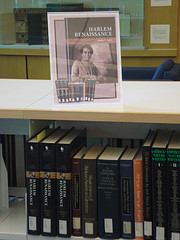
My part of the class preparations was to develop an exercise that would introduce the students to the 5 reference sets they’d need to navigate as they prepared for their final presentations. But the big question was how to make it easy for them to pick their sets out from the shelves and shelves of unfamiliar reference books, while still letting them see the sets in context rather than pulled out and put on a cart just for this assignment. Well, to ease this particular rub, I made signs for each set that had a full scan of the cover of the one of the set’s volumes, and then a cut-out image of the set’s place on the shelf.

Then I put these signs up on the shelves above each reference set.

That way, when the students came back to do their research after all of the librarians had gone home for the night, they’d be able to go back to the sets we’d shown them in class. I hope it worked for them.

Oh, and the exercise itself sounded great on paper, but would need more clarification next year. I still like the idea of it, but there were some recurring questions I should have anticipated.

Leave a Comment

Late on the Uptake?

We’re having our mid-meeting break at the moment (all-staff meeting from 9 to noon, followed by lunch and a photo). But I wanted to share my favorite quote of the day. It came from a co-worker, who quoted a speaker he’d heard at the Frye Institute.

The library is pregnant with change. In fact, it’s nine month’s pregnant, and it’s in the delivery room. And the library has just decided it’s time to go out and buy a pregnancy test.

2 Comments

But… What do you Do, Exactly?

I attended a cook-out this past weekend and had a wonderful time sitting around in lawn chairs talking, listening to others talk, or listening to the breeze whenever we all fell silent. The gathered group was actually comprised of two sub-groups: people who work at Carleton with one of the hosts and people who don’t work at Carleton but are cool and interesting anyway. By chance, I ended up spending most of my time sitting with the latter subgroup, and twice the Dreaded Question came up.

The DQ, as I like to call it (since I am a librarian and am thus compelled to make acronyms out of any phrase of two or more words), is only slightly less difficult for me to answer than that ubiquitous question: “So… where are you from?” Every time that omni-present conversation opener rears it’s ugly head I have to quickly assess whether the person wants to know where I was born, where I spent my early years, where I spent mostly of my time, where I’m mostly recently from before moving here, or if they just want to know where around here I live. The only thing I know they don’t want to know is everywhere I’m from. It’s very complicated.

But I digress. The DQ, as I’m sure you’ve guessed from the title of this post, comes just slightly after “Where are you from?” and it’s inevitable follow-up, “What do you do?” It’s the thing that comes after you say, “I’m a librarian.”

First there’s the instant smile and the comfortable “oh, that’s nice.”

Then there’s a pause.

And then comes the kicker: “So… what do you do, exactly?”

Long days at the office, dashes across campus to help professors conquer research emergencies, days spent agonizing over classes and preparing for student appointments, weekends spent “catching up,” and hours at the reference desk all flash through my head. But there’s not much that’s coherent, not much that I can latch onto and say “This. This is what I do.” So I rambled both times about working through research processes, sources, and analysis with students and faculty, teaching classes of students before they start out on research assignments, working with intellectual property policy on campus, and sitting at the reference desk several hours a week. We got into how the internet has changed this job in recent years and explanations about why people need a degree to do this job. And then people moved on to talk about a bar somebody liked, the neighbor’s dog, and how much money farmers can make from growing mint.

And maybe that’s ok. I have very little concept of what the woman next to me does all day even though she explained it, and her fiance told me the job is eating her live. Maybe there really are only a handful of jobs in the world that we all know and understand well enough that we don’t have to walk away from newly met people and wonder how they fill their time. Besides, maybe it’s more interesting to work in a job that has so many disparate parts to it, each one with it’s own challenges and rewards.

It’s also gratifying that people actually ask what I do rather than jump to the conclusion that I must shelve books all day. I never ask a lawyer what he or she does all day because I think I know. But I don’t, actually. And it’s only since my cousin became a lawyer that I bothered to find out that there are many branches and specialties in that field. Maybe having people assume our jobs have been usurped by Google is the best thing that’s happened for this profession in a while. Maybe now they’re curious about what happens when we aren’t sitting at the reference desk.

So as much as the DQ is frustrating and unsettling, maybe it doesn’t need to bother me any more. Maybe I can learn to love it as much as I love having people ask me what kind of dog my family’s mutt is, or what ingredients go into my soups.

3 Comments

Some Days I Actually Feel Like a Librarian… Some Days I Don’t

I often feel like I stumble through my job by pretending I know what I’m doing. There’s always the lurking fear that if people really knew how much guessing and bluffing I do, they’d never set foot in a library again.

Well, today has been both good and bad. At first I thought it would go down in the annals of my career as the day when all those strategies I was taught in library school, and which I always wish would work every time (but which almost always never really seem to pan out), actually worked! Here’s what happened. We have a new professor coming in the fall who teaches Quebecoise literature (focusing on the postcolonial yummy-ness of that whole colonizer-turned-colonized dynamic that happened in Quebec). Well, the library just isn’t outfitted to serve this type of curriculum yet because our books are bought by our faculty to support the classes they teach. And this whole area has never been taught before. Ergo: no collection to support such an area exists just yet. Not only that, but she wanted a particular edition of a particular French language book because she wanted her students to read the preface of that edition, but she didn’t know which edition it was. After a bunch of messing around in catalogs, I finally interlibrary loaned a bibliography of this author’s works and there it was! The editions of the book were all laid out in one place with descriptions of what changed in each (including prefaces). So, dusting off my 10-year-old French, I deciphered the descriptions and found the appropriate edition. Now I’ve sent the request off to acquisitions and was feeling very, very librarian-ish. Was.

In the midst of emailing this professor to confirm that this was, indeed, the correct edition (and that my tortured memories of French hadn’t betrayed my efforts), a student came up to the desk wanting a 1920s translation of an early Einstein paper. Of all places, after searching in all the “correct” places, Google turned up a footnote explaining where this seminal translation can be found, and Wikipedia turned up a PDF copy of it. So now where do I hand in my library school diploma for shredding?

I guess in the spirit cosmic balance it all evens out. Librarian-ish tenacity and the sussing out of appropriate pointing aids are great sometimes; Google and Wikipedia are great other times. So I guess what makes me a librarian is the fact that I try both places? Who knows.

2 Comments

What Do We Teach? Information Literacy and Information Technology in an Academic Setting

A few times a term, librarians from Carleton and St. Olaf meet to discuss an article that is either about some aspect of information literacy and IL instruction, or can be discussed from the perspective of people teaching information literacy. This morning, for example, we talked for about 45 minutes about Ann Grafstein’s new article in portal (which I highly recommend, by the way).*

On each of our campuses we’ve heard rumblings from time to time that what we do and what the IT people do is really fundamentally the same thing. When we say, “Uh, no, it’s really not,” they respond with, “I mean, if you forget the fact that they work in the IT department and you work in the library… just leave that out of the equation, what’s left is really fundamentally the same thing.” This is only true if by “fundamentally the same” you mean “help people do what they’re doing,” in which case almost everybody on campus fits that description.

The next argument is that we teach people how to get stuff out of databases just like IT teaches people how to manipulate spreadsheets. Well, I know our IT department does a whole lot more than that, and while I do indeed teach people how to get stuff out of databases, I do so much more than that. And a lot of what I do would be important even if there were no technology at all, or if the technology changed drastically.

So what do I do? What do I offer students that goes beyond a basic knowledge of subject headings, catalogs and databases, and the mechanics of search?

We Work with Content, Regardless of Format
When we teach database searching, catalog searching, search engine searching, and even *gasp* print index navigation, the format is simply a vehicle. Our true focus is on the content beyond the vehicle. This is why library sessions that aren’t tied closely to an assignment often result in zoned out students. If you’re simply teaching “this is a database… this is a subject heading” and the students aren’t trying to get at any content, everything feels unimportant and arbitrary. If the students are actively trying to find content to work with, and are finding the process frustrating, that’s when they pay close attention.

This is also why I’m against wholesale moves from print to electronic. Some sources simply work better in print. Some work better online. I would prefer to figure out which vehicle best suites the content and the students’ uses of that content than to squeeze all content into one format. Granted, electronic is a wonderful vehicle for many, many kinds of content, but not all kinds, and not all instances of each kind.

Evaluation of Sources
Probably more than any other component of this nebulous thing we call “information literacy,” evaluation of sources has taken hold as The skill that librarians are trained to perform and teach and that goes beyond simple location of sources. And while this task has become more tricky as more and more stuff floods the Internet, it is and always has been important even in the print-only world. I’m not convinced that it was ever easy, no matter how many people tell me it was so much easier when you had the print in front of you. I tend to think we simply haven’t honed our teaching skills in the newer formats to the same extent that we had before. But what do I know? I’ve never known an academic library that didn’t have JSTOR.

But I propose, as a topic for discussion, that while evaluating sources is definitely important, it has gained it’s current widespread status as almost synonymous with “information literacy” primarily because it’s taught in library school and because it has steps to follow. We’ve grown so used to saying that we don’t just teach “how to” any more, we also teach evaluation, that we don’t often look beyond that to the other things we can and do teach. And I’d propose that these other things are as interesting and as important, but that they don’t have clearly defined steps to follow and that they are not taught in library school (at least, not at the library school I went to).

What are these other things? Well, I think teaching research strategies falls into this camp even though these strategies do get lip service in library school, and we do mention them occasionally in classes, and we work a lot with them at the reference desk and in individual research consultations. And sussing out what counts as evidence for a particular discipline, sub-discipline, and audience is also a major component of information literacy.

Research Strategies
When I was in library school, we spent one day on information seeking behaviors and strategies (which mostly turned into a discussion about how we could get people to come to the library first rather than consult their friends), and about two weeks (with accompanying group projects and presentations) on evaluating sources. I am extremely grateful to have had evaluation beaten into my head with that kind of force because it has stood me in good stead. But I am still figuring out how to quickly and effectively help my students devise workable research strategies. It is not enough simply to know that they’ll consult friends and trusted professors, or to say that research is an iterative process. I want to default to thinking about helping my students navigate this thing that really frustrates them in the same way that I default to helping them think about how trustworthy their sources are.

What’s more, I don’t think students have a realistic sense of how much time research can take. I know… that’s not a radical thought… but here’s why it’s important. Someone might argue that we have to help them evaluate sources because they don’t think of asking for help with that because they don’t know that they don’t know evaluation, so they don’t know to be frustrated. They are often frustrated with the progress of their research, though, so it’s not as important to remind them that they will need help with this. Not so. They often get frustrated too late, when there’s no more time for interlibrary loan or restructuring arguments so that they can actually support what they’re saying with real evidence.

Matching Evidence to Audience
And this brings us to real evidence. “Real” evidence is the stuff that bridges the gap between your topic and your audience. If there is no gap, you need no evidence (and then it’s not really worth researching, is it?). So what counts as evidence to your field? What counts as evidence to the people in your field who would be interested in this particular topic? Will you need a traditional lit review or anecdotes? Will popular publications or snapshots of wikis on a particular days support what you’re saying and be credible witnesses for your case in the court of your audience’s opinion? Will you need statistical data or interviews with experts? Will your opinion count or will you have to cite others’ thoughts? None of these can be assumed to be important across the board. And I had no training whatsoever in thinking about these questions.

And yet, I would argue that this is the single most fundamental cornerstone of information literacy. Without this, everything else crumbles. And the closest we usually come to teaching this is to walk students through “what counts as a scholarly source.” That is a great start, and for some students in some classes that’s all they need. But it just doesn’t cut it for everyone in every situation.

So that is the beginning of my credo. I’m just starting to figure out what I my role is on my campus, and what I’d like it to be, and this is where I’ve gotten so far. I’m not done, and I’m sure I never will be done defining my job. But I’ve made a start. Sure, I also teach the mechanics of search and the steps for getting your hands on full text, but I do that in service of these other goals.


*Grafstein, Ann. “Information Literacy and Technology: An Examination of Some Issues.” portal: Libraries and the Academy 7.1 (2007): 51-64.
2 Comments

Maybe the Easiest Virtual Reference Set-Up Ever

I’ve been playing with Meebo Rooms today in between student appointments and crazy-hard research questions. For the two or three of you that haven’t heard of these things, they’re a brand new feature of Meebo and you can read more about them on the Meebo blog. Basically, it’s a free and easy chat room where you can also push links and video and you can embed the room on a web page (such as the Research Help page of your library?). What’s not to like?

I can easily envision this on the library site. We could be logged into meebo and hanging out in the room in case anyone had a question. This would alleviate a problem we’ve been facing: how to make it easy for students to ask IM questions even though we all have separate IM addresses and are not considering having a single “reference” account that we’d all log in and out of. And yet, students could ask questions without having an IM account. Perfect.

Except… We’d have to figure out what to do about the fact that anybody looking at the embedded room could see the questions we were working through, and anyone who logs in can see the last 50 or so lines of chat history. I’m the least privacy-concerned librarian I know, but even I think we’d have to have a warning about this posted prominently.

And then there are the ads. Every so often we are asked to “please enjoy this sponsored video,” which stinks. We could turn the media area off, I guess, but that seems like a kill-joy.

I can also not choose any options other than “only You can add video” and “anyone can add video.” I’d like to be able to authorize people to push video out onto the library site… just cuz I work on a college campus with, you know, college students.

But I’m still thinking we might be able to make this work. I’d love to make this work. Even if we only do the text part of it at first and save the cool media-pushing-thingy for later.

[Update 5/16/2007: I’ve embedded a few sample reference chat room configurations here. One cool thing is that people can copy the code for the room and paste it where ever they’d like, so they could easily add it to their own pages and have us right there in their own space if they wanted. The magic happens if you click “Copy Chat Room.”]

3 Comments
css.php