Skip to content

Category: Libraries and Librarians

The Difficulty of Making Students Care About Open Access

This week Gavin Baker came to talk to us and our students about open access. I wasn’t able to attend his formal talk, unfortunately, but the discussion session in the morning got me thinking… Why, when I hear that we should make sure students understand the benefits of open access, do I immediately think that it’s going to be a tough battle? After all, OA is free — students like free stuff — should be a no-brainer, right?

Wrong. Students have a hard time caring that OA is free because to them, everything is free. All our wonderful IP range subscriptions even populate Google links with juicy full text. So one answer might be to somehow make it clear which links uncover full text because the library paid through the nose for it to work that way, and which full text would be free no matter what the library does.

While there is some merit to that idea, I think there are some problems with it, too. For one thing, lots of our vendors would probably disown us if we broadcast what we pay them. They prefer to keep everyone guessing what a “good deal” actually looks like by keeping us from sharing information. But even if we could have a resource say “brought to you by your library for somewhere between 10,000 and 50,000 dollars per year,” I’m not convinced this would be enough of a motivator for students to care about open access because most of them don’t realize that they’ll want access to this kind of thing later. They don’t associate “access to journal articles” with warm fuzzies, wonder, awe, or gratitude. They associate it with completing assignments. With this attitude, it makes perfect sense to them that the college would provide the materials they need to complete coursework, no matter the cost, just like the college provides professors and classrooms and projection equipment and academic support and all the other “free” things that they know full well cost money. So what we need to do is readjust the attitudes that students have about journal literature. We need to get them to associate it with something larger than coursework.

Actually, I think that it’s this problem of attitude that might be the trickiest to navigate. I spend my days trying to instill a sense of the wonder and joy of research into my students. I want them to see a great article and have them thrill to the possibilities of putting it to use. And they have to get to this point before they can possibly care that they won’t have access later, or that other people don’t have easy access now. So here I am, helping students fall in love with journal literature, but I know I also have to make the complicated move of problematizing journal publishers and arousing righteous indignation in my students that less privileged individuals simply cannot afford access to these treasure troves of research.

Combine all this with the reality that librarians (at least as we function here at my library) are almost purely opportunistic teachers, and the situation seems even more difficult. We don’t have very many built in soapboxes from which to trumpet the benefits and complexities of Open Access in any systematic way. I’m not saying it’s impossible, and I’m certainly not saying it’s not worth the effort. I’m just trying to wrap my head around the difficulties.

I’d love to learn if anyone else has been able to navigate these issues effectively.

2 Comments

Highlights and Lowlights

I’m still processing my thoughts after CIL, and I’m sure this won’t be my last post on the issue, but I thought I’d just give a quick thumbs up and thumbs down list.

Thumbs down (first so I can get it over with):

  • Arlington doesn’t seem to have a blue sky. I’ve only seen clouds. Does the sun ever shine there?
  • Vendors who clearly haven’t heard what we’ve been saying for years. C’mon people. We aren’t trying to be mean when we question your relevance ranking algorithm or your obsolete file structure. We’re just frustrated. And nothing’s changing in any fundamental way.

Kinda in between:

  • Wireless that doesn’t work. In all fairness, ITI clearly tried very very hard. There was a whole lot more connectivity than there has been at previous conferences. Unfortunately, all of our bandwidth needs have also increased and so we crashed it… regularly and with frequency.
  • And for all the guff people gave for new ideas that didn’t work (you know the ones), I think it’s great that ITI is really working to make sure this conference structure and logistics move forward with the times. It’s regrettable that many of these experiments flopped in a big way, but a track on open source and a track on new user interfaces were two great steps forward.

Thumbs up (to leave you with the good stuff):

  • The people the people the people
  • More accommodations for the laptop laden (a blogger’s row in the front of every room, complete with power strips. Yay for power strips!)
  • Watching the stenographer at work. I had no idea they did that!
  • Pecha Kucha!!!!

And even though nobody else will care, here are the top in-jokes from this year (feel free to comment with those I’ve left out):

  • One-eyed pink bunnies.
  • “Libelous and slanderous”
  • “I’m late for choir practice”
  • “Hookers and blow”
  • “I hate technology”
  • Lobby 2.0

[Edited to get the right things into the right categories. Thanks, Greg, for the heads-up. Advice to all: never blog when this sleep-deprived, no matter how much you think it’ll be fun and easy.]

Technorati technorati tags: cil2008

4 Comments

The Story of My Profession

Well, this is a first. I fully intended to blog, twitter, upload pictures to Flickr, and do all the other things I’ve done at every other conference I’ve attended in the last 3 years. But a combination of technical and social factors have gotten in the way. Lack of reliable internet is a perennial problem at CIL. (This year they seemed to have made a concerted effort to improve… but the wireless routers kept failing and kicking whole rooms full of people off the network.) And this year I discovered that if you know a lot of fun, cool, engaged, and social people, you might not get a whole lot of one-on-one time with your laptop. This I take as a wonderful thing, and I had the best time meeting the majority of my until-now-only-virtual friends (more on this in another post). So the upshot is, I’ve spent every moment so far either fighting with wireless connectivity or actually talking with people, not blogging… not uploading photos (or even really taking photos… sorry), not even twittering a whole lot (my phone doesn’t do the whole web connectivity thing, either, and I just don’t want to pay for a conference full of twitterers’s ideas 10 cents at a time). Does this mean I have to hand in my 2.0 credentials?

Ironically, this lack of communication directly contradicts what I think has become the unofficial theme of this conference: telling stories. A few sessions have mentioned this theme explicitly (I’m thinking particularly of the Day 2 Keynote, presented by a trio known affectionately in these parts as “the Dutch Boys”). But even when presenters didn’t actually talk directly about story telling,they’d stir our interest by invoking stories of their own. Who wasn’t captivated by the clip from Mary Poppins in the Day 3 keynote? Who didn’t love Greg Schwartz’s fairy-tale-turned-Pecha-Kucha talk?

I found this underlying focus on Story compelling. At its heart, Story requires interaction, communication, and therefore community. I’ve also found that narrative stirs some deep and vital part of people. We’ll believe a narrative that hangs together even without the “evidence” that we train ourselves from school onward to interrogate. And we’ll often remember evidence-based narratives but forget all the actual evidence itself. On the flip side of that, facts without a narrative to tie them together are just about the epitome of “boring” and “forgettable” for me. And what’s more, Story is fun! It taps into the not-work-but-fun part of my psyche and sets my default mode to trust and enjoyment rather than skepticism. (Why do you think it takes so long to teach students to read fiction critically?… because it’s made up of good stories.)

All this talk of Story has inspired me to be on the lookout for the narratives we present and narratives we could present to our communities. I know we do, and we often even do it intentionally. I’m just interested in being mindful, myself, of the power of Story for my library.

But I actually think it should be more than just an inspiration. I think this idea of Story should be a great comfort to those who feel forced to think that the only way forward is to obliterate everything on which libraries are built. Quite the contrary. Our history of service and of meeting our community’s needs is fundamentally part of our story. It’s the part that’s implied when we start in medias res. It’s the part that sets the stage when we begin “once upon a time.” It’s the part that, if forgotten, renders the rest of the narrative stilted, limp, and ultimately boring. Moving forward is the rising action of the story, not a new story.

Technorati technorati tags: cil2008

9 Comments

Getting ready for CIL

I spent the morning tweaking my twitter account to be useful while I’m at CIL. I won’t be publishing my tweets here, but if for whatever reason you want to keep up with what I’m doing (whenever the notoriously spotty conference wifi will allow me onto the network, that is) you have two options: follow me on twitter or subscribe to my twitter feed.

Of course, I’ll be blogging as usual. I usually write a post or two each day pointing out the highlights of what I saw and learned. I don’t usually blog conference session notes, but plenty of other people do, so search Technorati for the tag cil2008 and I’m sure you’ll find all the session notes you need. (By the way, that same tag will work for Flickr and del.icio.us and a whole host of other tag-searchable things.)

Technorati technorati tags: cil2008

Leave a Comment

Becoming a Librarian for Languages

When I first started this job, I knew there was a lot I didn’t know about the unique needs of the different departments I’d be serving. I knew that typical research needs varied by discipline, and that I’d be serving three broad disciplines: languages, literature, and music. But I’d never done research in language or music courses, so I didn’t know what that kind of research looked like, or what it would need from me. So I made a plan. (I’m a planner, what can I say.) My first year, I’d just keep my head above water. I’d learn to teach, learn to work at a reference desk that actually got real reference questions (not the case at the two placed I’d worked during library school), and concentrate on not making a fool of myself. The next year, I’d figure out what it means to serve language departments. And the next year I’d figure out what it means to serve the Music department.

Needless to say, my plan didn’t go quite that tidily. But in general, I did concentrate on peering under the hood of a different discipline each year. I’ve already written about some of the things I’ve learned about being a Music librarian, so I thought I’d share a bit about what I’ve learned so far about serving language departments.

Time is of the essence:

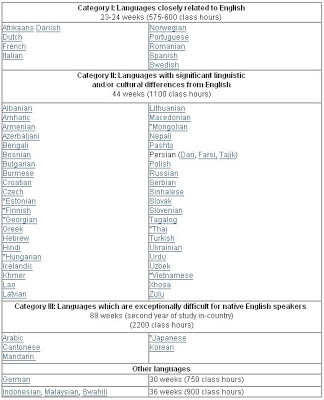
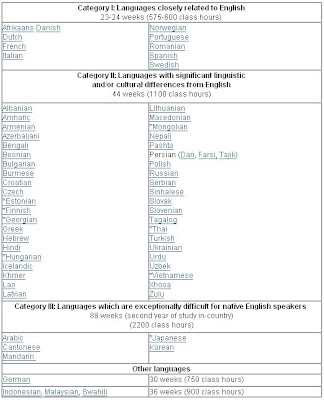
I spent at least a year being frustrated when professors of languages would ask me to please come teach everything there is to know about the library, and please keep it to 15 minutes. At first, I thought I needed to practice those skills you learn about in library school and at ACRL’s Immersion program and say, “That won’t be possible. If you give me 45 minutes here’s what I can cover.” It turns out, though, that in this particular instance that is not always the best strategy. Sometimes, sure, if the project facing students is a major research paper, or if the class is not (as they often are) focused on language and simply using a research paper as another way to gain facility with that language. But if the course’s primary goal is to move students toward language fluency, then the teachers are under a massive time crunch. They know that they’re racing the clock to expose their students to the number of hours of instruction it takes to achieve fluency in a language. And yes, it’s measured in hours.

Here is the chart that a group of language faculty presented this fall as part of their ongoing discussions about curriculum review. Notice that for the Category I languages (like French) it takes 575-600 class hours to achieve basic fluency. For the Category III languages (like Cantonese) it takes 2200 class hours to achieve fluency. (Source, the National Virtual Translation Center which takes some information from the Foreign Service Institute.)

With time to fluency ticking away, an hour of library instruction (delivered in English) is just too costly. So the faculty and I have started coming up with solutions that don’t involve me jeopardizing their instructional goals. I sometimes come and give a 15 minute overview and a handout that prompts students to ask me questions. Then they come to visit me in my office, singly or in groups.

Sometimes that option would eat up all of my time, so I ask for two or three 15-minute chunks of time with the class spread out over several class periods. The end result is that I’ve taken more of their precious class minutes, but this way students don’t go for an entire session without hearing their foreign language of choice so it doesn’t seem to derail instruction as much. It’s always a balancing act: the relative worth of my time balanced against precious classroom minutes.

What Language Students Need from Me:

Depending on the assignment, this changes, but language students need a couple of tips that no other students need. For example, when searching in a given database, should you search in English or in the foreign language? If searching in the foreign language, does it matter if you use accent marks or other non-standard-for-American-writing characters, or will the system understand that e may mean é? Since search is basically character matching, these questions can make the difference between relevant results and no results at all, so I’ve started including them in the research guides I build for those students (example).

At a library the size of Carleton’s (good sized, but not like a large research university’s library), language students also need to know how to interlibrary loan materials. I always tell them that in these classes, they MUST search and order ILL items early. Once that’s done, then they can procrastinate as much as they like. Every term a few students don’t realize how very serious I am about this point and end up having no good sources to work with.

So that’s the big stuff

Other than that, I’ve learned from working with my language students how to give up the mouse and keyboard while doing searches. There’s nothing like trying to scan through a result list in German, or brainstorming for Chinese search terms to encourage me to say, “Here, you take over and tell me what you see. … Now, do you see anything on the page that looks like….”

I used to be completely intimidated when contemplating my work with language classes. I felt uncomfortable standing in front of a class and knowing full well I couldn’t speak the language or even pronounce the example search terms we were using. But after a couple of years, I think these experiences have taught me to be more comfortable with the idea that I can contribute to student learning without any grounding in the subjects their studying.

3 Comments

“Is It Okay To Call You a Librarian?”

Sitting at the reference desk yesterday, I started talking to the student worker next to me about this and that, and she mentioned that a librarian had come to talk to her class last term. Then she got a concerned expression on her face and asked, “Is it okay to call you a ‘librarian?’ Is that the right word?”

“Of course,” I said.

“Oh. Good. Well… see, I was confused because in high school we weren’t allowed to call one of the women who worked in the library a librarian. She’d get mad and say, ‘Don’t call me a librarian. I’m not a librarian. She is. I’m a media specialist.’ She made a really big deal about it.”

I explained that it might have been a big deal to those two library employees because probably one of them had a masters degree in library science and one of them didn’t. I tried to reassure her that she didn’t need to worry about offending people here unless she called them “block head” or something.

She seemed relieved and very interested, but the amount of relief that showed on her face worried me. In light of the recent blog drama having to do with who is and who isn’t a librarian, who deserves respect, and who deserves recognition, I’d like to ask that we keep our patrons in mind. I’m certainly not against helping people understand the difference when it’s appropriate, but making them worry about addressing us because they’re afraid of getting our titles wrong won’t accomplish anything.

Leave a Comment

The Problem with Vocabulary

There are a couple of things I really like about being primarily a subject librarian, and about having subject librarians easily accessible in a college library. For one thing, it sure helps when those crazy-hard questions come to the desk and you can say something helpful-sounding like “I can get you started with some of the basics, and then you should go see so-and-so for more in-depth help.” Of course, then there are those crazy-hard questions that come to the desk and are in my area, so I can’t pass them off… but we’ll forget about those for the moment.

But one of the things that’s most valuable about this division of labor in an undergraduate environment is that each librarian can concentrate on developing discipline-relevant vocabulary. I’m not talking about vocabulary in the “how to talk to students” sense at the moment, though that’s certainly very important. After all, even “primary source” means something different to each discipline. No, I’m just talking about terms and vocabularies associated with topics of research. When a student of literature comes and talks to me about rhizomatic narratives or the relationship between metaphor and ideology, I have a whole thesaurus in my head that opens to the correct spot and starts coming up with alternate search terms. I know where these things fit into umpteen different literary theorists’ perspectives, I can recognize key works referenced in the titles of scholarly papers. Not only can I employ these terms and names directly by adding them to my search, but I can recognize articles in a result list that might be relevant simply by calling on this mental map of the topic. Then I can open those results and use vocabulary I find there to create new searches.

Since search is fundamentally a character-matching game, with people supplying characters in a row (i.e. words) and computers matching those characters to the characters in its index, lack of vocabulary renders search essentially useless. I don’t know or recognize the terms that are central to, for example, the IMF. So I’m basically stuck with ineffective searches and only limited options for refining my searches. And I can’t help steer students to refine their terms because I have no mental map of this topic beyond “something to do with money, and something that’s international.”

If we don’t have access to mental maps, how do we build our students’ mental maps? And how do we generate search examples that will help them learn?

And how do I develop mental maps of all the research topics my students need help with?

8 Comments

Exploding an Article

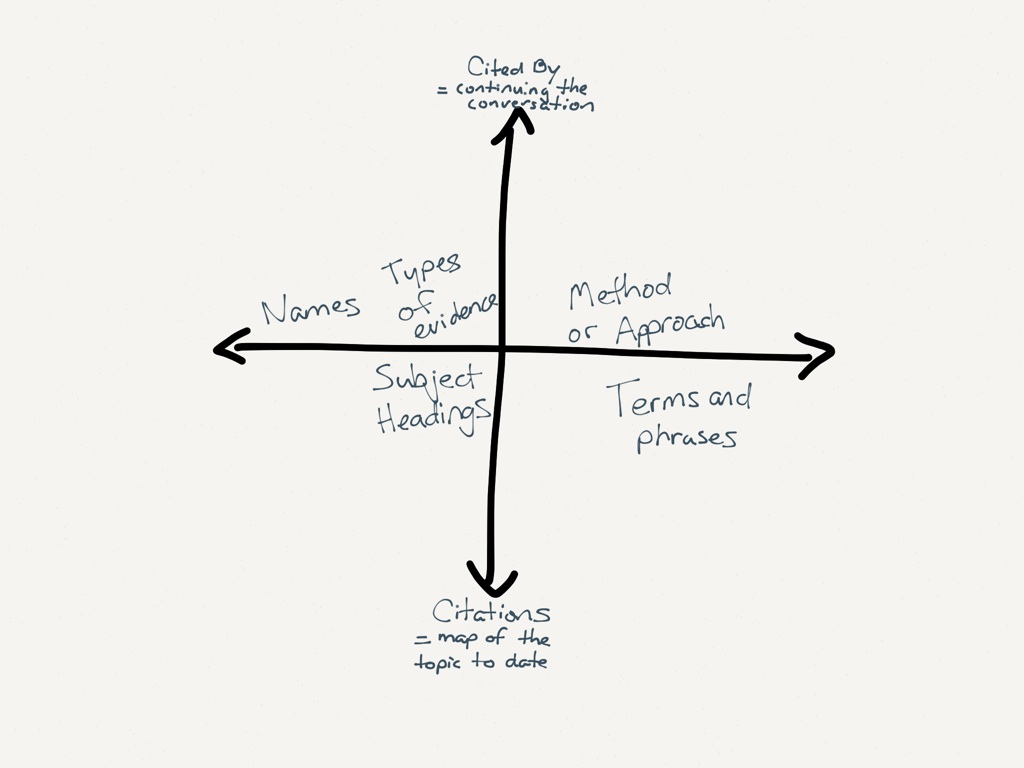
I don’t know why I hadn’t thought of it in these terms, before, but this morning just before a lightning-speed class I suddenly realized that if you have a good article in hand, you can look in four “directions” for more articles like it. (I use “article” because that’s what I was working with this morning, but it works for anything with citations, I guess.)

You can move backward by mining it’s bibliography. You can move forward by using Web of Knowledge to do a cited reference search. And you can move side to side (sort of) by reading it with an eye both for content and for vocabulary that you can use when constructing future searches.

exploding article
By Iris

8 Comments

Maintaining Research Guides, the Never Ending Struggle

I spent a good part of today trying to wrap my brain around a new subject area so that I could a) figure out which resources might be important for the assignment, b) figure out if we had access to those resources, c) figure out what to substitute for the stuff we didn’t have, d) create an online research guide for that assignment, and ultimately e) stand up in front of that class on Wednesday and say coherent and useful things rather than idiotic and generally boring things.

As I was experimenting with new sources and concocting tips for the students who will soon be using them, copying and pasting relevant chunks from other guides, and then deleting about a third of the information after realizing I’d needed it to wrap my head around the project, but my students probably didn’t need it… as my guide emerged little by little throughout the day, I mused on the changing role these guides are having in my professional life, and on their convoluted lifespan.

Before going further, a word of explanation. At our library we have three kinds of guides: subject guides, course guides, and general guides. General guides are those things that aren’t specific to a discipline at all (like “Using the Library from Off Campus“). Subject guides serve as portals for research within a major, and there’s at least one for every major on campus. Each liaison maintains the subject guides for his or her liaison departments, and we each have the option to create a course guide for any course we think needs one.

Recently, I’ve begun rethinking my guides. It started last year when I changed almost all of them over from being organized around types of sources (finding articles, finding books, etc.) to being organized around topics or tasks (finding primary sources, finding social/historical context, finding authoritative scores etc.). Now this year, I’m using the subject guides more and more while I’m at the reference desk, both to organize my own thoughts about a new topic and, more importantly, to model this behavior for students. After all, it’s probably much more useful to send students the extra click through a subject guide than to force them to sink or swim in a list of 200 or more research databases! This also keeps me honest, because I actually use the guides all the time, so their faults scream out at me until I finally get time to remedy them.

And in my life, I do my most careful thinking when creating course guides. These grow out of a specific research task and force me to really come to grips with the research challenges inherent to that task. Then, at the end of each term, I retire the term’s course guides but copy and paste the best bits into the subject guide for the appropriate major. Next term, as I create new guides, some chunks can be copied straight out of the subject guide, but there’s always something new, or some sections that just aren’t appropriate for the larger guide, so those get built from scratch almost every time.

And so this circular evolution of course guide to subject guide and back again keeps me writing and updating guides pretty much every week of the year.

p.s. For the curious, today I was working on a guide to Medieval and Renaissance Music (link will be live through March 2008, after which point it’ll be archived offline).

Leave a Comment

Musings on Periodicals

We’re in the midst of our biennial print periodicals review at the moment, and it’s gotten me thinking about how to be a good steward of our periodicals collection. Personally, I love electronic journals better than print journals in most cases. There’s just so much more you can do with them, none of which involve photocopying. (Photocopying is a sore topic with me, right now, for completely separate reasons, none of them interesting.) So faced with a list of journals and the choice to continue with the print subscription, flag them as candidates for e-access only, or cancel them entirely, I’d go with the electronic version in a heartbeat for many, many titles.

However (you knew there was a “however” coming), there are a couple of categories of things that I will not give up in print if I have anything to say about it. (And remember, I’m the librarian for Languages and Literature, so my views are biased in that direction.)

  • Periodicals that include ads or images that aren’t indexed or included in the electronic version. I spend enough time with my American Studies students (and my colleague spends even more time with her History students) finding ads and images that being forced to give up basically our only accessible copies of these ephemera makes me weep for the students of 20-years-from-now who will be basically prevented from pursuing whole swaths of research topics.
  • Periodicals that include or are primarily composed of fiction, poetry, or art. These genres are used in many ways, some of which is enhanced by electronic access, and some of which are decidedly NOT. I want to leave the door open for the later cases.
  • Periodicals that are routed and that a) don’t have good alerts built into the electronic version or b) are routed to people who don’t care for alerts because they and their workflows are set up to need the thing itself sitting and staring at them before they’ll be reminded that they actually did want to sit down and read for a while. I’m that way, myself, with somethings. Not with my professional journals, but with somethings, so I can entirely sympathize.

Assuming I’m looking at a periodical that doesn’t fall into one of these categories, the next things I’d want to know before jumping for the e-access-only option are:

  • Does the e-access include PDF full text? This is especially important if foreign characters (such as Greek, Russian, or Asian characters) are important, or graphs, or images, or really anything other than the text itself. It’s also easier for students to cite exact and original page numbers.
  • Do we get to retain perpetual access to the issues we’ve paid for? (This is a biggie, and possible from some vendors.)
  • Is the eJournal’s interface easily usable? Are the result lists for searches understandable?
  • Are there RSS and email alert options for searches and new issues?
  • It sure would be nice if we could still send articles to other libraries via Interlibrary Loan. (I still worry about the world’s libraries going e-only and cutting each other off from sharing their collections with each other and with smaller libraries.)

These are the things that run through my head as I page through the periodicals on my list. What other criteria should I be thinking about?

1 Comment
css.php