Skip to content

Category: Libraries and Librarians

Rethinking Instruction … Again

One of my favorite things about teaching is that I never feel like I’ve figured out how to do it well. There’s always something new to try, or something old to tweak, or something tried and true to throw out because as it turns out, the students don’t need it any more. All of this means that I’m never bored, and that I’ve never taught the same session twice.

Of course, this also means that I’m always a little uncertain about what I’m doing, how effective it was, and how meaningful it was. So far, no assessment I’ve done has completely set these nagging uncertainties to rest.

But uncertainties notwithstanding, I’m going to try something new this fall. When and where appropriate, I’m going to combine the idea of the Knowledge Survey* with classroom clickers.

I’ve been hearing about clickers for years and have experience their effectiveness myself. Quite against my own will, and in spite of feeling that I was participating in something as corny as any of those team building exercises I always hated (like falling backwards and getting caught), I found myself being sucked in and engaged in the activity at hand. If that could happen to me against my will, maybe I can use it to sucker some nearly sleeping freshmen into my sessions with a couple of well-placed participatory activities.

Still, my innate aversion to gimmicky things kept me from getting too excited until after I heard about Knowledge Surveys. Those things are amazing! Students get an accurate assessment of their own abilities (the Macalester Geology department has found incredibly high correlations between the responses on knowledge surveys and the students’ actual abilities), but I get a quick way to assess students, and I get a less-gimmicky way of encouraging participation and curiosity.

Now, if I could only get the stupid clickers to work, that’d be a great first step. So far, they hang at the “sending” notification whenever I test them, and never make it through to the actual recording of a response. I’ll have to get someone to help me figure out if they’re actually not working or if I’ve set something up wrong.

* I’ve heard Karl Wirth speak about these surveys three times, now, and ever time I came away thinking that there’s got to be a way to incorporate these things into my teaching somehow. Here’s a paper he and Dexter Perkins wrote on the topic.

Leave a Comment
Trying Something New

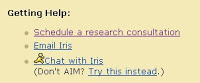
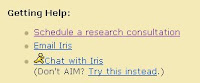
I spent a few moments today adding a new section to each of my subject research guides. Our CMS doesn’t allow for things like Meebo widgets, or any other embedded stuff like that, so I added the next best thing: a bunch of ways to reach me from within each page.

Here’s what it looks like:

(From my French & Francophone Studies Research Guide)

Frankly, I don’t know why this didn’t occur to me until today, but now that it has, I look forward to seeing if I get any increased traffic. (Of course, the other part of me is asking if I really want increased traffic… but of course, the answer is always yes.)

Point of need research assistance: the holy grail of every research services department.

Leave a Comment

Linking to WorldCat in Reference Emails.


So here’s the thing. Like many reference librarians, I use WorldCat all the time. And like many reference librarians, I use the FirstSearch version a lot for advanced features and more seamless integration with our local collections than WorldCat.org can offer. For instance, I love the “Advanced Options” under “More Like This” that lets me pick and choose which parts of the metadata were relevant to me and do a more advanced search on just those elements. And sure, the FirstSearch display is a little overwhelming, but part of what makes FirstSearch good for professionals is the huge amount of information displayed for each record. We’re used to the display, so it’s not a problem for us, and often I skim through all that information and learn a whole lot about an item in a very short amount of time. Besides, my eyes are trained to take in what I want from that interface and leave the rest. I know where on the page the OCLC number lives, for example, so I only look at it if I want to.

One thing it doesn’t do well, though, is let me link to a specific record. I can’t send a link to a student and say “Here, this is the journal I was telling you about.” I can do this at WorldCat.org, though, and that’s a much better interface for students and faculty anyway. I wish there were a “link to this record” in FirstSearch, or at least a “View this record at WorldCat.org,” but since there isn’t, here’s what I do.

  1. Do all my behind-the-scenes advanced searching in FirstSearch (when appropriate).
  2. Find what I’m looking for.
  3. Do a little happy dance in my chair.
  4. Copy the OCLC number.
  5. Open a new tab and click the bookmark I’ve names “WorldCat Link Base.” This contains the base of WorldCat.org’s permanent URL. http://www.worldcat.org/oclc/
  6. Paste the OCLC number onto the end of that URL and hit enter.
  7. Et Voila! Stable URL to the bibliographic record of whatever-it-is I wanted to send to somebody, complete with a friendly interface.

The trick comes when they’re off campus and don’t have pre-loaded links to our Interlibrary Loan system. I wonder if it’d be possible to go through our proxy server for that. If so, I’ll have to change my link base… Hmm…. things to ponder. And wouldn’t it be nice if I knew javascript and could make a bookmarklet that would do that to OCLC numbers for me, and maybe copy the full stable URL to my clipboard?

6 Comments

These are a few of my favorite things

I found myself listing my three favorite e-resources today. Usually I have trouble coming up with my favorite of anything, but these three popped into my head with little effort.

Ulrich’s
I hate trying to figure out where an obscure serial has been indexed, but Ulrich’s makes this easy (most of the time). But even beyond that, I absolutely love it for solving a major problem for my students. For the last two years, I’ve taught this as a cheat sheet of “print sources.” I had the hardest time coming up with an easy way to explain how to tell if what you’ve found online (on the free web or through our bibliographic databases) counts as a “print source” when print vs online is becoming a more and more murky distinction every year, and really makes no sense at all to students (or librarians, really). Students were paralyzed thinking they couldn’t use eJournals because their professors had banned “web sources,” and professors wondered why their students were using out-of-date and only-barely-relevant journal sources in their papers. It was because their poor students had been confining themselves to our print journal collection, which is only a fraction of our total journal collection. So now I get up in front of a class and show them the cheat sheet. If you can find a publication name (and I show them how to hunt one down), look it up in Ulrich’s. If it is listed, it counts as a “print source.” Problem solved.

OED
I love word histories, and this is the most comprehensive dictionary of word histories. Ever. I don’t often have much call to use it in my day-to-day work, but I love it for all those late-night “I wonder when we started using ‘research’ as an intransitive verb” moments I have. It has also solved many a word squabble in my family (which has at least 4 discussions about word usage, etymology, or relationship over the dinner table each week).

MLA International Bibliography
I love this because it’s such a treasure-trove of articles, and (please don’t laugh) because it’s incredibly quirky. I know that we’re supposed to love it when students can use resources on their own. You know… usability and stuff. But this thing is a bear to use well, and I’m pretty comfortable with it, which makes me feel useful. And I love feeling useful.

3 Comments

“Training” Does Not Equal Teaching or Learning

I hate being trained. I hate training people. I’m not good at either one. And yet I love teaching and learning, and I’m decently good at both of those. Don’t get me wrong. I recognize the value and often even the necessity of training. I just wish I didn’t have to have any part in it. Ever.

Here’s what I think of when I think of “training.”

  • Massive lists of “things you’ll need to know”
  • Boredom covered under a veneer of note-taking
  • Confused faces and no notion of whether those looks mean “I don’t get it,” or “I hope they think that this face means that I’m paying attention, because I’m not but I don’t want to be rude.”
  • Necessary evil. After all, I want to be able to do what-ever-it-is I’m being trained on.
  • Did I mention the massive lists of things to know? Simply the act of making a longer and longer list does not, in fact, mean that you’re a more thorough trainer.

I’m lucky that I’m not in a job that requires constant training of this sort, or that requires me to inflict it on other innocent people who really haven’t done anything to deserve such treatment. And yes, I can say this even though I do library instruction, and even though I used to conduct instruction sessions as if they were library training sessions, and even though there are bits and pieces of training in any given interaction with a student.

I guess that little by little, my whole approach to and concept of teaching has changed. I’ve thought a lot about the power of story, about solving one key problem rather than all the possible problems, and about the relative luxury of having a safety net for my more minimalist instruction built right into my environment. Unlike many other people, the nature of my job removes the pressure to teach “everything they’ll need to know because this is your one shot and you’d better not leave anything out or they’ll be completely lost.” Thanks in a large part to the Subversive Handout and our consultation model, students come and talk to me about specifics they need to know when they need to know it, or they can come to the reference desk, or they can (and do) email me at all hours of the day or night, or they’ll get some other little tidbit of “stuff they need to know” from another librarian in another class. All in all, I almost never feel like I have to cover all the bases anymore.

Unfortunately, this makes me resent having to participate in training (either giving or receiving) even more than I used to. Massive lists of things to know kill my soul.

2 Comments

Learning about Instruction from Subject Librarians

The past week has served as a clear and present reminder of the value of having subject librarians who are committed to helping students in their disciplines engage with and even contribute to the scholarly work of their chosen areas of study. Partially prompted by a desire to train our new librarian, and partially driven by our constant refrain of “wouldn’t it be nice if we could meet and tell each other about what we each do with our students,” my department met three times between last Thursday and today to do a little show and tell. Over the course of those 6 hours, we showed each other key resources in our areas, walked through pieces of lessons that we’ve developed, talked about common challenges and triumphs, and even did mock instruction sessions for each other. I learned so much.

I had never considered the value of surgical videos in the life of a materials scientist. I love the idea that when you read anything from a record in an index to an article or a book, you have to think about reading instrumentally as well as reading for comprehension. There are always clues to new research topics or subtopics, new search terms, and even information about how the search tool or topic or disciplinary discourse is structured. Reading instrumentally involves paying attention to all these things. I had no idea that we’d just acquired an archive of opera videos and another of dance videos, each of which let you search through rich metadata, create playlists of clips, and turn on a variety of subtitles. I learned a metric brainload about ICPSR, WDI (both online and off), and other key data sources, and how these get used in our curriculum. For example, did you know that Earth Trends is useful for way more than environmental research? I didn’t. But it turns out that in order to study the environment you have to study a bunch of other things, too, so Earth Trends ends up being a kind of statistical compendium. And it cites its sources, so you can figure out who’s publishing data on your topic. And I learned a lot by listening to our History librarian talk about the role of book reviews in research, and how teaching book reviews is a great way to introduce students to concepts like scholarly disagreement or how individual works fit into the broader universe of disciplinary conversation.

I showed a few things, too. I showed my “subversive handout” and my work on teaching scholarly attribution, the problem of controlled vocabulary for my students (since they have to work with the MLA International Bibliography, which relies so heavily on it’s thesaurus), and my lower-level work with students who need to learn about combining terms when performing searches.

Beyond learning really interesting and cool things, though, I was struck by the fact that even though we spend so much time working together, talking together, and sharing strategies with each other, that doesn’t even begin to scratch the surface of our individual stores of subject expertise. We rely on this structure of shared general knowledge backed up by deep subject expertise all the time. For example, I can sit at the reference desk and know that I can help a student get started with research in an unfamiliar area, but that I can (and frequently do) refer that student to the subject librarian for more in-depth help if we have to go beyond my own ability to be of any use. And in instruction sessions, the librarian that deals primarily with upper level social science students relies on the fact that I tend to work with a lot of lower level students, and that I give those students a grounding in some of the basics. We absolutely rely on the fact that we don’t each have to know everything and teach everything, and that our colleagues will be there for us when we get in over our heads with unfamiliar research areas. So our differences really do serve the student population as a whole.

And I feel like I’ve become a better librarian simply by being surrounded by subject specialists. I know more about how to find data and statistics than I did before because I’ve been able to watch our data librarian at work. I’ve learned (and stolen shamelessly from) our History librarian and the way she guides students through the process of finding and using primary sources. And the similar things could be said about any one of the other librarians I work with.

4 Comments

Seeing Patterns in Student Work

One of the aspects of expertise that fascinates me the most is the experts’ ability to look at a whole range of information and see useful patterns.* While reading the sophomore writing portfolios this week, I was constantly impressed by the way expert readers could, with incredible speed, read a student’s portfolio and say, “Well, this student has trouble framing quotations.” It was true, but it was a pattern that a novice reader might miss amidst all the details. The student had in various places also misused commas, or strung together paragraphs that didn’t seem entirely related, or had weak introductory sentences, or split infinitives, or had difficulty with tense or number agreement within sentences, or been uncomfortable choosing between primary pronouns (I/you/he/one… so many options!). And yet, an expert reader could take a broader view and say that over the course of all the papers submitted, this student had trouble framing quotations.

Musing on the facility with which these expert readers culled through details to find patterns, I realized that over the course of three years, I’ve begun to develop a similar capacity when faced with the student research experience. I could read a set of research papers and see that the student didn’t understand the concept of authoritative sources, or the conventions of scholarly disagreement, or how to deal with more than one or two secondary sources. And I know my colleagues and I often observe trends in the questions we get from students in specific classes. In fact, we often use these observations when we plan repeat support for a class or when we’re strategizing with the professors about how best to help the next batch of students.

Now I wish even more than I did before that I had time to comb back through all the notes I keep on all the appointments I have with students. I bet my instruction would improve dramatically if I had a better sense of the patterns of student confusion I see. And I bet the faculty I work with would appreciate it if I could communicate these trends to them in a less haphazard way than I am currently.

* For more on how experts differ from novices, see the chapter called “How Experts Differ from Novices” in How People Learn: Brain, Mind, Experience, and School. Eds. John D. Bransford, Ann L. Brown and Rodney R. Cocking. Washington D.C.: National Academy Press, 1999. 31-50.

Leave a Comment

Wikipedia Angst Still Alive and Well

I was reading The Sheck Spot this morning and thinking “Yes! My thoughts almost exactly!” when I remembered the surprising and recurring sub-theme at the Midwest Library Technology Conference:* Wikipedia angst. Wikipedia was mentioned in the first keynote and then became the dominant discussion theme during the question period. Then it resurfaced as a discussion topic during the question period after the second keynote. And it wasn’t that the discussion about Wikipedia was bad or inappropriate, it’s just that I was surprised at how little I’d expected that, of all things, to be the recurring theme after talks centered around how to leverage the power of millions of social web participants, how to develop systems that learn from and supplement user behavior, and the future trends in technology.

Part of my surprise stems from my own views on the tool, which go something like this: a) Students will use it and telling them not to won’t help because b) it’s not all bad, and students know that so they’ll disregard other things I say if I say that. What they don’t know is c) how it fits into the wider world of reference sources and d) how reference sources can and should be used appropriately in scholarly work. And inasmuch as e) reference sources are best used to point you to other sources, f) Wikipedia is becoming a better and better source as more links to authoritative sources end up in its citation lists. Sure, there’s always the caveat that g) vandalism and flat out stupidity still exist there. But if you’re using Wikipedia as a reference source, with the idea that it should point you to more authoritative sources, then these things won’t have a huge effect on your learning anyway.

Another part of my surprise probably exists because of the company I keep. Libloggers seem to have gotten bored with writing about Wikipedia some time ago, which isn’t to say that there isn’t still good stuff to write about it. It just fell out of vogue as a blog topic. So in an environment where I don’t hear much about the tool every day, it’s easy to think that people in general don’t talk about it, which just isn’t true. Libloggers are only a sliver of the profession, and it’s a sliver that gets bored with some topics very easily.

So while I was a little surprised at the force of Wikipedia Angst in evidence at the conference, I’m still unclear about whether I’m uncomfortable with that theme for good reason. Is it glib to say that we should just get over it already? Is it dismissive to wonder if this discussion is a little behind the times? Have I just decided that this is one of the many things I can’t change and must therefore work with, and has this caused me to effectively throw up my hands and decide not to worry about it? If there’s one thing I’ve learned over the years it’s that if the majority is worried or fearful, it behooves me to take that seriously and see whether my lack of worry is, in fact, founded. And on this issue, I still haven’t decided.

* And yes, I realize I haven’t written that conference up, which is a shame because I learned really cool things. I hope to get to it sometime… I really do.

2 Comments

Scholars Index Their Own Literature

This year I’ve been shamelessly cribbing off one of my co-workers who’s mantra is “scholars index their own literature.” At first, I didn’t know what she meant, but the more I work with the idea, the more I absolutely love it, especially for the “softer” areas of study where traditional indexing falls short (yes, I’m thinking of the MLA International Bibliography, here).

Here’s the idea, indexers can give a general sense of the primary topics of a given article. Scholars, however, make use of other scholars’ work as it relates to their own work. The web of citations that builds as each area cites relevant works is often a much richer, much more crafted set of interrelations than any result set is. (Incidentally, this is where dissertations are a great help, since part of a dissertator’s project is to map his field and place himself within that field… jackpot for those looking for a starting place in the web of interconnections.)

The problem is that tracing this web of interrelations also takes a whole lot longer than plunking keywords into a bibliographic database and clicking “Search.” Still… if there’s time, and especially if direct searching isn’t working, this is one of those other options that can, sometimes, pay off.

Now I just need to figure out how to explain this succinctly to freshmen. “Scholars index their own literature” doesn’t make much sense when “index” and “literature” are jargon within the scholarly community.

12 Comments

Collection Development Choices: the Example of JSTOR

Here I am at the reference desk for one of my Sunday shifts this term.* Sitting here, trying not to think about the tornado watch we’re under, or about cook-outs, or about holidays in general, I started thinking about JSTOR and what a perfect example it is of a whole cluster of things I’m sure my students rarely think about. Namely, the role that collection development choices make on the kinds of information to which they’ll have easy access.

JSTOR, like any other collection, was developed and continues to evolve based on choices people make about what to include and what to exclude. I’m not privy to the inner workings of JSTOR, but I don’t have to know those details in order to know that decisions must have been made to exclude some journals from the collection and to seek out other journals for inclusion. There’s no way around it.

Students, though, assume that it’s comprehensive. If anything, they may know that it doesn’t have much recent content, but they often figure that if JSTOR doesn’t have what they need they’re sunk because probably what they’re looking for doesn’t exist. I’ve seen this assumption loom it’s frustrating head in classes, at the reference desk, in my office, and now again in a set of focus groups we had done. Truth be told, it’s not just the students that think of JSTOR as The access point for scholarly articles in the library… we’ve heard the same assumptions bubbling up from some faculty.

But if you only search JSTOR, how might this affect your views of the scholarly discussion on a particular topic? A PoliSci professor on campus loves to point out that the journals in JSTOR for his discipline come, by and large, from one particular theoretical framework within the world of Political Science. I’d never thought about this until a couple of years ago (when I heard him say that for the first time), so I thought I’d take a closer look at the Language and Literature journals there. And sure enough, there are a couple of interesting trends in evidence.

First of all, there’s a distinct preference for journals published in the United Kingdom or the United States. I know other English-speaking countries publish high-quality, peer reviewed journals on language and literature, but vanishingly few show up in JSTOR.

Then there’s the question of dominant theoretical frameworks. Well, after admitting in the comments on my last post that distinguishing theories of reading is difficult, I’m sure you’ll forgive me if I pain in broad strokes here. That said… all the ways of reading a text (which I define very loosely, but which is easier to type than “mode of expression”) choose some method by which expression and meaning interact and dub it the most important or interesting site of meaning to explore. Some look to the text itself and exclude other contexts while others look to the reader’s interaction with the text or to the cultural context surrounding the text’s creation. JSTOR journals tend heavily toward the cultural-context option and exclude, almost entirely, the text-by-itself option. (Interestingly, the curriculum in the English department here has historically tended toward the text-by-itself option.) So if, as many undergraduates are, you’re looking for examples of ways that scholars have interpreted a given text, JSTOR will only give you a piece of that story because it seems to have chosen to develop its strength in contextually based criticism.

Of course, none of this is meant to imply that JSTOR is trying to pull one over on its subscribers, or that it’s not valuable, or anything like that. They can’t digitize everything, and they do have many of the absolute core journals in my disciplines. My point is just that students think it’s comprehensive, but it’s not. This is why we subscribe to more than just JSTOR. Each collection, physical or virtual, has it’s strengths and weaknesses, and remembering that this is true is a key part of becoming a savvy researcher.

* Life at this college only gives passing glances to holidays as it plunges headlong through 10-week terms. In the case of Memorial Day, this glance takes the form of an email message from the college president urging us to “take a moment” to honor those who died defending our nation, a vigil in the campus chapel, and probably sidewalk art. We enjoy sidewalk art here.

2 Comments
css.php
