Skip to content

Category: Carleton

Now We’re “Hip Techie Reference Librarians”

The other librarians and I are pretty tickled with some good press we just got. Last year we were named the “coolest librarians” by the Minneapolis St.Paul Magazine (see the bottom of this page in the “A List” section of the January 2006 issue). This year Carleton’s alumni magazine did a piece on Net Gen students called “plugged_in@edu” (Voice, 72.1, 2006, pp 16-21). In this piece author Patricia Miller writes:

Assignments in the syllabus eventually will lead students to Gould Library, where a host of services — along with hip techie reference librarians — await to help them do research and present their findings. (20)

The article then continues with a column and a half about how “plugged in” the librarians are, how plugged in the library is, and how this space and the new classroom spaces on campus are geared toward net gen students.

My discomfort with talking about students as if they’re alien life-forms aside, it’s fun to get such positive press. I just wish they’d also included a similar mention of the amazingly wonderful IT people who actually specialize in instuctional and collaborative technology.

Technorati tags: , ,

Leave a Comment

IM Reference at Carleton: A Low-Key Affair


Last year, sitting at our Research/IT desk, we started noticing that the SCIC workers sitting next to us were often engaged in lively conversation via IM. At about the same time, a few of us got started on Google Talk and it quickly spread through the rest of us as a way to ask quick questions of each other throughout the day without actually interrupting each other as completely as we had been by popping into each others’ offices. (Personally, I think this was mostly a strategy to keep me in my office because I was new and doing a lot of popping in to ask questions… but nobody’s admitting to that ulterior motive.)

We really took to this as a method of communication. We still do a lot of popping in, but now we have communication choices. Not only that, but every once in a while we’ll be fielding a tough question during the night or weekend desk shift and end up IMing a co-worker for help. This isn’t frequent, but I’ve benefited once and I’ve helped out once, and both times there’s no way the reference interaction could have been successful otherwise. We’re also keeping in social contact after work, which I really enjoy.

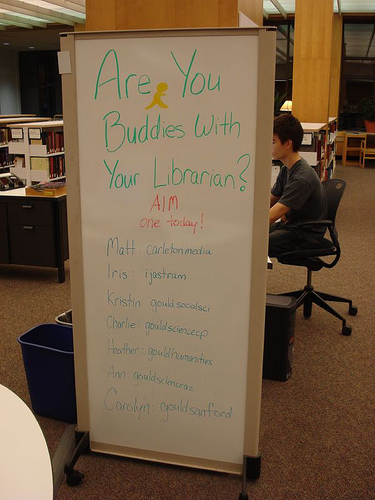
So after we’d played with this for one school year, we decided we wouldn’t mind creating AIM accounts to give out to students. We each have our own account, and we can each be online when we’re able to answer questions and offline or “Away” when we’d rather not answer questions, so we completely sidestepped all of the staffing and coverage issues that comes with “real” IM reference. On the other hand, this relies heavily on our liaison model, with students encouraged to meet with the librarian for their classes and major for anything more than general reference help. So in this sense, it’s more an extension of our individual consultation service than of our reference service. But it provided a no-risk method of trying a new service this term, so we decided to go this route.

So far, the response has been mixed. One of my co-workers has answered a couple of IM questions (and we all rejoiced), but the rest of us haven’t yet. [Update: It appears I’m wrong. One more of my co-workers has answered a couple of questions, and she is even one student’s very first IM buddy!} We’re also running up against a strong culture of face-to-face interaction here at Carleton, and some students have voiced the opinion that it’s “sad” when people can’t stand up, walk over, and ask us questions.

So I wouldn’t call our experience a rousing success if you look at it as a stand-alone service. And yet, there are three reasons that I’m glad we’re doing it and that we don’t have any plans to discontinue it.

First, it gives us a chance to experiment with a new “toy.” This is always valuable, especially when there’s no cost associated with that experimentation.

Second, it contributes to our efforts to not only BE approachable and accessible to students, but also to APPEAR to be approachable and accessible. I’ve been thinking a lot lately (as I experiment with Ask.com vs. Google or worry that my laptop is dying and notice how that changes what I think about putting into it) about the appearance vs. the reality of usefulness and trustworthiness. And basically I’ve come to the conclusion that the appearance of trustworthiness is more important than the actuality. If I trust something, it takes a lot to get me to go back on that trust, and the converse is also true. In the same way, I think building the appearance of accessibility, expertise, and usefulness to our students is at least as important as actually providing accessible, expert, and useful assistance. And our new AIM handles are helping with this… I think.

Third, I don’t care if I only receive one IM question. That’s one question that may not have come to the desk. And it’s not costing me anything in time or money to have AIM running in the background on my desktop. Even with a culture of face-to-face interaction on campus, there will always be someone who is shy about approaching the desk, or simply communicates better through the written word than the spoken word. There are lots of students that I only hear from via email, and I can foresee a time when these students will make me a buddy rather than putting me into their email address book.

Of course, I’m still waiting for that first IM question… but it’ll come. I’m nothing if not optimistic.

Technorati tags: , ,

3 Comments

The Research/IT Desk

Sitting here at the reference desk for my Monday afternoon shift, I’m reminded of one reason that I no longer dread my desk shifts. Well, one obvious reason is that now I have a lot more reference experience, so I no longer tremble whenever a student asks, “Do you have a minute?” But experience aside, I prefer desk shifts here because I rarely have to answer any technical questions, un-jam copiers and printers, recover lost papers, teach graph making in Excel, or trouble-shoot any other computer problem. At my previous library, this is mostly what I did during desk shifts.

It’s not that our students are more computer-savvy than the students at my previous library. If anything, there are more computer questions here because we have three computer labs here instead of one. No, this bliss is all because someone a couple of years ago (in September of 2004, to be precise) came up with the brilliant idea of providing a joint service point merging research help with technical help, transforming our reference desk into the Research/IT desk. So, to alleviate my sadness about not being at Internet Librarian, I thought I’d amuse myself by writing this all down before we forget what the first few years of this service were like.

The Progression

Before I begin, I should mention that I am NOT the authority on this subject. I just work here. My co-worker, Heather, is the point person for this and has presented on it several times and done a poster on it at ALA.

Anyway, For many years, now, Carleton has had IT support for students. They call this place the SCIC (pronounced “skick”), and it’s a pretty full-service joint. A whole battalion of geekish students (affectionately called “SCICers”), headed up by two full-time staff (“the SCICitator” and another guy without a nickname… we’ll have to work on that), troubleshoot software and even repair some hardware and clean up virus infestations.

Well, two years ago the decision was made that the SCIC would start sending some of the student workers over to the library to sit next to the librarian on duty at the reference desk. I wasn’t working here then, so all I know about these early experiments is second hand. Basically, everyone could see that it was valuable… except the student workers. They didn’t like being away from the SCIC because here they’re on their own, their fellow student workers are a building away, they are more visible so they can’t play games or wear headphones, and there’s different technology to learn. The biggest thing that year, though, was communication. The librarians weren’t these students’ supervisors, and we didn’t even really get to know them very well because there were 40 of them rotating through the library, and the librarians’ desk shifts weren’t consistent. So any SCICer could quite possibly work an entire term without working next to the same librarian more than once or twice.

Last year things got more formalized. SCICers staffed the desk for the entire time the library was open (even when there weren’t librarians on duty), and the SCICitator worked with the librarians to provide formal training in the special types of service and support issues that come with working in the library (microfilm reader/scanner/printers, SMART board issues, referring research questions, etc.). What’s more the SCICitator decided to schedule only second-year SCICers in the library, so they wouldn’t be learning the basics while cut off from their fellow student workers and their supervisor/mentor. On the librarians’ side, we regularized our reference desk shifts so that we would always be sitting next to the same students (except in the case of substitutions). Most importantly, though, we formalized the communication that happens between the librarians and the SCICitator. One of the librarians acts as the liaison to the SCIC and meets with the SCICitator briefly every week. She also coordinates training for the students. We’ve also worked on developing a habit of emailing the SCICitator if a student does really well or goes above and beyond, or if they miss shifts or in other ways slack off.

And slowly but surely, we’re seeing an attitude shift among the SCICers. It’s now a rare thing for them to show up with the attitude that this service point it “extra” or less cool. Some of them even try to shift their schedules so that they work only at the library.

The Benefits

Librarians immediately saw a significant drop in the number of “short” reference questions we answer. By itself, this is just interesting to us. But it become significant in terms of the service we provide when you pair this trend with the steady increase in the number of “long” reference transactions we have. Students are finding us available for in-depth research assistance now that we aren’t running after paper and re-starting computers. Now only that, but students are starting to seek out the technical assistance at our desk that they would previously have taken to the main SCIC, so there has been a significant increase in the number of questions handled by the SCIC side of the Research/IT desk over the course of the past two years. (The library is the busiest building on campus, so it makes sense to have this service here rather than sending everyone to another building.)

The Challenges

There are two main challenges that we’ve faced: communication/reporting and statistics collection. Formalizing the communication channels has really helped, and now that at least half of the SCICers don’t remember working when there wasn’t a library service point, they don’t balk at librarians stepping in to give them duties or brainstorm about solutions to problems. And this year we’ve gone to online statistics collection, which seems to feel more legitimate to these students. We know that they were under-reporting last year because many of them couldn’t be bothered to fill in little hash marks on a piece of paper. This year they’re still probably under-reporting, but making entries into an online database just FEELS more important, so they’re making the effort.

So we haven’t completely worked through all the ins and outs of this service point, but I’ve gotta say, I really like it. It frees us up significantly, and we get to develop relationships with a whole new set of students that we never really saw before.

Technorati technorati tags: , ,

2 Comments

Our Library’s Watch List

I’ve heard from people who want to know what our library has on it’s “Watch List,” so I thought I’d post them here.

But first, a little bit of the back story. If you remember, at the end of last year we had a series of surprisingly interesting and stimulating meetings about out library’s strategic plan (my posts about these meetings are here and here, and now a draft of the plan is available online as a pdf). Part of this plan involves watching trends and developments in the library world outside of our college. So each department made up a list of the things that they either are or would like to be watching, and then the full library staff met to pare the list down to those items that seemed interesting and important to the library as a whole and that meshed well with our strategic plan. Now we have a blog (visible only to library staff, and which I wrote about here) in which we track what we’re seeing, and we use WordPress’ category function to label each post according to the watch list item or items it covers. We can also use the blog space to suggest new items for the watch list, or to discuss taking items off the main list if those topics have stopped being of interest.

And here’s what we’re watching.

Collections:

  • Collection development with interlibrary loan
  • Storage/archival/retention issues: what to save, where to keep it
  • Preservation (print and electronic)

Electronic, new and emerging formats:

  • Licensing (Licensed streaming video as an alternative to videotape and DVD, and flexible copyright and licensing agreements
  • Statistics
  • Collection and management of websites
  • Electronic Resource Management
  • Digital Library: streaming videos, ebooks
  • Open Access publications: cataloging and including in collection
  • Image and multimedia management applications.

Access to our collections:

  • Aggregator neutral records (MarcIt)
  • Record enrichment (table of contents, dust jackets, reviews, comments, tagging)
  • New search interfaces, non-text search (visual, audio), and displays of search results
  • Metadata (Non-MARC, integrated from a variety of sources)
  • RSS feedsfor new book info, e.g.
  • Outsourcing cataloging and shelf-ready materials

Services:

  • Interlibrary loan (international, unmediated, costs, ILLPOD, etc)
  • Delivery systems (CC/StO) expansion
  • Self-checkout
  • Reference models at peer libraries, virtual reference and appointment models
  • Data & GIS in a liberal arts library setting
  • Students’ use of new web publishing models for research (wikipedia, mashups, web 2.0).
  • Social Software and other applications that help users organize their research and information (personal information management, bibliographic management tools, etc).

Digitization:

  • Who, what, how
  • Scanning and OCR service points
  • Institutional repositories

Equipment (hardware & software):

  • Printing
  • Touch screen computer monitors
  • RFID
  • Ares (Atlas course reserves product)
  • “Print/bind on demand” in-house or from publisher (not warehousing titles)
  • Open source software for libraries

Space:

  • Cafes/Coffee Shops
  • Space needs for Collection

Campus Initiatives:

  • Copyright
  • One card checkout technology

Other:

  • Government Documents
  • Workflow design
1 Comment

No Wonder We Felt Busy

A huge part of the librarians’ job at MPOW is spending time working individually with students, and we keep statistics about how many students, what class years they are, how long we spent, what their majors are, and such like. Well, we learned today that these numbers increased last year over the year before by 63%!

This is most important (to my life) because we’d just been told that these stats were actually down from the year before. But at the eleventh hour our reference associate discovered that the spreadsheet we were using wasn’t actually counting everything we put into it. As soon as we fixed the formula, our numbers jumped so high we spent quite a while trying to figure out how we’d gotten it wrong again. But it wasn’t wrong. We’d just been busy.

Funny how a couple little numbers can make you feel so much better about your work day.

Leave a Comment

Fun Stuff and Why I Have a Headache

First, the Fun Stuff.

My co-worker, Heather, presented at the Minnesota Library Association conference on using social software to keep up with government documents (ppt here). Then she brought Jenny Levine back to Minneapolis with her so we could all meet for dinner. What fun! [Update: Here’s a picture of us having fun with Jenny.]

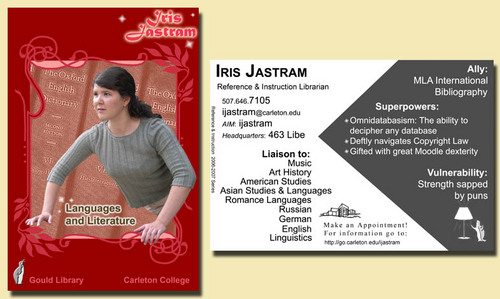
We also discovered the William College Liaison Librarians must have liked our 05-06 trading cards. Wow.

I’ve become a del.icio.us convert. I’ve even received a link from Steve in that oh-so-cool “Links For You” section. Now I wish all my co-workers were on del.icio.us so I could send them links. I still haven’t imported my links from Furl yet, but already I’ve more than doubled the number of links in my collection. Two things I’d like from del.icio.us: an easier to type name, and more than 255 characters to describe my links. (Two things I’d like from Furl to make me go back: faster/easier bookmarking, more social features like “links for you.)

And now… Why I Have a Headache.

Because it’s been a rough week, that’s why. I haven’t had the time or energy to blog at all, so the backlog of things I want to blog about is getting distinctly overwhelming. (I’ve started using the toread bookmarklet and in only a week I’ve accumulated 60 unread items! Yikes.)

I relearned how evil Elsevier is, though I’m not sure I’m at liberty to discuss their new act of extortion and peevish tantrum-throwing just yet.

I also spent almost all of three days trying to help one class of students answer impossible questions only to be told by a professor (not the professor class I was helping, btw) that I was doing their homework for them. Oh, and he copied the professor I WAS working for. He’s not even a professor in my liaison departments. Coming at a particularly vulnerable and tired time for me, this criticism completely shook me. I kind of expect to be told that I could do more, and I generally welcome constructive criticism, but the only two times I’ve been completely and utterly shaken by criticism at work were times when I’d worked extra hard only to be (figuratively) patted on the head and told “that’s nice, dear, but we didn’t want you to work that hard and we don’t really think the effort was worth it.” I guess it comes with the territory.

Basically, I’ve had one of those weeks a librarian dreads: all impossible questions with no sense of accomplishment. I even made people mad over the fact that we have electronic access to the Chronicle of Higher Education but aren’t allowed to give out the password or copy and paste articles. No, it’s all freely available, but you have to come “all the way” to the library and have one of us log you in. Yes, I realize that you might as well just read the paper copy we have at the library, but that’s life (and our license agreement).

Oh, and I’m facing a 6-day week since this is my Sunday to work and there’s no time for a comp-day next week. Bwah-ha-ha-ha.

But, I resolve to get to some of my backlog of blog stubs.

5 Comments

Unfortunately, I Seem To Have Misplaced My Brain

I somewhat miraculously made it through this entire day without the benefit of my brain. I’m not quite sure what happened to it, but there you have it. It was rather an unfortunate day to be without my brain because we were discussing database renewals this morning, I was trying to prep for a class this afternoon (with no apparent progress), and I participated in the first meeting of a reading group on campus sponsored by the Writing Across the Curriculum program.

That’s right. After inviting myself into this reading group, which will be meeting throughout the term to discuss books themed around “writing from sources,” I found myself sitting in a room full of teaching faculty, book in hand, and no capacity for rational thought. So sad.

But the faculty had a lively discussion about whether or not the book at hand (Rewriting by Joseph Harris) was useful or not. Personally, I appreciate Harris’ attitude toward writing. He places emphasis on being generous to other writers and coming to terms with their projects and approaches rather than on critiquing their work to shreds. The way he talks about entering the scholarly conversation has rekindled my interest in writing, and I’m not the only one to feel re-inspired by the book. Two separate professors in the room talked of suddenly feeling ready and able to go back to projects they’d shelved for years.

At the same time, the book is not perfect. I was never quite sure if it had actually been written for students or teachers (and the number of times Harris comes back to clarify this point lead me to believe that he wasn’t clear either). Several of the faculty members present were also annoyed by his lack of attention to the actual teaching of writing. Many complained that while the book helped them to think about teaching about intellectual thinking, it didn’t help them to think about “teaching writing.” I must confess that I was unclear about the distinction some were making between teaching about writing and teaching writing, but please remember that I was listening to all of this without the benefit of my brain.

One particularly interesting point in the conversation centered around citation, of all things. An art professor pointed out that in ceramics, students can “rewrite” past work by using a specific glaze, shape, or firing technique to comment on or invoke past moments in the history of ceramics. But unlike other disciplines, ceramics does not require students to “cite” these influences. So on the one hand, detailed and specific information about ceramics history isn’t required to be apparent, but that doesn’t mean that it’s not important. This professor says her heart bleeds every time a freshman “dunks” a pot into the celedon glaze without knowing or appreciating the history of the glaze, how it was meant to imitate jade, the position that jade had in the culture at the time, etc., etc., etc.

If my brain were present, I would observe something or other about how this relates to the importance of making use of prior knowledge when creating new works. I’d also comment on how it matters that people be able to understand when and why you make use of the past in this way. But alas, I can’t wrap my head around the phrasing at the moment. All I know is that I had a grand old time sitting there listening to these professors. (And it doubled as a perfect occasion to meet a few of my faculty, including two that I’ve only barely met before, in a social setting.)

Leave a Comment

Strong Bad Takes on Trading Cards!

I hope you’re familiar with Strong Bad, the funniest cartoon character in a helmet ever. He and his friends live over at the Homestar Runner site. (For way more fan information than you ever needed, here’s the Wikipedia entry.)

Anyway, periodically Strong Bad answers email from fans, and my co-worker just found his answer to this email:

Hey Strong Bad-
You should have trading cards … with a stick of gum in them.
Nerdly Yours,
Daniel, N.S. Canada (which Strong Bad narrates as “Not Safe in Canada”)

For his answer, click here.

p.s. In completely unrelated news… Our new trading cards are great! They’re way more superhero-ish than they were last year. They aren’t up online yet, but they’re coming SOON.

2 Comments
css.php