Skip to content

Category: Carleton

We Deserve a Commission

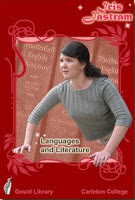
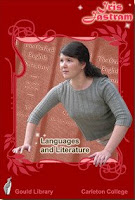
An admissions guy stopped me and two of my co-workers on the sidewalk today to tell us that he had recently read an application he thought we should know about. In this application the prospective freshman wrote about the librarian trading cards and their accompanying superpowers as one of her three reasons for applying to Carleton. Very cool. I say, admit that girl. She’s obviously a highly perceptive candidate.

2 Comments

Useful Library Maps

I always forget to use some of the most useful resources at the reference desk. So here’s a reminder to me: maps are useful things, they’re also handily next to the reference desk computer, so remember to use them when appropriate.


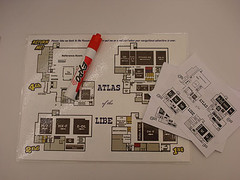
One of my co-workers came up with the brilliant idea of shrinking down our library maps to two sizes. There’s an 8.5×11 laminated size (on which we can write with dry-erase markers), and the note-pad size (on which we can write with anything we want).

These are most useful when you’re deep in a complicated question and another student has a “where is this call number” question, though it’s probably prudent to figure out if the second student understands how to read call numbers in the first place or if it’s simply a matter of figuring out where in the building that call number range might be.

One of my co-workers also put an “x” over the spot where a particular microfilm collection lives in the library and then handed out this annotated version of the notepads to each student in a class that was learning to use that particular collection.

But somehow I always forget about these handy things until just after the student leaves the desk having heard my verbal directions. No longer. I pledge to remember that these maps exist and to use them when appropriate. However, I also pledge not to use them when it seems that the student might benefit with a bit of company down into the stacks. That tramp down the stairs is a wonderful excuse to do a little bit of an extra reference interviewing.

Leave a Comment

“But I’m Not Eating It….”

I just turned away a pizza from the library. We have a “no food in the library” policy, and here was this kid standing 5 feet from the reference desk holding a pizza box that gave off the (heavenly) smell of a hot pizza.

He looked at me looking at him and winced.

I smiled and shook my head at him. He knew better.

His eyes got big… bambi-ish, almost. “But I’m not eating it. I’m just holding it.”

“I’m sorry,” I answered, “But there’s no food allowed IN the library. And that’s in the library whether your eating it or holding it.”

“Aw c’mon….It’s just a box, and I’m just holding it.”

“How about holding it in the entry-way?”

Grudgingly he and his friend proceeded to walk as slowly as I’ve ever seen a student move (and in my experience college students can move very slowly) toward the main doors. Inch by inch they conversed their way farther from me. Half way there they checked back to see if I was still watching them.

I just smiled at them with my cheeriest “thank you” smile.

Utterly defeated, they turned and walked to the entry way. Now they’re sitting there eating pizza.

That’s one more student who will never voluntarily ask me a question…

Related post: Food and Beverage Policy

Leave a Comment

Exploring Cooperative Collection Development

As part of MPOW’s strategic plan for this and the next three years, we are exploring the idea of cooperative collection development with St. Olaf. Situated as we are, just a couple of miles apart and having a shared catalog, we’ve decided that it makes a lot of sense to look carefully at our collections, our ordering, and our processing to see if there’s any way that we can capitalize on our proximity and general good will. We’re wondering if and to what extent it’s possible to pool our resources, provide the best possible access to the widest range of resources, and yet not jeopardize any of the current customization we offer our communities.

So for almost exactly a year, we’ve been analyzing our collections to find overlap, learning about other libraries that have gone the cooperative collection development route, and worked with R2 to evaluate and recommend a redesigned acquisitions and technical services workflow. Needless to say, this has been a little bit of a strain. I think we all harbor a little corner of fear that our jobs will change and we’ll have to give up something we love.

Personally, I’m feeling better about the process the farther we go. We’ve learned a lot that makes me think we’re already doing a pretty darn good job, which is always nice to hear. Of course, I’m not working in one of the departments that’s being thoroughly studied, so the stakes are lower for me. But even so, we’ve been able to norm ourselves against other libraries (and find that we’re generally doing well), and we’ve been forced to take the time to reconnect with what we do and why we do it that way. We’ve found that we have relatively little collection overlap already, and that we’re both pretty well in sync with our user communities.

But in this context of exploring the benefits and challenges of local, semi-local, aggregate, and singular collections, I’ve been interested in the analogous discussions about aggregate collections and aggregate data about collections. For example, there’s Walt Crawford’s piece in Google’s Library Center newsletter or his revisitation of the topic in his January issue of Cites & Insights (pages 3-4). In these pieces he states that “every good library is a local library,” but that aggregate collections can help us serve our communities. He specifies that a local library is not just a collection; it is also a space. And while I’m not going to get into the “library as place” issue here, I think that this intersects with collection development in important ways.

No matter how much we feel like “two libraries acting as one” (which is the catch phrase of this whole operation), we won’t have succeeded unless our user communities think of us as two libraries working as one. We’re only two and a half miles apart, and some libraries on university campuses are farther apart than that, but we can’t start to think of that as an insignificant distance to our students. Not only does it require that they request books ahead of their deadlines (and good luck getting people to do that, but that’s another topic entirely), but it also requires that we think carefully about the research impact of having a semi-split collection.

If we could reach every one of our students through instruction, the research implications might be slightly less important. But we don’t reach all students, and I can’t foresee a time when we will. So what happens when students browse the shelves and don’t see whole sections of the larger collection? This is especially important to literature and history students who might be faced with less than informative catalog records, titles, or even titles of chapters. We humanities people are not given to providing informative titles to things. We like style. Flare. Allusion. We don’t like to actually tell people what they’ll be reading about until they open up to the introductions, conclusions, and indices.

People have argued that virtual browsing will solve these problems, but I’m not convinced. We haven’t caught all students in our instruction nets, so how will they know that browsing is even possible, or that they should do this by subject and by call number? But more importantly, virtual browsing is just not up to par, especially for literature collections and especially with our current catalog. Virtual browsing would require intuitive and transparent browsing functions, deep indexing that goes well beyond LCSH to include such things as protagonists and geographical settings (and probably tagging), easy access to introductions, conclusions, and indices, and probably a whole host of other functions. In our particular catalog the situation is complicated by the fact that there was a space of time when cataloging policy didn’t include adding contents notes, which pretty much kills the findability for short stories or essays held within larger volumes.

This doesn’t mean that I’m against the project we’ve undertaken. I wholeheartedly agree that we shouldn’t haphazardly buy the same books at two libraries that are within (long) walking distance. I’m entirely behind the idea that we should make sure that we’re serving our user communities as efficiently (money-wise and space-wise) as possible. But through it all we need to make sure that our patrons see the benefit. We need to figure out how to maximize benefit without jeopardizing all the work we’ve done to make each of these libraries our users’ libraries, our users’ spaces for learning, research, socializing, and yes… even browsing.

The best possible outcome would be for our faculty (who do much of the book selecting) to come to a nuanced understanding of whether a particular book should be in one or both places, for our two libraries to focus on collecting browse-able and useful collections with an eye toward sharing, and for the librarians and both places to increase our collaborative relationship so that we develop even better working relationships as a side effect of learning how to negotiate between our two collections. Oh yeah, and for our faculty and students to recognize the decisions we’ve made and agree with those decisions.
Leave a Comment

Gould Goes Multi-Media

At the very beginning of Fall term here at Carleton, two other librarians and I recorded our first podcast: an audio tour of the library. But then the term hit with such force that we didn’t have time to figure out the technicalities of putting it up on the library’s web site. Turns out, we had to get the college’s web team to turn on a media page type in our CMS and then everything worked great, but it takes a certain amount of futzing to figure out what we aren’t able to do and then ask to have that done. It only took the web team a matter of seconds to fix the problem, but what with one thing and another, it took us until this week to get things figured out.

You can go here to listen to a tour of our library (and follow along on the tour map found in the blue “Related Documents” box). I take you through the bottom two floors (First and Second), so for those of you dying to know what I sound like when I talk… have at it. I kind of hope that’s not what I sound like in real life, but I’m afraid it probably is.

We’ve also loaded our “Library Survival Guide” onto that page, as well as a video we made just before graduation last year. It’s a really big file, but there are some pretty funny bits.

2 Comments

eReserves: Blessing or Curse?

Blessing. Definitely a blessing to our users and database vendors, but a blessing with a curse-ish aftertaste.

Everyone is familiar with the blessing part. Users get 24/7 access to their course readings, and database vendors get a more accurate picture of the amount of usage they’re getting for their license fees. (Without eReserves we’d have to print out a copy of an article and put it on paper reserve, where it would be read by a class of students, photocopied by most of them, etc. But there’d only be one hit on the vendor’s server.)

But on our campus eReserves is an easy target for all sorts of campus ills. For example, it’s common knowledge around campus that eReserves is the cause of our horrible printing problem, with reams and reams of paper filing through our printers every day. And I’m sure that classes that depend more and more on journal readings and less on text-book compilations do make for more use of eReserves and more printing. But what nobody seems to realize is that all the requests for electronic access to journals means that more and more of our journal collection is e-only. And even if we have electronic access and print access, guess which one will be used most often? And what do people do with journal articles they find online? They print them to mark up over lunch or a midnight snack.

Not only that, but there’s more and more good, authoritative, quality research available on the free web, and you can bet that students print these pages by the ream. This is especially true because printing is free on our campus, so everything from email to research to homework spills from the two printers in the reference area at the rate of 7.06 pages every minute the library is open. (The the two reference area printers account for more printing than every other printer on campus… combined.)

I’ve also seen more and more students lately who prefer to scan print journal articles slowly, page by page, and then convert the images into PDFs all so that they could print (for free) rather than photocopy (for a fee). In related news, the use of photocopiers in the library has dropped so much in recent years that our printing department is considering removing a few of the copiers from the library entirely.

So the upshot is that printing is a definite problem, but the answer isn’t as simple as, “Well, with the advent of eReserves printing went through the roof….” The information universe is changing, not just one section of it. All of it. eReserves, journal subscription, database licensing, online publishing, assignments and pedagogical approaches to information, everything.

Oh, and eReserves is also not a devious plot to keep professors from ordering text books or paying copyright fees or anything else like that. Moodle can do all that so much more easily. 😉

Technorati tags: , , , ,

2 Comments

Libraries in 2006

It’s hard to believe that 2006 is almost over. I was just getting used to writing that number on my checks, or when I sign important papers. There’s nothing quite like signing a VIP (Very Important Paper), dating it, crossing out the date, writing the correct date, and then contemplating all the various people who will grab your file and chuckle at the girl who doesn’t even know what year it is.

These are the thoughts that flitted through my head as I signed various (routine) medical forms yesterday, and then life continued all around me as I wondered how 2006 would be remembered in library circles. (And yes, I really am that crazy sometimes.) So what do you think are some of the salient features and overarching questions in libraries this year? I don’t pretend to have a clue, but I know that a couple of themes were important in my small part of the library world. In no order whatsoever, they are:

  • Space: everything, physical or electronic, takes up space. Ideas are cheep but space isn’t.
  • OPAC/Catalog/Discovery System Bruhaha: I have no idea if this was a theme in previous years because I wasn’t paying attention, but I know for sure it was a theme this year. People are pretty sure that what we have now isn’t cutting it for our users, but opinions are rather more divided on what should be done about the whole situation.
  • The Pedagogy of Information Literacy: what do our users need to know, and how will they learn these skills best? Active learning, gaming, virtual experiences, embedded information literacy… so many options.
  • The De-Scarification of Technology: Web Apps make doing stuff online, either privately or with networks of other people, easy and portable. This year (many) librarians started using web-based tools to work and play, and the amount of really great and authoritative information available online exploded… again.
  • The User Experience: There’s been a trend toward measuring every product and service by it’s effect on the user experience. (This one is very far-reaching and basis of many, many other topics)
  • Data: It’s not just about books any more.
  • Books: It’s still about the books. And how do you convince students that every once in a while there’s just no substitute.
  • Sustainability: This is especially important to my library, where printing is free. With more and more journals available only online, there’s a whole lot more printing than can be good for any planet. There’s also the problem of sustainability in terms of workload. It seems like there’s always enough work for twice the number of staff.
  • Doing vs. Collaborating: what with wikies and tagging and other such wonderful things, we can collaborate with each other and our users to create content where we used to have to do everything in isolation.
  • Metadata: We have the computing power, bandwidth, and massive aggregations of data to make metadata exploitation possible like never before.

I’m sure there’s more, but I wanted to put down some thoughts so that when I’m teaching library school classes 50 years from now I can tell my students with some authority what issues were interesting me and my compatriots back when users actually had to type their queries into crazy things called “search boxes” rather than simply think them while inhabiting a virtual discovery environment, and when we had to search three entirely different kinds of systems depending on whether we were looking for books, journal articles that might be indexed online, or journal articles that are too old to be indexed online.

Ok, so the thought-driven discovery environment is a little ambitious for 50 years… but you get the idea.

What would you add as a driving theme of 2006? Lets put our heads together and write the bird’s eye view of lib06.

2 Comments

Responding to Student Writing and the Power of the Line

This past week I participated in a faculty workshop entitled “Responding to Student Writing.” In preparation for this workshop, each participant was asked to email the coordinator with the most vexing problems they have when responding to student writing. Most faculty members wrote about the problems of balancing the time it takes to write good comments on papers with their other duties, figuring out how to respond constructively, wondering if students ever read the comments, and wondering whether or not to write extensive comments on end-of-term papers.

I had to “interpret” the assignment since I don’t ever read or grade student papers. Here’s what I wrote:

I’m in the odd position of responding to writing without ever seeing the entire picture or reading the entire paper. I’m most often responding to the student’s interpretation of the assignment and the initial phases of topic selection. In the instances where students come back with a semi-finished product, I generally respond to the bibliography or the student’s summation of the argument and the types of evidence he or she has found to support that argument. In some ways, it’s much easier to respond to students about their thought processes and progress towards their goals when I only get these verbal summaries since it frees me from all the minute details that might overwhelm me if I saw the project in it entirety. But it’s also difficult to give feedback that will support the project as a whole when I only see distilled sections and versions of the project.

I also have to respond on the spot without the benefit of time to compose my thoughts and write something down. I’m often more comfortable writing than speaking, so I usually feel like I’m floundering to put my thoughts in order, communicate clearly, and keep the student’s ultimate needs firmly in mind all at the same time. I often wonder if my tone is appropriate, if they’re hearing what I think I’m saying, and if what I’m saying is effective. (When I’m really worried about this, I’ll often send a follow-up email that reiterates my main points, but then I run into the problem of time, especially when I have days that are packed full of back-to-back appointments with students.)

Like the first assignment, much of the workshop didn’t directly relate to me and my job, but it was nevertheless an incredibly beneficial and enjoyable workshop. I met some wonderful professors and had stimulating conversations about everything from art to assignments.

One of the most interesting conversations was with a studio art professor who, like me, had to interpret many of the activities to fit his teaching activities. He talked with such passion about the history of the line: how The Line started with the urge to represent and communicate and how it has diversified over time to include everything from representation art to writing. He talked about how creating art is always a way to possess, whether it be to capture an image you don’t want to forget or to articulate and keep hold of an idea, and that there is always an element of transaction involved, either literally or via communication.

What a beautiful thought. When we teach students to do research, we give them the keys to this act of possession and transaction. We help them to allow the originators of the work they study to complete this timeless transaction, this fulfillment of the original act of creation, of setting down representations of things and ideas via the eternal Line. And then the students, in turn, set down their ideas, using the same Line, waiting with eager anticipation for their readers to complete this new transaction.

And when readers comment on student writing, they grant that writing weight by taking partial ownership of the work via new instances of the Line, because the Line gains rather than loses power when more people own it, use it, and proffer it to others.

Leave a Comment

Of Socks and Writing

For the past three days I’ve been attending one of the many December workshops offered by faculty for faculty on our campus. This particular workshop was put on by our Writing Across the Curriculum program and was a fabulous opportunity to learn more about what good pedagogy looks like, think carefully about what we want our students to get out of their college experience, and get to know faculty from all over the curriculum. I don’t directly teach writing, but I do support those who do, and I almost never get three days in which to talk over the underlying goals of writing assignments with my faculty. What fun!

But everyone always looks forward to the last day of the workshop because on that day the Dean of the College presides over the annual outrageous sock contest. And this year… I WON! Last year I was deemed “almost tasteful” and was therefore disqualified. This year my fur-lined santa socks earned me a Sock Monkey grand prize.

Leave a Comment

Food and Beverage Policy


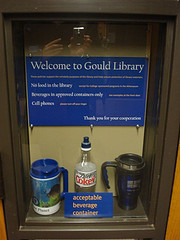
One item on the library’s new strategic plan (draft PDF here) is to explore the possibility of putting a cafe in our library. Rolled into this point is the assumption that we will be evaluating our current food and beverage policy.

Currently, no food is allowed in the library, and beverages are allowed only if they are in containers with lids that don’t have to come off for you to drink out of them. We even have a huge bowl of water-bottle-like pop-up lids in the entry way so that you can make un-approved containers (like soda bottles) into approved containers. Though I gotta say, sipping soda through a pop-up lid is … odd.

One amusing consequence of this policy is a daily silent feud that goes on around the garbage cans. Nobody knows who put signs on each of them saying that you’re not allowed to throw food wrappers or other food-related garbage into them, but each garbage can has one, and there is a difference of opinion about the value of this type of approach. So every day somebody goes around and turns the signs so that they face the wall. And every day somebody else goes around and turns them back so that everyone can see the signs. It’s one of those mysteries that sits at the back of your head, not important enough to investigate, but interesting all the same.

Anyway, we had our open forum to discuss the drafted strategic plan, and quite a large part of the forum time was taken up over debates about the food and beverage policy. Some students were vehement that they’d prefer to walk to the student union (about 100 yards away) than to introduce aggressive, pest-killing chemicals into the library, burden the custodial staff, and make us face replacing ruined books. Other students talked about the need to be trusted not to put their caramel rolls into reference books, and about how difficult it is to unplug a laptop, pack it and your books up, walk to the student union, come back, unpack everything, plug in the laptop, and continue working. It was fascinating to see students debating amongst themselves about trust and responsibility and how far the library’s should go in either way.

And what does the library think? Well, we have a working group assigned to look into the matter, but they haven’t reported back to us yet. Some librarians are passionate about the need to maintain our policy, while others are in favor of liberalizing it, at least a little.

As usual, I’m conflicted. On the one hand, I can totally see the benefits of keeping fumigation, cleaning, and replacement costs down. We also house three computer labs, and the IT people on campus love it that they don’t have to clean food out of keyboards over here. But on the other hand I have a very hard time enforcing the policy as it is now. This isn’t because I lack the gumption to walk up and make people take their ice cream cones outside. I’ve done that. I’ve also turned away a pizza delivery, suggesting that they eat it in the entry-way and providing napkins.

But I’m also working very, very hard to make the library a welcoming place, and to seem approachable to every student. I remember being a student lugging books and laptops everywhere and spending hours and hours on end in the library. It’s a fact that students are spending longer and longer in the library, and the library is the busiest building on campus. I’d like to keep it that way. It also puts the liaison librarians in a very tricky position to charge them with being everybody’s friend but also to put them on the front lines of enforcing this policy. As a student, if I’d been “caught” eating in the library I’d be too embarrassed to go to that librarian and reveal my ignorance and inadequacy as a researcher. It takes guts to go to the reference desk, and that would have been enough to keep me from making eye contact, let alone approaching the desk.

So for now we’re considering whimsical table tents (along the lines of “Dude, that’s gross” next to a picture of pizza on a book). And we’re still suggesting that people finish their dinners in the entry way rather than at the computers. But I, for one, will be happy when the library comes to a consensus and can put all of our efforts behind a policy that balances trust, responsibility, consequences, and stakeholders’ interests. I’m just glad I’m not on the working group that’s trying to strike this delicate balance.

Technorati tags: , , ,

2 Comments
css.php