Skip to content

Pegasus Librarian* Posts

Policy, Copyright, and How They Contribute to Knitting and Sleep Deprivation

As many of you know, I’ve been part of a group on campus charged with creating Carleton’s first ever campus-wide copyright policy. We’ve had a policy on copyright ownership, but never a stated policy on the use of copyrighted material.

Well, we began this process almost exactly a year ago, beginning with copious amounts of research into the law, prevalent guidelines, and the policies in place at other institutions like ours. Then we started making decisions: would we adopt a guidelines approach or a personal responsibility approach? Is there an interpretation of copyright law and fair use that not only sits well with the college but also sits well with our lawyer? Will we institute a central copyright office on campus or simply a funding mechanism to help faculty and staff pay for their own permissions? The list goes on and on.

After this, we drafted a policy, sent it to a lawyer for review, and then redrafted it according to the feedback we received. And now, finally, the Board of Trustees has signed off on it. Great. Go us. But…

Now we’re suddenly faced with implementing this new policy, which means we not only have to design and provide copyright education to faculty and staff (with special emphasis on the departmental secretaries). This would be a daunting enough task if it weren’t for the time-frame. You see, we have to have a plan in place for implementation and education… by Monday. Did I mention that our library is overhauling our reserves and e-reserves policies to more fully mesh with the new policy? Well, it is… by Monday.

So this past Monday was the first in my series of at least one copyright related meeting per day this week. On Monday I met with our College Librarian, the head of Loan Services, the head of Reserves, and the Media Librarian to begin this process. Tuesday I met again with the head of Loan Services and the head of Reserves to come up with a list of key policy-points, draft some release forms, brainstorm about possible procedures, and generally have a grand old time in policy land. Later Tuesday I met with the campus-wide copyright group to come up with campus-wide implementation plans and report on the library’s progress with our reserves policy and procedures. Today the original group from the library met again to refine our plan and put it into a form that could be taken to the Dean’s Office. Later this afternoon the head of Reserves took the plan to the Dean’s Office (and met with general approval! Yay!). Tomorrow I meet with the rest of the liaison librarians to see exactly what our role will be in all of this. And Friday I meet with the head of Loan Services and the Associate Dean of the College to finalize the planning for the library’s chunk of this whole process. Then, on Monday, the associate Dean will present all of this at the faculty meeting.

Last week, I had no idea that ALL my time this week would be eaten up by this project.

May I suggest to all of you policy makers out there that if you decide to implement a college-wide policy, you allow more than a week for the planning of that implementation. You never know what unsuspecting librarian might find herself unable to do any of her normal work and who might have to stay up very late knitting herself back into a balanced state of mind. You might find that such a librarian (young, inexperienced, lacking in authority on campus, a policy-writing virgin, and increasingly sleep deprived) might just run out of both imagination and the ability to predict the possible consequences of policy decisions. I’m just sayin…

Technorati tags: , , , ,

Leave a Comment

Information Literacy 2.0

I’ve been reading an absolutely fantastic article (Elmborg’s “Information Literacy and Writing Across the Curriculum”) and a slightly less fantastic article (Shapiro’s “Information Literacy as a Liberal Art”). And it’s gotten me thinking back to my first months as a librarian here, when my supervisor brought James Elmborg here to talk to us for an afternoon about being new librarians. We were full of questions about how to talk to faculty when we couldn’t be subject specialists in every subject we served, how we could advance the library’s goal of integrating information literacy more fully into the curriculum, and how to talk to faculty about information literacy in a way that would communicate that we were talking about more than boolean operators and controlled vocabulary.

In the course of that afternoon, Elmborg gave us lots of tips and solid advice, but he also challenged us to think more broadly. I’ll never forget when he urged us forward, saying, “You need to articulate your epistemology.” As a group, he said, librarians have a hard time coming to grips with precisely how we fit into students’ educational development. We have a hard time selling ourselves to faculty when we can’t describe what it is that we do. And just two months out of library school, I was flabbergasted to learn that I didn’t actually know what it was that I did or where I fit into students’ development.

Just this last week week I revisited Elmborg’s article in a new context. It was included in a packet of articles that served as the background for a meeting, and the Shapiro article was also in that packet. The contrast between the two was startling.

While the Shapiro article talks a lot about “information literacy,” it foregrounds information technology in almost every example. It also says that the facet of the proposed information literacy curriculum termed “Resource Literacy” is “practically identical with librarians’ conceptions of information literacy, and includes concepts of the classification and organization of such resources” (see the section entitled “An Information Literacy Curriculum”). This facet, by the way, falls second after “Tool Literacy” which is “the ability to understand and use the practical and conceptual tools of current information technology, including software, hardware and multimedia.”

While these concepts are certainly not outside the realm of information literacy, I don’t think that they are the primary goals, either. Instead, they are tools working in aid of true information literacy, just as punctuation and grammar are tools in aid of good writing. Nobody would argue that anyone with a perfect command of the grammatical rules of writing is automatically a good writer. Nor would they argue that the teachers of writing should hold grammatical rules as their primary instructional goals.

After reading the Shapiro article it was such a relief to read Elmborg saying exactly that. “There is a ‘grammar’ of information….” he says, “Like sentence-level grammar, these are isolated skills that separate research from the making of meaning” (72-73). And when skills are isolated from the process of making meaning it “breeds cynicism and a view of writing [and research] as busy-work” in students (Elmborg 72).

Making meaning, then, is a fundamental part of information literacy. Without this as the ultimate goal, information literacy becomes a task, a chore more akin to Hercules’ Labors than to anything else. Helping students construct meaning should be our primary goal. Along the way we may have to help them develop specific skills, including the “grammar” of searching, recognizing what constitutes evidence in their disciplines, and evaluating the information they find against the measure of their information need.

With this as the primary goal, competency standards (such as those drafted by ACRL) and “resource literacy” are just the important intermediary steps on the path toward the ability to grapple with a subject, interrogate it, recognize the voices that contribute to its discussion, and contribute one’s own voice to that discussion. Information Literacy is not a skill to be tacked on to a syllabus. It is one in a collage of abilities that enhance students’ capacity to access course content and participate in the discourses of their chosen disciplines. This is my epistemology and the foundation of my theory of pedagogy.

References:

  • ACRL “Information Literacy Competency Standards for Higher Education.” 2000.
  • Elmborg, James K. “Information Literacy and Writing Across the Curriculum: Sharing the Vision.” Reference Services Review 31.1 (2003): 68-80
  • Shapiro, Jeremy J. and Shelley K. Hughes. “Information Literacy [or Technology] as a Liberal Art.” Educom Review 31.2 (1996): 31-34 — I noted the possible change in title because I can’t determine definitively which is correct. The “Literacy” version appears on the Educom web site, but the “Technology” version is indexed in Academic Search Premier, and is cited by other articles I’ve read.

Technorati tags: , , ,

Leave a Comment

Thomson (of Thomson Gale) No Longer in the Education Business

Thomson Gale is probably one of the most recognized names in library and reference resources, but the day before yesterday Thomson Corporation announced that it would be selling off it’s Thomson Learning business as of January 1st, 2007. Here’s what they say:

The Thomson Corporation (NYSE: TOC; TSX: TOC) today announced a realignment of operations to sharpen its strategic focus on providing electronic workflow solutions to business and professional markets and better position the company for future growth. As part of the realignment, which becomes effective January 1, 2007, Thomson intends to sell its Thomson Learning businesses, including those serving the higher education, careers, library reference, corporate e-learning and e-testing markets. (From their Oct. 25th Press Release)

They’re splitting Thomson Learning into three parts, and the bidding for the higher education part has not yet started.

Technorati tags: , ,

2 Comments

Free Beta Open-Source CMS

The Web Services Group at my college has developed a Content Management System that the whole college has been using for a couple of years. Last year the library migrated over to this system (and instantly became the “power users” on campus), and just the day before yesterday the current version was released as a beta open-source CMS called Reason.

Earlier this month there were a spate of messages on Web4Lib talking about the pros and cons of a CMS, and a few people wondering if there were any cheep ones out there. Well, this one’s free, but it’s beta. It’s a very good beta, but still…

I’m no techie, but the guys that built this thing work within the library (they don’t work for the library, but their offices are here), so I can hook you up if you have questions.

In other open-source news, Northeastern University has incluced our material type icons in their catalog. Cool!

Technorati tags: ,

Leave a Comment

Crazy Dream

I don’t know if it’s something I ate or what, but I’ve had the craziest dream. My Immersion 06 classmates and I were competing to create gourmet drinks (mine had something to do with cola and canned fruit with ice… but it was so much more complicated than that, and probably just as revolting as that sounds), and Tim Gunn from Project Runway was judging us.

I’d just been told to “make it work,” when I discovered I had to blow my nose, so I used a tissue from a pile I found in one corner of the table. I had no idea that this was the center piece of a creation by Jason, and apparently he thought I’d deliberately sabotaged his project. He was so mad that he ground up a glass ball (like the ones you hang on Christmas trees) into my drink!

All I can say is that I would never knowingly sabotage your tissue-esque greatness, Jason. Please don’t try to kill me with tiny shards of glass.

I think I’ll try to get more sleep in the next few days, and maybe drink soothing tea before bed. Though there’s no break in my schedule for a bit yet. Hmmmm…. Maybe I’ll just have to put up with wacky dreams for a bit.

Leave a Comment

IM Reference at Carleton: A Low-Key Affair


Last year, sitting at our Research/IT desk, we started noticing that the SCIC workers sitting next to us were often engaged in lively conversation via IM. At about the same time, a few of us got started on Google Talk and it quickly spread through the rest of us as a way to ask quick questions of each other throughout the day without actually interrupting each other as completely as we had been by popping into each others’ offices. (Personally, I think this was mostly a strategy to keep me in my office because I was new and doing a lot of popping in to ask questions… but nobody’s admitting to that ulterior motive.)

We really took to this as a method of communication. We still do a lot of popping in, but now we have communication choices. Not only that, but every once in a while we’ll be fielding a tough question during the night or weekend desk shift and end up IMing a co-worker for help. This isn’t frequent, but I’ve benefited once and I’ve helped out once, and both times there’s no way the reference interaction could have been successful otherwise. We’re also keeping in social contact after work, which I really enjoy.

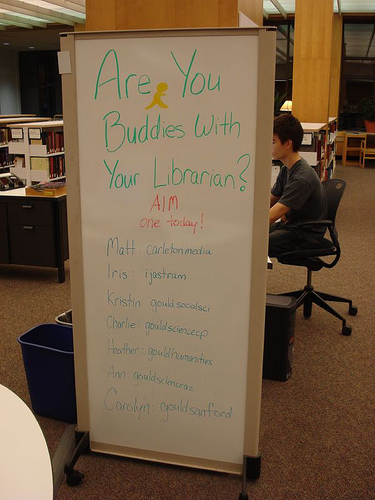
So after we’d played with this for one school year, we decided we wouldn’t mind creating AIM accounts to give out to students. We each have our own account, and we can each be online when we’re able to answer questions and offline or “Away” when we’d rather not answer questions, so we completely sidestepped all of the staffing and coverage issues that comes with “real” IM reference. On the other hand, this relies heavily on our liaison model, with students encouraged to meet with the librarian for their classes and major for anything more than general reference help. So in this sense, it’s more an extension of our individual consultation service than of our reference service. But it provided a no-risk method of trying a new service this term, so we decided to go this route.

So far, the response has been mixed. One of my co-workers has answered a couple of IM questions (and we all rejoiced), but the rest of us haven’t yet. [Update: It appears I’m wrong. One more of my co-workers has answered a couple of questions, and she is even one student’s very first IM buddy!} We’re also running up against a strong culture of face-to-face interaction here at Carleton, and some students have voiced the opinion that it’s “sad” when people can’t stand up, walk over, and ask us questions.

So I wouldn’t call our experience a rousing success if you look at it as a stand-alone service. And yet, there are three reasons that I’m glad we’re doing it and that we don’t have any plans to discontinue it.

First, it gives us a chance to experiment with a new “toy.” This is always valuable, especially when there’s no cost associated with that experimentation.

Second, it contributes to our efforts to not only BE approachable and accessible to students, but also to APPEAR to be approachable and accessible. I’ve been thinking a lot lately (as I experiment with Ask.com vs. Google or worry that my laptop is dying and notice how that changes what I think about putting into it) about the appearance vs. the reality of usefulness and trustworthiness. And basically I’ve come to the conclusion that the appearance of trustworthiness is more important than the actuality. If I trust something, it takes a lot to get me to go back on that trust, and the converse is also true. In the same way, I think building the appearance of accessibility, expertise, and usefulness to our students is at least as important as actually providing accessible, expert, and useful assistance. And our new AIM handles are helping with this… I think.

Third, I don’t care if I only receive one IM question. That’s one question that may not have come to the desk. And it’s not costing me anything in time or money to have AIM running in the background on my desktop. Even with a culture of face-to-face interaction on campus, there will always be someone who is shy about approaching the desk, or simply communicates better through the written word than the spoken word. There are lots of students that I only hear from via email, and I can foresee a time when these students will make me a buddy rather than putting me into their email address book.

Of course, I’m still waiting for that first IM question… but it’ll come. I’m nothing if not optimistic.

Technorati tags: , ,

3 Comments

Empty

I have so much to do… but I’m not doing any of it well. My house is too empty. My cat isn’t in a mood to warm my lap. And work reading is a far cry from the “good book” that should be going with my cup of tea. If I lived in a city I might go to a coffee shop or something, but I don’t. And besides, it’s cold outside. And dark.

Leave a Comment

That Whole Tagging Thing

As I’m sure many of you have noticed, I haven’t been tagging my posts at all. There’s no good reason for this. Pure laziness (and forgetfulness) is all there is to it. There was no way I could see myself remembering to type in all the link code at the end of every post. But I just found a cool bookmarklet that will help me. You just copy the code found in this post into the “location” box of a new bookmark. Then every time you click the bookmarklet you get a little dialog box into which you can type your tags. Click “OK” and it spits out the HTML you can paste into your blog post.

Now, will I remember to tag stuff… We’ll see. We’ll also see if I can come up with any useful tags. How do you tag meandering posts about tagging, for example?

Oh, and on a completely unrelated note, I’ve added the options to save to del.icio.us and email posts that come over my feedburner feed. It’s been a blogarific evening.

Technorati technorati tags:

2 Comments
css.php