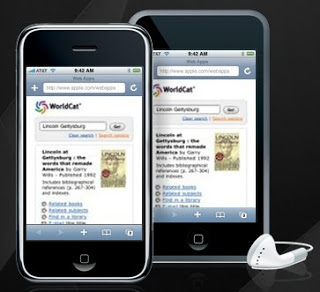

This may become my default method of searching for books on my iPod Touch. There’s now a mobile interface (designed specifically for iPhones and iPod Touches): http://mobileworldcat.org/
(Via)
4 Comments
This may become my default method of searching for books on my iPod Touch. There’s now a mobile interface (designed specifically for iPhones and iPod Touches): http://mobileworldcat.org/
(Via)
4 CommentsNot understanding football frequently makes casual conversation difficult, especially on Sundays during the football season. Hanging out in the LSW Meebo room yesterday and watching people talk about the various games they were watching, I thought I should do something to rectify this obvious gap in my cultural literacy. I had no idea there were so many games on TV on a Sunday. Mostly at random, I settled on a match between Indianapolis and Minnesota (though why it’s a city against a state I don’t quite understand) and settled in to watch my first football game…
…And I think I learned an awful lot about what it might be like to navigate an academic library for the first time.
It’s been a while since I was faced with a thing of great complexity and too little context to see patterns in the details. Most of the time, I couldn’t even figure out if what I’d just seen was a Good Thing or a Bad Thing in football. But, undaunted, I used my librarianish skills to find the NFL page on Wikipedia and follow the links from there to a glossary and set of rules. Yay, right?
Not right. Here’s the definition of that mysterious thing called a “down”: The period of action that starts when the ball is put in play and ends when it is dead. If you don’t quite know if you understand “put in play” and “dead,” this isn’t all that helpful. And besides, downs get counted up… why? and how far? and what’s the significance of that anyway? But there was no way I’d answer those questions by poking around on the NFL site.
Thankfully, the people in the LSW room very patiently explained these basics to me, and they didn’t laugh at me quite as hard as they had when I first thought that the football team here was the Twins… or maybe that was the basketball team… (I kid you not. And I am ashamed.) But you know what? It took me 20 minutes to figure out enough to even know if I was asking them answerable questions.
I wonder now if my library’s physical and online presence is as impenetrable to the uninitiated as this game and reference source were to me.
(By the way, by luck I watched a game that got pretty exciting near the end.)
5 CommentsOne of my favorite things about teaching is that I never feel like I’ve figured out how to do it well. There’s always something new to try, or something old to tweak, or something tried and true to throw out because as it turns out, the students don’t need it any more. All of this means that I’m never bored, and that I’ve never taught the same session twice.
Of course, this also means that I’m always a little uncertain about what I’m doing, how effective it was, and how meaningful it was. So far, no assessment I’ve done has completely set these nagging uncertainties to rest.
But uncertainties notwithstanding, I’m going to try something new this fall. When and where appropriate, I’m going to combine the idea of the Knowledge Survey* with classroom clickers.
I’ve been hearing about clickers for years and have experience their effectiveness myself. Quite against my own will, and in spite of feeling that I was participating in something as corny as any of those team building exercises I always hated (like falling backwards and getting caught), I found myself being sucked in and engaged in the activity at hand. If that could happen to me against my will, maybe I can use it to sucker some nearly sleeping freshmen into my sessions with a couple of well-placed participatory activities.
Still, my innate aversion to gimmicky things kept me from getting too excited until after I heard about Knowledge Surveys. Those things are amazing! Students get an accurate assessment of their own abilities (the Macalester Geology department has found incredibly high correlations between the responses on knowledge surveys and the students’ actual abilities), but I get a quick way to assess students, and I get a less-gimmicky way of encouraging participation and curiosity.
Now, if I could only get the stupid clickers to work, that’d be a great first step. So far, they hang at the “sending” notification whenever I test them, and never make it through to the actual recording of a response. I’ll have to get someone to help me figure out if they’re actually not working or if I’ve set something up wrong.
* I’ve heard Karl Wirth speak about these surveys three times, now, and ever time I came away thinking that there’s got to be a way to incorporate these things into my teaching somehow. Here’s a paper he and Dexter Perkins wrote on the topic.
Leave a CommentI realized this evening, as I checked my mailbox on the way back home, that communication patterns have really shifted. At least, they have for me. There was a time when I’d open mail addressed to me as soon as it was delivered, but I’d only check email once or twice a week. Now I check email multiple times per day, but I only open my accumulated snail mail about once a week.
2 CommentsNew students arrived this week. Yesterday there were new student week leaders dancing on our welcome sign all morning. (That’s quite a reception as you’re going to work!) Tomorrow I’ll be staffing the library table at the academic fair, leaving that a little early so that I can help host the library’s annual picnic for faculty and academic staff, working frantically on a couple dozen last-minute projects, and then helping out with the library’s annual murder mystery event (which gets started at 9pm).
I’m simultaneously looking forward to it and dreading it. Each of these things sounds like a whole lot of fun. The whole, though, sounds like it’ll much more tiring than the sum of it’s parts. I will therefore be wearing distinctly unfashionable, comfy shoes. Stereotype, here I come! Too bad I just got my hair cut today and can’t make a bun anymore.
3 Comments
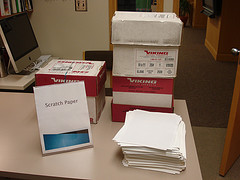
This is how I ended up with 5 feet of scratch paper, no real idea of where to store it all, and the warm fuzzies for all my co-workers who instantly donated more paper than I thought we’d collect in a year.
4 CommentsHello All,
As you probably know, the introduction of print management last year brought about a huge reduction in paper use here in the library (to the tune of about 17% less paper used!). With fewer duplicate print jobs being sent to multiple printers, fewer accidental print-outs, and more attention being paid to what and how much was being printed, we saw the massive piles of unclaimed printouts dwindle down to a few sheets here and there. And there was much rejoicing in the land.
Much rejoicing until students wanted scratch paper to write on, that is. Having grown accustomed to a Limitless Supply of Scratch Paper (hereafter called the LSSP) near the printers, students took to opening the printers and removing sheets of paper from the printer trays. Not only is this poor use of ITS supplies (they do not exist to underwrite students’ scratch paper needs), but the opening and closing of the printer trays seems to have caused a sharp increase in the rate at which those trays go out of alignment and need repairs. Clearly, something needs to change, and asking students to buy notebooks would probably be met with blank stares.
What we need is a good old bait and switch. To this end, the printer area will serve as bait (so much paper, so much history of free paper, so much traffic in general), but when the students arrive at the printers we will dazzle them with big, beautiful stacks of scratch paper which will mimic the LSSP. Not only will this fill a clear public service and save ITS many printer-tray-related headaches, but it will also be a good use of paper that would otherwise be recycled only partially-used.
Your mission, should you choose to accept it, is to help us collect this precious scratch paper. On the middle shelf of the cart near the main black and white printer in the TS area you will find a double-decker Paper Collection Device (PCD). The top level of this PCD, the one marked “Scratch Paper,” is for paper that has been printed on one side and that contains no sensitive information (remember, this will end up in the hands of students) or even paper that is blank on both sides but is no longer fit for the printer. The lower level of the PCD is for anything else (colored paper seems to inhabit it now). The SCIC students [explanation of these students] and the reference librarians will use the paper from this PCD to attempt to keep a pile of scratch paper by the printers dazzling, big, and beautiful in order to mimic the LSSP as closely as possible.
I know what you’re thinking, but don’t worry, this message will not self-destruct.
Best,
Iris
There have been quite a few new (or new-to-me) things to experiment with lately. Of course, this directly coincided with the ramp-up for Fall term, so I haven’t done very thorough explorations. But here’s what I’ve fired up at least once lately.
What have I missed?
2 CommentsI was going to write about scratch paper today (really, I was), but that can wait for another day. Today I’m thinking about Darien Library, Drupal, and John Blyberg’s SOPAC (Social OPAC).
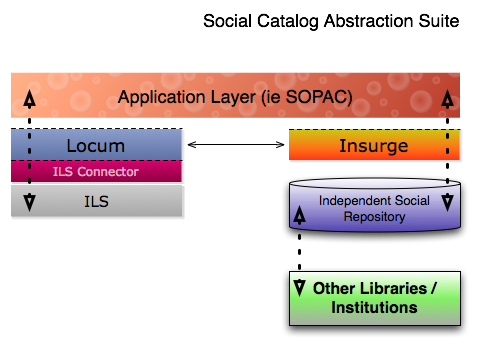
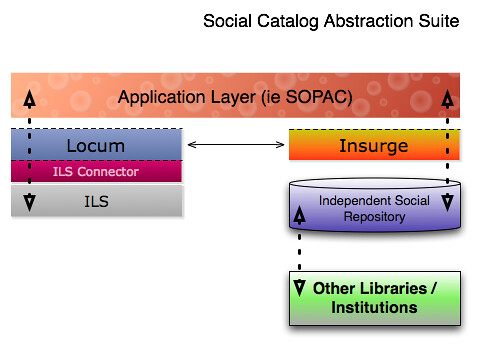
A year and a half ago, when he released the first version of the SOPAC for the Ann Arbor District Library (here’s his blog post), Blyberg’s extensive customizations were definitely cool, definitely innovative, and definitely had potential. He was working hard to put lipstick, a wig, and a dress on his pig. Well, now he’s covered the pig altogether. I won’t get into details (mostly because I only barely understand them myself), but he has coaxed his Drupal-based web site to pull information from their ILS rather than pushing the searcher into the ILS’s environment.
Other people have tried to insert new interfaces between their ILS and their patrons with more or less success, but I think Blyberg has just shown us an example of this type of project that not only works well (drawing on information from the ILS, from a local database of user-generated content, and potentially from a much larger database of user-generated content from other libraries), and is ILS-agnostic, butthat also looks good.
Here’s the diagram he uses to explain where all the information comes from:
And here’s what the catalog looks like (notice the juicy tags on the left):
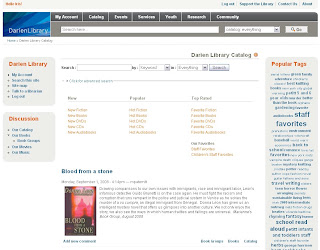 When you do a search, results appear in the main content area of this same screen, fully themed to match the site. So beautiful!
To say I’m jealous is an understatement. If we can’t bring ourselves to migrate ILSs, I want something like this. But I do have two reservations: this still requires the discovery layer to harvest and store information from the ILS, and that pig is still under there somewhere. As far as I can tell, the ILS is still locking down untold treasures in the form of data that catalogers have worked so hard to include in our records and it’s preventing us from exploiting that data fully. An actual relational database as the foundation for bibliographic information would make me so very happy. Still, this is really really exciting. I can’t wait to see if other libraries pick up this open source software and continue to develop it further.
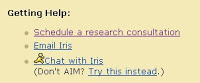
Leave a CommentI spent a few moments today adding a new section to each of my subject research guides. Our CMS doesn’t allow for things like Meebo widgets, or any other embedded stuff like that, so I added the next best thing: a bunch of ways to reach me from within each page.
Here’s what it looks like: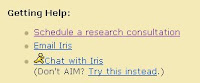
(From my French & Francophone Studies Research Guide)
Frankly, I don’t know why this didn’t occur to me until today, but now that it has, I look forward to seeing if I get any increased traffic. (Of course, the other part of me is asking if I really want increased traffic… but of course, the answer is always yes.)
Point of need research assistance: the holy grail of every research services department.
Leave a Comment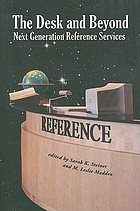
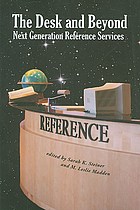
I’m pretty excited. The book that contains the chapter that my co-worker and I wrote is now really and truly published!
I can’t wait to see what the other authors wrote about, but I can tell you that Ann and I wrote about individual student consultations, how they fit into a research service alongside reference and instruction, and why we think they’re pretty amazing.
6 Comments