Skip to content

Category: Random Thoughts

Academia, Libraries, Work, and the Public Good

As our public debate swirls around whether the working poor should go to college, whether academics work hard enough to justify their pay and social standing, and whether libraries are worth their budgets, it stikes me that we’re grappling with what it means to have value in our society. Faculty and librarians answer, “We work for the public good — education, access to the thoughts and works of others, and the critical thinking skills to make something of that access all create a better society.” But I think that may be answering a question that is not being asked, or answering it based on assumptions that are not shared. As a society, we’re questioning the fundamentals: From what capacities do we derive value? From what outputs can that value be measured? What, ultimately, contributes to the value of society as a whole — the public good? And what are the rewards for value in time, money, and social standing?

As I think on this, here are some of the voices I’ve heard giving compelling answers or asking compelling questions about these fundamental questions.

Do Librarians Work Hard Enough? by Barbara Fister

“We have never tried to corner the market on information or drive any other organization out of business. We’re the opposite of empire builders. We’re trying to preserve access to common ground where ideas can be shared openly, not a trading pit for buyers and sellers. We’re not serving customers, we represent the will of the people so they can help themselves and be part of a community that learns.”

The Last Enclosures by Timothy Burke

“I think it’s fairly simple. You know the classic “First they came for the X, then they came for the Y, and I did nothing, and then they came for me?” schtick? This is one of those stories. In fact, it’s the end of one of those stories. They already came for the doctors and the psychiatrists. They already came for the lawyers. They already came for the accountants and auditors. They already came for all the professions. Professors are the last to be broken on the wheel, the last to be put at their station in the new assembly lines of the 21st Century Service Economy.”

Why We Have to Go Back to a 40-Hour Work Week to Keep Our Sanity by Sara Robinson

“Odds are good that you probably turn out five or six good, productive hours of hard mental work; and then spend the other two or three hours on the job in meetings, answering e-mail, making phone calls, and so on. You can stay longer if your boss asks; but after six hours, all he’s really got left is a butt in a chair. Your brain has already clocked out and gone home.”

Kathrine Rowe, while talking to Carleton humanities seniors yesterday about how their skills prepare them for work, in this case the work of software development.

“I have spent my life, my career, apprenticing myself to the study of acts of expression.”

“Humanists are trained to enquire if the questions being asked are the right questions and if the assumptions being made are the right assumptions.”
2 Comments

The Reference Pager; or, Things That Will Probably Kill Me

Last summer, our workhorse of a pager finally fell to bits. Literally. So we had to buy a new one, and it’s actually  not a walk in the park to find one that will transmit all the way through our library, but we landed on this one. The good news is that it does indeed transmit throughout our library.

Aaaahhhhhh!!!!!!!!!

The bad news comes in two parts. First, it turns out that “Good Vibrations” is actually stamped onto the pager — a pager that vibrates exuberantly. This is… not what I really want to be wearing on my belt buckle as I go about my librarianly work. We covered the phrase over with a slip of paper that says “Reference Pager.” Imaginative, I know, but I’m all for utterly useful things at service points.

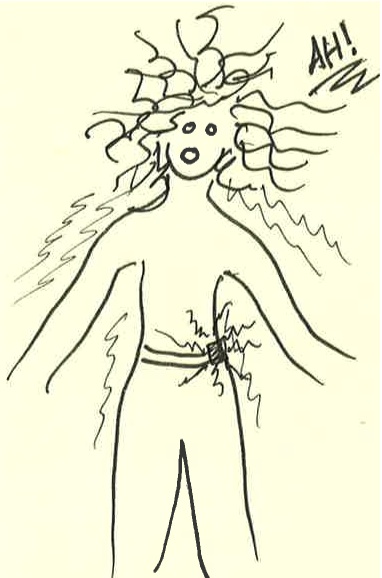
The second part of the bad news was the extreme exuberance with which this pager vibrates. You can hear it vibrating away from across the main floor of the library, followed immediately by the poor on-call librarian’s startled scream. And at the beginning of every shift, you can watch as the librarian on duty gingerly unplugs the pager from its charger, turns it on, and cringes as it gives 4 excessively happy “I’M FUNCTIONING AND I’VE MISSED YOU AND I’M SO READY TO WORK TODAY” vibrating pulses.

I’m on call this afternoon while all my other colleagues are either working off campus, at a conference, or on vacation. If this thing goes off and I have a coronary, nobody will know what happened until everyone returns tomorrow to find my cold, dead hand clutching the maniacally vibrating pager.


p.s. Here’s the thing’s “I’m awake” war cry. (Surgeon General’s Warning: turn down your volume if you value your ears.)

3 Comments

How students (and faculty) really find articles

In January we started piloting the Wiley pay-per-view option. Based on our usage stats and other schools’ usage stats, we bought tokens that would get us through the calendar year, after which we would reassess. Sounded like a plan!

Due to several unforeseen factors, we didn’t turn on the pay-per-view access in our link resolver. Seemed like a tiny bump in the road. Our real pilot would be delayed a couple of weeks. No biggie.

However, in those first two weeks, we went through over a quarter of the tokens we’d purchased, tokens that were supposed to last us a full calendar year. Apparently Google, Google Scholar, and the DOIs in scientific citation styles lead enough students to the Wiley publisher website version of these articles that going purely pay-per-view would crush our serials budget.

And it’s not just the students. The last 2-3 years, one of the main themes to the questions at new faculty orientation has been how to get to the full text from Google or Google Scholar.

Now, if you’re like me, none of this is particularly surprising. It’s just the first time I’ve seen it quantified in budget form. But it’s left me wondering if our to-be-configured discovery system will make a dent, and what Google plans to do with Google Scholar anyway now that the redesign (rolling out slowly to different people) removes Scholar from the “more” menue. And I wonder about the future of aggregator databases and of our budgetary structures. Not that I think databases are “dead” or anything, but I do think that Academic Search Premier does not now serve the function it served even just a few years ago, so it and it’s ilk will inevitably change focus or fade.

3 Comments

Thank you, Steve

What with one thing and another, getting this space looking functional again seemed like an insurmountable task. I couldn’t even make myself find a new base theme that didn’t have that awful, huge, contextless, ever-changing image. And I certainly couldn’t write here while that image was staring me in the face.

But then Steve Lawson swooped in and did all the heavy lifting (and nearly all of the light lifting, too), and now my blog is looking like my blog again. Thank you, Steve!

2 Comments

Library Hold Shelf Pros and Cons

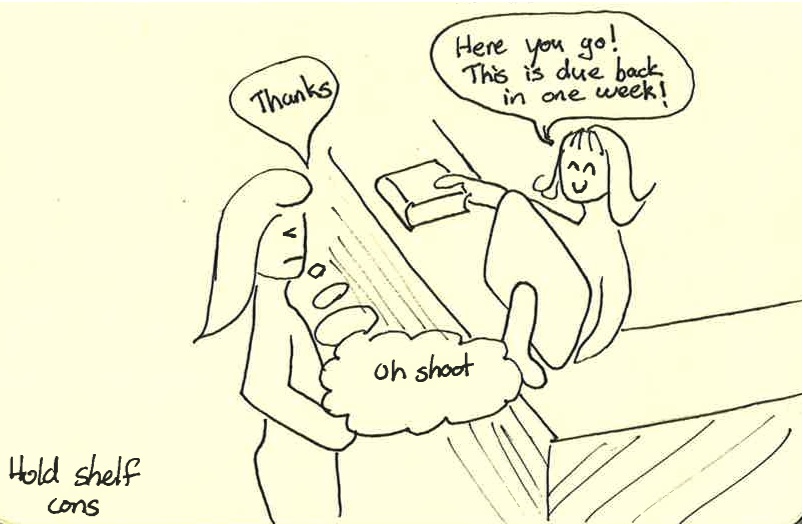
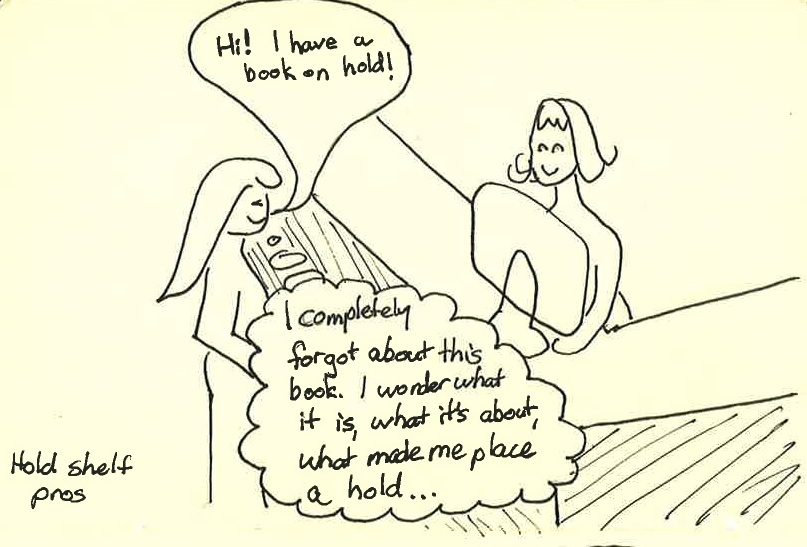
I recently got a notice that I had a book waiting for me at the circulation desk. Thrilled, I raced over there having completely forgotten a) that I had put a book on hold months ago, and b) anything about said book. What fun! What an adventure!

After having had my library card scanned and the book desensitized, I realized that there’s a downside to placing a hold on a book that’s so popular that a million other people had placed a hold before you and 85 million people had placed a hold on after me.

1 Comment

Writing Well

I’ve been thinking a lot lately about the kind of writing I enjoy, that I strive for, that I aspire to.

I love writing that sounds like exactly the words you would have chosen if you’d thought of it. Simple and clean. I love it when there’s an underlying coherence to the language — a rhythm, a lilt, a metaphor. Nothing that bashes you over the head, but there if you look for it.

Recently, as NPR cajoled me into wakefulness one morning, I heard an interview with Tina Brown talking about what makes a good columnist and these two quotes jumped out at me:

“Columnists speak in a voice readers understand — their own, but just a bit better.” (Quoting the introduction to Deadline Artists, edited by Jesse Angelo, Errol Louis and  John Avlon)

“It’s really about how they think and their ability to empathize in a unique and interpretive way, in a sense, both with their readers and the culture,” Brown says. “You really want to feel that the writer is both absolutely in tune with what’s happening in the culture but also has a kind of counterintuitive response to it.”

This is what I like best about my favorite bloggers’ writing. This is even what I like in those few formally published articles that I’ve enjoyed not only for content but also for style. In fact, this is what I enjoy most in fiction, as well. Basically, this is the kind of writing I love.

2 Comments

What does it mean to have a library?

Unsurprisingly, a lot of my friends have been talking about the dismantling of the People’s Library at Occupy Wall Street, and it’s got me thinking about why the protesters set up the library and why people care so much that it’s gone. And why tiny towns have libraries, and why universities are judged on their libraries, and why tweed-coated English gentlemen built private libraries far larger than they could read through in a lifetime.

For lending libraries, of course there’s an economic benefit to the community that comes from sharing books. And I imagine that this was a core benefit to the People’s Library, too. It’s easy to see how the protesters would have wanted to carry out simple acts of sharing with all who were in want.

I think there’s also a nice metaphor of cultural exchange that happens with lending libraries. Ideally, more than one person will have read each book, and that means that those people will have experiences in common to discuss and build upon.

I think a library, any kind of library, is also a statement about belonging and longevity. “We are here,” they help us say, “and we plan to be here for a while.” And it’s not just belonging and longevity, but also a statement about progress. “We know things,” they help us say, “and we will continue to learn new things and add those things to this collection.”

I have been having a hard time feeling outrage about the dismantling of the People’s Library, but maybe it is in part because I have been thinking of it as a collection of books in a tent. Maybe it was more than that.

1 Comment

Arguments wear clothing

A couple of weeks ago Bryan Garsten came to give a convocation speech here. The speech consisted primarily of a tale of several conversations in which his cast of semi-fictional characters hashed out what they thought college was for. But before he began that tale, he started with a beautiful little metaphor.

Arguments wear clothes, he said. When you bring an argument out into the world, it should be clothed for the appropriate occasion. There do exist argument nudist colonies, but in the end these remain on the margines. Appropriately clothed arguments, on the other hand, have power and sway in all areas of society.

Leave a Comment

You know you’re a reference librarian when…

I’ve had the more standard stress dreams, the ones where I’m supposed to teach but have no idea what or where and I’ve missed most of the term already, the ones where I’m supposed to take a final for a class I don’t remember enrolling in and have never attended. Last night I had a new kind of stress dream.

The library’s heavy duty stapler had died under the constant stress of massive eReserves printouts and student frustration. The library had decided that handing out large paperclips was the better way to go considering the expense of a new heavy duty stapler and the amount of time we spent fixing it every week. Then we got an email from a (fictional) history prof on campus who had forgotten that librarians might be on the all-campus email list and had sent out a passive-aggressive plea supposedly behind our backs asking for the campus to chip in and help buy a heavy duty stapler. (Man am I glad this guy doesn’t actually exist.) This prof hinted that the library must not care much about the history department since our decision hurt them the most. He also said that only one model of stapler would do and that he intended to collect the money and then hand it over to the library so that we could make the purchase.

When we looked into it, it turned out that this model of stapler was discontinued (and yet we knew we’d have to find one anyway). Not only that, but the staples that it required were only available in small quantities at auction, and each set of 100 staples came in its own display box, much like the little boxes watches come in, with the staples hanging from a display stand. As you would imagine, the staples weren’t a bargain.

At this point, I woke up in a cold sweat.

6 Comments
css.php