Skip to content

Category: Teaching and Learning

Information Literacy in a Utopian High School

About a month ago I got two separate emails from completely different people asking about what I think high school students should know about information literacy before coming to college. I, uh, procrastinated a bit. The question was just kind of daunting and got all wrapped up in all the normal thoughts people have about these things (“College students today, they just don’t understand even the BASICS!”) along with some worried thoughts I wasn’t expecting and don’t actually believe in (“If they know this stuff when they get to me, what will I do?”). Plus, we’re in the last few weeks of school here (yes, still) so I could procrastinate while being busy with student questions, which could even be a great excuse except that I know I was just putting it off.

Before I go any further, I should point out that not only have I never taught in a high school myself, I never even went to high school. So I’m certainly no expert in what gets taught there. My perspective is that of a librarian who spends the first 10 weeks of every school year teaching about a third of our first year seminar students. Also, these are ideas, not a curriculum. I’m just thinking out loud here, as usual. So with that said, what should high school students know before coming to college?

Habits of Mind

  1. A research paper is not (usually) a report. Very few reports get assigned in college. When faced with their first research projects here, students really really want to write what John Bean terms an “all about” paper — these tend to have “And then” as a standard transition and they basically summarize all known facts about a particular topic.
  2. Curiosity, and high comfort with the idea of finding out what people know about whatever you’re curious about. I have a browser open nearly all day every day, and I can’t tell you how many searches I do in a day — everything from checking on the spelling of a word (Google is my dictionary) or figuring out more about something I saw on TV or something I’ve read.
  3. Understanding that journalists, scholars, business people, etc don’t have their well-formed ideas drop on them from the sky. They do not utter Truth-with-a-capital-T. They offer perspective and (hopefully) support that perspective with some context/evidence/proof.  They, too, went through the messy process of figuring out what they even wanted to know about a given topic, and the uncertain phase of collecting and analyzing and rethinking and collecting some more. This is a really difficult lesson to learn, so the sooner you start thinking about it the better! And the better you know this, the easier it will be to engage with outside sources rather than simply report on them.
  4. Gather information, THEN write the paper. The other way around is just painful.
  5. Cite what you use. This is good for you (no plagiarism) and good for your reader (more context), and besides, you’ll be graded on it. This is a habit more than a skill because the individual rules for this citation style or that matter far less than the habit of bringing in and acknowledging the participants in the conversation that you’re having in the form of your research project.
  6. Talking to people (especially librarians or writing consultants or discipline experts) is not cheating. It’s the way knowledge creation happens. And since this isn’t a “report” getting information isn’t the whole point. You’ll still be able to think about and communicate about your analysis and synthesis and conclusions. Those journalists and scholars who didn’t have their ideas fall on them out of the sky? They talked to people, too.

Research skills

  1. I tend to expect students to have searched google. A lot. This is not always the case, but it’s the assumption upon which I build many of my classes and one-on-one instruction.
  2. Books are good, and knowing the parts of the book (table of contents, the amazing thing that is the index, the introduction, the conclusion) will help you get the most out of a shelf of books in extremely short order.
  3. Browsing is good. Search can only get you so far, particularly if you are a novice in the field (which is everyone in high school) and therefore don’t know the vocabulary that each field develops and uses to exchange ideas. I call this the Term Economy, and it’s what makes searches work or fail. If you haven’t paid much into that economy yet, browsing is even more your friend than it is for everyone else.
  4. Call numbers mean a topic. You don’t have to know what topic any given string means, but knowing that really helps with browsing.
  5. Find full text based on a citation. Only about 30% of our incoming students can do this and I would love it if all of them could.
  6. Keep track of what you find. Whether that means printing stuff out, saving it to something like Zotero or Evernote or whatever, it will stand you in really good stead.

Tools

  1. Word processing
  2. Basic proficiency with a browser
  3. Browser addons (so many library tools involve bookmarklets and browser addons)
  4. Citation generator? Zotero is great and useful in many many more ways that just producing citations. Straight up citation generators? I’m neither opposed to nor in favor of them. The only thing I really care about is whether the student knows enough about basic citations to be able to look at a citation and use it to find the text. THAT’s what’s important about citations. The rest is periods and commas.

I’m sure there are plenty of other things high school students do and should know before entering college, but these are the things that trip up my first year students either consistently or spectacularly.

3 Comments
Classes and Appointments over the years

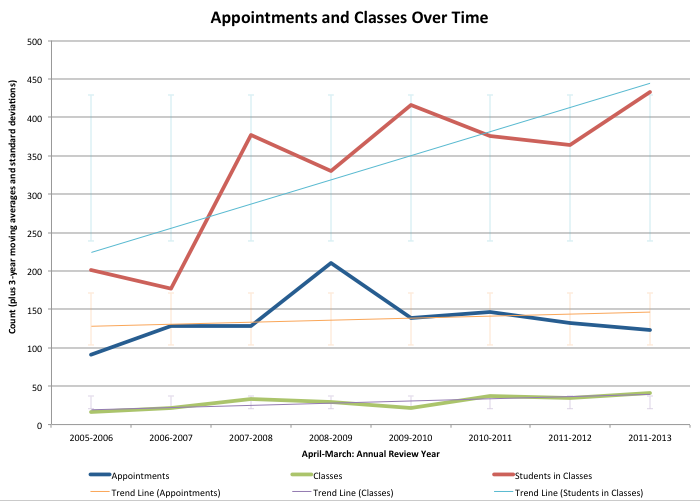
I’m currently writing my annual review document… or rather, procrastinating on writing my annual review document. In the process I made a graph:

appointments and classes

For the last three years we’ve been making a concerted effort to help students understand that they can ask many of their questions at the reference desk (especially students in first year seminars). We’ve also gotten more involved in curricular initiatives on campus, using more of our time to work on curricular-level projects than we used to. I think both of those changes are reflected in the downward trend in appointments. (And really, not a ton of change over time if you disregard that one weird year where apparently EVERYONE needed me.)

I think that curricular-level work, plus slow but steady relationship building with the faculty in my departments accounts for the upward trend in classes. This year I’m more than a standard deviation above the mean.

I’m sure my colleagues have very different graphs since our departments fluctuate in different ways. But I found my graph interesting, so I thought I’d share it.

Leave a Comment

Bad Term Paper Math

So, you’re assigned a 20-page paper when really you’re only used to 5-page papers. That’s pretty daunting. It’s a lot of space to fill. Therefore you’ll have to fill it with a lot of stuff. Four times as much stuff. Four times as large a topic. Four times as significant a claim!

Except that that’s not right at all. That’s the wrong multiplier. Go down that road and you’ll start trying to develop new theories of renaissance post-modernism, or a comprehensive description of the minority female healer in the modern consciousness.

A better multiplier is nuance or detail. Four times as much nuance is a wonderful thing.

Leave a Comment

Discussing Discourse

If I could only be un-nervous and fully supported in my geekery in every class (by profs and students), they could all be as fun as last Tuesday’s class was. I’ve done similar things in other classes, but I often come out feeling like people were just kind of baffled by the crazy librarian who seemed really excited about… something.

Exploding a Reading
Exploding a Reading

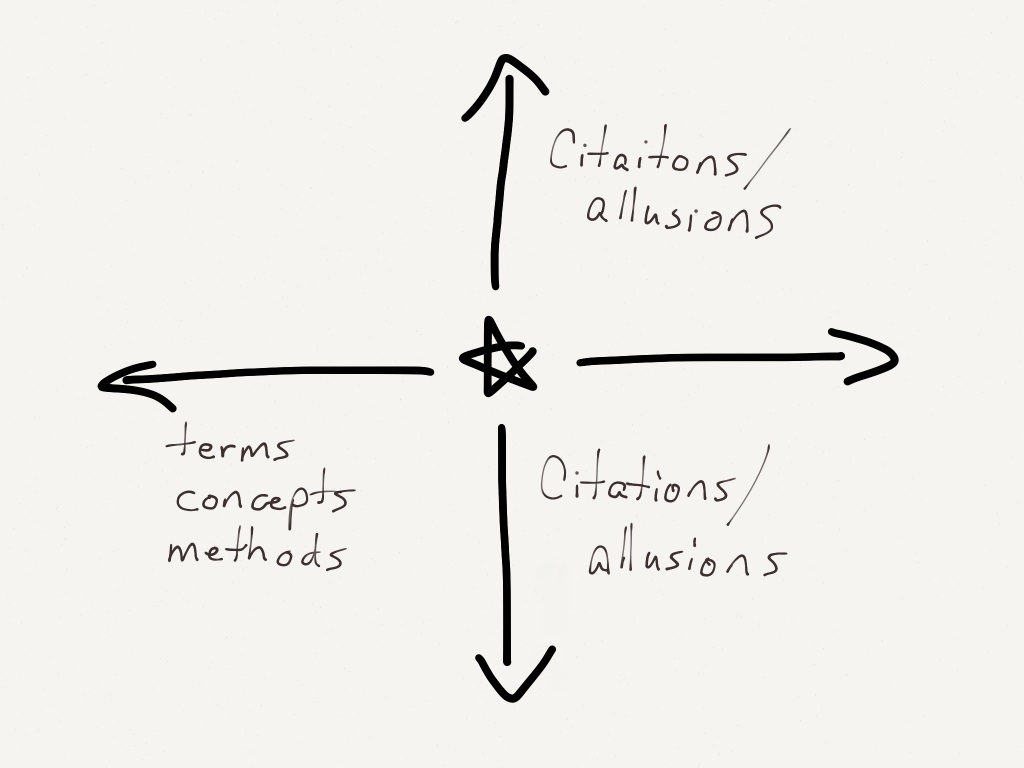
So last week was based on what I think of as a fairly standard class: exploding the article. Basically, you take any given reading. You figure out who the author builds upon (citations and allusions) to move backwards in time. You figure out who has cited the work (technically citations and allusions, but really the allusions are pretty hard to search for so you’re left with cited reference searches in Web of Science or Google Scholar) to move forwards in time. And you Read Instrumentally to figure out the language and methodology of this community of inquiry so that you can search for more people using similar language or methodologies.

For this class, the professor and I chose to explode the least explode-able of the day’s readings: and excerpted portion of a book theorizing the silences in history.* There weren’t any citations included, and the piece was difficult to begin with, so we thought this approach might help us all figure out his argument a bit by figuring out who he’s talking to and what his base set of information is.

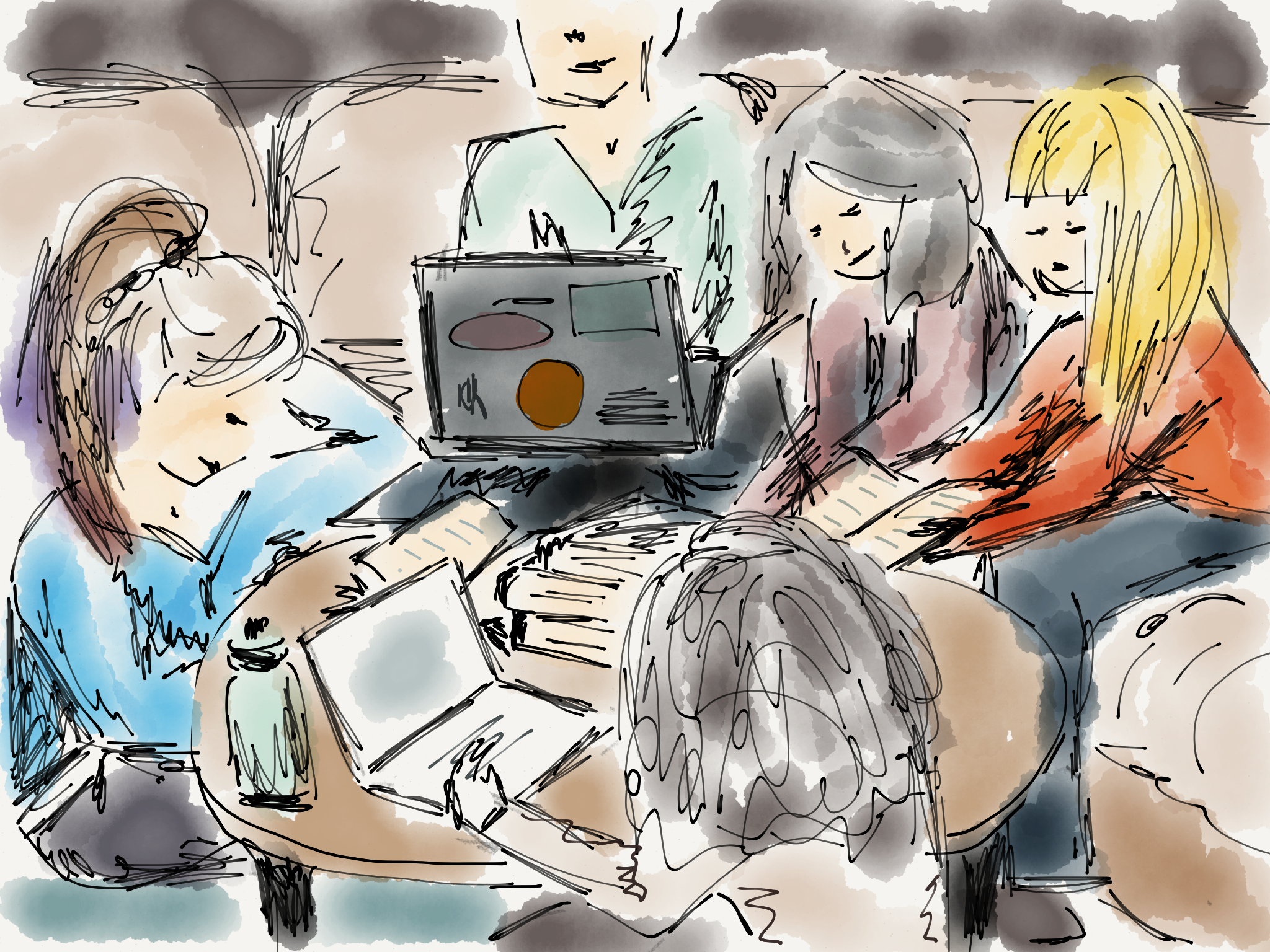
Our class that day, held in the student union.

We started out discussing what outside voices the author included in his argument (and I’d brought the un-excerpted version from the stacks just in case we wanted to track down any actual citations), but very quickly started talking about how hard the piece was to read. We agreed (heartily) that this had not been written for OUR discourse community. In fact, it seemed bent on keeping us at arm’s length.

Talking over what made us feel unwelcome in this author’s world helped us think about conventions that we’re used to in American Studies papers that help us understand what’s going on. Some of that is vocabulary, some of that is topic, some of that is the dreaded citation (which everybody hates but which everybody really missed in this work because they felt like he was just name-dropping or referencing things and then leaving us without context). Basically, we talked about how discourse is situated within a community, and that following the conventions (of vocabulary, method, acceptable evidence, and yes, even citation) makes readers in your community more at ease — more ready to think through your thoughts with you rather than write you off or give up in frustration. Every piece of the work, from vocabulary to argument, has to work together to move your reader from thinking what they already thinking to agreeing that your way of thinking is interesting and useful. Every piece should help your reader trust that what you’re saying is reasonable. If you don’t pay attention to the rhetoric, your message risks being discounted or simply lost.

* Trouillot, Michel-Rolph, “Silencing the Past: Power and the Production of History,” American Studies: an Anthology, Malden, MA: Wiley-Blackwell, 2009. 558-566.

2 Comments

Focal Flexibility

One of my favorite metaphors for humanistic inquiry is “unpacking.” Sometimes it feels like an over-full suite case springing open, scattering previously unseen clothing and toiletries all over the place and revealing that present that grandma brought for you nestled there in the center. Sometimes it feels like carefully and laboriously picking the infinitely delicate locks on a briefcase, not knowing if what you’ll find inside will be precious or just some long-forgotten trash.

Unpacking means finding and reveling in richness and awe-inspring reality. Facility with unpacking is a tantalizing scholarly goal.

Little wonder, then, that my students balk a bit when I force them away from that goal. During one session where the professor and I were trying to get students to plot the interrelationships of some articles by finding their commonalities (either topic or approach or theoretical underpinnings), one student complained that “it seems like we’re reducing these articles down to their least interesting, most simplistic components.”

And we were, in a way. We were doing the opposite of unpacking. We were packing them carefully into suitcases, shirts on one side and pants on another, with no thought to the color, weave, or provenance of the individual pieces.

FocalFlexibility
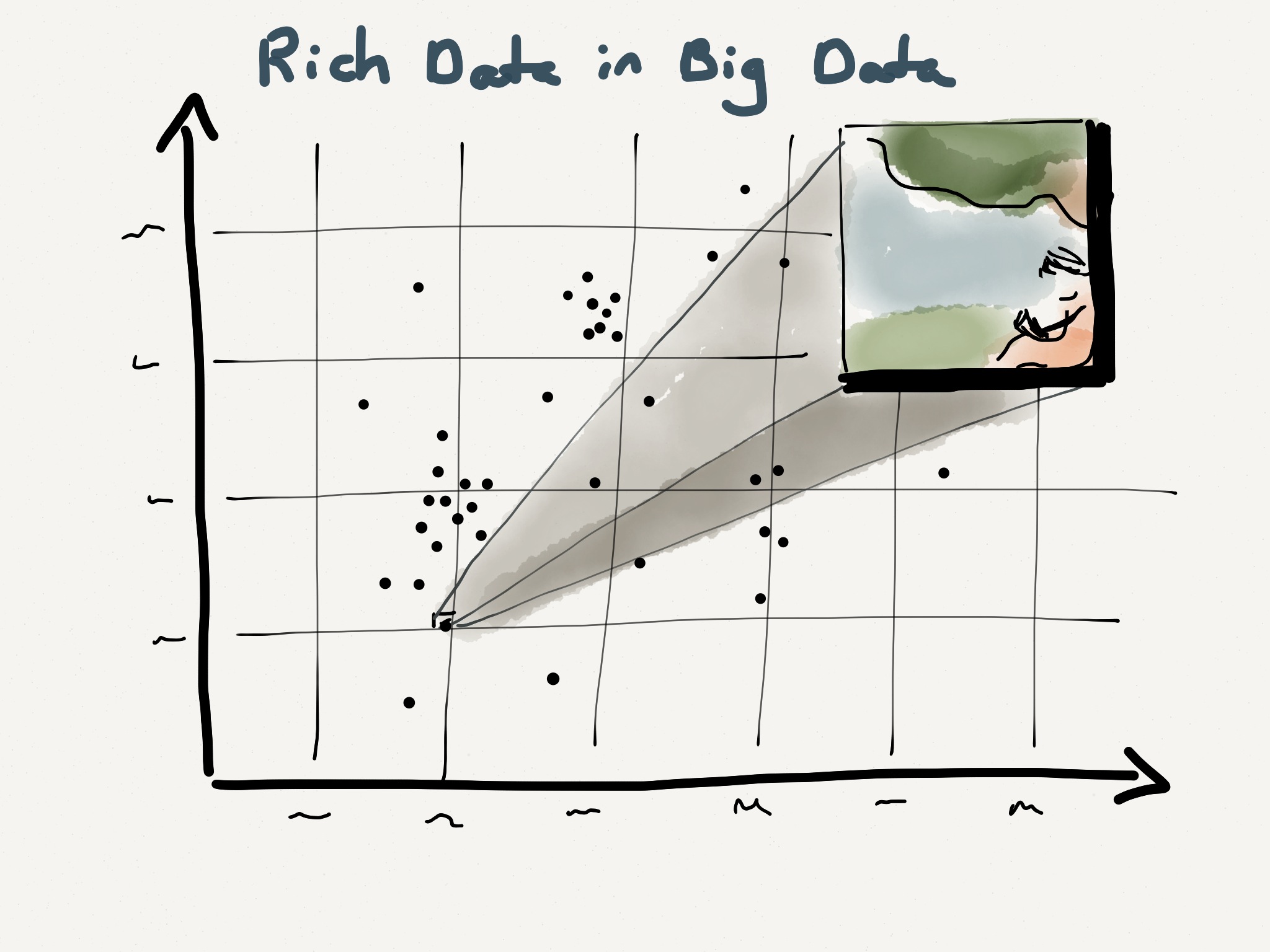
Focal Flexibility – by Iris Jastram

It hadn’t occurred to me before that moment how important focal flexibility is — the ability to see a given work in all its richness and unpackable complexity, and also see it as one of a constellation of other works — to be able to plot it dispassionately amongst its peers, and also gaze at its internal universes.

3 Comments

What do I teach, anyway?

This morning I got an email from a librarian wondering what kinds of concepts I teach, particularly in 300-level courses, beyond how to search. As it turns out, that’s something I think about a lot! Here is what I wrote:

Well, I’m not sure I have much to add that isn’t on my blog already, so I’ll include a bunch of links here, but contextualize them a bit. And probably the closest I can come to telling you about 300-level courses is a four-part post on highest level course I teach before their thesis. Another class that I’ve written up is Critical Methods. These are both for the English department, but I’ve done very similar things for American Studies and languages. The concepts are pretty flexible, and I’m coming to think of them as some of the core info lit concepts for most non-laboratory research. They probably aren’t the ONLY concepts, but they may give you some ideas. Essentially, I have come to think of Information Literacy as being highly related to rhetoric, where the point is to participate as an expert insider within a discourse community, using evidence that makes sense within that community in ways that resonate with the community in order to add to the community’s understanding in some way.

Also, a concept that I flesh out and emphasize differently depending on the level (but which I teach more and more often due to the feedback I get and the research we’ve done) is a circular research process that appears in the middle of this post.
With upper level courses I emphasize that there is a ton of actual reading involved because they’re developing a sense of the scholarly conversation, mapping in out (here’s where mindmapping can come in), feeling out its boundaries, and learning its vocabulary. Sometimes we practice what I call Instrumental Reading and what Booth breaks down into three types of reading (in his Craft of Research, pages 91-96 of the 2003 edition).

And finally, I should say that I teach an awful lot about searching, but I frame it as if I’m not teaching searching, but teaching something more conceptual. Boolean and limiters and all those things come up with the examples we do together in class or examples I’m showing when I’m actually teaching them something else, and I’ll digress briefly to make sure everyone understands why I just wrote OR there before moving on. I say this just because when I first started moving away from “how to” teaching I felt guilty whenever I ended up showing those things, but now I think it’s the best way. The “how to” serves the higher order concepts, and they need both.

So that’s where I am right now in my teaching. I didn’t arrive here all at once, and I hope I’ll keep evolving and learning how to teach because there are a whole lot of rough edges yet. But for me it has been liberating and satisfying to think more and more about information literacy’s relationship to rhetoric and about the deep concepts that interest ME about information literacy. If I’m interested in what I’m teaching, I have a much better chance of interesting my students, and a FAR better chance of feeling fulfilled in my work.

~Iris
And since I’m a librarian at heart, here is a bibliography of my current favorite/formative readings on the topic.
  • Bean, John. Engaging Ideas. 2nd ed. San Francisco: Jossey-Bass, 2011.
  • Bennett, Scott. “Libraries and Learning: A History of Paradigm Change.” Portal: Libraries and the Academy 9, no. 2 (2009): 181–197.
  • Bizup, Joseph. “BEAM: A Rhetorical Vocabulary for Teaching Research-Based Writing.” Rhetoric Review 27, no. 1 (January 4, 2008): 72–86.
  • Elmborg, James. “Critical Information Literacy: Implications for Instructional Practice.” Journal of Academic Librarianship 32, no. 2 (2006): 192–199.
  • Elmborg, James K. “Libraries in the Contact Zone: On the Creation of Educational Space.” English 46, no. 1 (2006): 56–64.
  • Fister, Barbara. “Teaching the Rhetorical Dimensions of Research.” Research Strategies 11, no. 4 (1993): 211–219.
  • Harris, Joseph. Rewriting: How to Do Things with Texts. Logan: Utah State University Press, 2006.
  • Head, Alison J. Learning Curve: How College Graduates Solve Information Problems Once They Join the Workplace, 2012. http://projectinfolit.org/pdfs/PIL_fall2012_workplaceStudy_FullReport.pdf.
  • Kapitzke, Cushla. “Information Literacy : A Review and Poststructural Critique.” Australian Journal of Language and Literacy no. July (2001).
  • Kruger, Justin, and David Dunning. “Unskilled and Unaware of It: How Difficulties in Recognizing One’s Own Incompetence Lead to Inflated Self-assessments.” Journal of Personality and Social Psychology 77, no. 6 (1999): 1121–1134.
  • Leckie, Gloria J. “Desperately Seeking Citations: Uncovering Faculty Assumptions About the Undergraduate Research.” Journal of Academic Librarianship 22, no. 3 (1996): 201.
  • Lloyd, Annemaree. Information Literacy Landscapes: Information Literacy in Education, Workplace, and Everyday Contexts. Oxford: Chandos Publishing, 2010.
  • Norgaard, Rolf. “Writing Information Literacy in the Classroom: Pedagogical Enactments and Implications.” Reference and User Services Quarterly 43, no. 3 (2004): 220–226.
  • ———. “Writing Information Literacy: Contributions to a Concept.” Reference and User Services Quarterly 43, no. 2 (2003): 124–130.
  • Oakleaf, Megan. The Value of Academic Libraries: A Comprehensive Research Review and Report. Review Literature And Arts Of The Americas. Chicago, 2010.
  • Saunders, Laura. “The Future of Information Literacy in Academic Libraries : A Delphi Study.” Portal: Libraries and the Academy 9, no. 1 (2009): 99–114.
  • Shannon, Claude E., and Warren Weaver. “Communication Problems at Level A.” In Mathematical Theory of Communication, 9–12. U of Illinois P, n.d.
  • Simmons, Michelle Holschuh. “Librarians as Disciplinary Discourse Mediators: Using Genre Theory to Move Toward Critical Information Literacy.” Portal: Libraries and the Academy 5, no. 3 (2005): 297–311.
  • Wiggins, Grant P. Assessing Student Performance. Vol. 15. San Francisco: Jossey-Bass Publishers, 1993.
Leave a Comment

Becoming a Linguistics Librarian

When I started here I had degrees in English and a degree in Library and Information Science. But I was also the librarian for languages, music, linguistics, and American Studies. A while ago I wrote about important things I learned about being a music librarian (part 1 and part 2), and about being a librarian for language departments. Well, for the last week or so, I’ve been sitting in on a linguistics class, and over the last year or so I’ve been working more closely with their upper division classes, and here are a few things I’ve learned in the process.

The Field

From the perspective of the interested outsider and the helper of undergraduates, the field is easiest for me to think of if I liken each branch of it to other fields. So there are the neuroscience-linguists, and the psychologist-linguists, and the sociologist-linguists. And lo and behold, that helps when picking databases and search terms. Happy librarian! PsycINFO and Sociological Abstracts can come in really handy to flesh out the Primary Duo (i.e. Linguistics & Language Behavior Abstracts and the MLA International Bibliography).

Linguistic Data

Linguists talk all the time about data and about datasets. When they do this, they mean “example sentences” or “example sounds.” So a grammar of Turkish is full of data on the Turkish language (which is distinct from a book on the grammar of Turkish, which may or may not be all that full of data). So if students want data on Turkish, I’d look for a grammar, I’d look for articles on a particular construction or sound in Turkish, and I’d look for researcher websites (using the “site:.edu” limiter in google, usually) where researchers put up their linguistic datasets.

If I were going after a much lesser known/studied language, SIL and researcher websites are probably the best bet. I find SIL’s website hard to navigate, so I search it using Google.

If there’s “nothing on my topic” I’d use Ethnologue and find related languages and see if they can be useful by analogy.

Currency Oddity

Linguistics is odd in that some of the sources need to be very current indeed, particularly the parts having to do with brain science. Meanwhile, other parts of the field rely heavily on books that are 50, 60, or 80 years old. Typically, complete descriptions of languages are only done once and then amended in the literature, so it shouldn’t be very surprising if the primary source of primary data comes from a well worn book written by some African explorer in the 1920s.

Navigating the Jargon (with undergrads)

Linguistics is jargon-heavy. I often can’t even make out the wikipedia articles on the topics I’m supporting. But just like being a librarian for foreign languages, this is a good reminder for me to keep my consultations highly collaborative with the student. They supply the terms, I suggest ways to come up with terms (“what kind of a thing is a genitive? a Case? Ok, so what if we look for Russian cases if we’re not finding what we want when searching for Russian Genitives?”). They interpret the results while I give them pointers about categories of things to watch for in the results.

Jargon is also your friend because it makes keyword searching so much easier than in the humanities. “Ergative-Absolutive” is far more likely to return accurate results than “performance of self” regardless of my level of understanding.

My next steps

I’ve been pretty happy with my research guide for Linguistics, and they’ve said that it’s very useful. But now that I’ve sat in on a couple of class sessions I think I’ll add a tab on gathering linguistic data. And if I can, I’ll try to sit in on some different classes next term.

4 Comments

MindMapping for Research

It’s the beginning of a new academic year, and this year’s thesis students are starting to come see me in panicked waves. The meetings are intense and exciting and full of possibility and fear and anticipation. Right now we’re mostly trying to come up with a Plan rather than specific sources. Given your interests and given the kinds of resources we each know of, what would be both stimulating and researchable here and now.*

Lately, I’ve been mentioning mindmapping more and more often as students wonder how to figure out if they’re original enough, or how to figure out if they’ve created a stable enough grounding in the relevant literature. I teach it sometimes as a way to build good searches with useful terms, but this is different. Sometimes the student has a clear question in mind, and we can draw in supporting bodies of research. Sometimes the student doesn’t have a clear question in mind yet, and we can draw in the supporting topics first — the things where they say “I’m kind of interested in x and y and want to see if they’re connected with z,” and then fill in the spaces between the topics to find the question.

After a session this morning, I’ve realized that I teach four distinct forms of mindmapping to move students from the very preliminary topic questing through to the production of the final product.

Types of mapping

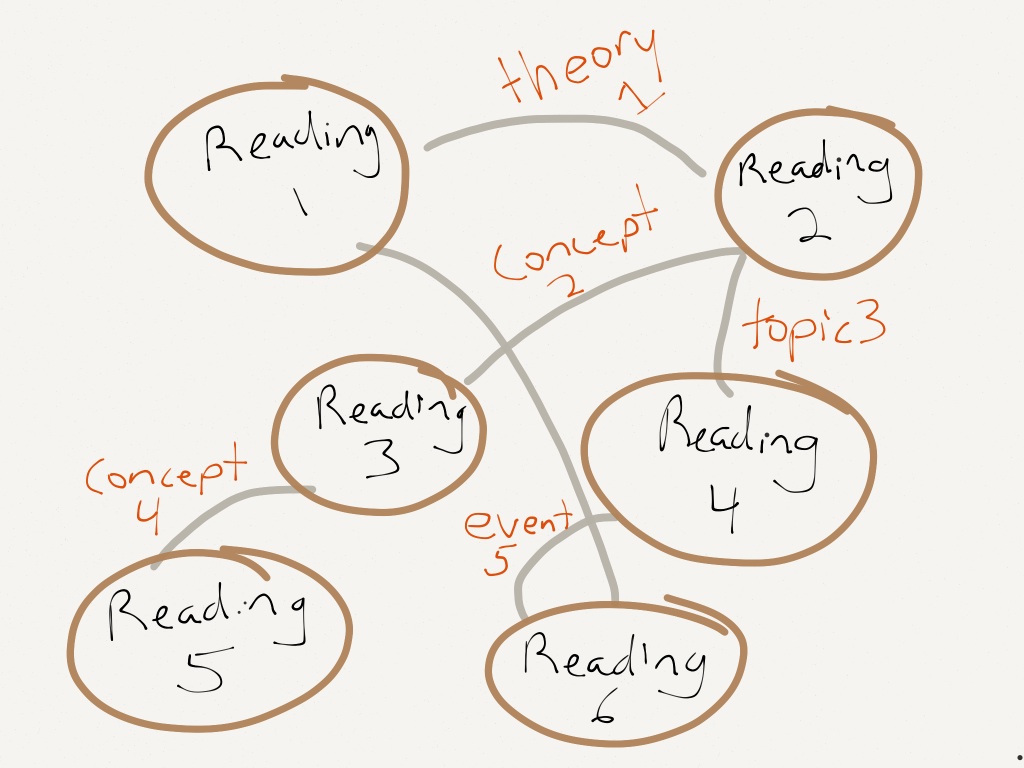
1) Mapping sources to find concepts (early stage of work)

For the early stages in topic selection, students often have vague ideas about topics but haven’t yet come to a point where they’re able to say what piece of the topic they’re going to concentrate on. They know they want to do something with the implications of fictional characters’ names, for example, but haven’t really figured out exactly what about the names to pursue or maybe even what fiction to use as foundational examples. But they’re really interested in race and culture, and they know that fictional characters have names chosen for them by authors, so there’s got to be something they can do that combines the two.

For this, some students find it very helpful to keep their broad topic in mind while reading/skimming several readings. Each reading becomes a node, potentially related to other readings, but not necessarily. The students can then draw connections between readings, using this process to discover the concepts that may be key to their own work.

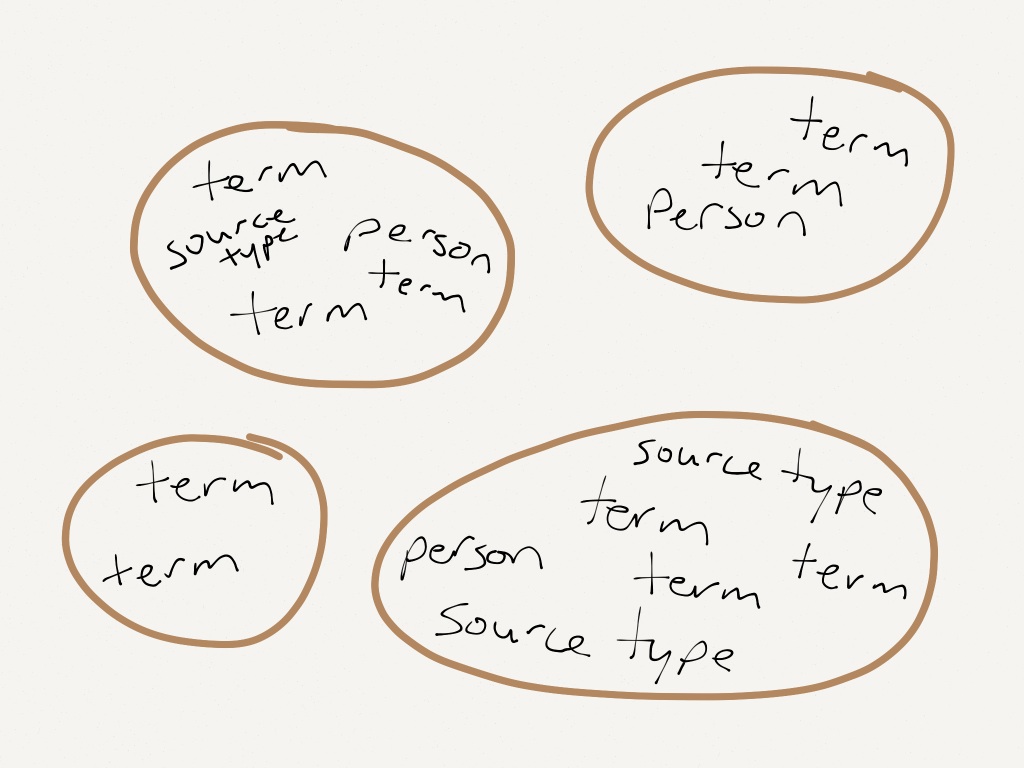
2) Collecting search terms and source type strategies

Another tricky part of early stage research, particularly in the humanities, is learning the vocabulary of your topic and learning what counts as evidence to the community of inquiry that you’re planning to enter. Unless you do these things, searching can be pretty impossible since it’s just term matching. If you’re using “self-concept” and your community of inquiry is using “identity” you’ll never retrieve the sources you need.

Similarly, if you produce an argument based on evidence that your community scoffs at, or if you need ideas for what kinds of sources would help you make explore your topic, watching what kinds of evidence show up in the literature can be a great strategy.

And of course, following up on people or institutions mentioned in the literature is another great way to build future searches based on readings you’ve found.

So for this kind of map, I have students think about their major concepts, and then fill in those concepts with terms, source type ideas, and people/institutions associated with that concept. These all become fodder for future searches.

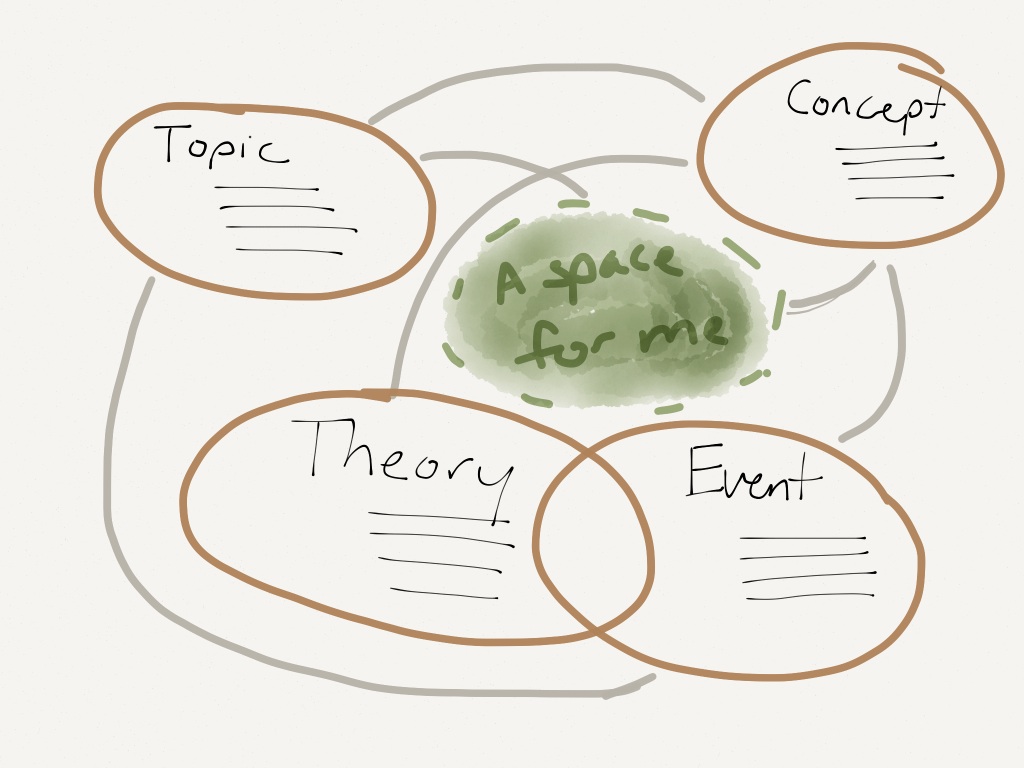
3) Mapping concepts to find your own question

Once students have solidified the core concepts of their work a bit more, they still need to figure out how to assimilate the source material into something that original rather than duplicating others’ work or simply patching together quotes from here and there. For this, a pretty traditional mindmap can help.

I have students plot out their key concepts and list the key sources for each concept (for students to did option 1, these can often be the labels they assigned to the connecting lines between sources — in fact, the whole map is like the inverse of option 1). This time we pay close attention to the spaces between concepts. Students can then see what has and what has not been covered by their source material and figure out what they’re adding to the conversation. “People have covered x, y, and z, but I’m going to take these parts of what they have said and add this new idea.”

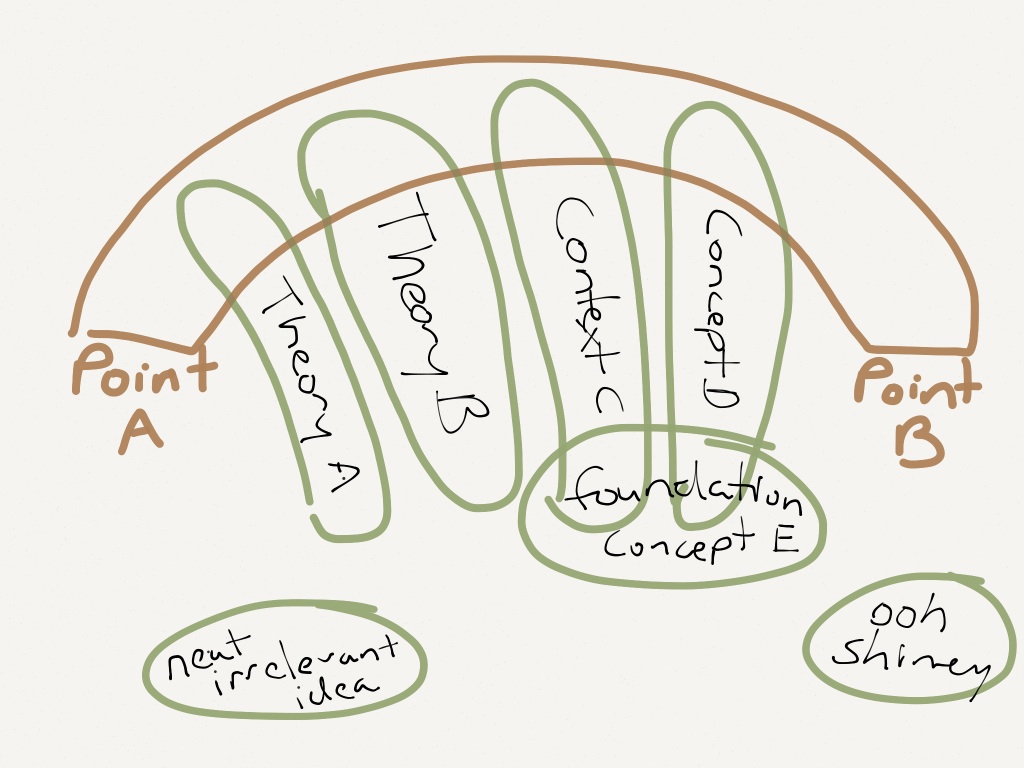
4) Mapping to test the completeness of your evidence

And finally, for students who are thinking critically about their work and want to be sure they’ve made a rock-solid case for their position, I have them think about building a bridge between themselves and their readers. Their paper is supposed to walk their readers from Belief A (the reader’s start point) to Belief B (what the student hopes the reader will believe after reading the paper). We start thinking “Well, they’d have to be on board with the assumption that x, and know about y event…”

Each of these concepts contributes a bit of itself to the students’ goals, forming one of the planks in the bridge the student is building.

It’s also a way to think about potentially interesting ideas that aren’t actually necessary to the paper.

Tools I use

Generally, if I’m working with students in a class setting or in my office, we do one of these types of mindmaps and we do it using whiteboards. Low-tech and potentially messy, but it gets the point across.

For myself and my own thinking, I do this kind of thing on paper if I’m thinking on the fly or if I’m not intending to use it as the basis for a long-term project. It’s faster and there’s something helpful in the tactile and kinesthetic activity itself — the sketchiness. (Now that I’m getting used to drawing on my iPad, I can imagine the pencil/paper version moving to the iPad from now on. Incidentally, I did the sample maps for this post using the iPad.)

If I’m doing a long project (where I know the map will get pretty big and where I’ll probably be rearranging nodes as my thinking becomes more nuanced and clearer), I use MindNode.

* Over the years, these meetings have grown from being (literally) introductions to the catalog and one major database in their field to being highly collaborative sessions where each of us brings our own expertise to the project of finding an interesting, original, and researchable topic. What a relief! There was nothing more demoralizing than covering such basics with thesis students.

3 Comments
css.php