Skip to content

Category: Services

Freakishly Personalized

We talk a lot about personalization, and about how personalization improves the user’s experiences, and about how personalization makes the user feel appreciated. Well, I’ve just found out that you can take personalization too far. My dad got a birthday card from the dealer that sold him his car several years ago. This is freaky.

It’s funny because we give dealers all sorts of information about ourselves when we apply for loans, but there’s a level of politeness which assumes that the dealer will a) only use the information for the purpose we intended when we handed over that information, and b) pretend not to know the information when they’re in situations outside of that originally intended information exchange.

I remember learning this lesson when working at a small, independent bookstore for several years. We were expected to watch what our regulars bought so that we could recommend books to them that they would like, but we had to pretend not to know that one regular was reading up on divorce after having spent a year or so buying “fix my relationship” books. And we were certainly never to know why that same person later bought the books on managing finances after divorce…

We also collected phone numbers of the customers who signed up for our charity program (buy a book and 1% of the sale goes to a charity of your choice). But we weren’t supposed to “know” their phone numbers even when, after years of ringing up purchases and entering the phone number which served as their account numbers, we could rattle off the names and numbers of several dozen of our regular customers.

There is decency in asking our patrons to provide us directly with information we use for their accounts, or let them know what information we collect about them. But I think there is even greater decency in “forgetting” even readily remembered personal information when we’re interacting with our patrons in contexts outside of the personalized services we provide.

Technorati tags: , ,

3 Comments

Bundled Collections

A question was implied during my library’s recent exploration of the functions and implications of a catalog that actually works as a discovery system. It came up during the hour-long question and answer period with Roy Tennant (have I mentioned what a good idea it was to set aside that much time for questions?!?) when he made the comment that we should build the search skills of reference librarians into the catalog interface. That’s great, but then what will reference librarians do?

I’ll tell you what we’ll do. We’ll have time to coach students in more than keyword searching, we’ll be able to explore the exploding realm of quality, authoritative information available online, and we’ll be able to develop ways of feeding this rich content to our users when they need it. “Googling” things is great, but as more and more information gets uploaded for public consumption, the relevant hits will become increasingly diluted in a sea of irrelevant hits. This means that we’ll have to teach better search strategies for web search engines, and we’ll have to develop tools that will help our users get to the information they need. We’ll also have to spend more and more time teaching students to distinguish between the useful and the bogus in their result lists.

People are already creating tools to aid in the quest for authoritative information. The first one that springs to mind is, of course, the Librarian’s Internet Index. But on a much smaller scale, librarians are beginning to create rich troves of web-based sources using del.icio.us, Furl, and now Google Custom Search Engine.

I adopted del.icio.us earlier this year and have decided to make mine first and foremost a curricular collection that will be useful to students in my liaison areas as well as to students on our campus in general (you can see my account here). It’s still a growing collection, but it’s a great place for me to “remember” the image repositories I find while helping one student with her research, the web sites I choose for students in a class on globalization, and so on.

But I have high hopes for tools like the Google Custom Search Engine. This is what reference librarians could do with all the “free” time gained from not helping students navigate the catalog. (And I’ll believe in the theory that we’d have free time when I see evidence of it… but that’s another whole topic.) A few other bloggers have noted some of the bundled searches that are being developed already. And now there’s a budding directory of GoogleCSE forms here. I’m also keeping track of any custom search forms that look particularly useful to the library world and adding them to my del.icio.us account. So far, here’s what I’ve found:

I still haven’t ventured into the water myself, but I think it’s only a matter of time before I start creating custom search portals that I know will return authoritative information to my students. I think one of our directives in the coming years will be “go forth and bundle” because without it our poor users will stumble around in an increasingly expansive conglomeration of more-or-less random information.

Technorati tags: , , , , ,

2 Comments

The Reference Desk Under Fire

Every so often, I hear variations on the theme of “Why sit behind a reference desk? What are you — scared of the students?” I’ve heard everything from wearing uniforms so that we’d be recognizable while we were “out doing our work in the stacks,” to carrying a cell phone, to simply “walking around” and being available. I’ve heard eloquent deconstructions of the barriers we put between ourselves and the students when we sit at a reference desk. And I’ve sensed unspoken assumptions that if we’re “just sitting there” we aren’t actually busy or working.

Now, I completely agree that desks can pose barriers, especially when they’re the podium type that raises the librarian on high and requires timid students to crane their necks just to see us. I am also a huge proponent of making myself not only be available and approachable, but also seem available and approachable. Not only that, but I’ve seen wonderful and creative examples from other institutions who have abandoned their desks altogether.


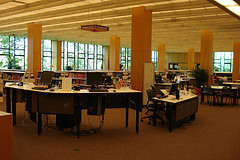
Why, then, do I steadfastly argue for my desk shift? Because I can’t think of any way to make myself be or seem more available and approachable to my user population. Of course, our particular desk configuration helps. We sit at a very low desk that is no more substantial than any of the work tables in the reference area (and it’s on wheels, though we haven’t moved it in a while). We also have a chair next to us for students to sit in while we work with them. We’re also directly across from both of the public printers for the main floor of the library and right next to the main floor’s computer area (which is in this room and just off the upper right side of my picture).

But simply having a non-scary desk in the highest-traffic area of the busiest building on campus isn’t enough (though it helps). That simply means that we’re visible, not that we’re approachable. Rather, having a predictable place where we can be found at predictable times, making the most efficient use of space in our somewhat unwieldy library, and playing off of the culture of our campus all contribute to my sense that our desk, or something like it, is necessary.

The physical library space needs little elaboration. There is simply very little space for anything other than books on the lower three floors of the library (remember, people enter our library on the fourth floor and work their way down). Not only that, but there’s no predictable traffic pattern on the lower floors, and the discussions that happen at the desk would disrupt the quiet levels on the lower floors. Of course the argument could made (and has, in fact, been made) that we would simply walking around down there, so traffic patterns and, to some extent, noise levels needn’t be an issue. But the fact is that the other librarians and I are rarely called upon to do work that would involve wandering in and out of the stacks. We go there to collect books in preparation for our classes, or with students when we’re in the midst of an appointment or reference interaction. But that’s about it. Then there’s the problem of the computer. Most questions need at least some computer interaction, and the computers in the library are usually all in use by students. It’s far easier to know that while librarians may be wandering around, there’s also one who’s scheduled to be either at the desk or who will be returning to the desk shortly.

No, the strongest argument in favor of the desk as a physical, predictable, and intuitive space lies in customer service. There’s nothing more frustrating than wandering 4 floors without any long sight-lines, looking in and out of stacks, climbing up and down 6 stair cases, just trying to find somebody who can answer a question.

What’s more, the librarians function in an analogous way to professors when we sit at the desk. Just as students can make appointments with their professors but can just drop in during office hours, they can also make appointments with us or simply drop in on our desk hours. Culturally, this meshes well with campus culture and student expectations.

I’ve wondered for over a year now if I’m simply defensive and stuck in the mud when I baulk at challenges to our service model. But I’ve come to the conclusion that there are very good reasons for having a reference desk, as long as that desk is positioned and designed with approachability and usability in mind, and as long as the people sitting at the desk make sure to look up, take their hands away from the keyboard, and smile whenever they’re approached. After all, approachability has at least as much to do with the person as it does with the furniture.

Technorati tags: , ,

4 Comments

IM Reference at Carleton: A Low-Key Affair


Last year, sitting at our Research/IT desk, we started noticing that the SCIC workers sitting next to us were often engaged in lively conversation via IM. At about the same time, a few of us got started on Google Talk and it quickly spread through the rest of us as a way to ask quick questions of each other throughout the day without actually interrupting each other as completely as we had been by popping into each others’ offices. (Personally, I think this was mostly a strategy to keep me in my office because I was new and doing a lot of popping in to ask questions… but nobody’s admitting to that ulterior motive.)

We really took to this as a method of communication. We still do a lot of popping in, but now we have communication choices. Not only that, but every once in a while we’ll be fielding a tough question during the night or weekend desk shift and end up IMing a co-worker for help. This isn’t frequent, but I’ve benefited once and I’ve helped out once, and both times there’s no way the reference interaction could have been successful otherwise. We’re also keeping in social contact after work, which I really enjoy.

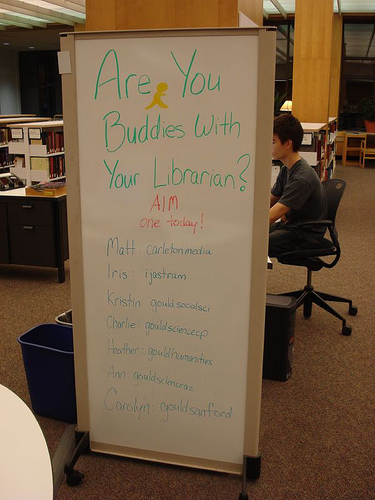
So after we’d played with this for one school year, we decided we wouldn’t mind creating AIM accounts to give out to students. We each have our own account, and we can each be online when we’re able to answer questions and offline or “Away” when we’d rather not answer questions, so we completely sidestepped all of the staffing and coverage issues that comes with “real” IM reference. On the other hand, this relies heavily on our liaison model, with students encouraged to meet with the librarian for their classes and major for anything more than general reference help. So in this sense, it’s more an extension of our individual consultation service than of our reference service. But it provided a no-risk method of trying a new service this term, so we decided to go this route.

So far, the response has been mixed. One of my co-workers has answered a couple of IM questions (and we all rejoiced), but the rest of us haven’t yet. [Update: It appears I’m wrong. One more of my co-workers has answered a couple of questions, and she is even one student’s very first IM buddy!} We’re also running up against a strong culture of face-to-face interaction here at Carleton, and some students have voiced the opinion that it’s “sad” when people can’t stand up, walk over, and ask us questions.

So I wouldn’t call our experience a rousing success if you look at it as a stand-alone service. And yet, there are three reasons that I’m glad we’re doing it and that we don’t have any plans to discontinue it.

First, it gives us a chance to experiment with a new “toy.” This is always valuable, especially when there’s no cost associated with that experimentation.

Second, it contributes to our efforts to not only BE approachable and accessible to students, but also to APPEAR to be approachable and accessible. I’ve been thinking a lot lately (as I experiment with Ask.com vs. Google or worry that my laptop is dying and notice how that changes what I think about putting into it) about the appearance vs. the reality of usefulness and trustworthiness. And basically I’ve come to the conclusion that the appearance of trustworthiness is more important than the actuality. If I trust something, it takes a lot to get me to go back on that trust, and the converse is also true. In the same way, I think building the appearance of accessibility, expertise, and usefulness to our students is at least as important as actually providing accessible, expert, and useful assistance. And our new AIM handles are helping with this… I think.

Third, I don’t care if I only receive one IM question. That’s one question that may not have come to the desk. And it’s not costing me anything in time or money to have AIM running in the background on my desktop. Even with a culture of face-to-face interaction on campus, there will always be someone who is shy about approaching the desk, or simply communicates better through the written word than the spoken word. There are lots of students that I only hear from via email, and I can foresee a time when these students will make me a buddy rather than putting me into their email address book.

Of course, I’m still waiting for that first IM question… but it’ll come. I’m nothing if not optimistic.

Technorati tags: , ,

3 Comments

The Research/IT Desk

Sitting here at the reference desk for my Monday afternoon shift, I’m reminded of one reason that I no longer dread my desk shifts. Well, one obvious reason is that now I have a lot more reference experience, so I no longer tremble whenever a student asks, “Do you have a minute?” But experience aside, I prefer desk shifts here because I rarely have to answer any technical questions, un-jam copiers and printers, recover lost papers, teach graph making in Excel, or trouble-shoot any other computer problem. At my previous library, this is mostly what I did during desk shifts.

It’s not that our students are more computer-savvy than the students at my previous library. If anything, there are more computer questions here because we have three computer labs here instead of one. No, this bliss is all because someone a couple of years ago (in September of 2004, to be precise) came up with the brilliant idea of providing a joint service point merging research help with technical help, transforming our reference desk into the Research/IT desk. So, to alleviate my sadness about not being at Internet Librarian, I thought I’d amuse myself by writing this all down before we forget what the first few years of this service were like.

The Progression

Before I begin, I should mention that I am NOT the authority on this subject. I just work here. My co-worker, Heather, is the point person for this and has presented on it several times and done a poster on it at ALA.

Anyway, For many years, now, Carleton has had IT support for students. They call this place the SCIC (pronounced “skick”), and it’s a pretty full-service joint. A whole battalion of geekish students (affectionately called “SCICers”), headed up by two full-time staff (“the SCICitator” and another guy without a nickname… we’ll have to work on that), troubleshoot software and even repair some hardware and clean up virus infestations.

Well, two years ago the decision was made that the SCIC would start sending some of the student workers over to the library to sit next to the librarian on duty at the reference desk. I wasn’t working here then, so all I know about these early experiments is second hand. Basically, everyone could see that it was valuable… except the student workers. They didn’t like being away from the SCIC because here they’re on their own, their fellow student workers are a building away, they are more visible so they can’t play games or wear headphones, and there’s different technology to learn. The biggest thing that year, though, was communication. The librarians weren’t these students’ supervisors, and we didn’t even really get to know them very well because there were 40 of them rotating through the library, and the librarians’ desk shifts weren’t consistent. So any SCICer could quite possibly work an entire term without working next to the same librarian more than once or twice.

Last year things got more formalized. SCICers staffed the desk for the entire time the library was open (even when there weren’t librarians on duty), and the SCICitator worked with the librarians to provide formal training in the special types of service and support issues that come with working in the library (microfilm reader/scanner/printers, SMART board issues, referring research questions, etc.). What’s more the SCICitator decided to schedule only second-year SCICers in the library, so they wouldn’t be learning the basics while cut off from their fellow student workers and their supervisor/mentor. On the librarians’ side, we regularized our reference desk shifts so that we would always be sitting next to the same students (except in the case of substitutions). Most importantly, though, we formalized the communication that happens between the librarians and the SCICitator. One of the librarians acts as the liaison to the SCIC and meets with the SCICitator briefly every week. She also coordinates training for the students. We’ve also worked on developing a habit of emailing the SCICitator if a student does really well or goes above and beyond, or if they miss shifts or in other ways slack off.

And slowly but surely, we’re seeing an attitude shift among the SCICers. It’s now a rare thing for them to show up with the attitude that this service point it “extra” or less cool. Some of them even try to shift their schedules so that they work only at the library.

The Benefits

Librarians immediately saw a significant drop in the number of “short” reference questions we answer. By itself, this is just interesting to us. But it become significant in terms of the service we provide when you pair this trend with the steady increase in the number of “long” reference transactions we have. Students are finding us available for in-depth research assistance now that we aren’t running after paper and re-starting computers. Now only that, but students are starting to seek out the technical assistance at our desk that they would previously have taken to the main SCIC, so there has been a significant increase in the number of questions handled by the SCIC side of the Research/IT desk over the course of the past two years. (The library is the busiest building on campus, so it makes sense to have this service here rather than sending everyone to another building.)

The Challenges

There are two main challenges that we’ve faced: communication/reporting and statistics collection. Formalizing the communication channels has really helped, and now that at least half of the SCICers don’t remember working when there wasn’t a library service point, they don’t balk at librarians stepping in to give them duties or brainstorm about solutions to problems. And this year we’ve gone to online statistics collection, which seems to feel more legitimate to these students. We know that they were under-reporting last year because many of them couldn’t be bothered to fill in little hash marks on a piece of paper. This year they’re still probably under-reporting, but making entries into an online database just FEELS more important, so they’re making the effort.

So we haven’t completely worked through all the ins and outs of this service point, but I’ve gotta say, I really like it. It frees us up significantly, and we get to develop relationships with a whole new set of students that we never really saw before.

Technorati technorati tags: , ,

2 Comments

More Staff Means More Service

Our library’s Annual Report was due yesterday afternoon, and I’ve gotta say, I’m very interested in one particular measure my supervisor included this year. She tracked the number of classes taught, students taught, and individual consultations held by each librarian for the last five years. Then she averaged the total by the number of librarians employed each year to show that adding staff directly impacted the services we provide.

For the first two years there were “only” five librarians and these librarians conducted quite a few individual consultations and classes per year, and they reached a lot of students. For the next two years there were six librarians, and each of these librarians conducted a few more consultations and classes per year, and they reached a few more students. Each librarian was, on average, more busy than the average librarian in the first two year. Last year, though, there were eight librarians, and each of us conducted LOTS of consultations that year and reached a LOT more students even though we taught only a few more classes than in previous years. Each “average” librarian was significantly more busy than the average librarian in any of the previous years. The graph doesn’t just slant up, it curves up quite steeply.

I think a few things have contributed to this change. Not only has our emphasis on transforming from a “faceless” institution to a “faced” institution begun to pay dividends, but we’ve begun to be perceived as accessible by the students, and we’ve begun to develop more individualized relationships with our faculty (both in pedagogical contexts and in campus social contexts). Best of all, even though we’re not faculty, we’re no longer seen as outsiders in faculty reading groups or campus committees. (Of course, I keep saying “we” but since I only joined this staff last year I can really only claim credit for riding the tidal wave. My co-workers are AWESOME.)

Not that we’re absolutely loved or completely trusted or anything. There’s a long way yet to go. But we’re beginning to see the fruits of our labors, and I am SO excited to be here to watch this tipping point in action.

And what’s in store this year? Well, I can’t speak for the rest of my co-workers (though I know they’re all teaching classes and holding consultations at a breathtaking rate). But even though I teach fewer classes and provide fewer consultations than most of my co-workers, I’ve already had more consultations this October than I had last October (and I’ve only gotten through one week of this October). This year we’re hearing a lot more students who say their professors recommended they come talk to us. And today I had my first instance of a student telling me, “I have a friend in a different major, and she keeps saying what a help her librarian is and asking me if I have a librarian. She keeps saying I should come see you.” Cool! I think our service is really taking hold.

Leave a Comment

Three Cheers for Collaboration!

One of the greatest things about working where I do is the way I get to work with people from our IT department. Or rather, it’s the way that the idea of working with the IT department isn’t a big deal. I absolutely take it for granted that we have a combined service point (which we’ve named Research/IT… yeah, “research it”…) instead of a reference desk. I think nothing of calling down to Matt on the web team if I need something from our content management system that either isn’t there yet, or that is there but I can’t figure out. In any given week, it’s entirely possible that I’ll spend more time working on projects with IT people than I will with people from other departments in the library.

Well, today we had a half-day retreat for all library staff, all IT staff, the archivist, and the slide librarian. The first hour was filled with three- to five-minute descriptions of projects we’ve done in the last year that were collaborative across our department. May I say “Wow”? We’ve done everything from design and implement a new icon set for the different material types in our catalog, to planning for a new concept of data services that will provide much needed support for all the classes that need to find, manipulate, and analyze data sets.

There’s still room for improvement, but if there weren’t life would be boring. So for the next part of the retreat we broke into groups to talk about the future. What do we want to improve? Well it’s no surprise that we want to have a better handle on who knows what so that we can tap expertise whenever possible. We also want to think of ways to improve communication so that we aren’t so dependent on vast quantities email. We’d also like to develop of system of periodic short (half-hour or 45-minute) sessions of presentations and/or discussions focused on what we do, what we think about, projects we’re working on together, projects we’re working on separately, and anything else of interest. Oh, and they would be open to the entire campus. The faculty have this in place already via our amazing Learning and Teaching Center, but we’d like periodic sessions produced by us as well.

I’m so pumped!

1 Comment

Being a Patron

Note: If the title sounds an awful lot like titles of much more thoughtful and useful articles you’ve read in the last couple of days, it is purely … um … thievery. But the title fits.

I went to my local public library this week, as I do quite often. It’s a small library, but they have a decent collection of books and quite a good collection of videos, dvds, and audio books (good for those long drives to other towns, through corn fields, which still mess with this city girl’s head). I had just gotten back from the wedding and family reunion week, and I knew I had a book on tape checked out (Ayn Rand’s Atlas Shrugged, part 2 of 3), but I thought it was due the next week. It wasn’t. It was already three days overdue.

“Did you bring back “Atlas Shrugged” today?” asked the circulation lady.

“No,” I replied, still wondering why she’d want me to bring back a book that was due next week.

“Oh, because its a little overdue, but let me just renew it for you,” the circulation lady say, without any hesitation at all.

Just like that, she renewed my overdue book. It made my day. Kudos to the Northfield Public Library for putting customer service over ILS messages. (And btw, she did the same thing for the three overdue videos of the family in front of me.)

Leave a Comment

Customer service gone wrong

While we’re on the topic of customer service, take a look at this post from Library Garden:

Library Garden: On underwear, beanies, and other fashion statements…

I’ve seen some pretty effective ways to reduce younger clientele (such as when the local coffee shop I worked at during graduate school closed its doors at the late, late hour of 7:00 every night, 3:00 on weekends… SO stupid), but this is one of the most creative ways I’ve come across recently.

Leave a Comment
css.php