The Librarian In Black points to a great post by Laurie The Librarian, who has developed a helpful PDF on how to evaluate library databases. Thanks Laurie.
Leave a CommentLearning in Libraries and Loving It*
The Librarian In Black points to a great post by Laurie The Librarian, who has developed a helpful PDF on how to evaluate library databases. Thanks Laurie.
Leave a CommentOur college is hosting almost 50 high school students this week, all working on an intensive writing/thinking/debating/research project (the one my whole department taught yesterday afternoon). While shepherding them through exercises to give them practice with print and online resources, one of my coworkers overheard a student saying, “I hate books. They’re so dirty.”
Really? Wow. More dirty than the keyboards on which you’re all typing merrily away? Personally, I’d take a little dust over a bunch of microbes any day, but that’s just me.
2 Comments[Update: It seems that the people who’d gotten their assignments already are the ones going to regional programs rather than the national program. So I’m feeling distinctly less lost now… still not happy about the tone of some of the answers to people’s questions early on, but definitely less lost.]
I just realized that The Gypsy Librarian is going to Immersion this year. I am too. Who else will be there?
I’m also getting a little bit frustrated. Even with two major communication channels (email and WebCT), I’m feeling distinctly out of the loop. Apparently some people know what they’re supposed to be reading for the jigsaw readings already, but I haven’t gotten my assignment. In fact, I haven’t gotten any official communication in a few weeks. Does anyone know what cohort they’re in? I don’t.
I should probably ask these question on the WebCT discussion board, but to be honest, I’m scared to. The tone of some of the responses seems to suggest that we should know better than to ask these questions since the answers were posted elsewhere. I’m sorry, but I’ve downloaded every Word Document on that site (Why can’t they just be viewable? Why do I have to download the document?), I’ve read the posts, I’ve read the emails, and I’m still confused. All the information is too compartmentalized for easy navigation. I shouldn’t have to refer back to an email we got months ago telling us how to access WebCT in order to find out about what I should be reading. That should be posted in the “Readings” section of the site, or the “Assignments” portion.
Ok, ok. I know I shouldn’t get worked up about this. I just hate feeling like I don’t know where to find information. That’s why I became a librarian.
Leave a CommentMy co-workers are back from New Orleans today (yay!), and Kristin has loaded a bunch of photos onto her flickr account. Here’s one of them. She has a whole set from ALA here.
Leave a Comment
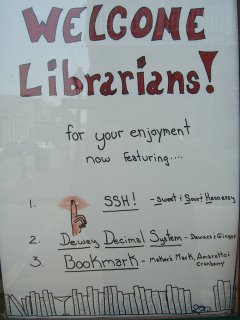
I just got this picture via email (with permission to post). Apparently there were librarian-themed drinks served at area bars in New Orleans.
Today the annual reunion extravaganza is beginning at the college where I work. Alums from almost every class year ending in a 1 or a 6 are converging on our little town for a long weekend of revelry and memories. The librarians always put on a whole host of activities during Reunion (including a reception for former library student workers) and it’s fun to hear how many alumni end up choosing careers as librarians.
But probably the most heart-warming part of the whole weekend is watching the college archivist interact with the older alums. Often, these alums don’t have anyone there from their year, or any of the surrounding 10 (this year there is one alumnus here from the class of ’36!). The archivist, though, reminisces with them as if he had been alive and in school with them. He knows the names of professors and classmates. He knows what things looked like. He knows the issues that were important topics of discussion at the time. He’s AMAZING.
And he proves that libraries are more than just repositories of information; libraries are centers of living memory. Living memories enrich our lives of today and help us build towards our lives of tomorrow. I raise my glass to you, Eric. Thanks for clarifying yet another glorious aspect of this wonderful job.
3 CommentsThis morning was the first of three consecutive mornings that I’ll be spending reading the sophomore writing portfolios at my college. This is my first time reading such things, and I must say that it’s kind of daunting.
You see, each year, all the sophomores turn in three to five examples of their writing from their first two years of college. Each year, some time soon after school gets out, a whole bunch of faculty and some staff (all volunteers) gather to read hundreds and hundreds of portfolios over the course of three mornings. And this year, I’m included in this bunch of readers.
Readers volunteer for a number of reasons. They want to see examples of assignments from other professors. They want to re-calibrate their own grading by reading masses and masses of writing. They want to intervene with students who need help. And the list goes on. It’s really fun to see a bunch of people taking on a task that just has to get done, but rather than just do it they reinvent it as a powerful professional development tool.
I’m there because my college is thinking of coming up with information literacy benchmarks for first- and second-year students. So another librarian and I are helping to read the portfolios not only to help make it through the boxes and boxes of papers, but also to find examples of information literacy at work and see if we can generalize our observations to help us develop an assessment matrix or a first-year info-lit initiative.
So far, after reading only a couple of portfolios, I’ve learned that:
On a somewhat separate note, I’m quite happy that I can walk into a room full of faculty members and not only greet and be greeted by name, but also carry on conversations with them about everything from libraries to pedagogy to gardening and not feel out of place. I’ve worked hard this past year to build this kind of relationship, and it’s finally feeling less I’m “just staff.” In fact, all the librarians have been working at getting involved in all sorts of things across campus, and now we’re beginning to be invited to meetings as less of an afterthought. Slowly but surely…
(The Pinky and the Brain song comes to mind…) Tee hee hee.
1 CommentI’ve been doing a lot of thinking and reading, lately, about what makes an expert and what makes a novice, especially when it comes to information seeking. There are all sorts of theories out there, but today I ran across one that really makes sense to me. There’s a discussion happening on the ngc4lib listserv at the moment called “What’s Better? Dumbed Down or Loaded with Functionality” (don’t get me started on the ideology of “either-or” that’s inherent in this question). Anyway, one responder made a comment that completely resonated with me. It’s a teeny little comment of just a couple of lines, but packed with implications. This person mentioned that even when he fails at a Google search, he continues looking and tweaking his search string because he’s “pretty darn sure” the answer’s there somewhere. This motivates him to keep looking.
And there you have it: one more piece in the expert/novice discussion. Novices have less knowledge of what’s out there to begin with, so they have less motivation to keep tweaking search strategies, so they are less likely to find what they’re looking for. This would also hinder their efforts to come up with viable research topics.
I don’t know how many students have come to me frustrated because they’re having trouble finding good stuff on depression in PsychInfo, and yet they’re unable to narrow their searches to a workable sub-topic because they don’t know what they’ll be able to find. To make matters worse, when they have spent 15 or 20 minutes not finding what they want, they ask if maybe they should change their topics, by which they do NOT mean refine… they actually mean CHANGE to a completely different topic. And then the cycle is repeated.
So file this away in the “how can I help with this” section of your brains. I don’t know how I’m going to help develop experts, yet, but I’m going to give it the old college try (just as soon as all the students get back from their summer vacations…[insert some pining for a summer vacation here]).
Leave a CommentI’ve been to a lot of conferences in the last year. Big ones and teeny ones, local ones and far away ones. And based on all this field research, I’ve just realized that I committed a major faux pas when I gave my talk this week. I never once mentioned Millennials. I wish to apologize for this oversight and plead for forgiveness based on the defense that I didn’t know what I was doing (obviously). Henceforth I promise to either talk about this new breed of human or come up with a very good reason for not talking about them.
Here’s the thing, though. I’m getting a little tired of the hue and cry. These kids are … well … kids. And just like every other generation of kids, they have needs and they have desires. And just like every other generation of librarians, we have to figure out what our users’ needs are and fill those needs, individual by individual and group by group. We also have to figure out what our users’ desires are, and cater to as many as are possible within the realm of reason and as many as are helpful.
Personally, I think saying things like,
“I’ll be doing a few panels of Millennials in the coming months. I always enjoy talking to these people and their insights and thoughtfulness always impresses.” (Stephen’s Lighthouse)
is not helpful. Don’t get me wrong Stephen has a lot of really good stuff to say. I admire the fact that he’s working hard not only to find ways of serving library users as well as possible, but also to push other librarians to do the same. But speaking of kids as if they’re aliens is, I think, counter-productive. In these sentences, “Millennials” becomes a term to describe a group that are completely separate, completely Other.
The two sentences I’ve quoted (found in a post that highlights some very interesting and useful information about his demographic sample) are pretty typical of what I call “Millennial Discomfort.” This disease is taking the library (and IT and education) world by storm. It’s reaching epidemic proportions.
Lets face it: there’s another generation running around, and eventually they will take over the world. In the mean time, we need to do exactly what we’ve done for generations upon generations… figure out what we can do to make sure they survive and flourish.
So instead of learning about and using MySpace, Flickr, del.icio.us, and all the rest because the Millennials are doing it (doesn’t that sound oh so middle-school-ish), let’s start learning and using these services because they’re useful and fun for our users and ourselves. Let’s learn as much as we can from the web services people like or the information seeking habits people have. Let’s remember that there are lots and lots of kids who are NOT tech savvy. And let’s remember that those kids who are tech savvy are not necessarily savvy in deciphering and leveraging the meaning, rhetoric, implications, or sometimes even the basic content of the information they take in. Let’s spend that proportion of conferences devoted to cries of “The Millennials are coming! The Millennials are coming!” and rededicate that time to learning from each other about new processes, best practices, and yes, even some of my beloved theoretical underpinnings. We can do it. I KNOW we can. There’s so much to talk about, think about, and do.
It’s been a weird week… I’ll step off my soap box now.
8 CommentsThe “M” Word, Libraryola, and The Librarian in Black have all picked up the story. The New York Times did a piece on it, as did the ACLU Press. Here’s The “M” Word’s version:
In case you didn’t hear, the “Connecticut Four” are finally able to speak out after enduring the months-long gag order they had been restricted by when the FBI demanded records about their library patrons under the Patriot Act. See the articles in the NY Times this morning,
Four Librarians Finally Break Silence in Records Case and Librarians Decry Patriot Act Gag Order (free subscriptions required). According to a statement
released by ALA , “The Plaintiffs were finally allowed to speak publicly after lawyers representing the government withdrew an appeal to keep their identities hidden after Federal District Court Judge Janet C. Hall declared the perpetual gag order that accompanies National Security Letters unconstitutional.”
The four librarians were:
George Christian of Windsor, Ct., executive director of the Library Connection, Inc ., a consortium of libraries in the central part of the state Peter Chase, the vice president of Library Connection and director of the Plainville Public Library Janet Nocek, director of the Portland Library and Library Connection secretary Barbara Bailey, director of the Welles-Turner Memorial Library and president of Library Connection
The librarians expressed “frustration about the sweeping powers given to law enforcement authorities by the USA Patriot Act.”
”I am incensed that the government uses provisions of the Patriot Act to justify unrestrained and secret access to the records of libraries,” said George Christian of Windsor, Conn., executive director of the Library Connection, Inc., a consortium of libraries in the central part of the state.”George Christian was the first one to receive the confidential request from the F.B.I. He was quoted as saying:
“I was shocked by the restraints the gag order imposed on me,” said Mr. Christian, who said that after receiving the request he was unsure whether he could consult a lawyer or his board of directors.
“The fact that the government can and is eavesdropping on patrons in libraries has a chilling effect, because they really don’t know if Big Brother is looking over their shoulder,” he added.
Being free to speak now, weeks after the Patriot Act was reauthorized for several more years, was “like being allowed to call the Fire Department after the building has burned down,” he said.
According to
ALA’s release , incoming president Leslie Burger hopes that the stand they took will have an effect in creating new laws that “better reflect what this country stands for.”