Skip to content

Category: In My Classroom

Reading Instrumentally

A few years ago at a kind of instruction in-service we held in my department, my coworker Kristin talked about a way of reading that she was beginning to teach in her classes. She called it “reading instrumentally” and talked about how she was trying to get her students to read articles for more than subject comprehension — to read them in order to use them as springboards for finding new material. Since then, I’ve started teaching this, or bits and pieces of it, in more and more of my classes. For me, it’s the best answer I can come up with so far to the problem of the Term Economy.

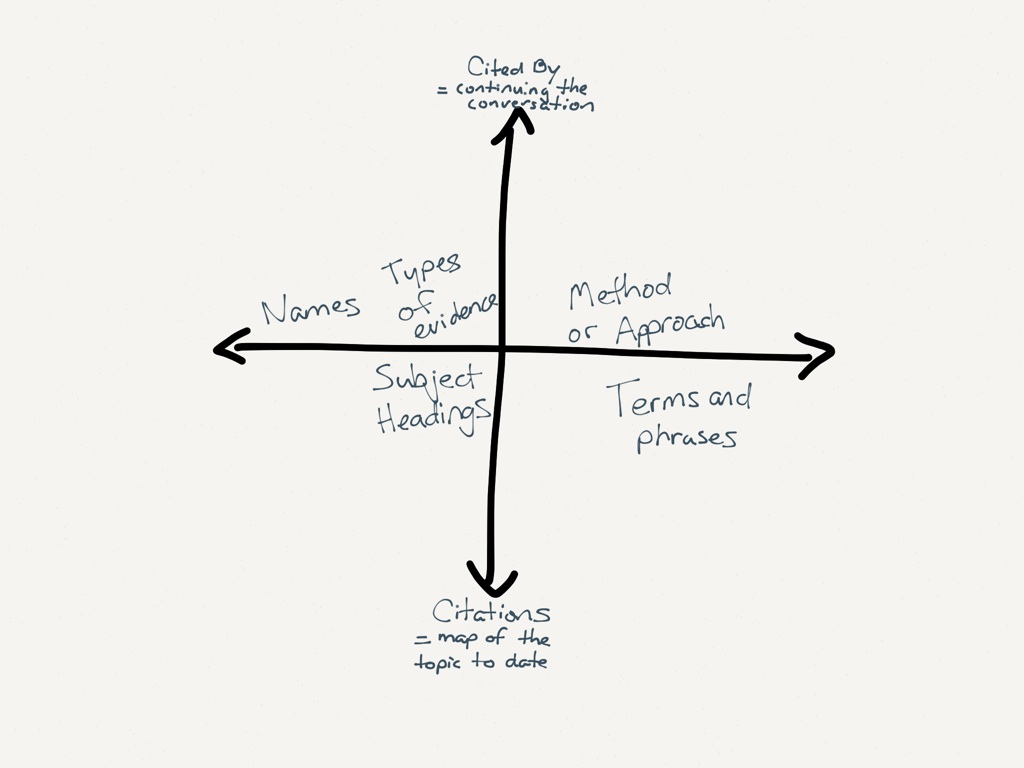
The idea is that reading for comprehension is good and important and all that, but that the point of the article is only one of many things you can learn by engaging with it. Just reading the first few paragraphs of a work slowly and carefully, you can glean a whole host of names and terms that you can then use when crafting further searches or deciding where to search next. For example, you can note down concept names, other vocabulary, researcher’s names,  relevant institutions that might produce or publish information for the topic, or types of evidence used in this kind of argument. After reading the first few paragraphs of a few likely articles, you can go back and start using these new concepts and terms and research/institution names to craft more focused searches. At this point, you’re more likely to be using vocabulary that a more expert person would have used in the first place.

Here’s one concrete example.

Cooks, Bridget. “Fixing Race: Visual Representations of African Americans at the World’s Columbian Exposition, Chicago, 1893.” Patterns of Prejudice, 41.5 (2007): 435-565.
ABSTRACT Cooks examines the Johnson family cartoon series published in Harper’s Weekly during the World’s Columbian Exposition in Chicago in 1893. Her analysis addresses the series’ caricatures of African-American fairgoers in the context of the landmark exposition, a national celebration of America’s cultural leadership and accomplishment since its ‘discovery’ by Christopher Columbus in 1492. The Johnson family cartoons are remarkable because they are the only racist images in the issues of Harper’s Weekly in which they appear, highlighting the importance of their message that African Americans were an unwanted presence at an event that served to solidify America’s national identity. The series provides insight into some of the social anxieties of white Americans regarding the presence of African Americans at the exposition. It also explores white American discomfort with racial and economic diversity through the antics of the imaginary yet symbolically representative Johnson family. Cooks’s discussion includes a visual analysis of the cartoons and comparisons of the Johnson family images with photographs and illustrations of African-American labourers at the fair and with depictions of proper behaviour by white American fairgoers. This examination of the cartoon series questions the roles of race, class and social hierarchy in turn-of-the-century America, and illustrates that acceptable mainstream attitudes clung to ideas of racial prejudice.

Just from this I get a whole bunch of clues about how and where to look for evidence that might reveal attitudes about race in the late 19th century. I might not have thought to page through Harper’s and other magazines at the time. How would I find out which other magazines to look at? I could look at caricatures in general, cartoons (oh, and I bet there were caricatures and cartoons in newspapers at the time, too, so I could look there), advertisements, and anything else that exaggerates normality or abnormality. I could do more research into the World’s Exposition, since it’s positioned as being a representation of America. Terms like “national identity” and “social anxiety” might be useful. The abstract also makes it clear that one great way to build an argument about difference is to make an argument about what the ideal sameness might be. It also compares caricatures to photographs, which is kind of a similar rhetorical move — making arguments about exaggeration by comparing it to its opposite: realism.

If I read a few paragraphs of the article itself, I’m sure there will be useful citations to follow, possibly some argument about why Harper’s is a good source (which might hopefully mention some similar periodicals as part of this argument), certainly other historians who are interested in race in America, possibly some theorists (which would be a jackpot, particularly if this were a literary article, since searching for theorists is one of the hardest things to do), possibly some other types of scholars who might have an interest in this kind of topic, and hopefully some clues about where to go looking for photographs, either from citations for the photographs used or from other context.

Once I realized that this is how I approach most of the searching I do (since I’m almost never searching for topics in fields in which I’m an expert), I decided to back up and start teaching this as a way to read result lists and abstracts, too (part of my exploding the article idea). So now I often have students help me pick relevant terms out of both controlled vocabulary and abstracts, or point out clues hidden in article records that might point us to related genres or topics or avenues into the literature. Then we search again, and then again, usually (hopefully) finding whole pockets of literature that we’d never have stumbled on otherwise.

8 Comments
Beyond Course-Integrated Instruction: An Example from Linguistics

I just finished teaching this term’s installment of one of my least usual classes. This is a class that takes the idea of course-integrated instruction to an even more integrated level. There are trade-offs, for sure, but it remains one of my favorite sessions to teach.

The General Idea

I show up for one class period of an intro to linguistics course. During the first half of the session, the professor covers an introduction to made-up languages, tells the students about their upcoming assignment (a short presentation on one of several made-up languages), and demonstrates the way a linguist might describe a language in hopes that the students will do something similar in their presentations.

Pretty straight forward stuff. Except that while he’s doing that, I’m also teaching. Here’s how it works. He chose Láadan as his made-up language to describe, so I then show how you might find things like consonant inventories and vocabulary and grammar rules. We start with Wikipedia, and I show them how to use it as a reference work (sifting through for important terms and using it to point them toward authoritative web sites). Meanwhile, the professor swoops in whenever I hit on a particularly linguistically relevant bit of information and uses them as the foundations for mini-lectures on linguistic characteristics.  All in all, I only talk for about 5 or 10 minutes, but, we cover basic search strategies and web evaluation, and we do it in the context of building actual linguistics skills.

For the last half of class, the professor and I launch into a little ad libbed song-and-dance that is ostensibly there to introduce students to one of the kinds of research they’ll have to do for their final paper and a basic gloss on what makes a good research question. But it also serves as a fascinating introduction to the neurological work involved in reading. The professor explains the history of the three writing systems in Japan, and then talks about a paper he found that used an fMRI to determine that Kanji and Kana are processed via different cortical pathways. This, he says, would make a really interesting basis for a research project, but the problem is that the study was published in 2000.

So I show how to use the Web of Science to do a cited reference search, and then how to do a search for (kanji OR kana OR hiragana OR katakana) and then combine that new search with the cited reference search to find the nearly 30 articles which both cite the original paper and have something to do with Japanese writing. All this gives me a chance to talk about how scholars index their own literature (via citations) and about exploding articles. Meanwhile, the professor jumps in whenever I hit on an interesting article. He usually mentions something (some theory, or a part of the brain), that I can Google in the background to find an example or an image, and then I can show how to evaluate the web site or image we find. Again, all in all I talk a for about 10 minutes, but together the professor and I demonstrate how research and evaluation are part of learning to be a linguist rather than a completely separate set of “library skills.”

Drawbacks

Clearly, there are strategies and tools that I can’t cover in this format. Many of the students’ topics end up requiring books, for example, and I never show them the catalog. My main goal is to teach two things: I can help you, and there are some pretty powerful tools out there that can help you, too. The upshot of this is that I spend much of the next few weeks in one-on-one consultation with these 20+ students, which takes a lot of time.

Benefits

The students see me (the single greatest influence on whether they’ll come to work with me in my office later), and the professor claims that the quality of the papers is measurably better now, even though I only teach for a couple of minutes, and even though only half to two-thirds of the students come see me later.

For me the most interesting part of the whole thing, though, is that it’s the only class I teach where I feel fully integrated into the disciplinary work that the students are doing. The skills I teach are part of the lecture, part of the work of learning about linguistic structures and brain activity rather than being separated out into an auxiliary library day.

So while there’s no way this would work if it’s the only kind of class I taught, I still get a kick out of every term when the professor calls me and says, “Ready to go again? Shall we use Láadan as an example this time? Can we still use the Sakurai article?”

Leave a Comment

Why Advanced Search?

I often teach Boolean searching to classes of students.

There, I’ve said it. And I’ve decided not to be ashamed of that practice even though most of the literature I’ve read since library school has steadfastly lambasted the practice as outdated, unnecessary, and self-indulgent.

Of course, I don’t teach it in every class, but sometimes there’s just no substitute for a good advanced search, and students of all class years may end up hearing about how they can use OR to combine conceptual synonyms and how they can use AND to combine those clusters of conceptual synonyms, and just look at how much better ProQuest behaves now that it understands what you mean by “gender” and “higher education” and “achievement,” and that you’d really like articles that address all three concepts, please. Freshmen eat it up like candy, and when I do my mini-surveys at the end of class (name one thing you learned that will be most useful to you — name one thing that still confuses you), the “how to use AND and OR” portion of class is a consistent hit. Sophomores through seniors really can’t function well in the MLA International Bibliography without it. And just yesterday, I learned one reason why they may latch on to Boolean searching as their ticket to research nirvana.

I was talking with a professor while her students were busily putting into practice the things I’d just taught them about searching the MLA International Bibliography, and she mentioned that she hasn’t ever really needed to know this type of advanced searching because she gets pretty good result lists and can scan them quickly to pick out what she needs. “I rely a lot on people’s names, though,” she mused. And that’s when I realized that advanced search techniques are important to students because they provide at least a partial compensation for the students’ lack of disciplinary context.

So, armed with the knowledge that a) my students like it, and b) they need it because they don’t know the names of the major players in their research areas, I’m going to happily continue teaching Boolean searching (when appropriate) until it seems like neither of those criteria apply any more.

5 Comments

Turning Topics Into Searches

The last couple of mornings I’ve spent time with a couple of different freshman writing seminars getting them ready to tackle the research component of their classes. Both times I tried a technique that I’d done once last year when I co-taught with a colleague of mine. It’s kind of like concept mapping… but with an eye toward building searches.

Here’s how it works:

  1. Talk about how writing a research paper is like participating in a conversation.
    When you enter a conversation at a party, you need to know a) who’s talking, b) what they’re talking about, and c) how they’re talking about it. Parroting back what people say is not a conversation. Actually contributing to the conversation means having a grasp of the topic and the vocabulary that is in use within that conversation. Relevant vocabulary is also important because search is basically vocabulary matching.
  2. Write a “topic” up on the board.
    This should not be a beautifully narrowed topic, both because that makes the exercise harder and because that’s not actually reaching students where they are. In both cases, for me, the students were at the “I want to do something about globalization and agriculture” stage. Yesterday I got a student volunteer to write his topic on the board. Today’s class was a little more structured and twice as long, so I picked a topic that I knew would serve as a robust enough foundation for all the components of the class.
  3. Invite students to come up and write the answers to two questions: “Who might have studied this topic?” and “What questions might they have asked of the topic?”
    So, for example, if the topic is “organic food” students might write “EPA,” or “Behavioral economists,” or “farmers,” or “doctors,” or “sociologists” (these are examples from this morning’s exercise). Some questions included “is organic food more nutritious than conventionally grown food?” and “what motivates people to buy organic food?”
  4. Talk as a group about what terms might crop up in the articles by the different groups, building searches as you go.
    Basically, that black board full of groups and questions serves as the basis for the rest of the class. Searching Google? Show how to limit to .gov sources to hit those EPA people. Searching Academic Search Premier? Talk about differences in disciplinary language and collect subject headings that match the topic at hand. Having trouble with students still typing “effect of pesticides on the production of corn” into search boxes? The blackboard helps you remind students to step outside of their own phrasing of the topic and choose meaningful terms that would have appeared in, for example, a report from the USDA. STILL having trouble? Do it again. And again. And little by little it sinks in.

An added benefit of this technique is that it gets the whole class up and moving near the beginning. I can’t tell you how much this changes the atmosphere of a morning class full of sceptical freshmen. I don’t know why it helps, but I’ll go with it.

11 Comments

Course and College Integrated Instruction

It has been an odd but inspiring week at work. It was odd because my department members and I took one entire day to sit down together and write a couple of documents on a very tight deadline. It was inspiring because one of these documents mapped our experiences with last year’s first-year seminars to the goals of our newly devised first-year seminars (which the college is calling “Argument & Inquiry” seminars), forcing us to articulate what it looks like to be an instruction librarian for first-year students at a liberal arts college.

It was doubly inspiring because immediately after drafting that description of instruction librarianship in the liberal arts, I got to go and actually do that work with a 100-level course that is one of my perennial favorites: Linguistics 110.

I love this class because it absolutely embodies one point we made in our document: “Locating discussions of content relevant to the course within the context of library instruction makes explicit the connection between information gathering and knowledge production.” The professor teaches his class, talking about the different cortical pathways used to process kanji and kana (with a healthy dose of the convoluted history of Japanese writing systems and vocabulary). Meanwhile, I jump in every once in a while and show how to find out if the article he’s used as the basis for this lecture is still being cited in the literature and is still thought to be credible (he supplied me with the article information ahead of time), how to use terms from that paper to find more papers on similar topics, and how to evaluate the web site that popped up when he used Google to find images of these cortical pathways. Meanwhile, he riffs off of the papers that we find to talk about how they either confirm or complicate what he already knows, or how they relate to other concepts they’ve covered in class.

This feels so much closer to the way real research happens. It’s not set aside as “library day” when students will step outside of their roles as Students Of Linguistics and step into their roles as Students Who Must Soon Write a Paper. This is thesis development that’s built on class discussion and lecture, sprinkled with “but is this really credible,” encouraging the habit of taking facts and asking “but how would I find out more about that” and “what do I do with what I’ve found,” and always circling everything back around to how the new information informs thesis development and relates to the course content.

This model wouldn’t work for all courses, certainly, but every Fall I look forward to the call that will schedule this particular session.

2 Comments

Learning about Instruction from Subject Librarians

The past week has served as a clear and present reminder of the value of having subject librarians who are committed to helping students in their disciplines engage with and even contribute to the scholarly work of their chosen areas of study. Partially prompted by a desire to train our new librarian, and partially driven by our constant refrain of “wouldn’t it be nice if we could meet and tell each other about what we each do with our students,” my department met three times between last Thursday and today to do a little show and tell. Over the course of those 6 hours, we showed each other key resources in our areas, walked through pieces of lessons that we’ve developed, talked about common challenges and triumphs, and even did mock instruction sessions for each other. I learned so much.

I had never considered the value of surgical videos in the life of a materials scientist. I love the idea that when you read anything from a record in an index to an article or a book, you have to think about reading instrumentally as well as reading for comprehension. There are always clues to new research topics or subtopics, new search terms, and even information about how the search tool or topic or disciplinary discourse is structured. Reading instrumentally involves paying attention to all these things. I had no idea that we’d just acquired an archive of opera videos and another of dance videos, each of which let you search through rich metadata, create playlists of clips, and turn on a variety of subtitles. I learned a metric brainload about ICPSR, WDI (both online and off), and other key data sources, and how these get used in our curriculum. For example, did you know that Earth Trends is useful for way more than environmental research? I didn’t. But it turns out that in order to study the environment you have to study a bunch of other things, too, so Earth Trends ends up being a kind of statistical compendium. And it cites its sources, so you can figure out who’s publishing data on your topic. And I learned a lot by listening to our History librarian talk about the role of book reviews in research, and how teaching book reviews is a great way to introduce students to concepts like scholarly disagreement or how individual works fit into the broader universe of disciplinary conversation.

I showed a few things, too. I showed my “subversive handout” and my work on teaching scholarly attribution, the problem of controlled vocabulary for my students (since they have to work with the MLA International Bibliography, which relies so heavily on it’s thesaurus), and my lower-level work with students who need to learn about combining terms when performing searches.

Beyond learning really interesting and cool things, though, I was struck by the fact that even though we spend so much time working together, talking together, and sharing strategies with each other, that doesn’t even begin to scratch the surface of our individual stores of subject expertise. We rely on this structure of shared general knowledge backed up by deep subject expertise all the time. For example, I can sit at the reference desk and know that I can help a student get started with research in an unfamiliar area, but that I can (and frequently do) refer that student to the subject librarian for more in-depth help if we have to go beyond my own ability to be of any use. And in instruction sessions, the librarian that deals primarily with upper level social science students relies on the fact that I tend to work with a lot of lower level students, and that I give those students a grounding in some of the basics. We absolutely rely on the fact that we don’t each have to know everything and teach everything, and that our colleagues will be there for us when we get in over our heads with unfamiliar research areas. So our differences really do serve the student population as a whole.

And I feel like I’ve become a better librarian simply by being surrounded by subject specialists. I know more about how to find data and statistics than I did before because I’ve been able to watch our data librarian at work. I’ve learned (and stolen shamelessly from) our History librarian and the way she guides students through the process of finding and using primary sources. And the similar things could be said about any one of the other librarians I work with.

4 Comments

Scholars Index Their Own Literature

This year I’ve been shamelessly cribbing off one of my co-workers who’s mantra is “scholars index their own literature.” At first, I didn’t know what she meant, but the more I work with the idea, the more I absolutely love it, especially for the “softer” areas of study where traditional indexing falls short (yes, I’m thinking of the MLA International Bibliography, here).

Here’s the idea, indexers can give a general sense of the primary topics of a given article. Scholars, however, make use of other scholars’ work as it relates to their own work. The web of citations that builds as each area cites relevant works is often a much richer, much more crafted set of interrelations than any result set is. (Incidentally, this is where dissertations are a great help, since part of a dissertator’s project is to map his field and place himself within that field… jackpot for those looking for a starting place in the web of interconnections.)

The problem is that tracing this web of interrelations also takes a whole lot longer than plunking keywords into a bibliographic database and clicking “Search.” Still… if there’s time, and especially if direct searching isn’t working, this is one of those other options that can, sometimes, pay off.

Now I just need to figure out how to explain this succinctly to freshmen. “Scholars index their own literature” doesn’t make much sense when “index” and “literature” are jargon within the scholarly community.

12 Comments

The Whirlwind Class

After my first year here, when I realized that I needed to sell the power of a library instruction session from the inside rather than the outside (meaning, by actually teaching rather than begging for time) to those departments that hadn’t made much use of my services, I came up with a plan. The plan was to point out that students would come seek me out for help if they knew my face and could see that I’m a real person and not scary or mean or intimidating or any of those things. I pointed out that if professors were structuring their classes in a way that relied on their students coming to me rather than having me come to their class, they’d have to give me at least a little face time.

For reasons I’ve described before, this mini-class idea was especially important to the language departments, but it wasn’t just them. In a 10-week term, pretty much every professor is jealous not of hours, but of minutes of class time. It’s been one of the most interesting challenges of my time here to figure out a) when library sessions really are important and how to explain that to faculty, and b) when they’re not as important, and how to get students the help they need without the structure of a classroom.

So here I was, offering whirlwind sessions of 10, 15, or 20 minutes here and there. I’d bop in, hand out my trading cards and maybe a subversive handout, explain how to find my Availability Calendar, and then teach the class one thing that so boggled their minds that they’d realize I might be worth coming to see with questions later. My goal was to teach something that the teacher wouldn’t have known. Something flashy. Something so pithy and assignment-relevant that if this was the only thing these students learned all term, I’d be ok with that. And you know what? This is very very hard to do. I put more time into preparing these mini classes than I do into most of my hour-long classes.

And for the most part, I’ve been very pleased with them, and several of them have grown over the years into either longer sessions, or into more sessions over the course of the term. But they’re certainly not good for every situation, or even most situations. They’re really only good if several conditions are met:

  • It’s an upper-level class
    I have zero time to cover the basics.
  • Students will be working on wildly different topics
    I’ve had times when students did come to me after my whirlwind class, but I spent the first half-hour of every appointment going over the very same processes and resources… NOT a good use of anyone’s time.
  • I get the first portion of the class period, not the last
    Even when I finish my bit on time, the sessions usually stretch on as the professor and/or students ask questions. Of course, this leaves me in the odd position of having professors who think I accomplished a lot in 15 minutes, when really I was in their classrooms for twice that long.
  • I don’t have too many of them in a term
    They take a long time to prepare, and I would never have time to see every student in every class in every department I serve as an individual appointment.

Still, they do serve their purpose sometimes, and if nothing else, it’s a foot in the door. Still, I’m becoming a little bit uncomfortable with the thought that I might become known as “the one who can do a 15 minute class.” In reality, this is not enough time, and students do struggle with this stuff, and accessing and deploying the literature of a field is an integral part of becoming a scholar in that field. Simply plunking keywords into databases is only the first baby steps in that process. And really, if professors work with me and tell me what their course goals and readings are, I can craft a longer session that isn’t just an add-on to the class. They can be chalk full of course content and therefore not actually take much away from the incredibly precious minutes in a 10-week term. And I don’t want to undermine the efforts of my colleagues as they also struggle with ways to make their content and expertise an integral part of the classroom experience in their departments.

p.s. Yes… I know… I’ve been tagged. I’ll work on it. Really I will.

2 Comments

Exploding an Article

I don’t know why I hadn’t thought of it in these terms, before, but this morning just before a lightning-speed class I suddenly realized that if you have a good article in hand, you can look in four “directions” for more articles like it. (I use “article” because that’s what I was working with this morning, but it works for anything with citations, I guess.)

You can move backward by mining it’s bibliography. You can move forward by using Web of Knowledge to do a cited reference search. And you can move side to side (sort of) by reading it with an eye both for content and for vocabulary that you can use when constructing future searches.

exploding article
By Iris

8 Comments

Subversive Handouts: One Librarian’s Secret Weapon

I’ve recently (within the last year and a half) taken to the idea of handouts. Real, printed, paper handouts. I almost never list specific resources on those handouts, though, since I save that kind of thing for the online guide that goes with each class (unless I have a good reason to think the class will want a paper cheat-sheet). That kind of handout works well with some teachers and some students, but I’ve never been able to pull it off to my satisfaction. Instead I create what I’ve affectionately termed “subversive handouts.”

Before you get too worried, I should say that the name came from my very first incarnation of this thing and is no longer an accurate description of the genre. I’d been asked one too many times to do an “everything the class will need to know about research in 10-15 minutes, please” session. All efforts to get more time failed, so instead I paired the class down to the two small tasks that I thought the students would need most… and I created my very first subversive handout. This listed the two things they’d learn that day at the top, continued with a lengthy list of catchy and interesting/important sounding skills they could ask me about later, and concluded with my contact information and the URL for my calendar at the bottom.

The idea was threefold:
1) Students would still get a little concrete information and a chance to see my face (invaluable if they’re supposed to come make individual appointments with me later).
2) They’d have their imaginations jogged about the kinds of things they didn’t know were possible, or the skills they didn’t know they needed to learn.
3) The professor would see that “everything they need to know” encompassed a whole lot more than the library catalog and finding journal articles. And I won’t lie; in this original case, this third point was the most important to me.

And you know what? It worked. I ended up staying 15 minutes past time as the professor and students asked me questions off of that handout during class time. That meant I had effectively doubled my face-to-face time for with that class, and everyone was engaged and asking questions.

Since then I’ve used the “Here’s what we learned today… Here’s what you can ask me about any time… Here’s how you can get help…” handout in many, many classes. And while they’re useful for lots of kinds of classes, they’re particularly good for two kinds of sessions: those like the one I described above, and those where the professors know full well that the primary goal of a short session is to introduce their students to me so that the students will be more likely to come see me with their research conundrums later. And my original experience of having professors and students alike ask questions from the handout while still in class has held true of almost every session for which I’ve created one of these. (Here’s an example of one I created for English major thesis students.)

Even though I almost never create these handouts with the primary goal of educating the professor any more, the name has stuck. It’s just so fun to knuckle down to the task of creating a handout and be able to rub my fingers together and imagine myself scheming minor subversion. (Imagine shifty eyes and a monologue populated with mutterings such as “They didn’t know they’d want to know about THIS…. Mwa-ha-ha-ha.”) This little bit of fiction is all it takes to make a mundane task feel interesting every single time. Which I suppose means that I’m easily amused.

24 Comments
css.php