Skip to content

Category: In My Classroom

What advanced researchers need to know about using the MLA International Bibliography

I live and breathe the MLA International Bibliography. I’m liaison to literature departments, language departments, and linguistics, so it’s pretty much home base for me. And using it is one of the reasons I’m very very grateful to have taken some cataloging/indexing courses while getting my library degree. I will never have the skills necessary to be a cataloger/indexer (those people are amazing!), but a few years into teaching the MLA-IB I realized that one of those pesky rules that I hadn’t quite grasped was completely ruling my chances of success in that database. This is still very much a librarians’ database, and it’s the only database where I find it important to explain its history to my upper level students so that they can have any chance of mining its treasures.

Three pieces of history matter a lot for this database:

  • indexing rules
  • the long legacy of the print index
  • and the almost complete lack of abstracts in the index.

Remember back in indexing class when people dozed off while the professor said something about “aboutness” and about balancing that with local policies about how many indexing terms to assign to any individual item? And remember how, back in the days of the print index, every item had to be listed under the subject headings it was assigned, resulting in increased use of paper directly proportional to the number of subjects it got? I don’t know the MLA’s internal policies on numbers of subjects, but I do know that indexers have it deeply ingrained that they are to assign the fewest number of terms that most completely describe the piece. Every term assigned should describe the full work (its “aboutness”) rather than just parts of the work, and there really shouldn’t be more than a few terms from the same term hierarchy level on any item. The reasoning being that if you need, say, 5 sub-terms from the hierarchy to describe the work, then really you should just use the next broader term because clearly that term is better at expressing the work’s aboutness. Historically, adding additional terms was a very real, practical matter of the physics and economics of publishing, and even now there’s a limit to how many terms it’s feasible to attach to any given record.

And sure, these things exist for most other indexes that have a long history, but the MLA-IB exacerbates all this by mostly not including abstracts. So people can’t kind of muddle through on keyword searching as much because there are just so many fewer words involved in the first place. Not much of a safety net. Not only that, but high end modern systems (like Google) have background thesauri so that if someone types in “heart attack” it’ll say, “Oh, that’s the same is myocardial infarction, so I’ll return those results, too, and maybe this person is confused about the exact cause of the heart attack, so let’s throw in some information about arterial sclerosis.” (They hire computational linguists for a reason! Also, sometimes I hate this “help” so very much, but that’s a rant for a different day — basically I want it to know when to do it and when not to do it.) So that’s even more safety nets. But back in the MLA-IB, lacking all these safety nets, people really have to pay attention to the indexing in a very literal way.

Here’s how you can see that playing out. Search for “Woolf, Virginia” as a subject in the MLA-IB. You’ll get several thousand results because scholars love to study her work. Now, the first thing to note is that (as we all know) works that simply mention her somewhere in the argument won’t list her as a Subject. She gets listed if the full work’s aboutness depends on her. So that’s already a caveat to note for future search strategies.

But let’s say you really want works that are really ABOUT Virginia Woolf, and you would like to explore the scope of what people have written about gender and her work. That’s pretty typical, right? She’s a cornerstone of feminist/queer literary criticism for a reason. But if you search for the Subject “Woolf, Virginia” and then AND in the keyword “gender” you get 250 results. So I tell students to use their critical thinking skills and think about this result list. Is it really likely that less than 4% of literary criticism addresses Virginia Woolf’s depictions of gender? No, it is not very likely. Not likely at all. So this is where those indexing rules kick in.

If the indexer decided that the work was about gender – nothing more specific than that – then the indexer would assign that subject heading. But scholars are usually much more specific than that. They narrow their topics. They write about Virginia Woolf’s depiction of women, men, boys, girls, masculinity, femininity, sex, sexuality, gender, misogyny, ….. So only if a work of scholarship dealt significantly with several of those narrower terms would the indexer move up the hierarchy to “gender.” Relatively rare, right? So the way to get around this is to search for narrower terms ORed together (I sometimes call this “teaching the computer what I mean by gender”). And remember to OR in some narrower terms that are the opposite of the main topic, too. So if I’m interested in the depiction of femininity, articles on masculinity can be almost equally useful, or they can point me to useful literature through their bibliographies.

One more thing to note: this applies to authors and their works as well. If you’re searching for a particular poem, you can OR together the poem and the name of the collection it was originally published with (if applicable) and the name of the poet if the previous two don’t pull in enough results, or OR together specific shakespeare tragedy play names if you’re interested in Shakespearean tragedy, or specific European country names plus “Europe.” You get the idea. The MLA-IB is not a database that functions in a post-boolean, single search box world.

Which brings us to taking notes about terms associated with your topic. This is just utterly and completely necessary if you’re going to spend time in the MLA-IB. As you’re reading and searching, keep adding to your list of words associated with your topic and play around with those in your searches. And watch bibliographies for useful new vocabulary, because unlike search (which is just matching letters-in-a-row in a very, very literal way), bibliographies are compiled by humans who know the field and can tell if a work is related by more than just pure letter-matching.

For really advanced students starting long-term research, this is where I teach them how to save searches and do advanced searches that link previous searches. So say you spent a really long time developing an extensive ORed together “definition” of what you mean by “gender.” Save that search. Then you can go into your search history and AND it together with other topics (searches for Mrs. Dalloway, maybe, or To the Lighthouse). That way you can pretty efficiently explore how your broad topic looks when applied to various literary works or genres or themes or whatever.

Three final mini-tips, especially for foreign language literature:

  1. The MLA-IB doesn’t parse accent marks well (they were entered in various encodings over the years, if entered at all), so you pretty much always get better results if you leave them out.
  2. Translated works are indexed under their translated name and their original name. Find that original name and do your subsequent searches using that original name as a subject. If things seem inconsistent, try ORing together both names.
  3. Don’t want just things that are ABOUT Virginia Woolf, but also anything that mentions her? That’s when you skip out of the MLA-IB into a full text search system like JSTOR or Project Muse. No one tool can do it all.

So there. That’s pretty much my one area of “expertise” as a librarian for literature. So now you know all my secrets.

3 Comments

Result lists as a genre of writing

Idea – by me

I’ve been having a bit of an up-and-down teaching term this Fall — some classes going really well and some falling flat — but one thing that I’ve really enjoyed is that so many of the classes I’m working with are in new subject areas for me, or are taking different approaches than I’ve taken before. It’s felt like everything is new, an experiment, and if I look at it in that light I feel just a little better about the term as a whole.

One recent experiment consisted of actually speaking words in a lower level class that I’ve been mulling over off and on for years but have only ever uttered once in an advanced seminar several years ago. And I think it was ok. I think it was worth the few minutes of time it took, and I’ll think about where I can work it into other teaching I do.

The words? “Result lists are a genre like any other genre of reading. They may look different from tool to tool, but they all conform to certain conventions, and you can read a result list like a type of document, applying genre-specific reading strategies just like you’d approach an article differently than a mystery novel.”

The class I was teaching was of a type that I generally really enjoy: teaching students how to read instrumentally in order to do better research. And we talk about different kinds of reading: skimming, deep reading, and reading instrumentally. In lower level classes this generally involves me passing out a short reading (usually a newspaper or magazine article) and having students work together to generate lists of topics, key terms, and names associated with those topics by reading the article carefully. Sometimes I have them do this with the aid of a worksheet and sometimes I just do it with them on the chalk board.

And this time I added reading result lists as a type of reading that has its own specific place in a research strategy. Result lists come in many forms, but they will all help reveal the range of questions authors seek to answer that involve the search terms you use, patterns in authors or publications that revolve around the terms you used, and clues about the vocabulary of your topic which you can then take note of and use to revise your searches. They are highly condensed, jargonized reference “entries” that teach you a lot about patterns of publication, about vocabulary, and about where you can go next with your searching.

In this particular class I didn’t elaborate on speech genres in general, or explain that they’re “relatively stable types of utterances” that operate within a particular context and reflect “specific conditions and goals” (Bahktin 60). I didn’t even indulge in a geeky digression into the ways that “secondary” speech genres “arise in more complex and comparatively highly developed and organized cultural communication” (Bahktin 61-62). Does this remind you of scholarly communication pathways and norms? Disciplinary discourse conventions? Yeah, me too. But in a 45 minute class with first year, first term students I thought maybe Bahktin was a bridge too far.

Even so, understanding result lists in this way has really helped me, over the years, to get away from the frustration of “failed searches” and become far more comfortable with the idea that spending time opening results here and there and quickly gathering vocabulary and a sense of publishing patterns is one of the quickest ways to arrive at useful results, even if it at first feels like taking detours through a swamp full of weeds. I hope it will help those students, too.

Bakhtin, Mikhail. 1987. “The Problem of Speech Genres.” Speech Genres and Other Late Essays. Edited by Caryl Emerson and Michael Holquist. Translated by Vern W. McGee. Slavic Series. Austin: University of Texas Press. pp. 60-102.

Leave a Comment

Tangible information literacy

Books HD
Photo by Abhi Sharma

One of the professors I work with a lot on campus has me join her American Studies Methods course a couple of times each term she teaches the course. The first time centers around three main questions:

  1. Where does your research question sit within the theory of the field?
  2. Where does the information you’ll need to explore your question sit within the archive of the field? (“Archive” here means the universe of sources useful within the field.)
  3. And how much of the archive of the field is necessary for your purposes?

Last year we had them mind-map their research questions onto the blackboard in among the major topics of American Studies research that they’ve been studying. Then we used these mindmaps as the basis for search strategies for primary and secondary sources.

This year for various reasons we didn’t do a full class on the information literacy of American Studies. Instead, I visited their class for the full class period and participated in their conversations about the two readings assigned for that day, pitching my participation to help draw out the patterns of information use in each of the readings.

What can we tell about the theoretical foundations of the author’s claim based on the bibliography? Who are the major voices the author claims as theoretical kin? What kinds of primary sources appear and how does the author use them? Why these sources and not others?

To help us grapple with the archive of these readings, I spent the morning hunting down every single primary and secondary source that Amy Kaplan used in her article “Manifest Domesticity” (American Literature 70.3 (1998): 581–606) and piled them up on the classroom tables. We had print copies of many of the early 19th century monographs and periodicals that Kaplan marshaled in her readings of the overlap between the rhetoric of empire building and of domesticity. What we didn’t have in print we had in digitized primary source collections, so I could print off a few pages of each. And of the secondary sources we had ready access to all but 2 of the books, one of which could have come over from St. Olaf if I’d planned ahead a little more.

So there we sat, exploring Kaplans scholarship while her archive lay there in front of us for direct exploration, manipulation, and interrogation.

I’m not sure what the students got out of the exercise. I hope they sensed the possibilities for their own research – that writing from 190 years ago is not exotic and out of reach and that the major voices in their field are represented here in our library’s collection. I hope they enjoyed holding paper and ink from the 1830s in their own hands. I especially hope that they sensed the vital research practice of mining other scholars’ bibliographies.

For me, I experienced wonder at just how much is accessible these days even in a curricular collection on a small liberal arts college campus. And I admit that it was a thrill to open those pages and see what other scholars saw, exactly as they saw it.

It certainly wasn’t a traditional library session, but I hope it was as useful. It was certainly fun.

Leave a Comment

Library instruction for undergraduate thesis writers

A librarian emailed me to ask what I teach when I teach seniors who are starting to write their senior theses. I realized that I haven’t written some of this here, yet, so here’s my answer to that librarian only slightly edited.

The pre-thesis session changes a bit every time because I start it with time to go around the table, have each student tell me and the group their thesis topic, and also tell us at least one thing about the research process that they’re concerned about. (This wouldn’t work for majors in departments with departmental cultures that prevent revealing weaknesses, but it works quite well for my English and American Studies and Language students.) For American Studies students I also ask them what they remember from our session the previous spring, since I get to see them at the end of their Junior year and the beginning of their Senior year. If they look at me blankly, I’ll cover that stuff again only more quickly, and if they remember a lot, I’ll add in some razzle dazzle advanced resource that will be new to them.

Basically, based on that conversation, I prioritize the rest of the hour.

There are always a few things I want to get to, of course, but luckily the students nearly always bring these things up, so the whole session usually feels like their idea even though I can usually predict at least 75% of the content.

So, what are some of these things? Many of them are covered in this old blog post of mine: http://pegasuslibrarian.com/2012/12/what-do-i-teach-anyway.html The Circular Research Process is particularly important for research at this level, as is Instrumental Reading. In addition, I nearly always talk about managing your research riffing off of the “Keeping Track” tab of their subject research guides for each major http://gouldguides.carleton.edu/content.php?pid=58440&sid=3083204

I also make sure that they either hear or remember conversations we’ve had about how bibliography is not just an alphabetical list. Instead, it’s a mind map of the scholarly conversation that the author was joining. They should get used to looking for clues about major players and how claims can be built and what counts as evidence in this conversation, etc.

Two things that come up a lot are appropriate topic scope and how to know when you’re done researching. For the first I often use the analogy of a cropped photograph for a good topic: focused in on the important parts and only gesturing toward the rest of the things that you mentally know are part of the original scene but are cut out of the cropped image. We’ll also talk about how to combine related bodies of scholarship into your new, combined topic (students often aren’t very good at thinking about related research as useful to their new claims). And as far as when you know you’re done? Being true to your cropped image and then running continually into bibliographies that list people you’ve already read.

I will always take them through the advanced research features and search strategies of the one or two databases most likely to be core to their disciplinary work. If there’s time, I’ll show them how to do cited reference searching using both Web of Science and Google Scholar. Depending on the group I’ll also do a more in-depth look at either Zotero or Mendeley, whichever the group votes up.

I also give them a “Subversive Handout” which lists questions they can come talk to me about later, and I take them through scheduling an appointment with me and give them some hints about what might be good points in the research process to sit down with me (i.e. when they’re testing topic feasibility, when their just starting to explore, just before their proposals are due, and any time they feel stuck).

Clearly, I don’t to every piece of this! But these are the things that I’m prepared to do and that I choose from during that initial conversation with the group.

4 Comments

Doing it Wrong?

Two students have come to me in the last week saying that they listened and understood while taught how to navigate the MLA International Bibliography, but then when they tried it themselves, nothing seemed to work.

This tells me two things. First, MLA is hard. Second, I’m teaching it wrong.

There are caveats, of course. One of them being that my “research for compsing seniors” instruction session is rapid-fire review of things they’ve hopefully learned in lower level courses, plus advanced techniques they’ll need now more than every before. This is the one class where covering a bunch of stuff quickly matters to me (rather than experimenting and playing with a thing or two in class).

On the one hand, perhaps these and similar caveats really do mean that I should be doing lecture/demo, having them do the “workshop” portion of a hands-on class outside of class, and then wrap up with me one-on-one, just as they’re doing. On the other hand, maybe I’m using this as permission to rely on the less difficult instruction format of lecture/demo when really I should be working at finding an efficient hands-on approach to that session. Or maybe I need to rethink the approach of my lecture/demo.

So many options, so little clarity. All I know is that these students didn’t learn what I wanted them to learn, and that’s got to be at least partly my fault.

Leave a Comment

Heartfelt Questions

At the end of most of my instruction sessions now I ask students to do a combination Metacognitive Exercise and assessment form that consists of three questions: What is one thing you learned that was new and/or helpful? What is one thing that is still confusing or that you would still like to know about? Overall, how satisfied were you with the instruction session (scale of 1-5)?

For my last instruction session I got this response in the “What is one thing you would still like to know” category:

Does researching get easier over time? With practice? Depending on the subject?

What would you tell this student?

4 Comments

Morning of Nerddom: appointment schedulers and feedback forms

First of all, I’m back! I’ve been devoting any writing energy to some article revisions, but now those are all submitted and I don’t have to feel guilty about cheating on my article with my blog. What a relief.

Anyway, this morning I spent nearly all of my time shirking other responsibilities in order to set up an appointment scheduler and some feedback forms. A couple of my colleagues use and love schedulers, so I thought I’d give it a try, and I’ve been hearing non-stop lately about the value of very very brief assessment, so I thought I’d try that in a more formalized way, too.

How my calendar looks to the scheduler
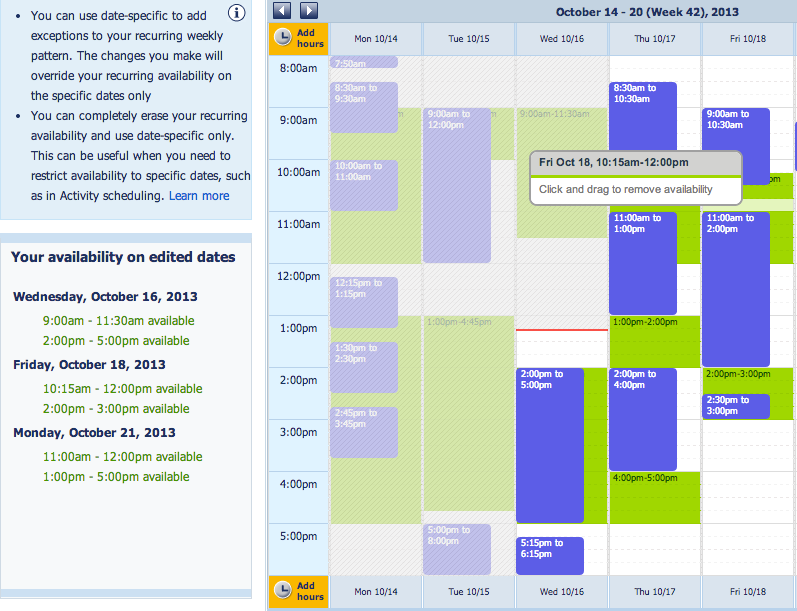
How my calendar looks to the scheduler. Blue is “busy” time from Zimbra via Gcal (this trumps available time). Green is available time that I can add to or erase by clicking and dragging.

I heard about ScheduleOnce on a recent friendfeed thread and made an account almost on a whim. “I’ll poke around and maybe set it up later.” Famous last words. It’s pretty nifty and lets me do pretty much all of the things I want, and some things I didn’t know I wanted. For example, I could set it up to send a reminder email to the student (maybe fewer no-shows?), and tell it how soon before the desired appointment time a student can book me. The one catch is that it’s made to work with Google Calendar, and my school uses Zimbra, so I had to import my Zimbra calendar into a google calendar (there are some limitations with this, but it’s better than nothing) and then tell ScheduleOne to look at the imported calendar for busy times (which required an upgrade to the $5/month plan). But if it works, it’s totally worth it to me.

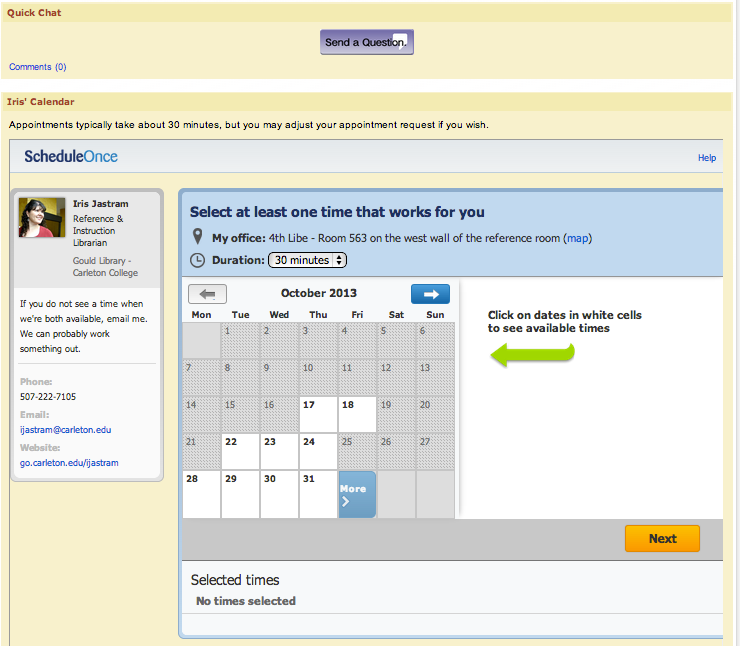
What my students see

After a couple hours of tinkering and testing and tinkering and importing and syncing and cursing Zimbra/Gcal quite contentedly, I embedded the scheduler page in my liaison page and thought I was done.

Then I remembered the “follow-up email” option in the scheduler that I had turned off. Who needs more email, right? Well, maybe people will give me some basic feedback if I ask nicely. So I hopped over to Google Docs and made a feedback form that basically asks two questions: “how satisfied are you” and “do you have follow up questions” (if yes, email me, because this form doesn’t collect any identifying information. Then I leave the traditional optional space to tell me more. Done. I added the link to a follow-up email thanking the student for the research meeting and telling them to email me if they have further questions, and I figured I was done.

But no. This made me think of the people talking about having students fill out forms embedded in libguides at the end of instruction sessions. I’ve done the “on the front of the notecard write something that was new and/or helpful; on the back write something that is still confusing or you’d like to know more about” kinds of exercises on occasion, and I’d love to do more of them, but I often don’t have notecards at the last minute. So I basically made that into a Google Form, embedded it in a page on libguides, and now I’m set to copy that page to any other guides I make. Tada!

And thus ends my morning of nerddom.

Update: 10/31/2013

This is going exceptionally well so far. I’ve done a few user error things along the way, but over all it has been such a help. Almost no futzing with calendars every day, and almost no back-and-forth emails with students about meeting times. I’m in love!

3 Comments

Discussing Discourse

If I could only be un-nervous and fully supported in my geekery in every class (by profs and students), they could all be as fun as last Tuesday’s class was. I’ve done similar things in other classes, but I often come out feeling like people were just kind of baffled by the crazy librarian who seemed really excited about… something.

Exploding a Reading
Exploding a Reading

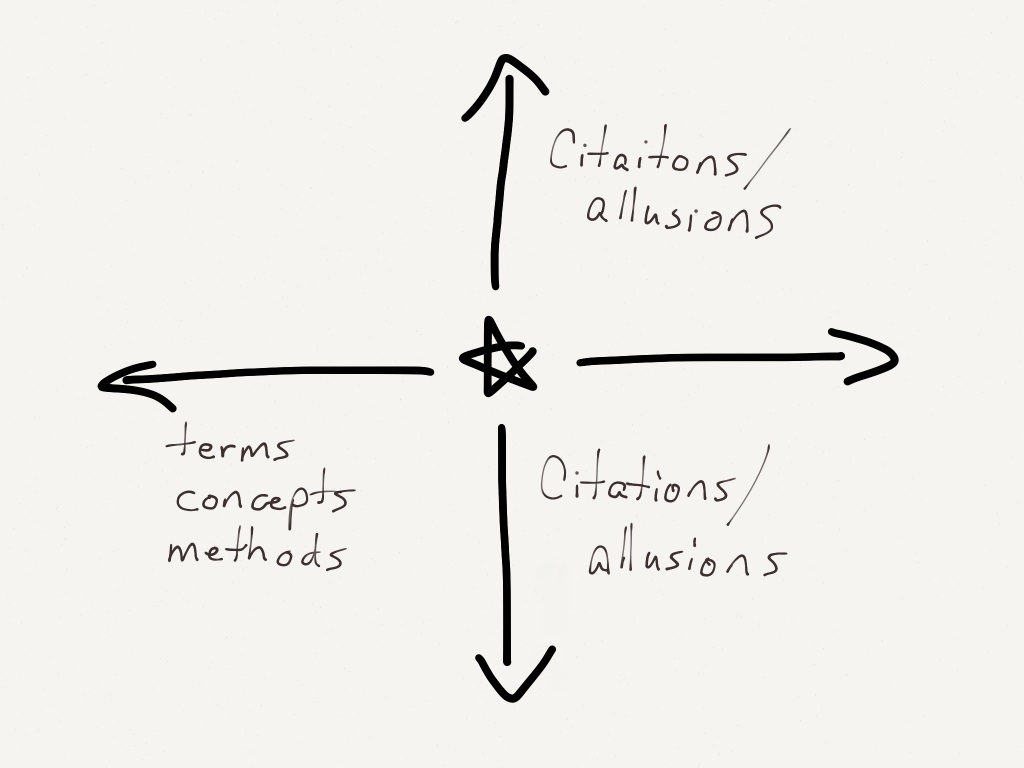
So last week was based on what I think of as a fairly standard class: exploding the article. Basically, you take any given reading. You figure out who the author builds upon (citations and allusions) to move backwards in time. You figure out who has cited the work (technically citations and allusions, but really the allusions are pretty hard to search for so you’re left with cited reference searches in Web of Science or Google Scholar) to move forwards in time. And you Read Instrumentally to figure out the language and methodology of this community of inquiry so that you can search for more people using similar language or methodologies.

For this class, the professor and I chose to explode the least explode-able of the day’s readings: and excerpted portion of a book theorizing the silences in history.* There weren’t any citations included, and the piece was difficult to begin with, so we thought this approach might help us all figure out his argument a bit by figuring out who he’s talking to and what his base set of information is.

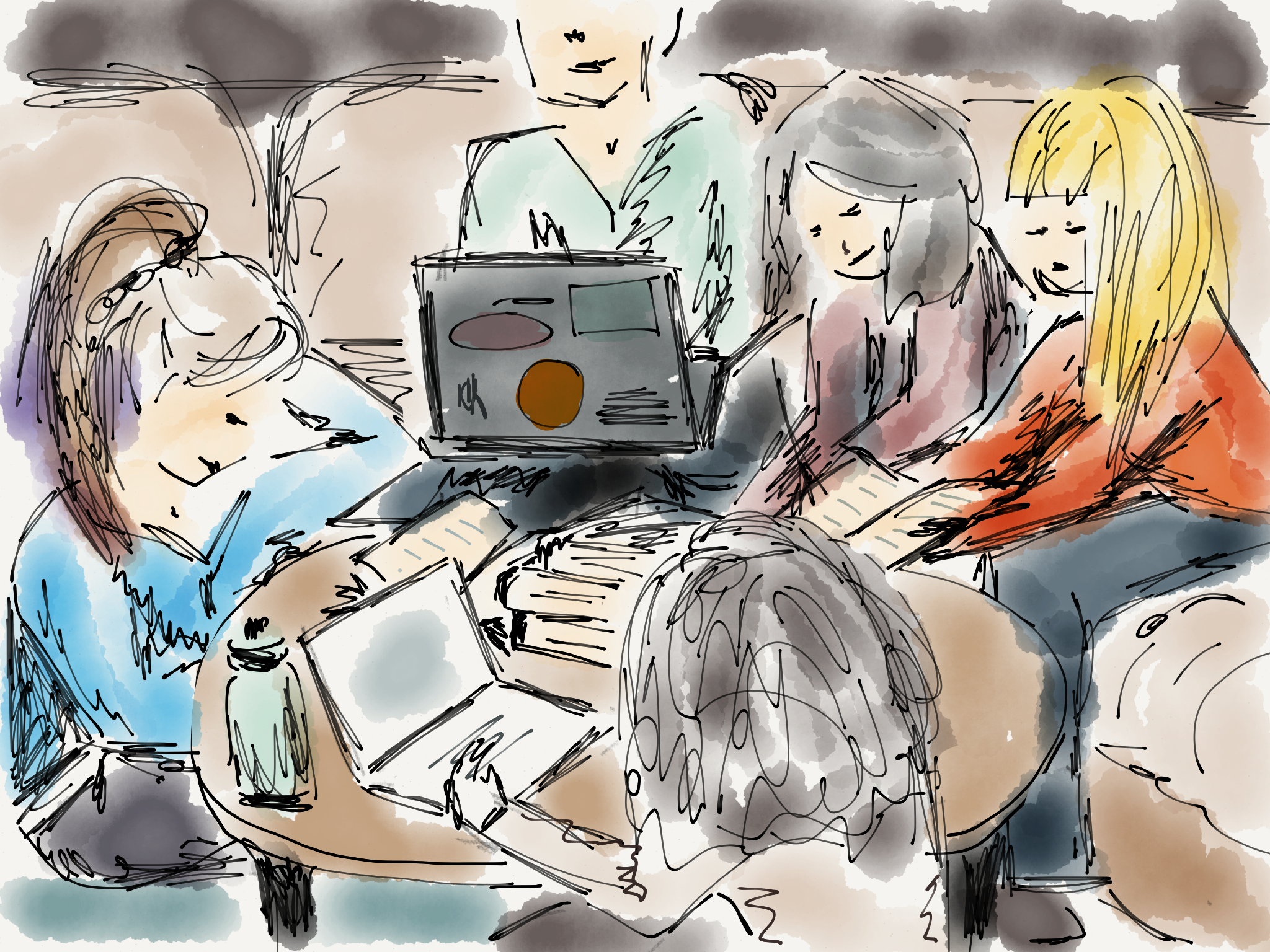
Our class that day, held in the student union.

We started out discussing what outside voices the author included in his argument (and I’d brought the un-excerpted version from the stacks just in case we wanted to track down any actual citations), but very quickly started talking about how hard the piece was to read. We agreed (heartily) that this had not been written for OUR discourse community. In fact, it seemed bent on keeping us at arm’s length.

Talking over what made us feel unwelcome in this author’s world helped us think about conventions that we’re used to in American Studies papers that help us understand what’s going on. Some of that is vocabulary, some of that is topic, some of that is the dreaded citation (which everybody hates but which everybody really missed in this work because they felt like he was just name-dropping or referencing things and then leaving us without context). Basically, we talked about how discourse is situated within a community, and that following the conventions (of vocabulary, method, acceptable evidence, and yes, even citation) makes readers in your community more at ease — more ready to think through your thoughts with you rather than write you off or give up in frustration. Every piece of the work, from vocabulary to argument, has to work together to move your reader from thinking what they already thinking to agreeing that your way of thinking is interesting and useful. Every piece should help your reader trust that what you’re saying is reasonable. If you don’t pay attention to the rhetoric, your message risks being discounted or simply lost.

* Trouillot, Michel-Rolph, “Silencing the Past: Power and the Production of History,” American Studies: an Anthology, Malden, MA: Wiley-Blackwell, 2009. 558-566.

2 Comments

What do I teach, anyway?

This morning I got an email from a librarian wondering what kinds of concepts I teach, particularly in 300-level courses, beyond how to search. As it turns out, that’s something I think about a lot! Here is what I wrote:

Well, I’m not sure I have much to add that isn’t on my blog already, so I’ll include a bunch of links here, but contextualize them a bit. And probably the closest I can come to telling you about 300-level courses is a four-part post on highest level course I teach before their thesis. Another class that I’ve written up is Critical Methods. These are both for the English department, but I’ve done very similar things for American Studies and languages. The concepts are pretty flexible, and I’m coming to think of them as some of the core info lit concepts for most non-laboratory research. They probably aren’t the ONLY concepts, but they may give you some ideas. Essentially, I have come to think of Information Literacy as being highly related to rhetoric, where the point is to participate as an expert insider within a discourse community, using evidence that makes sense within that community in ways that resonate with the community in order to add to the community’s understanding in some way.

Also, a concept that I flesh out and emphasize differently depending on the level (but which I teach more and more often due to the feedback I get and the research we’ve done) is a circular research process that appears in the middle of this post.
With upper level courses I emphasize that there is a ton of actual reading involved because they’re developing a sense of the scholarly conversation, mapping in out (here’s where mindmapping can come in), feeling out its boundaries, and learning its vocabulary. Sometimes we practice what I call Instrumental Reading and what Booth breaks down into three types of reading (in his Craft of Research, pages 91-96 of the 2003 edition).

And finally, I should say that I teach an awful lot about searching, but I frame it as if I’m not teaching searching, but teaching something more conceptual. Boolean and limiters and all those things come up with the examples we do together in class or examples I’m showing when I’m actually teaching them something else, and I’ll digress briefly to make sure everyone understands why I just wrote OR there before moving on. I say this just because when I first started moving away from “how to” teaching I felt guilty whenever I ended up showing those things, but now I think it’s the best way. The “how to” serves the higher order concepts, and they need both.

So that’s where I am right now in my teaching. I didn’t arrive here all at once, and I hope I’ll keep evolving and learning how to teach because there are a whole lot of rough edges yet. But for me it has been liberating and satisfying to think more and more about information literacy’s relationship to rhetoric and about the deep concepts that interest ME about information literacy. If I’m interested in what I’m teaching, I have a much better chance of interesting my students, and a FAR better chance of feeling fulfilled in my work.

~Iris
And since I’m a librarian at heart, here is a bibliography of my current favorite/formative readings on the topic.
  • Bean, John. Engaging Ideas. 2nd ed. San Francisco: Jossey-Bass, 2011.
  • Bennett, Scott. “Libraries and Learning: A History of Paradigm Change.” Portal: Libraries and the Academy 9, no. 2 (2009): 181–197.
  • Bizup, Joseph. “BEAM: A Rhetorical Vocabulary for Teaching Research-Based Writing.” Rhetoric Review 27, no. 1 (January 4, 2008): 72–86.
  • Elmborg, James. “Critical Information Literacy: Implications for Instructional Practice.” Journal of Academic Librarianship 32, no. 2 (2006): 192–199.
  • Elmborg, James K. “Libraries in the Contact Zone: On the Creation of Educational Space.” English 46, no. 1 (2006): 56–64.
  • Fister, Barbara. “Teaching the Rhetorical Dimensions of Research.” Research Strategies 11, no. 4 (1993): 211–219.
  • Harris, Joseph. Rewriting: How to Do Things with Texts. Logan: Utah State University Press, 2006.
  • Head, Alison J. Learning Curve: How College Graduates Solve Information Problems Once They Join the Workplace, 2012. http://projectinfolit.org/pdfs/PIL_fall2012_workplaceStudy_FullReport.pdf.
  • Kapitzke, Cushla. “Information Literacy : A Review and Poststructural Critique.” Australian Journal of Language and Literacy no. July (2001).
  • Kruger, Justin, and David Dunning. “Unskilled and Unaware of It: How Difficulties in Recognizing One’s Own Incompetence Lead to Inflated Self-assessments.” Journal of Personality and Social Psychology 77, no. 6 (1999): 1121–1134.
  • Leckie, Gloria J. “Desperately Seeking Citations: Uncovering Faculty Assumptions About the Undergraduate Research.” Journal of Academic Librarianship 22, no. 3 (1996): 201.
  • Lloyd, Annemaree. Information Literacy Landscapes: Information Literacy in Education, Workplace, and Everyday Contexts. Oxford: Chandos Publishing, 2010.
  • Norgaard, Rolf. “Writing Information Literacy in the Classroom: Pedagogical Enactments and Implications.” Reference and User Services Quarterly 43, no. 3 (2004): 220–226.
  • ———. “Writing Information Literacy: Contributions to a Concept.” Reference and User Services Quarterly 43, no. 2 (2003): 124–130.
  • Oakleaf, Megan. The Value of Academic Libraries: A Comprehensive Research Review and Report. Review Literature And Arts Of The Americas. Chicago, 2010.
  • Saunders, Laura. “The Future of Information Literacy in Academic Libraries : A Delphi Study.” Portal: Libraries and the Academy 9, no. 1 (2009): 99–114.
  • Shannon, Claude E., and Warren Weaver. “Communication Problems at Level A.” In Mathematical Theory of Communication, 9–12. U of Illinois P, n.d.
  • Simmons, Michelle Holschuh. “Librarians as Disciplinary Discourse Mediators: Using Genre Theory to Move Toward Critical Information Literacy.” Portal: Libraries and the Academy 5, no. 3 (2005): 297–311.
  • Wiggins, Grant P. Assessing Student Performance. Vol. 15. San Francisco: Jossey-Bass Publishers, 1993.
Leave a Comment

MindMapping for Research

It’s the beginning of a new academic year, and this year’s thesis students are starting to come see me in panicked waves. The meetings are intense and exciting and full of possibility and fear and anticipation. Right now we’re mostly trying to come up with a Plan rather than specific sources. Given your interests and given the kinds of resources we each know of, what would be both stimulating and researchable here and now.*

Lately, I’ve been mentioning mindmapping more and more often as students wonder how to figure out if they’re original enough, or how to figure out if they’ve created a stable enough grounding in the relevant literature. I teach it sometimes as a way to build good searches with useful terms, but this is different. Sometimes the student has a clear question in mind, and we can draw in supporting bodies of research. Sometimes the student doesn’t have a clear question in mind yet, and we can draw in the supporting topics first — the things where they say “I’m kind of interested in x and y and want to see if they’re connected with z,” and then fill in the spaces between the topics to find the question.

After a session this morning, I’ve realized that I teach four distinct forms of mindmapping to move students from the very preliminary topic questing through to the production of the final product.

Types of mapping

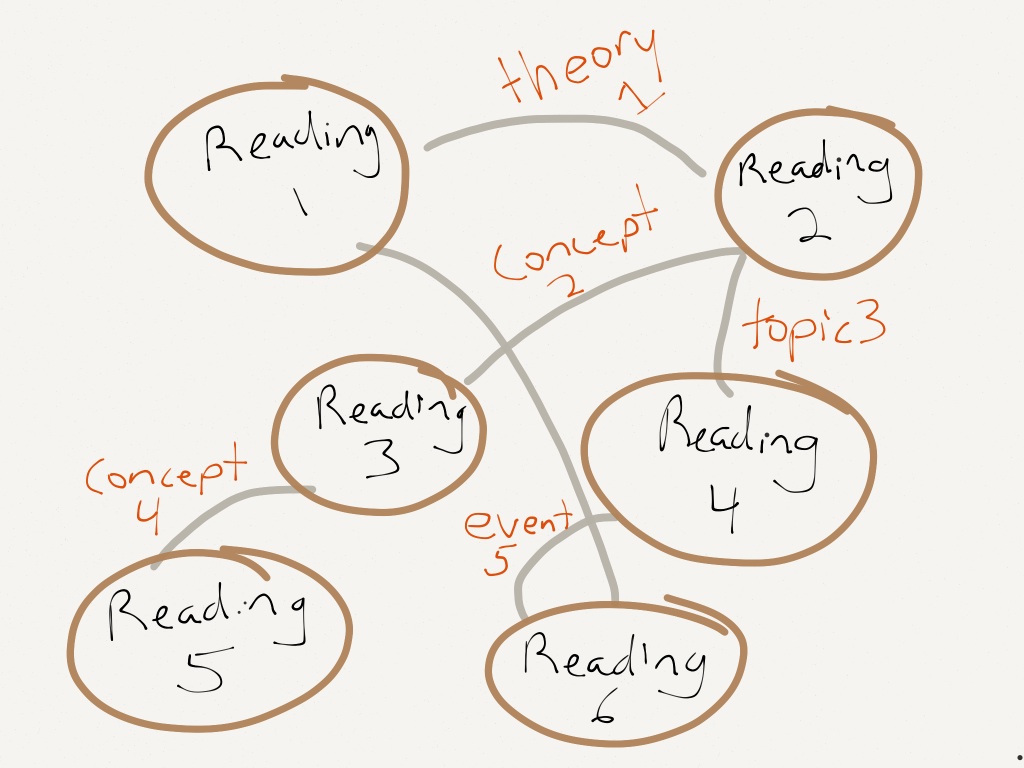
1) Mapping sources to find concepts (early stage of work)

For the early stages in topic selection, students often have vague ideas about topics but haven’t yet come to a point where they’re able to say what piece of the topic they’re going to concentrate on. They know they want to do something with the implications of fictional characters’ names, for example, but haven’t really figured out exactly what about the names to pursue or maybe even what fiction to use as foundational examples. But they’re really interested in race and culture, and they know that fictional characters have names chosen for them by authors, so there’s got to be something they can do that combines the two.

For this, some students find it very helpful to keep their broad topic in mind while reading/skimming several readings. Each reading becomes a node, potentially related to other readings, but not necessarily. The students can then draw connections between readings, using this process to discover the concepts that may be key to their own work.

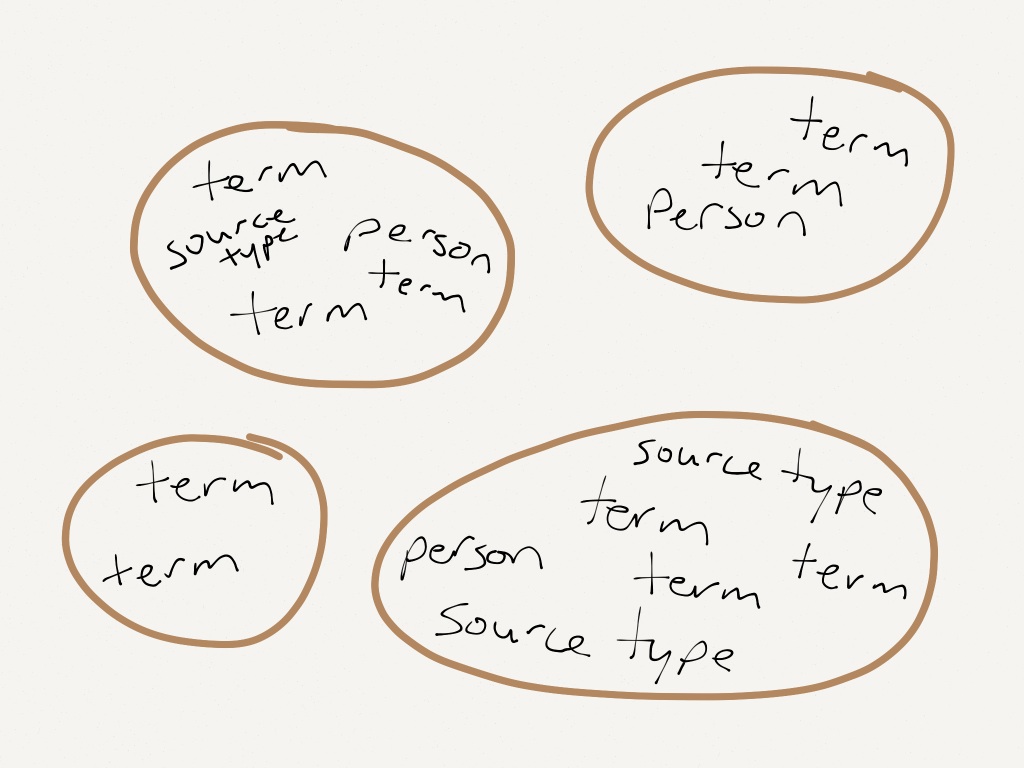
2) Collecting search terms and source type strategies

Another tricky part of early stage research, particularly in the humanities, is learning the vocabulary of your topic and learning what counts as evidence to the community of inquiry that you’re planning to enter. Unless you do these things, searching can be pretty impossible since it’s just term matching. If you’re using “self-concept” and your community of inquiry is using “identity” you’ll never retrieve the sources you need.

Similarly, if you produce an argument based on evidence that your community scoffs at, or if you need ideas for what kinds of sources would help you make explore your topic, watching what kinds of evidence show up in the literature can be a great strategy.

And of course, following up on people or institutions mentioned in the literature is another great way to build future searches based on readings you’ve found.

So for this kind of map, I have students think about their major concepts, and then fill in those concepts with terms, source type ideas, and people/institutions associated with that concept. These all become fodder for future searches.

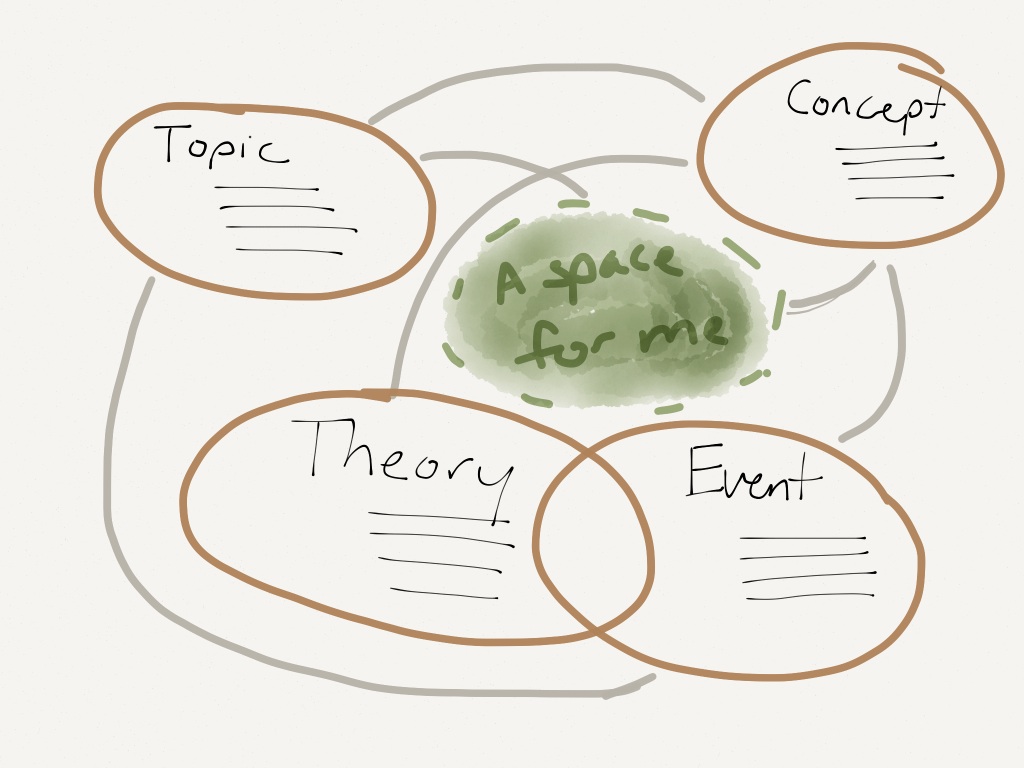
3) Mapping concepts to find your own question

Once students have solidified the core concepts of their work a bit more, they still need to figure out how to assimilate the source material into something that original rather than duplicating others’ work or simply patching together quotes from here and there. For this, a pretty traditional mindmap can help.

I have students plot out their key concepts and list the key sources for each concept (for students to did option 1, these can often be the labels they assigned to the connecting lines between sources — in fact, the whole map is like the inverse of option 1). This time we pay close attention to the spaces between concepts. Students can then see what has and what has not been covered by their source material and figure out what they’re adding to the conversation. “People have covered x, y, and z, but I’m going to take these parts of what they have said and add this new idea.”

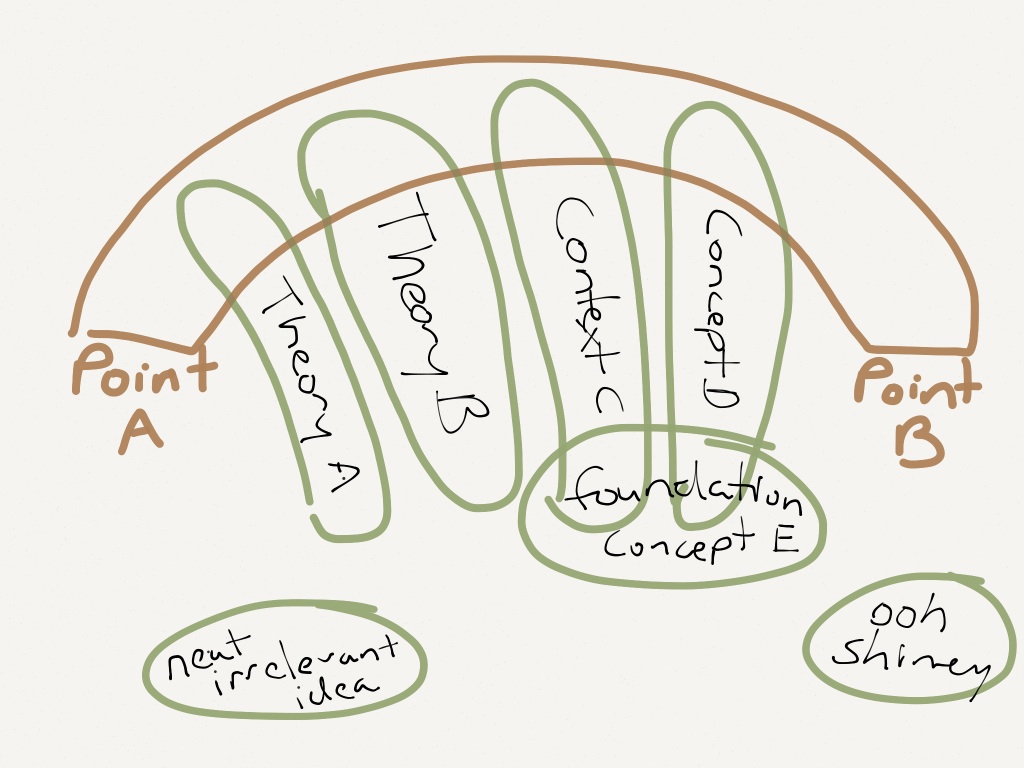
4) Mapping to test the completeness of your evidence

And finally, for students who are thinking critically about their work and want to be sure they’ve made a rock-solid case for their position, I have them think about building a bridge between themselves and their readers. Their paper is supposed to walk their readers from Belief A (the reader’s start point) to Belief B (what the student hopes the reader will believe after reading the paper). We start thinking “Well, they’d have to be on board with the assumption that x, and know about y event…”

Each of these concepts contributes a bit of itself to the students’ goals, forming one of the planks in the bridge the student is building.

It’s also a way to think about potentially interesting ideas that aren’t actually necessary to the paper.

Tools I use

Generally, if I’m working with students in a class setting or in my office, we do one of these types of mindmaps and we do it using whiteboards. Low-tech and potentially messy, but it gets the point across.

For myself and my own thinking, I do this kind of thing on paper if I’m thinking on the fly or if I’m not intending to use it as the basis for a long-term project. It’s faster and there’s something helpful in the tactile and kinesthetic activity itself — the sketchiness. (Now that I’m getting used to drawing on my iPad, I can imagine the pencil/paper version moving to the iPad from now on. Incidentally, I did the sample maps for this post using the iPad.)

If I’m doing a long project (where I know the map will get pretty big and where I’ll probably be rearranging nodes as my thinking becomes more nuanced and clearer), I use MindNode.

* Over the years, these meetings have grown from being (literally) introductions to the catalog and one major database in their field to being highly collaborative sessions where each of us brings our own expertise to the project of finding an interesting, original, and researchable topic. What a relief! There was nothing more demoralizing than covering such basics with thesis students.

3 Comments
css.php