Skip to content

Category: Carleton

Games in the Library

One of the first things I noticed when I came to MPOW to interview last spring was a table, four chairs, and shelves full of puzzles and games. It was all just sitting there, near the entrance to the library, inviting students to come and have a few minutes of fun in the midst of their work days.
Throughout the school year, it’s so much fun to walk past this spot and see students working on puzzles or playing Monopoly together.

This nook made a lasting impression on me when I interviewed, and I’ve seen it make similar impressions on prospective students. Now if I could just figure out how to make lists of databases this inviting… I can see it all now: students huddled over a computer monitor, fiddling with search parameters…

Yeah, the heat’s getting to me.

3 Comments

Set for Common Reading: Persepolis

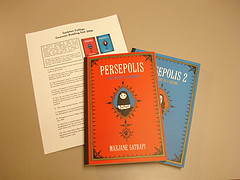
Each year incoming freshmen are assigned a “Common Reading” book, and one afternoon and evening of orientation are devoted to a presentation and many small-group discussions about that book. Each small-group is lead by a faculty or staff facilitator as well as a current student co-facilitator, and this will be my second time participating as a facilitator. Last year was a blast, and I have high hopes for this year.

This year, for the first time, the common reading book is in graphic form. We’ll all be reading “Persepolis” by Marjane Satrapi, and I just got my copies, along with some starter discussion questions. Time to start gearing up for incoming freshmen!

Leave a Comment

Noisy Libraries

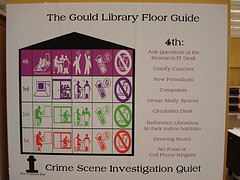
We’ve got a pretty noisy library at MPOW. At least, the part that I live in is pretty lively (when there are students around, which there aren’t right now, which is why I’m waxing nostalgic about noise). I don’t know who came up with the idea, but a couple of years ago they instituted noise levels on each floor and then furnished the floors according to the noise level.

Before continuing, you should know that our library is built into a hill, so people enter on the fourth floor and then work their way down to the first floor. This is lots of fun to explain to new students or lost parents. It reminds me of explaining the differences between catalogs and databases. It makes sense, but not much sense. In our defense, it makes a lot more sense than going into negative numbers, or sub-sub-lower-levels. Oh, and lest you think that these are basement levels, because we’re built into a hill every level has windows.

Anyway, on the fourth floor there are open spaces, grouped chairs and tables, all sorts of computers, printers, microform reader/printer/scanner/thingamies, circulation, reference and IT service (we call it the Research/IT desk), a huge smart board, couches, and lots and lots of noise.

Quiet Levels: 4th floor

On the third floor there are microform readers, a couple computer labs, our instruction room, some couches, tables, chairs, and study rooms. People talk, but not very loudly. The loudest noises are usually me teaching in the instruction room (my voice tends to carry when I’m teaching…) or the electric compact shelving beeping as students manipulate it or try to trap their friends in it.

Quiet Levels: 3rd floor
On the second floor there are tables, chairs, and study rooms. People talk, but they’d better have a good reason.

Quiet Levels: 2nd floor
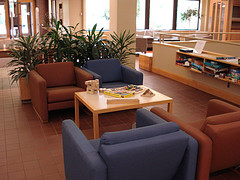
Then you get down to the first floor… As far as I know, there is only one area of comfy couch/chair seating. The rest of it is wooden. The seating is fitting of the floor’s quiet level indicator: “Monastery Quiet.” People have to want to study there, and study hard. Whenever a reference question takes me down there (usually to government documents), explanations get difficult because it’s almost physically impossible to make a sound down there. As soon as you enter the first floor, an invisible hand seems to clamp onto your throat. If a noise does manage make it’s way past your lips, students, pale from lack of sun (and food, remember no food allowed), glare at you in the certain conviction that they will fail their comps because you just interrupted their thought processes.

Quiet Levels: 1st floor
So that’s the story of our noise levels. It’s pretty self-enforced, which is great. But the best part is that there’s always someplace to which you can refer students who either want more or less noise in their study-life.
7 Comments

My Week Without Chaos

This week is my “Week Without Chaos.” The other librarians and I have been quite busy for quite some time, so our supervisor has given us each one week this summer to be at work, but not at work. We can close our office doors, take a laptop down to one of the study rooms, or do anything else that will help us get some uninterrupted time to complete whatever tasks we choose to complete. And this week is my week.

My Week Without Chaos

Up until today, this week hasn’t been all that different from a normal week. Four of my co-workers were preparing two posters to take to ALA, and I wasn’t mentally prepared to have basically no human interaction all day, so I spent portions of each day helping people with posters and handouts and whatever else they needed help with. This probably wasn’t what was intended, but that’s fine with me. After all, I was interrupting myself. I was in control of my schedule for the first time in quite a while.

But today… Today everyone but A and I were off to ALA. Today I took full advantage of my WWC. I took a laptop and my project out to the sumptuous red couch that has been tantalizing me all year. It sits in the center of the huge bank of windows in our reference area, and it lures students into its deep, soft suede cushions. They think they’re going to study there, but it doesn’t take long for the couch to exert it’s soporific powers.

Working Hard

Well, now that no students are around, that couch looked so lonely. I vowed that it wouldn’t get the better of me. I was stronger than the couch. If push came to shove, I could quit any time. And somehow, through sheer dint of will, I managed to stay awake all day. I sat on that couch and read my Immersion pre-reading. It was glorious. THIS is what a Week Without Chaos is good for.

3 Comments

Trading Card Buzz

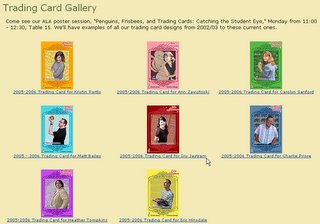
Wow! What a morning. I logged into my aggregator this morning to find that my library’s Librarian Trading Cards were featured on both The Shifted Librarian and Library Stuff! If you want to see the full run (different every year since 2002), they’ll be displayed as a poster at ALA. (I won’t be there, but six of my colleagues will.)


These cards were a blast to make (says she who didn’t have to build each one in Photoshop). And I’m really looking forward to making next year’s because when we made the current batch I’d only been working here for a couple of weeks and was still a bit hesitant about building some humor into the card. (Someone noted in a comment that only the guys have funny vulnerabilities. This is a symptom of having the concept evolving while the cards were already in production. When I was asked for information for the backs of the cards they hadn’t come up with the idea for vulnerabilities yet.)

Bigger Version of the Trading Cards
Oh, and my Libraries and Living Memories post got included in this week’s Carnival of the Infosciences (which is hosted by …The Thoughts Are Broken…). How much link love can one blogger stand in one day!!! This is quite the banner day for me, I tell ya.

5 Comments

Obvious?

This morning was the second of three mornings spent reading portfolios. I have to say, this could grow on me. We sat there at round tables reading paper after paper after paper. Every once in a while someone would giggle at a particularly humorous turn of phrase (some of these were even intended to be humorous). Every once in a while someone would ask those sitting nearby to help decide what grade would be appropriate, or what comments would be most helpful.

Two moments stand out for me. I read one portfolio by a student who was a very good writer… but he knew it a little too well. I couldn’t figure out how to write a comment that basically said “You’re a great writer, but try to humor your readers and pretend you’re not a god.” My favorite word of the entire day, though, came when I was reading the most incomprehensible piece of writing I’ve ever read. I was literally just looking to see if the sentences were complete because I couldn’t understand a thing that was going on. And then, in the midst of this, the writer started yet another incomprehensible sentence with the least perfect word possible: the word “obviously.” I burst out laughing, and (when I’d shown it to the other readers at my table) pretty soon my half of the room was laughing. Nothing was less obvious than the points the writer was using to support the argument, except perhaps for the conclusions the writer was drawing based on those points. (I’m still giggling as I write this…)

2 Comments

What Writing Can Teach Us

This morning was the first of three consecutive mornings that I’ll be spending reading the sophomore writing portfolios at my college. This is my first time reading such things, and I must say that it’s kind of daunting.

You see, each year, all the sophomores turn in three to five examples of their writing from their first two years of college. Each year, some time soon after school gets out, a whole bunch of faculty and some staff (all volunteers) gather to read hundreds and hundreds of portfolios over the course of three mornings. And this year, I’m included in this bunch of readers.

Readers volunteer for a number of reasons. They want to see examples of assignments from other professors. They want to re-calibrate their own grading by reading masses and masses of writing. They want to intervene with students who need help. And the list goes on. It’s really fun to see a bunch of people taking on a task that just has to get done, but rather than just do it they reinvent it as a powerful professional development tool.

I’m there because my college is thinking of coming up with information literacy benchmarks for first- and second-year students. So another librarian and I are helping to read the portfolios not only to help make it through the boxes and boxes of papers, but also to find examples of information literacy at work and see if we can generalize our observations to help us develop an assessment matrix or a first-year info-lit initiative.

So far, after reading only a couple of portfolios, I’ve learned that:

  • underclassmen don’t understand citation, but that they can do it if guided
  • they are happy to use outside sources, but the sources control the writer rather than the other way around
  • that they think of “fact” and “interpretation” as much more distinct categories than they really are
  • and that I’m a very slow portfolio reader (I’ll really have to pick up the pace tomorrow… it’s been a long time since I was a regular writing tutor and could do this in my sleep.)

On a somewhat separate note, I’m quite happy that I can walk into a room full of faculty members and not only greet and be greeted by name, but also carry on conversations with them about everything from libraries to pedagogy to gardening and not feel out of place. I’ve worked hard this past year to build this kind of relationship, and it’s finally feeling less I’m “just staff.” In fact, all the librarians have been working at getting involved in all sorts of things across campus, and now we’re beginning to be invited to meetings as less of an afterthought. Slowly but surely…

(The Pinky and the Brain song comes to mind…) Tee hee hee.

1 Comment

It’s a … CMS! (Isn’t it cute…)

After two years of deliberations, testing, talking, and not a little hair-pulling, my campus has finally decided to adopt Moodle rather than Sakai. This decision, which was made just about 20 minutes ago, is the culmination of weekly meetings for the last 10 weeks. I’ve spent literally hundreds of hours in the last couple of months sifting through surveys, usability studies, and pedagogical issues, and I can say with full sincerity that I’m very pleased with our decision. Sakai has so much potential but is just not as polished as Moodle.

I’m flying pretty high right now. It’s going to be quite a job to keep my concentration going today (yes, I am at work because my college doesn’t take today off), but I’ve got to just grit my teeth and do it. My presentation won’t organize itself…

Leave a Comment

Strategic Planning 2.0

After our rousing success with the vision statement meeting (posted on here and here), the entire library staff got together to discuss our three-year strategic plan. I’ll admit, I was worried. We’ve had a lot of meetings lately and it’s getting a little old. But we somehow managed to discuss the strategic plan for an hour and a half, make significant process, and not end up hating the process, our co-workers, or the plan itself. (The scones and fruit waiting on the staff-room table helped keep us all focused.) Note that this does NOT mean that I hope we have all-staff meetings every other week! However, if we do have all-staff meetings, they should be like this one and the visioning meeting. They were successful because there was something to do, a plan for getting it done, collective and collaborative work toward doing it, and we stopped the meeting when it was done. These simple rules should apply for all meetings, please!

What do I like so much about this strategic plan? Well, it begins with an introductory statement which grew out of our discussion about the vision statement. We were burning with enthusiasm for the growing role the library will play in collecting, organizing, housing, and aiding in the discovery of not only text but also data, images, media, etc. And we were very excited about providing access to content regardless of format. Unfortunately, this excitement originally eclipsed any mention of text and content. So our Strategic Plan, as it is drafted at the moment, tries to bridge the old and the new in a much more constructive manner. It also includes specific affirmations of experimentation, not for experimentation’s sake, but in response to user need and with the recognition that not everything will work as planned.

Here are some of the specific pieces of the plan that really struck me:

  • Experiment with new approaches to services, technologies, professional development, space, and furnishings to respond to user needs.
  • Experiment with tools and interfaces that move us towards the goal of seamless access to a broad scope of distributed information resources and customizable views of information space.
  • Secure grant funding to experiment with selection, acquisition, organization, and providing access to data, sound and image resources, and other digital content as needed by faculty and students.
  • Widen the campus discussion of the future of scholarly communication and publishing and help develop a better understanding of their implications for the role of libraries.

There are three pages of bullet points… but you get the idea.

Since this meeting, we’ve learned that our strategic plan will have to remain in draft form until next fall (yikes!) when it can be vetted by some departments that are too busy right now to look at it.

Leave a Comment
css.php