Skip to content

Author: admin

Get your applications in! The search is underway!

Come work with me! The search committee for our Reference & Instruction Liaison Librarian for Humanities and Digital Scholarship position is meeting soon to start reviewing applications, so get your application in soon. I’ve gotten a sneak peak at some of the job duties as I’ve been the interim digital scholarship person, and it’s really a neat area to be involved in on our campus. What started as an experiment is now growing wings, so it’s right at that interesting stage where there’s a lot going on and a great network of people to work with, but it isn’t a solidified program on campus so the new librarian will have plenty of room to move the program in interesting directions.

Also, you’d get to have a trading card made for you to match this year’s postcard theme.

Here’s the job ad:

Carleton College seeks a Reference and Instruction Librarian to join us in a lively, imaginative and team-based program of information resources and services. The library is committed to an intellectual partnership with the faculty in integrating information literacy into the curriculum of the college. Our information literacy program is linked to a college-wide initiative to address the basic literacies (information, quantitative, visual, writing, and speaking) that cut across the curriculum. Our digital scholarship work happens throughout the library and is done in close collaboration with colleagues on the faculty and in ITS.  We place a high value on a solid grounding in the world of scholarship, regardless of format.

This is an ideal position for an individual who is 1) looking for an opportunity to work in an institution focused on teaching, in collaboration with an unusually fine group of students, faculty and colleagues; 2) committed to excellence in teaching and to information literacy as a liberal art; 3) deeply rooted in and excited about humanities research; and 4) engaged in the methods of digital scholarship and its application to the liberal arts.

The full job description and application instructions can be found here: https://jobs.carleton.edu/postings/2456

Founded in 1866, Carleton is a private, highly selective liberal arts college with 1950 undergraduates located in Northfield, Minnesota, 45 miles south of Minneapolis and St. Paul. Best known for its academic excellence and warm, welcoming campus community, Carleton offers 37 majors and 15 concentrations in the arts, humanities, natural sciences, and social sciences. Carleton is committed to attracting and retaining a diverse group of faculty and staff and offers a comprehensive benefits package.

As they say in all the best commercials: Apply Today!

I’m happy to answer any questions you might have, or direct you to members of the search committee who can also answer questions. Or you can contact my department head (and search committee chair) Ann Zawistoski.

Leave a Comment
Big fun with small data

While I’m on shift this Sunday (during the most glorious fall day we’ve had, on a day that combines Family Weekend and Homecoming Weekend), I played around a bit with our chat reference statistics.

Our students have never really used chat reference much. In part this was our fault (we didn’t have a very friendly chat widget and we didn’t have the unlimited funds needed to have 24/7 reference service) and in part this was because on a small residential campus, the majority of the people who wanted help while we were on staff were already in the library. (That’s what students told us when we asked, and the data from this year bears it out by a slim margin.)  So last year we’d fielded three whole chat reference questions in the first four weeks of school.

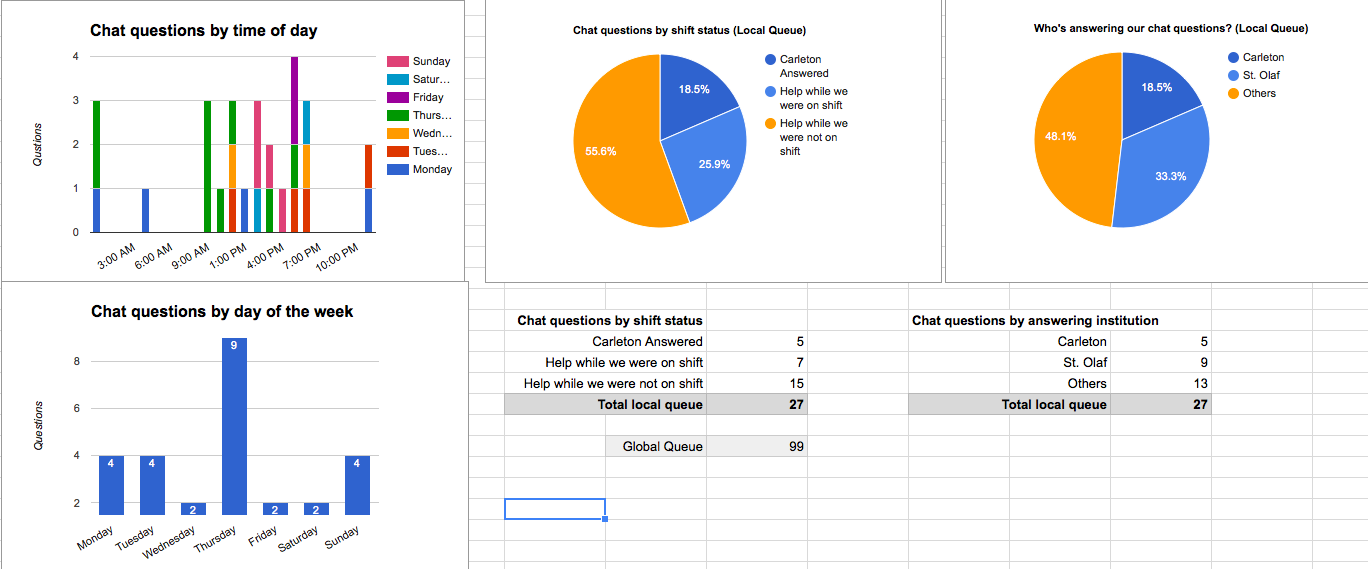
This year we’ve switched to QuestionPoint, which means we have 24/7 reference and access to a chat widget that looks a lot more like chat widgets people are used to seeing. Now here’s where the big fun with small data comes in. Because last year’s n was so small, I can say that this year we’ve had a 800% increase in chat questions. Woo!

If we’d changed nothing but the interface, we would likely have answered just the 5 questions that we have answered while on shift this term (66% increase), but the change in librarian coverage has made a huge difference. 15 of this year’s 27 questions were answered while we weren’t on staff, and another 7 question were answered while we were on staff but otherwise occupied. So that’s pretty cool. Usability and coverage FTW!

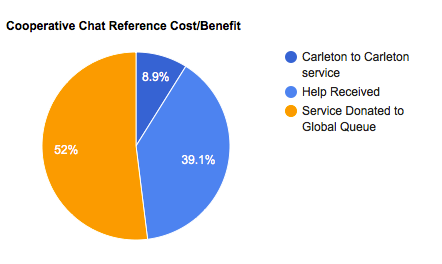
Updated to add: I was curious to see how the service is working from a cost/benefit perspective. We donate a specific number of hours per week based on our FTE, and it looks like the formula is working ok. We have answered 29 questions for other institutions, and between the help the collective has given us us and our own efforts, our patrons have gotten 27 questions answered.

2015-10-11_2246

Leave a Comment

Email List Politics: a brief local guide

I’m sure most campuses have a similar point of hilarity. On our campus, the hilarity has to do with mass email communication. There are three email lists that govern our lives: the one for all faculty, the one for all students, and the one for all staff.


On our campus, only the faculty and the Dean of the College’s office can email all faculty, only the Dean of Students’ office can email all students, and everyone can email all staff. So I’ve been in meetings where people say “Well, we’ll email all staff and they can forward it to interested faculty or students.” Meanwhile, the staff get the PDF newsletters from all the different departments, the special event notifications… basically, we know a lot about a lot of stuff on campus.

1 Comment

Silver Linings in Fair Use

The 9th Circuit just came out with a ruling that “copyright holders must consider fair use before asking services like YouTube to remove videos that include material they control” (quote from the NYT; Wikipedia also has a useful summary; and hardcore copyright nerds can read the full decision). So that is good news for the Fair Use side of copyright. 

Now, nobody knows exactly what “considering” fair use means, and the case will almost certainly be appealed. Still, this is a very interesting moment for copyright folks, YouTube and its ilk, and pretty much anyone who has ever had copyrighted material stripped out of their uploaded content for dubious reasons. As far as I can tell, music and movies are the two areas where fair use has been practically non-existent unless people have lots of money for lawyers and all their ducks in a row, so any hint that fair use is a real thing that applies to these kinds of content is pretty exciting to me.

And here, for your viewing pleasure, is the Dancing Baby… who is now at least 9 years old.

Leave a Comment

Managing Digital Humanities Associates, Week 2

Well, classes start tomorrow, and I meet my student workers for the first time on Tuesday, so the time to get organized is NOW.

Along with several more useful meetings with people who have information and training to share about current DH projects on campus, this week a few over-arching things fell into place. First, the computers that the students will use (and, oddly, the positions that the students fill on campus) were officially blessed as “ongoing.” This means that the ancient computer will get replaced sometime in the next few weeks, and the newer computer will be automatically up for replacement when it reaches 5 years of age. What a relief! As anyone can tell you, the state of the digital humanities and of technology in general could be entirely different in 5 years, but whatever happens, I’m absolutely sure that faculty will still be performing scholarship, and student assistants will still need technology of some sort to help support that. So for now, that piece of academia’s future on our campus is a little less shaky. Whew.

A second big falling-into-place was that the college’s post-doc in Digital Humanities, Austin Mason, and I sketched out a kind of syllabus for our student workers. Their work is so very academic that this approach made natural sense to Austin and me. They have to get some basic training, but even more than that they have to learn to think like digital humanists. So they’ll each have the their own projects, but our weekly team meetings will also give them a chance to brainstorm with each other, explore topics in the field, and present their work.  We’re also going to explore more conscious and consistent participation in the DH community by putting our thoughts and updates out there in the DH blogosphere rather than locking it down in a Moodle site. The DHA program already has a blog that needs some work, so one of our group projects is going to be to clean up the current structure, About Page, Bios, etc, and develop a coherent structure and look for our future work. Mundane or private things can be published privately, but we’re going to use the site pretty heavily for both internal and external communication.

Along with that, I’ve spent a few hours today setting up a workspace in Asana for us and linking it up to a Google Docs folder structure. There’s a Gdocs folder and an Asana project for every DH project we’ll be supporting, and I’ve built in regular recurring tasks to ask for documentation and project management, along with prompts about when to check in with me.

Of course, I still haven’t managed to secure a table to put in the room where we’ll meet and work. Tables are, apparently, worth their weight in gold on our campus.

Leave a Comment

Managing Digital Humanities Associates, week 1

So, I’ve had this new responsibility for one week now, and what a week it has been! And I haven’t even met the student workers yet!

One thing that I think might be a distinct advantage of having a newbie in charge is that it gives all kinds of stakeholders on campus the chance to articulate their understanding of what’s going on and what they see coming down the pike. It’s kind of like having an external review without the external reviewers or the reports or the expense or the… well all of it except for the useful things everyone learns when they have to say their assumptions out loud. Now, I don’t think that people were necessarily in different places before this week or that I’ve triggered any “ah ha” moments or anything like that. I just think that it’s incredibly useful as we get ready to make decisions about the future of digital humanities on our campus to have everyone take a moment and say “This is what has been amazing so far, this is where I see things going, and here’s the stake I have in that future.” I’m going to do my best to document these things for the new librarian, but I also know that when we do hire the new librarian that person will add his or her own facets to these conversations.

I’ve also learned (again) that grant funding is a double-edged sword. We had a grant on campus years ago that was awesome but then left us with all kinds of aspirations and assumptions on campus that are no longer supported or funded. One tiny piece of that is one of the two computers my student workers will use. It’s now too old to function well but was bought with grant money and therefore isn’t on a replacement schedule, so who’s going to pay for it? And can we get it on a replacement schedule this time around so the headache doesn’t repeat itself ad infinitum? These are questions I hope to sort out during week 2. Wish me luck!

I’m also learning that this venture shares a characteristic with many of the exciting campus-wide initiatives that I’ve been a part of or heard a lot about: it is fueled by lots of talent and enthusiasm from many quarters on campus, but it is not (yet) part of a cohesive structure on campus. There’s nobody who “owns” digital humanities on campus, so coordination isn’t as tight as it could be and funding for things like computers (see above) is kind of up in the air. Luckily, solving that is high on the agenda for several of the big stakeholders on campus. Hopefully we can figure out how to get all the benefits of a cohesive structure without losing any of the start-up like innovation of the current semi-structure. (My own view is that this future cohesive structure should actually coordinate and fund the Digital Liberal Arts, not just Humanities, but more on that another time.)

And finally, the breadth and depth of the projects this small but growing group of student workers has contributed to is pretty awesome. And the students themselves seem like they’re going to be quite a team to work with (though I really wish they were all equally good at responding to my request for their schedules). I hope that I can give these students the structure and support they need so that they can keep doing the work they’re so obviously good at doing.

Here’s a little video about one of the projects that the students have worked on in the past.

Leave a Comment

Taking on someone else’s job (or, Hey look, I’m in charge of the Digital Humanities Associates now.)

As of today, I find myself in charge of the Digital Humanities Associates on our campus, seven exceptional student workers who partner with faculty on digital humanities projects while they also help build the digital humanities conversation, community, and infrastructure on our campus. It’s a temporary assignment until we hire a new librarian, but it’s a weighty one for me. There are so many hopes and expectations riding on this program, so many practical and political, technical and interpersonal aspects. So much room for excitement, engagement, and success. So much potential for failure.

Dutch Boy and Dike
“The Hero of Haarlem” from Hans Brinker; or, the Silver Skates: A Story of Life in Holland, by Mary Mapes Dodge (1865)

My good friend and outstanding colleague Heather Tompkins built the program from scratch (not alone, of course, but centrally important), and now she’s moved on to work her magic at St. Kate’s. Walking up to work this morning, everything felt slightly unreal, slightly fractured, as I realized that there’s a Heather-ish hole in our library now, and that I’m supposed to be able to patch one portion of that hole – keep the dike from bursting – while doing some semblance of justice to Heather’s vision for the DHAs and the digital liberal arts at Carleton.

Taking over from someone who has built a program from scratch is a daunting thing. You’d think that with a young program, now entering its fourth academic year, it’d be easier to pick up and move forward. There’s less history to learn, for one thing. But with less history comes fewer people who know that history who can support you as you find your way, more things that lived solely in one person’s memory, fewer stable pieces of infrastructure to cling to.

So today I’m going to pour over the documentation and notes that Heather left for me and the notes I took while she told me about her work, and I’m going to begin the process of wrapping my head around this new project.

Leave a Comment

Come work with me!

Photo by  Brenda Gottsabend
Photo by
Brenda Gottsabend

Have you been wanting to come work at Carleton? Here’s your opportunity!

The library at Carleton College seeks a Reference & Instruction librarian to join us in a lively, imaginative and team-based program of information resources and services. The library is committed to an intellectual partnership with the faculty in integrating information literacy into the curriculum of the college. Our information literacy program is linked to a college-wide initiative to address the basic literacies (information, quantitative, visual, writing, and speaking) that cut across the curriculum.

This is an ideal position for someone who is 1) looking for an opportunity to work in an institution focused on teaching, in collaboration with an unusually fine group of students, faculty and colleagues; 2) committed to excellence in teaching and to information literacy as a liberal art; and 3) deeply rooted in and excited about interdisciplinary or area studies. We place a high value on a solid grounding in the world of books and scholarly information.
The full job description and application instructions can be found here: https://jobs.carleton.edu/postings/2383
If you have any questions, feel free to contact either me or the Head of Reference and Instruction — we’re both on the search committee and happy to talk to you about the position. My contact information is here, and Ann’s is here.
Edited to add: Some people have asked if we are deliberately looking for entry-level librarians, and the answer is that we are deliberately NOT restricting our pool to only people who have a specific amount of experience. If you would like to come work with us, please apply!
Leave a Comment

Leveling Up on Chat Reference

Our library recently joined AskMN, the Minnesota cooperative of OCLC’s global QuestionPoint service. On the one hand, this is extremely exciting. We get to donate a few hours per week to the “global queue,” answering questions that people at other academic institutions ask but whose own librarians are either busy or gone for the day. In return, we get 24/7 chat reference service for our patrons provided by the cooperative. Pretty sweet deal!

On the other hand, the experience of providing chat reference services to people I can’t see at institutions I don’t know has been a nerve-wracking and humbling one for me so far. The institutions in the cooperative leave us a cheat sheet of sorts, so we know their link resolver information, their loan rules, etc, so we’re not totally flying blind, but some schools provide more information than others, and some schools have very few resources available in the first place. So every time I hear that “ding” that tells me there’s a new patron waiting in the queue my heart races a little bit, my hands get a bit sweaty, and I’m thrown right back to my very first days staffing reference desks where every approaching patron was simultaneously a thrill and a terror. Will I be able to figure this out with the patron? Will they lose all respect for me if I take a wrong step along the way? The chances of failure seem so very high. Each success is its own day-making victory. And no matter how many successes I have in a week, they all seem to get categorized in my brain as the exception to the rule that I’ll probably fail the next person.

I’ve tried various strategies during my shifts. “I’ll pick up questions that I pretty much know I’ll be able to answer without trouble” didn’t last long. There aren’t many of those, and I don’t want to be a bad colleague and leave everyone else to answer all the questions while I sit on the side being scared. Also, if you take too much time to read and think about the answer before picking up the question, another librarian will swoop in and get it. Or rather, they’ll pick up the ones you wish you could have picked up while the super convoluted questions sit there and sit there, taunting you, explaining your guilt and fear to you in minute detail.

“I’ll pick up any question, without even looking to see what the question is first” also didn’t last long. Basically, I couldn’t make myself do it more than a couple of times because frankly, I’m not a terrific data librarian and that happened to be the subject of one of the first questions I got under this new resolution. Luckily “refer to patron’s institution” exists in QuestionPoint!

Today as I took what I know about databases in general and how they interact with EndNote and slowly, slowly walked a patron in Connecticut through importing references from a database I don’t have and can’t see into an EndNote installation I also can’t see (we did it! Victory!), I realized three things:

  1. The bedrock basics of reference work is the same — even though I feel more like I’m working alone than I do when I’m at our physical reference desk, and therefore more pressure to get the question answered thoroughly all in one shot, I’m actually still conducting the same pattern of work: “Let me get you started, at least, and then set you up with an expert afterwards if needed.” I need to remember that.
  2. Just like in face-to-face reference, a lot of customer service has to do with being good natured and generally cheerful, even if you have NO idea what’s going on (and it turns out that the patron has been secretly clicking on something you didn’t realize he would click on, especially since you said to click on something else, and THAT’S why he keeps saying he doesn’t see what you’re seeing). I always say my job is about 90% bluff (“SURE I can help you find that thing I’ve never heard of…”). The same is true online. I need to remember that.
  3. I really love face-to-face reference in a library I know well. But I can do it other ways too. I need to remember that.
6 Comments

Emergency Planning For Safe Learning Environments – ACRL 2015 – Links and Handouts

As I mentioned before, my coworker Kristin and I presented a workshop at ACRL 2015 on emergency planning for libraries. The idea was that there are all kinds of things that libraries or individual groups within libraries can do to be more prepared for disruptive circumstances, many of them are even very simple.

The workshop proved to be an action-packed 3 hours featuring a cast of wonderful participants. I learned a lot, and I hope they each came away with something useful. If you want to see our materials, we shared all of our handouts here http://bit.ly/1E7Sl7L including example copies of an emergency plan and a set of scenarios to use if you’d like to conduct a lively and informative exercise with your colleagues.

Happy planning!

Leave a Comment
css.php