Skip to content

Author: admin

A practical guide to the 2016 Georgia State eReserves Copyright Case for Librarians

Wikimedia Commons
Wikimedia Commons

The academic library world has been watching the Georgia State (GSU) eReserves copyright lawsuit with interest for half of my career, and now there’s a new ruling in the case. On the one hand, I recommend reading the ruling because there’s interesting language in Judge Evans’ Fair Use assessments for each item at issue, and every time I watch someone who knows a lot about copyright go through the four factor test I learn a little bit more about how I might apply it in my own work. On the other hand, it’s 220 pages long, so there’s that.

Oh, and another thing, I’m not a lawyer and don’t even play one on TV. I’m just a librarian who takes an interest in copyright but has no legal advice to give.

History of this case

In case you’ve forgotten how we got to this ruling, Cambridge University Press and a few other publishers sued GSU over book chapters that had been scanned and loaded into GSU’s eReserves system, 99 items in all, of which Judge Evans ruled on 74. The first ruling in that case was back in 2012 by Judge Orinda Evans (and I wrote a Practical Guide here). The publishers weren’t particularly thrilled with the outcome, so they appealed the case, and the appellate court handed down a ruling in 2014 that sent the case back to Judge Evans with instructions about how to amend her item-by-item Fair Use analyses (and I wrote a Practical Guide here). This Judge Evans has now done for the 48 items that the publishers thought were still at issue, resulting in the 2016 ruling that came out on March 31st. If you’re interested, here are all the details and filings involved in Cambridge University Press et al. v. Patton (this case’s official name).

One of the main things that the appellate court asked Judge Evans to do was a much more thorough analysis of the “Market Effect” (Factor Four), delving into year-by-year sales and permissions licensing fees to see what the effect of unpaid nontransformative copying really might have been on those two markets. This plus the appellate court’s insistence that there should be no “mechanistic” Fair Use analysis means that the new ruling isn’t very generalizable to on-the-ground decision-making in our libraries and classrooms. Still every new ruling helps to clarify the boundaries of Fair Use, so this one is still worth paying attention to.

In this case, of the 48 items under consideration, 4 were ruled to be copyright infringement, and all of these 4 had previously been ruled infringement in the 2012 version of the ruling. Interestingly, of the 48 items, only 2 decisions changed as a result of the appeals process:

  1. One item had previously been rejected because the publishers hadn’t sufficiently proved that they owned the copyrights in the first place. This one was now ruled to be Fair Use, so the publishers must have provided that proof at some point.
  2. One item had previously been ruled infringement, and this time it was ruled to be Fair Use.

If you’re a real nerd, here’s a spreadsheet I made to track the item-by-item analysis and compare their outcomes between 2012 and 2016.

Highlights of what librarians should know

  1. This ruling makes it clear that there is no transformative nature to eReserves. Judge Evans says, “the excerpts are nontransformative because they are mirror-image copies of a part of the book” (page 5). I’ve heard some people wonder if readings like this might be transformative for various reasons including presenting only excerpts in juxtaposing items in ways the original publishers didn’t intend. This ruling makes it clear that rearranging how students experience the readings is not a transformative use.
  2. Because the copying was nontransformative, Factor Four (the “Market Effect” factor) was given the majority of the weight in the Fair Use analyses for each item.
  3. GSU’s status as a non-profit educational institution, and all of this copying done in the service of teaching, Factor One (the “Nature of the Use” factor) always favors Fair Use. One useful thing to note is that the professors in the courses were questioned about exactly how each of the readings figured into their courses, and this information informed both Factor One and also Factor Three, the “Amount and Substantiality” factor. If the amount copied was “narrowly tailored” to the professor’s pedagogical goals (see page 22 for example), that helped tip things toward Fair Use.
  4. For each item, two markets were considered: the market for sales of the full book, and the market of permissions fees for the book chapter(s) when available. The publishers worked very hard to make it look like if there are licenses available for the chapters, then faculty and librarians should pay those fees almost without thinking. Nancy Sims (J.D., M.L.I.S.) and Kevin Smith (J.D.) strongly advise the opposite. Smith’s contention is that there will only be a market for those licenses if we pay for the licenses all the time. If we don’t pay for the licenses unless we really have to, then there’s no market to effect. I think what he has to say on the matter warrants a nice long quote:

    “We should resort to paying for licenses only very rarely, and when there is no other alternative.  The simple fact is that the nature of the analysis that the Court of Appeals pushed Judge Evans into is such that licensing income for the publishers narrows the scope for fair use by libraries.  To my mind, this means that whenever we are faced with an e-reserves request that may not fall easily into fair use, we should look at ways to improve the fair use situation before we decide to license the excerpt.  Can we link to an already licensed version?  Can we shorten the excerpt?  Buying a separate license should be a last resort.  Doing extensive business with the Copyright Clearance Center, including purchase of their blanket campus license, is not, in my opinion, a way to buy reassurance and security; instead, it increases the risk that our space for fair use will shrink over time.” (emphasis mine)

  5. At the appellate court’s demand, Judge Evans was directed to pay careful attention to Factor 2 (the “Nature of the Work”) factor. This is the factor where if the item is creative, that makes copying less fair, and if it’s not creative, that makes copying more fair. (At the extreme, lists of phone numbers in the phone book are not creative enough to be copyrighted.) Some people have painted this with a very broad brush and said that fiction is creative and non-fiction is not creative. That’s obviously not nuanced enough. It was really interesting to watch Judge Evans evaluate each excerpt looking at writing style and whether the author provided opinion or evaluation. One item’s analysis on this factor ended with, “Author opinion, subjective description and evaluative expression dominate. Factor two disfavors fair use” (pages 36-37). Only 2 of the 48 items in this case came through with a “favors fair use” on Factor Two. The other 46 were either neutral or disfavored fair use.
  6. Given all of this, but #3 and #5 in particular, it was reinforced for me how important it is that the faculty member do the fair use analysis before putting things on eReserve. There’s no way that library staff would be able to carefully weigh the four factors without reading the works and knowing exactly how they will fit into the syllabus.
  7. And finally, I really appreciated Kevin Smith’s point that since very little of the Market Effect analysis is possible without court orders, making Fair Use decisions in “Good Faith” becomes all the more important. That way employees of non-profit educational institutions or libraries are not subject to statutory damages. (And I would add to his point that keeping records of these good faith decisions is very important.)

Further Reading (by people who know more than I do):


2 Comments

Searching and Browsing: Lessons for Life from Libraries

Our campus is in the midst of moving from one email/calendar solution to another, and from local network storage to cloud storage. (Specifically, we’re moving from Zimbra to Gmail and Google Calendar, and from local network storage to Dropbox — we already use Google Drive but it doesn’t fill all the needs in the file storage area.) So all of a sudden there’s this moment where the campus gets to/has to think about individual and departmental practices and figure out if these processes can or must change during the transition. (Personally, I totally geek out on these kinds of conversations, but you’re not surprised to hear that, I’m sure.) Tucked into these conversations, there’s a topic in which two very entrenched camps face off: Do you rely on search to find your email or files? Or do you rely on a folder structure? In library terms this comes back to the age old balancing of search vs browse.

Here’s the thing (and take it from a librarian, because we’ve built a whole profession on this over many many many years) most people cannot rely only on Search or only on Browse. Most people need to have mechanisms that allow for both.

Here’s why. Search relies on there being the right letters-in-a-row in your query, which the computer then matches to the letters-in-a-row contained in the items it indexes or in the metadata associated with those items. If there’s a misspelling, if there’s more than one word for the thing you’re searching on and the other person used the other word, or if there’s no built in metadata for the type of thing you’re trying to gather, search will fail you. Search will be useful in many ways and may even be your primary entry point into your saved emails or files, but it is not sufficient.

This means that there also have to be mechanisms that allow for smart browsing. In email and file storage, these mechanisms are folders or tags or labels or whatever. In library catalogs these are subject headings and call numbers. These are the things that get applied in a consistent way to say “all of these messages are related in a meaningful way, regardless of the keywords and metadata.” It would take too much time to make everything browsable in all possible ways, so Search is also important if you have anything more than a very few emails or files. So Browse won’t work all the time, but it is important.

For me, it’s important that I have a way to browse just the emails between me and my students because I really can’t remember all the names of everyone who meets with me, or what words we used in our emails, so if I want to be able to go back to a conversation the only thing in my head that I can use as a hook to go back into my email and pull relevant messages out is “student.” So I created a folder for that. I have similar folders for major projects where I know I’ll need to skim back over information that I can’t gather together through a search. The same principle governs my folder structure on my computer.

For me, I rely heavily on search, especially for email. Probably 85% of my email goes into the main archived email bin without being tagged or put into a folder. But I’ve searched for enough things in my life that I know for sure and certain that it won’t solve all my retrieval needs. Browsing is also critical.

And just for a few more thoughts on organizing your stuff, here’s an archivist talking in simple and useful ways about using her professional training to help her with her computer files. Enjoy!

Leave a Comment

Spring Term 7th Week Burnout Blues

Carleton doesn’t have semesters or even quarters, we have terms. Each term is 10 weeks long, and there’s Fall, Winter, and Spring term. The week numbers of each term matter so much that at the end of every spring term I look ahead to the next year and enter “Week 1, week 2, week 3…” as events on the Monday of each week for the next year’s terms. Week numbers matter more than months or dates or days of the week. Classes start on the Monday of Week 1 and end on the Wednesday of Week 9. Then there are two Reading Days, and then finals run on Saturday, Sunday, and Monday.

Right now we’re at the beginning of 7th week of Spring Term, and it feels like we’ll never survive through to graduation next month. On top of that, it’s been a crazy intense year+ that’s left me burned out and used up. Apparently powering through Chronic Fatigue Syndrome while juggling a ton of extra work, a few massive transitions, plus all the normal intensity of this job only works for so long. The fallout is starting to show up in medical bills and mental anguish.

So how do I turn it around? I like my coworkers and don’t want to let them down. And I’m pretty sure that when I step out of my own head I actually still believe that the work matters. And then there’s the mortgage, which probably won’t pay itself. I want to get back to liking my job. I want to get back to liking me in my job.

2 Comments

What does a reference & instruction librarian do all day?

I remember wondering what a reference librarian did all day back when I was interviewing for reference librarian jobs. I’d been an on-call/fill-in librarian at a public library, and I’d been a part time librarian at a small university, but I still couldn’t quite imagine what these jobs would be like in their full-time versions. Would I get bored waiting for people to ask me things? Or would I be swamped with reference questions and never get to do anything else? I was actually kind of worried…

Every so often I get interviewed by library school students, and usually one of the questions amounts to “What do you actually DO all day?” Since I just wrote this down for one such student yesterday, I thought I’d post my response here as well. It’s a pretty brief and general response, but if you’re curious, here’s a sketch of what I do all day.

Typically, my work divides up into 4 categories. First and foremost, there’s the liaison work, which involves meeting with faculty and students about their research needs, teaching classes, creating research guides, helping to staff the reference desk, and doing my best to keep up with both the pedagogical and the research trends in my departments. As one of a team of liaisons, another component of this work is to help steer people to their liaison when issues around library support and information literacy (practice or pedagogy) come up in random conversation. We’re always advocating each other’s work in this way.

Then there’s the work I do as part of the library as an organization. This involves participating in committees, task forces, and collaborations having to do with the running of the library or our work with St Olaf (we’re in a highly collaborative consortium together). For me, this work often revolves around areas like digital humanities support infrastructure, public service coordination between the various public services in the library, and coordination around the publicly available technology in the library. Other librarians have their own areas of expertise, but we all have work of this nature which is more internal to the library.

Then there is the work that I do as a member of our campus community in general. For me this involves working on the campus’ copyright committee, helping to coordinate the various support entities on campus that support digital humanities, collaborating closely with the Writing Center and the campus’ Academic Technologists, and (currently) serving on an implementation team for the college’s transition from locally hosted email and file storage to gmail and dropbox. Other librarians here have their own versions of this list, but we all get drafted into roles like these where our knowledge of information literacy and our relationships with the faculty, staff, and students on campus are called upon in service of a non-library project or function.

And finally, squeezed in as there’s time, there are professional activities that stretch beyond our campus and consortium. For me, this includes participating in an active online librarian society called the Library Society of the World, participating in local library networks, helping to edit an OA library journal called the Journal of Creative Library Practice, blogging here and there, and the occasional presentation or publication.

So there’s a sketch of my work. I like that at a small college I get to do more than one thing, and I like that the main theme of my work is working with people to help them solve problems and get around barriers. Most of my work, most of the time, is about enabling discovery and trying to find the best solutions to messy problems. And most of the time I get to do this work with engaged, inquisitive, smart people. Not a bad way to spend a career, I say.

4 Comments

Most fun instruction sessions ever

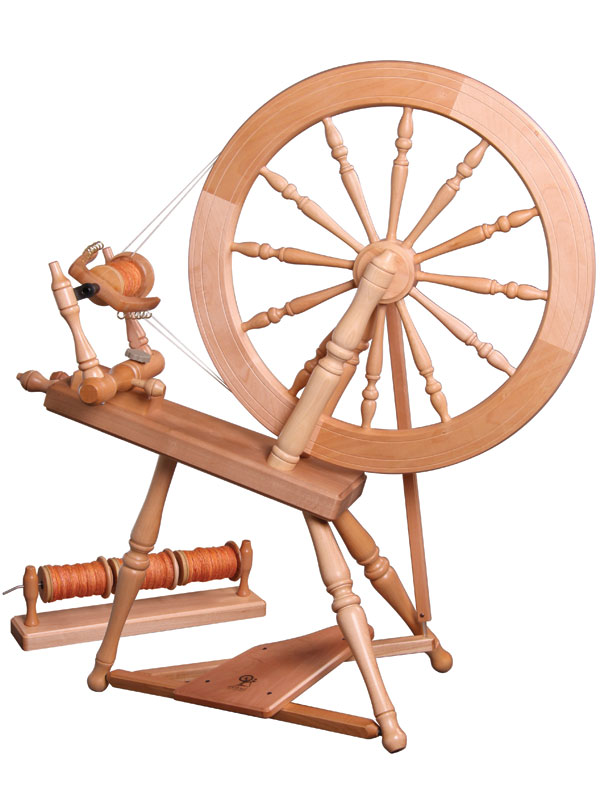
This is my wheel, plus the "lazy kate" to hold the bobbins for plying.
This is my wheel, plus the “lazy kate” to hold the bobbins for plying.

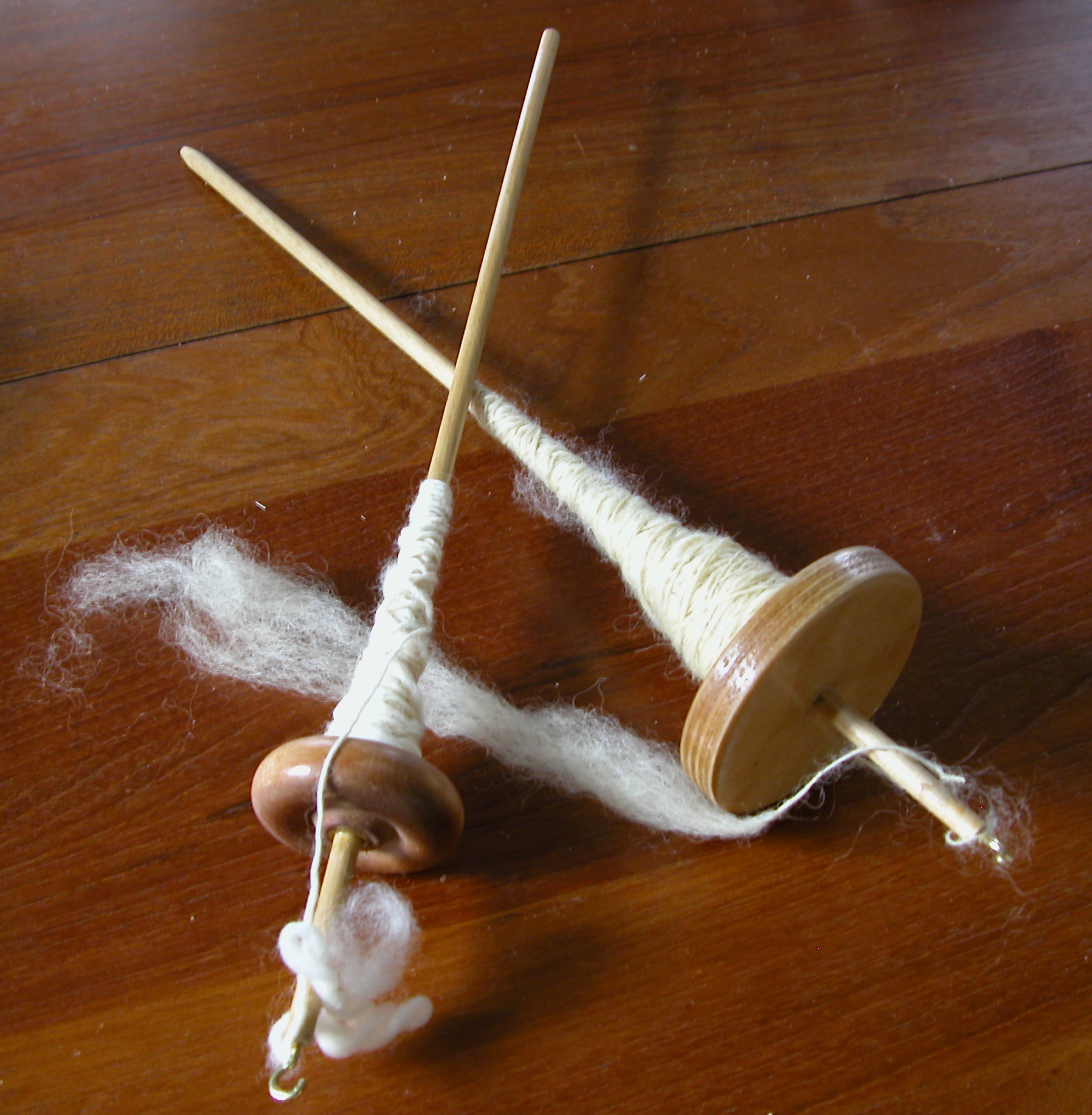
Last week and this week I got to expand my repertoire of class sessions into very new territory. I got invited to a class on early Anglo-Saxon material culture to demonstrate making yarn using a drop spindle and to talk about using that homespun yarn for weaving. And later I got invited to another class studying 18th Century English Workhouses (where the residents did a lot of spinning), to demonstrate making yarn with a treadle spinning wheel and then talk about knitting and weaving with that yarn.

Such fun! I got to use words I’ve never used at work before, like “lazy kate” and “niddy noddy.” Students got to try their hands at spinning with the wheel and the drop spindle. And the one down-side was that I hadn’t oiled my fly wheel recently so there was an annoying squeak. Oh, and that my nephew has hidden my orifice hook, so I had to use a crochet hook to thread the wheel. (Somebody needs to think of a better name for the orifice hook.)

I also got to tell them about sitting with an angora rabbit on my lap and spinning directly from his coat. (And also the other rabbit that hated me and would NEVER sit still for such a thing.) Such a different set of things from the things I normally tell students, and they were soooo much more interested in what I had to say. Database searching is never this fun!

One student in the Workhouses class is building a game scenario in which the gamer “spins” using the space bar as a treadle and some other keys as the hands working with the wool. He needed to know about treadle technique and timing, and he also timed me spinning so that he knew how many inches of yard I can produce per minute.

Next week I’ll rejoin the Anglo-Saxon class to do my demonstrations as part of their end-of-term project: a sort of pre-renaissance fair with demonstrations of all kinds of early Anglo-Saxon material culture. I might even get my very own apprentice.

Example of drop spindles

There was a lot to love about being involved in these classes, but one of my favorite things was that these were heavily digital classes, working with 3D modeling and game design, and here I was doing the farthest thing from digital work I can imagine — making yarn from sheep’s wool. The juxtaposition was delicious.

Leave a Comment

PSA: “Instructional Use” is not a Thing

Wikimedia Commons
Wikimedia Commons

One of the most common things I hear when talking to people, especially faculty, about Fair Use is “But this is an instructional use, so it’s ok, right?”

Instructional or Educational Use is not a uniquely determinative thing in copyright. It just isn’t. It would be so educationally useful to post all those PDFs to a website so that people without library access could read them, but being educational isn’t the only litmus test. I really really wish it were because I’m pretty much in favor of opening up information as much as we can to as many people as we can, but Fair Use isn’t about re-publishing stuff, it’s about making use of stuff.

Now, in-classroom use, THAT is a thing in copyright that doesn’t get enough air time. Section 107, the Fair Use section says that reproductions “including multiple copies for classroom use” may be just fine, depending on those famous Four Factors. Reproduction for research purposes: probably fine (but do that Four Factor test as always). Reproduction that is necessary for comment and criticism: same deal. Reproduction that is “instructional” or “educational” though, is just too broad a brush. Almost everything is educational in some way.

That said, don’t be too scared to make excellent uses of the Fair Use provisions of copyright law. If we don’t use them, we will lose them. Market Effect will come inching ever inward if we let it. Arm yourself with those Four Factors and use them as they were intended: to extend conversation and allow for the creation of new knowledge while being fair to the rights holder.

[Updates for additional clarity on my mini-rant:

  • Classroom use is not the ONLY venue for educational Fair Use. It is simply one spelled out use that we on college campus can take advantage of.
  • Republication can be Fair Use, but it isn’t necessarily Fair Use just because we are educators. The Four Factors are still the important points to weight.]
3 Comments

Calling All LSW Members: It’s time to reunite

LSWlogoBack in the ancient days of social networking, all the way back in 2007, my friend and former classmate Josh Neff posted a tweet that rocked the library world, we just didn’t know it yet. He declared that there would be a library society that didn’t charge dues, and that this society would be called the Library Society of the World. My friend Steve Lawson took up the call, and I signed on as a “founding member” along with several others. We gave each other goofy titles and made up goofy bylaws (my contribution was that we would always be one short of a quarum). After a while we set up a chat room on Meebo (remember Meebo??), and a while after that we took up residence on FriendFeed. And little by little it dawned on us that we weren’t joking any more. We were a real library society comprised of library folk from around the world.

In the 7 years we lived together on Friendfeed, membership grew to the thousands depending on where you counted, friendships blossomed and drama came to visit from time to time. Some people left the profession, and new librarians were born. FriendFeed got bought by Facebook (and donated likes and threaded comments to the Facebook interface). And finally Facebook pulled the plug on us in April of 2015.

For nearly a year we’ve been in diaspora. Some went to Facebook, some went to Slack, others went back to Twitter. We tried message boards and Frenf.it. Nothing felt like home.

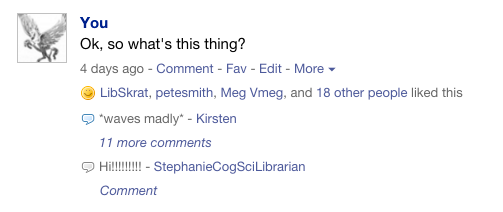
Then mokum.place appeared. And now I’m mounting the call: it’s time to come home! LSWians Unite! And if you aren’t sure just how much like home it will feel, here’s a screenshot for you. Look familiar?mokum

2 Comments

The Digital Humanities and the Librarian

map visualization
Image by raph.ae/

Here at Carleton I’ve been tasked with helping to draft a proposal for a campus-wide digital humanities initiative and infrastructure. Being the librarian that I am, I’ve been spending a good deal of time reading the literature of the field in addition to investigating potential model programs at other institutions and pulling together what amounts to a SWAT analysis about our own institution. And one of the really interesting things in the literature of the field is how librarians are thought of (and think of themselves) in relationship to DH work.

There’s a sizable camp of  vocal “librarians should be full partners in the research” proponents. There are quite a few “provide good, quiet service and provide it well” advisers. There’s the “this is a new thing for librarians so we really need to figure out what we can do” camp. And there’s the “there’s nothing new under the sun for librarians so just do this” camp.

I fall somewhere in the middle of all this. There aren’t well-oiled mechanisms here or at many other institutions for humanists (as opposed to scientists) who want to do digitally inflected research, and yet this research is becoming more and more of an expectation in humanities fields. So in that sense there’s an awful lot to figure out, cobble together, and invent when it comes to supporting this research.

On the other hand, librarians have always studied and supported information use and dissemination, research methods, and scholarly communication cultures. We have always fought to make sure that intellectual freedom is a reality and that everyone has a chance to create new knowledge from the record of human thought. These things sit at the core of our profession — the core of our guiding documents and professional ethics.

A few years ago the humanities departments I serve became much more dependent on data and statistics as they engaged in scholarship, so I learned what I needed to know about finding, understanding, and using numerical information. Right now it’s becoming clear to me that the humanities research in my departments has taken on a decidedly spacial flavor, so it’s time for me to learn enough about spacial analysis and GIS to be conversant with the information and methods of the scholarship in my areas. And while I will never be a GIS specialist, basic familiarity is no more outside of my professional scope than leaning database searching was for the librarians who trained me. The stuff of scholarship changes, but our professional expertise lies first in understanding and facilitating how information flows and functions within scholarship, and it lies second in understanding the mechanics of locating the particular kinds of information that happen to be in use at the moment.

On top of all of this, the information that makes up the bulk of the data for humanities scholarship resides in various kinds of libraries, the “labs of the humanities.” The ties between librarian and scholar have always been particularly strong in the humanities. We geek out together over dusty codexes and digitized primary source collections, monograph browsing and frustratingly jargonless full-text article searching, bulky archival boxes and streaming video collections. Humanities scholarship has never been the solo enterprise that has gotten so much air time lately. Librarians and scholars have been there for each other through the ages, though the librarians’ role is often invisible to the broader community. The librarians aren’t listed as co-authors (and shouldn’t be!), but they do participate in very real ways in humanities scholarship’s inception, feasibility, creation, dissemination, and use.

So I think librarians and scholars function best when they are full partners with each other, and I think that “full partnership” often means playing a pretty invisible role.* I think that there is a lot that’s new that needs to be figured out, and I think there’s nothing new under the sun. But most of all I think that this is our world and our reality, and I think that we are equipped to tackle it, messiness and unanswered questions and all.


* There are some problems with invisibility, including things like being underpaid, over worked, etc. But that’s a topic for another post.


Here’s a bibliography of things that contributed to me thinking these thoughts.

Aarsvold, Nancy, Kasia Gonnerman, and Jason N. Paul. “Shaping the Roles of Academic Librarians to Meet Emerging Demands of DH Scholarship.” In Supporting Digital Humanities for Knowledge Acquisition in Modern Libraries, 44–65. Hershey, PA: Information Science Reference, 2015.

Maron, NL, and Sarah Pickle. Sustaining the Digital Humanities Host Institution Support beyond the Start-Up Phase. New York, NY, 2014.

Nowviskie, Bethany. “Asking For It.” Nowviskie.org, 2014.

Posner, Miriam. “No Half Measures: Overcoming Common Challenges to Doing Digital Humanities in the Library.” Journal of Library Administration 53, no. 1 (2013): 43–52.

Schell, Justin, Jennie M. Burroughs, Deborah Boudewyns, and Cecily Marcus. “From Digital Arts and Humanities to DASH.” In Supporting Digital Humanities for Knowledge Acquisition in Modern Libraries, edited by Kathleen L Sacco, Scott S. Richmond, Sara Parme, and Kerrie Fergen Wilkes, 234–252. Hershey, PA: Information Science Reference, 2015.

Vinopal, Jennifer, and Monica McCormick. “Supporting Digital Scholarship in Research Libraries: Scalability and Sustainability.” Journal of Library Administration 53, no. 1 (2013): 27–42.

What would you add to this list?

2 Comments

Tangible information literacy

Books HD
Photo by Abhi Sharma

One of the professors I work with a lot on campus has me join her American Studies Methods course a couple of times each term she teaches the course. The first time centers around three main questions:

  1. Where does your research question sit within the theory of the field?
  2. Where does the information you’ll need to explore your question sit within the archive of the field? (“Archive” here means the universe of sources useful within the field.)
  3. And how much of the archive of the field is necessary for your purposes?

Last year we had them mind-map their research questions onto the blackboard in among the major topics of American Studies research that they’ve been studying. Then we used these mindmaps as the basis for search strategies for primary and secondary sources.

This year for various reasons we didn’t do a full class on the information literacy of American Studies. Instead, I visited their class for the full class period and participated in their conversations about the two readings assigned for that day, pitching my participation to help draw out the patterns of information use in each of the readings.

What can we tell about the theoretical foundations of the author’s claim based on the bibliography? Who are the major voices the author claims as theoretical kin? What kinds of primary sources appear and how does the author use them? Why these sources and not others?

To help us grapple with the archive of these readings, I spent the morning hunting down every single primary and secondary source that Amy Kaplan used in her article “Manifest Domesticity” (American Literature 70.3 (1998): 581–606) and piled them up on the classroom tables. We had print copies of many of the early 19th century monographs and periodicals that Kaplan marshaled in her readings of the overlap between the rhetoric of empire building and of domesticity. What we didn’t have in print we had in digitized primary source collections, so I could print off a few pages of each. And of the secondary sources we had ready access to all but 2 of the books, one of which could have come over from St. Olaf if I’d planned ahead a little more.

So there we sat, exploring Kaplans scholarship while her archive lay there in front of us for direct exploration, manipulation, and interrogation.

I’m not sure what the students got out of the exercise. I hope they sensed the possibilities for their own research – that writing from 190 years ago is not exotic and out of reach and that the major voices in their field are represented here in our library’s collection. I hope they enjoyed holding paper and ink from the 1830s in their own hands. I especially hope that they sensed the vital research practice of mining other scholars’ bibliographies.

For me, I experienced wonder at just how much is accessible these days even in a curricular collection on a small liberal arts college campus. And I admit that it was a thrill to open those pages and see what other scholars saw, exactly as they saw it.

It certainly wasn’t a traditional library session, but I hope it was as useful. It was certainly fun.

Leave a Comment

What are we DOING as we support digital humanists?

As I manage student’s workload and facilitate the projects they do in support of digital humanities projects on campus, I’ve noticed that one of the underlying dynamics that I have to negotiate is what The Work is that the students do. People talk about job descriptions and the scope of the service, but unarticulated below of if that are deeply held assumptions about what counts as meaningful work for whom.

The student workers themselves are divided on this point. Some of them are very good at zeroing in on core questions that help us think through the project as a whole and set baselines for future decisions. They engage with the process of defining projects, and documenting decisions, and engaging with the campus, and they see this as part of The Work. Other students see this kind of thing as “administrative” work. They would prefer to DO rather than plan or document. Planning and documenting is not The Work to them.

I can see the same thing playing out in different ways with the faculty heading up the projects. Some see the student workers as collaborators with whom to exchange ideas about how to proceed. Others see the student workers as people to cary out project duties as assigned.

Meanwhile, as I look at my own work associated with digital humanities on campus, I can see that I’m kind of at war with myself on this topic. First, I’m an interim in this position, which I’m not good at. A couple of times I’ve wanted to engage with questions or jump into action and my steady comrade-in-DH has reminded me that we should do things right rather than soon, and I’ve felt chagrined each time because I know this and I think that in my regular work I’m usually good at this, but somehow in my current situation I seem to get ahead of myself sometimes.

Another layer of my own internal struggle is that my main goals as the interim DH supervisor is to keep the program afloat and to document, document, document. I want the transition for the new person to be as smooth as possible, and I want to be an effective project manager for my students. But sometimes I worry that I might be too deep in the “admin stuff” (as one student calls it) and pulling my students too far in with me. I can totally relate to the desire to just plug away at a project.

Planning, documenting, and program development are important parts of the job for each of us. They are definitely a good part of The Work of digital humanities on my campus. The trick is to figure out the right balance for each person. I don’t think I’ve figured out that balance point yet.

Leave a Comment
css.php