Skip to content

Author: admin

Holding Down the Fort

It’s pretty lonely in my neck of the woods today. Most of the time, my wall of offices is full of my co-workers. Today, I’m the only one along this wall. My supervisor is here, but her office is farther off. And the liaison in charge of all things media is here, but he’s, like, 40 whole feet away and in another area of the library.

Why am I so isolated today? Because one of our librarians doesn’t work summers and isn’t back yet, two are taking the day off, and one more has reduced her FTE so that she can have Fridays off to be with her baby girl. And that leaves me.

I have enough to do that this should be a welcome development. But unfortunately, my office is the only one that’s open and visible from the reference desk now, so I’ll be getting all the drop-in questions that should go to the person on call (who will be here, but not directly visible from the reference desk). I’ll have to be ruthless about paging the on-call librarian or I’ll never get anything done. I hate doing that. It always feels like I’m deliberately not being helpful or something

Leave a Comment

New Email/Calendar System: Day One

This morning when I arrived at work, only one email appeared in my inbox. The long-anticipated day had come. All my email had been migrated from our imap server to our bran’-spankin’ new Zimbra system.

Until today, members of our campus have used not one but several email systems. Faculty and academic staff were on one (but could use one of at least three supported access methods, including webmail and two desktop clients). Administrative and other staff were on a completely separate system (GroupWise). I’m not sure what students were on (though I know it wasn’t GroupWise). So as much as we’ve all been dreading the migration headache, clearly we needed a change.

So today I became one of the first groups of people on campus to migrate over to Zimbra, but most of my day was spent in meetings, so I didn’t have a whole lot of time to tinker, play, and futz. So the impressions I have are just that: impressions. And I’m not sure if it’s wishful thinking, the “oooh, shiny” factor, or something more substantial that makes me generally want to like it. But I generally want to like it, and I certainly do anticipate the joys of being able to search for common free time when setting up meetings (this will be the first time our whole campus has had a single calendaring system, too). I also like the tagging and message search functions.

But there are a couple of strangenesses, too. For example, there’s no way to copy a message to a folder; you have to just flat out move it. I can’t customize my view quite the way I’d like. Things seem to take several clicks rather than one or two. I don’t think there are any notifications for new messages, or any indication if you’re in the calendar view that there may be new messages waiting for you if you click over to mail view. But most puzzling (though not Zimbra’s fault), is that I now have three complete calendars, each of which need updating. My palm needs all my information so that it can go with me to meetings. My google calendar needs at least some of my information, but exactly how much will depend on departmental decisions that haven’t yet been made. And I’m strangely fond of my published availability calendar, which wouldn’t be possible if I dropped my google calendar. Then there’s the zimbra calendar, which must be used if people are to be able to easily schedule meetings with me via the new all-campus system. Something’s gotta give, but I have to keep them all up until I figure out what I can drop without hampering my work and that of my colleagues.

Leave a Comment

Planning for New Trading Cards

Today was the first of three solid days of meetings for me. We’ve blocked off these three days for my department to work on the collaborative summer projects that have been stacking up and not getting done. And today, we didn’t do so badly. We learned to use the “Create Lists” function in III’s Millennium interface, saw our departmental profile in Blackwell’s online collection development interface, developed our departmental goals for the coming school year, and took care of several other conversations that needed to happen but haven’t really had a proper venue. What’s more, that’s exactly what we said we’d accomplish today, so that felt good.

Tomorrow we’re going to talk about citation management software, make decisions about databases we have and want, and train each other on some of our new databases or on databases that have changed platform (so, for instance, the social sciences librarian will introduce us to a couple of new social sciences databases that might be useful to us and that we might want to know about as we work at the reference desk).

And then on Wednesday we’ll talk about our new trading cards. This meeting always makes me uncomfortable.


The first year I was here it was uncomfortable because I was afraid it’d be hokey. Well… it kind of was, but in the best possible way. I absolutely loved my first trading card. I didn’t know how we could top it. So last year I was worried we’d change to a new design or color scheme or… whatever, that’d ruin it. I’d grown really fond of my card. But last year’s card turned out even better than the year before, so that fear was averted.


This next year, there’s talk of changing our theme. So this year I’ve started mourning my current card again. I really love my current card. I’ve grown used to it. I feel like it fits me well… like a well-worn pair of jeans. Only way cooler. How could a new design possibly be better, I wonder?

Leave a Comment

Back Online

This is just a note to say I’m back.

My blogging vacation was great. I sat on the porch, read Harry Potter, read a few New Yorkers (now I’m only behind by 3 weeks!), watched the grass grow, and generally took a true and thorough vacation. I’ve got a hefty to-do list here at work, including slogging through email and attending triply my normal load of meetings, but even so I’m not dreading the day, so I guess the vacation worked it’s magic (though I wouldn’t say no to about 3 or 4 more months of it).

Leave a Comment

Blogging Vacation

You may have noticed that blogging around these parts has slowed to trickles and little spurts lately. And strangely enough, this isn’t for lack of topics. Seriously. I’ve never been one for keeping lists of posts I want to write, but lately I’ve developed a ridiculously long list of topics, none of which have made it here.

Well, I’ve been busy with both work and non-work stuff, and a little bit more susceptible to stress than usual, and a little, well, blah. Fine, but blah.

So I’m going to take next week off from blogging, from stress, from stuff. I’m going to get some power-relaxing in, some reading, and some staring into space. Then I’ll be back and thinking about tackling that list of bloggable topics. Or not. Maybe I’ll have a whole new bunch of topics to blog about by then. See you then!

1 Comment

Introducing High School Students to a College Library

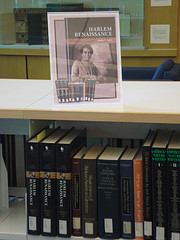
Every summer a group of high school students, gleaned from high schools all over the United States, comes to campus for a week-long program called CLAE (the Carleton Liberal Arts Experience). There are various courses they can take (everything from “how to apply to college” to “the Harlem Renaissance”) with the dual purpose of introducing them to the idea of a liberal arts college and giving them a little bit of experience living and studying on a college campus. The emphasis is really on empowering them to think that college is possible, doable, interesting, intense, and fun.

And every year, one of the classes brings all the kids to the library. For the past three summers I’ve worked with the history librarian to prepare the students to engage in a modernized Washington/Du Bois debate. But this year the class and professor changed, so the history librarian and I started from scratch to build a class for students studying the Harlem Renaissance.

My part of the class preparations was to develop an exercise that would introduce the students to the 5 reference sets they’d need to navigate as they prepared for their final presentations. But the big question was how to make it easy for them to pick their sets out from the shelves and shelves of unfamiliar reference books, while still letting them see the sets in context rather than pulled out and put on a cart just for this assignment. Well, to ease this particular rub, I made signs for each set that had a full scan of the cover of the one of the set’s volumes, and then a cut-out image of the set’s place on the shelf.

Then I put these signs up on the shelves above each reference set.

That way, when the students came back to do their research after all of the librarians had gone home for the night, they’d be able to go back to the sets we’d shown them in class. I hope it worked for them.

Oh, and the exercise itself sounded great on paper, but would need more clarification next year. I still like the idea of it, but there were some recurring questions I should have anticipated.

Leave a Comment

Where Working Groups Break Down

Carleton and St Olaf share a catalog, so there are several working groups between the two schools designed to make this collaboration possible. I’ve been on the Public Access Working Group (which oversees the function and appearance of the catalog itself), and there are various other groups (Cataloging, Serials, Gov Docs, Etc.) that work to keep the two schools in sync as much as possible. And generally these divisions make sense. We either know what falls under our general purviews, or we know which other groups we need to work with to get a particular project done. My group, for example, often has occasion to work with the serials group and the cataloging group, since the catalog interface is fairly directly influenced by those two groups.

But every once in a while, these divisions are a little bit vexing. And no, it’s not when there’s a major issue that cuts across all of our areas of interest. That’s easy to solve: just call a mass meeting and make sure that representatives from each group are there. No, what’s vexing is when there’s a little problem, a little change, that could fall equally under the domains of half a dozen working groups. It seems like overkill to call a mass meeting, but lots of people need to know about the changes, and no one group is guaranteed to have a complete grasp on the issue.

Such is the case with a MARC field that was recently brought to my attention. It’s the 035 field, and we sometimes need it for gov docs so that MARCive records get overlaid properly. But apparently it’s recently been reassigned by the people who assign fields in MARC, so now [See comments for clarification] It’s a “system number” full of what looks to me like gobbledygook. So, already this affects the gov docs group and the cataloging group, right? Well, in our case it also affects the Public Access group because the 035 field is set to display with the label “Gov Doc #” in our catalog. (See the bottom of this record, for example, or this record for a government document.) Each group thinks it’s somebody else’s issue, so none of us are thinking about it, but it’s such a teensy little problem it doesn’t seem worth the effort of organizing a meeting of all three groups. And the catalogers who are actually working with the problem didn’t really know who to talk to about it in the first place.

It’s it funny how it’s so easy to collaborate on the big issues, and so thorny to try it with the little ones?

6 Comments

One of Those Days… Again

The way things have been going, I could have just come to work for a few hours on Monday and then not come in the entire rest of the week. Every day, I was thwarted in my attempts to work on my projects, and what’s worse, all the work I did do (and I was remarkably focused this week… lots to do) ended up vanishing before the end of each day. Sounds incredible, I know, but it’s true.

We have a guy who lives in town and spends hours and hours each summer in the library looking up the lives of the rich and famous from the days of yore. He’s mentally unstable, a little bit frightening, and incredibly time-consuming for whomever happens to be on call for reference duty. And this week, that unluckly librarian was, you guessed it, ME.

That would have been enough to throw off my productivity for the week, but no. I also got to experience the Revenge of the Evil Content Management System. Every so often (usually a couple of times a day), our CMS would misinterpret my clicking on “Save” to mean “Erase All My Work, Purge All the Saved Versions of My Work Back To Last January, And Then Save.” The general mantra for avoiding loss of work is to Save Often… Yeah, well that’s exactly what would kill me with this bug. What is a girl to do? So I developed a habit of switching to HTML code view (which the web developers have given only a few people access to see), copying the code into a text file, and THEN saving. But here’s the kicker, just before it decides to erase all my work, it also won’t let me into the code view. So today the web people set me up with an error console and instructions on how to copy code from several different places whenever these errors happened. Well, apparently I had enough errors today that they think they’ll be able to locate the bug… which means I had quite a few errors today… which means I’m not a happy camper.

Then there were all the normal interruptions that come with being the reference on-call person. … The phone rings and an innocent voice says that she’s off campus this summer and wanted to download EndNote and get started setting up her reference library in preparation for her senior thesis project. Heh. Oh the fun-ness. Downloading, installing, creating a library, figuring out how to log in for off-campus access to databases, searching databases, saving records, and importing them into EndNote. Thankfully she thought she could probably wait till she comes back to campus learn how to cite while she writes or create stand-alone bibliographies. … add to this finding maps from the mid-19th century, finding research on free musical improvisation and it’s link to different world cultures, and figuring out what obscure African language a speaker was referencing when he gave a talk that now has to be transcribed. It was quite a reference week, and there’s one more day to go.

With all of this, the only thing that’s saved me from finally losing the last shreds of composure was my weaving (pictures). For the first time since moving here, I’ve warped my loom and spent half an hour or so every evening weaving dishtowels for a gift. The rhythmic swish… thunk… swish… thunk as each thread slips into place is incredibly therapeutic. My cat doesn’t agree. He spends most of his time sticking his paw under the loom room door and whining that he wants to help play with strings. But for me, it’s been the best excuse to think about absolutely nothing for stretches of time every evening.

2 Comments

Comments: Terms of Service

I’ve been thinking about a blog post I ran across a while ago about laws that apply to bloggers, specifically point 7 on that list of 12 laws: Who owns user-developed content and can you delete it? This reminded me that comments people write here are their own, and that I may not have the right to delete them even if they’re threatening or offensive. According to the law, I need a “terms of service” in order to be able to delete any such content.

I have never received any such comments and I hope I never do, but just in case, here are my terms of service.

I reserve the right to delete any comment left on this blog if I think that the comment is inappropriate or harmful in any way.

I hope that I never have to exercise these rights.

4 Comments

Wikipedia Could Help Search Engines Understand Names?

The Search Engine Watch Blog just pointed me to a post that pointed me to a paper entitled “Large-Scale Named Entity Disambituation Based on Wikipedia Data” (PDF) by Silviu Cucerzan of Microsoft. Most of the paper is technical and algorithmic greek to me, but this one sentence makes perfect sense to me (or rather, the first half of the sentence makes sense to me and the rest should have been its own sentence).

The application on a large scale of such an entity extraction and disambiguation system could result in a move from the current space of words to a space of concepts, which enables several paradigm shifts and opens new research directions, which we are currently investigating, from entity-based indexing and searching of document collections to personalized views of the Web through entity-based user bookmarks. (page 9, my emphasis)

One of the main gripes about web search has been that it can’t benefit (at least not very well) from human knowledge of the relationships between words. It matches letters in a row while directories gather pages based on concepts. But then, directories got out of hand and people couldn’t keep up with them, and then they all turned into search engines no matter how much they still tried to look like directories… Well, if this thing gets off the ground, we could have the best of both worlds. We could have the scale of search with the power of directories.

Another source of this conceptual linking that’s so powerful and so difficult to teach to computers may be the Google Book Project. Think of all of those indexes to all of those books. Surely we could harness the power of generations of indexers to map concepts. How hard could it be? 😉

3 Comments
css.php