Skip to content

Author: admin

The New Travel Ban: The source documents behind the news

The Primary Source Crusader (my own mashup of images)

39 days after the first travel ban, Trump signed his second one. This second order takes effect on March 16th, and at that point it will rescind the first order and start the clock on new temporary bans and new permanent procedures. Plenty of news sources give interpretations, but as usual I wanted to see the source document for myself and trace the documents it references. Here’s what I found…

[Update 6/8/2017: There are 28 court cases pending on this topic.]

[Update 3/9/2017: The first court case challenging this Executive Order has started: Hawaii v Trump.]

[Update: 3/9/2017: added links to the newly published Federal Register version of the document.]

Legal Challenges (section added 3/14/2017)

Some of the legal challenges from the original travel ban are carrying over, and Hawaii v Trump started after the new travel ban was signed.

All three cases have hearings scheduled for Wednesday 3/15/2017, and all three are seeking to block the new travel ban from going into effect on 3/16/2017.

Update 3/15/2017: Judge Watson (Hawaii) has issued a nation-wide Temporary Restraining Order, halting the implementation of Section 2 and Section 6 of this Executive Order. This mirrors the TRO that halted the last Executive order. The ruling is… pointed:

  • “Because the Executive Order at issue here cannot survive the secular purpose prong, the Court does not reach the balance of the criteria.” (page 29)
  • “The illogic of the Government’s contentions is palpable.” (page 30)
  • “It includes significant and unrebutted evidence of religious animus driving the promulgation of the Executive Order and its related predecessor.” (page 33)
  • “When considered alongside the constitutional injuries and harms discussed above, and the questionable evidence supporting the Government’s national security motivations, the balance of equities and public interests justify granting the Plaintiffs’ TRO.” (page 42)

Update 3/16/2017: Judge Chuang (Maryland) has issued a nation-wide Temporary Restraining Order, halting the implementation of section 2(c) of this Executive Order. This ruling is less pointed than Judge Watson’s. Here is the rationale for the section of the Order that is blocked:

  • INA arguments:
    Plaintiffs pointed out that 8 U.S. Code § 1152(A) prohibits immigration discrimination based on nation of origin, but the Judge says that prohibition probably doesn’t apply in this case: “They have not shown a likelihood of success on the merits of the claim that § 1152(a) prevents the President from barring entry to the United States pursuant to § 1182(t), or the issuance of non-immigrant visas, on the basis of nationality.” (page 24)
  • Establishment Clause arguments:
    Plaintiffs argue that religiously based bans violate the Establishment Clause of the First Amendment. The Judge agrees that they are likely to succeed with that argument: “But while the travel ban bears no resemblance to any response to a national security risk in recent history, it bears a clear resemblance to the precise action that President Trump described as effectuating his Muslim ban.” (page 37)
  • The result:
    “Plaintiffs have asked the Court to issue an injunction blocking the Executive Order in its entirety. The Court declines to grant such broad relief. The Plaintiffs’ Establishment Clause and INA arguments focused primarily on the travel ban for citizens of the six Designated Countries in Section 2(c) of the Second Executive Order. The Court will enjoin that provision only.” (page 40)

Update 3/17/2017: Judge Robart (Washington State) has issued an order denying the request to extend the Temporary Restraining Order imposed on the first executive order and apply it to the second executive order. The defendants in this case appear to have asked that the old TRO be applied to the new executive order rather than asking to have a new TRO applied to the new executive order.

  • “In this instance, the court agrees with Defendants that the court’s preliminary injunction should not automatically extend to [the new Executive Order, EO2].” (page 7)
  • “The court does not say, however, that Plaintiffs are not entitled to a temporary restraining order or preliminary injunction with respect to certain aspects of EO2. The court makes no ruling on that issue, and notes that Plaintiffs have now filed a motion for a temporary restraining order with respect to EO2.” (page 8) And here is that motion.

Executive Order Protecting The Nation From Foreign Terrorist Entry Into The United States [full document]

Quote: “By the authority vested in me as President by the Constitution and the laws of the United States of America, including the Immigration and Nationality Act (INA), 8 U.S.C. 1101 et seq. [remember, those are two ways of citing the same set of laws], and section 301 of title 3, United States Code, and to protect the Nation from terrorist activities by foreign nationals admitted to the United States, it is hereby ordered as follows:…”

Section 1: Policy and Purpose

Quote: “I am imposing a temporary pause on the entry of nationals from Iran, Libya, Somalia, Sudan, Syria, and Yemen, subject to categorical exceptions and case-by-case waivers, as described in section 3 of this order.”

This section does three things:

  1. It lays out the history of the previous Executive Order (which I previously wrote about) in some detail, including reasons that the White House felt the first order was justified.
  2. It lays out country-by-country justifications for increased scrutiny of nationals from Iran, Libya, Somalia, Sudan, Syria, and Yemen (as well as reasons that Iraq is now left off of the list). Unlike last time, this time it actually names each country.
  3. It lays out justification for the current ban, including a paragraph listing several immigrant criminals from recent history.

Let’s take the main paragraphs in order.

The Order says that the descriptions of each of the countries is “taken in part from the Department of State’s Country Reports on Terrorism 2015.” This is part of a suite of reports put out regularly by the Department of State as required by Title 22 Section 2656f of the United States Code. (The report refers to ISIL rather than ISIS, so if you go searching through it keep that in mind.) The reports include general Country Reports on 87 countries (4 of which are included in this order, and 3 of those 4 are also included in the specialized sections on State Sponsors of Terrorism or Terrorist Safe Havens), plus reports on 3 countries that are “State Sponsors of Terrorism” (all of which are mentioned in this order), and 13 countries that are “Terrorist Safe Havens” (4 of which are mentioned in this order, though one of those 4 is Iraq, which is not banned).

The order gives these descriptions, which I’ve quoted and then added links to sources:

  • Quote: Iran has been designated as a state sponsor of terrorism since 1984 and continues to support various terrorist groups, including Hizballah, Hamas, and terrorist groups in Iraq.  Iran has also been linked to support for al-Qa’ida and has permitted al-Qa’ida to transport funds and fighters through Iran to Syria and South Asia.  Iran does not cooperate with the United States in counterterrorism efforts. (All contained in the State Sponsors of Terrorism chapter of the report.)
  • Quote: Libya is an active combat zone, with hostilities between the internationally recognized government and its rivals.  In many parts of the country, security and law enforcement functions are provided by armed militias rather than state institutions.  Violent extremist groups, including the Islamic State of Iraq and Syria (ISIS), have exploited these conditions to expand their presence in the country.  The Libyan government provides some cooperation with the United States’ counterterrorism efforts, but it is unable to secure thousands of miles of its land and maritime borders, enabling the illicit flow of weapons, migrants, and foreign terrorist fighters.  The United States Embassy in Libya suspended its operations in 2014. (This information comes from the Terrorist Safe Havens chapter of the report.)
  • Quote: Portions of Somalia have been terrorist safe havens.  Al-Shabaab, an al-Qa’ida-affiliated terrorist group, has operated in the country for years and continues to plan and mount operations within Somalia and in neighboring countries.  Somalia has porous borders, and most countries do not recognize Somali identity documents.  The Somali government cooperates with the United States in some counterterrorism operations but does not have the capacity to sustain military pressure on or to investigate suspected terrorists. (This information comes from the Terrorist Safe Havens chapter of the report.)
  • Quote: Sudan has been designated as a state sponsor of terrorism since 1993 because of its support for international terrorist groups, including Hizballah and Hamas.  Historically, Sudan provided safe havens for al-Qa’ida and other terrorist groups to meet and train.  Although Sudan’s support to al-Qa’ida has ceased and it provides some cooperation with the United States’ counterterrorism efforts, elements of core al-Qa’ida and ISIS-linked terrorist groups remain active in the country. (All contained in the State Sponsors of Terrorism chapter of the report.)
  • Quote: Syria has been designated as a state sponsor of terrorism since 1979.  The Syrian government is engaged in an ongoing military conflict against ISIS and others for control of portions of the country.  At the same time, Syria continues to support other terrorist groups.  It has allowed or encouraged extremists to pass through its territory to enter Iraq.  ISIS continues to attract foreign fighters to Syria and to use its base in Syria to plot or encourage attacks around the globe, including in the United States.  The United States Embassy in Syria suspended its operations in 2012.  Syria does not cooperate with the United States’ counterterrorism efforts. (All contained in the State Sponsors of Terrorism chapter of the report.)
  • Quote: Yemen is the site of an ongoing conflict between the incumbent government and the Houthi-led opposition.  Both ISIS and a second group, al-Qa’ida in the Arabian Peninsula (AQAP), have exploited this conflict to expand their presence in Yemen and to carry out hundreds of attacks.  Weapons and other materials smuggled across Yemen’s porous borders are used to finance AQAP and other terrorist activities.  In 2015, the United States Embassy in Yemen suspended its operations, and embassy staff were relocated out of the country.  Yemen has been supportive of, but has not been able to cooperate fully with, the United States in counterterrorism efforts. (Most of this information comes from the Terrorist Safe Havens chapter of the report.)

Travel from Iraq is not banned in this Executive Order like it was in the previous one. It is listed as a Terrorist Safe Haven, but the EO says that Iraq has been working closely with the U.S. and will therefore be allowed visas.

The justifications section concludes with a statement that requires some sourcing, which I’ve provided in footnotes within this section:

Quote: (h)  Recent history shows that some of those who have entered the United States through our immigration system have proved to be threats to our national security.  Since 2001, hundreds of persons born abroad have been convicted of terrorism-related crimes in the United States.*  They have included not just persons who came here legally on visas but also individuals who first entered the country as refugees.  For example, in January 2013, two Iraqi nationals admitted to the United States as refugees in 2009 were sentenced to 40 years and to life in prison, respectively, for multiple terrorism-related offenses.**  And in October 2014, a native of Somalia who had been brought to the United States as a child refugee and later became a naturalized United States citizen was sentenced to 30 years in prison for attempting to use a weapon of mass destruction as part of a plot to detonate a bomb at a crowded Christmas-tree-lighting ceremony in Portland, Oregon.***  The Attorney General has reported to me that more than 300 persons who entered the United States as refugees are currently the subjects of counterterrorism investigations by the Federal Bureau of Investigation.****

* This appears to be referring to a 2016 Justice Committee list, prepared by its then-chairman Jeff Sessions, of 580 people convicted of terrorist activities since 9/11. Of these, the committee determined that 380 were foreign-born, 39 of which were from countries named in this ban. These numbers are complicated because there’s no formal definition of the word “terrorism” or how closely a conviction has to be tied to terrorism in order to be included on these lists. The Cato Institute determined that 40 of those 580 were terrorist activities, for example, and they published an extensive report in September 2016 on the topic of terrorism convictions. The New America group has studied the demographics and other characteristics of terrorists convicted since 9/11 (in the footer of the page you can download a spreadsheet of their data). They list 181 foreign-born people convicted of terrorist activities since 9/11, but none of these came from the 6 countries that are currently banned. The Migration Policy Institute cites both of those reports in their own work.

** This appears to refer to the Bowling Green incidents. Iraq, these convicts’ country of origin, is not covered under this ban.

*** This appears to refer to Mohamed Osman Mohamud.

**** This appears not to be a published statistic. The statement also mentions suspects rather than convicts, so it would be interesting to know the ratio of suspects to convicts in this sort of crime — of all the people accused of a connection to terrorism, how many are ultimately found to have committed the crime. But I haven’t found a study on that yet. The only context we can really build for this number is in relation to the number of refugees in the country, which we can do using Refugee Processing Center data or the annual reports of the Office of Refugee Resettlement. If we count entering refugees since 2001, that would make it about 0.15% of refugees under investigation. If we go back farther, that percentage gets smaller.

Section 2: Temporary Suspension of Entry for Nationals of Countries of Particular Concern During Review Period. [This section is currently blocked by 2 Temporary Restraining Orders]

This section says essentially four things:

    1. The Secretary of Homeland Security (in consultation with the Secretary of State and the Director of National Intelligence), will conduct a worldwide review to find out what information is needed from each country when making decisions about granting visas.
    2. Once that’s done, and everyone has agreed on which countries need which kinds of information, they’ll ask countries to start providing us with whatever information was deemed necessary for visa processing.
    3. While all of this is being worked out, there is a temporary travel ban: “I hereby proclaim, pursuant to sections 212(f) and 215(a) of the INA, 8 U.S.C. 1182(f) [the relevant words] and 1185(a), that the unrestricted entry into the United States of nationals of Iran, Libya, Somalia, Sudan, Syria, and Yemen would be detrimental to the interests of the United States.  I therefore direct that the entry into the United States of nationals of those six countries be suspended for 90 days from the effective date of this order, subject to the limitations, waivers, and exceptions set forth in sections 3 and 12 of this order.”
    4. Once these 90 days are over, there will be a new proclamation that would “prohibit the entry of appropriate categories of foreign nationals of countries that have not provided the information requested until they do so or until the Secretary of Homeland Security certifies that the country has an adequate plan to do so, or has adequately shared information through other means.”

As a side note, I’m still curious how Section 1182 referenced above works with Section 1152.

8 U.S. Code § 1182 – Inadmissible aliens (enacted in 1952) reads:

(f) Suspension of entry or imposition of restrictions by President Whenever the President finds that the entry of any aliens or of any class of aliens into the United States would be detrimental to the interests of the United States, he may by proclamation, and for such period as he shall deem necessary, suspend the entry of all aliens or any class of aliens as immigrants or nonimmigrants, or impose on the entry of aliens any restrictions he may deem to be appropriate.

8 U.S. Code § 1152 – Aliens and Nationality (enacted in 1965) reads:

1) Nondiscrimination
(A) Except as specifically provided in paragraph (2) and in sections 1101(a)(27), 1151(b)(2)(A)(i), and 1153 of this title, no person shall receive any preference or priority or be discriminated against in the issuance of an immigrant visa because of the person’s race, sex, nationality, place of birth, or place of residence.

Update 3/16/2017: Judge Chuang (Maryland) has given an opinion on this apparent conflict in the law. He says:

At first glance, President Trump’s action appears to conflict with the bar on discrimination on the basis of nationality. However, upon consideration of the specific statutory language, the Court finds no direct conflict. Section 1182(f) authorizes the President to bar “entry” to certain classes of aliens. 8 U.S.C. § 1182(f). Section 1152(a) bars discrimination based on nationality in the “issuance of an immigrant visa.” … Accordingly, an executive order barring entry to the United States based on nationality pursuant to the President’s authority under § 1182(f) does not appear to run afoul of the provision in § 1152(a) barring discrimination in the issuance of immigrant visas. (pages 20-21 of the TRO from 3/16/2017)

Section 3: Scope and Implementation of Suspension.

Unlike last time, this EO lays out some details about which people are and are not covered by this order. Here are the relevant words:

  1. Quote – This order shall apply only to foreign nationals of the designated countries who:
    1. are outside the United States on the effective date of this order;
    2. did not have a valid visa at 5:00 p.m., eastern standard time on January 27, 2017; and
    3. do not have a valid visa on the effective date of this order.
  2. Quote – This order shall not apply to:
    1. any lawful permanent resident of the United States;
    2. any foreign national who is admitted to or paroled into the United States on or after the effective date of this order;
    3. any foreign national who has a document other than a visa, valid on the effective date of this order or issued on any date thereafter, that permits him or her to travel to the United States and seek entry or admission, such as an advance parole document;
    4. any dual national of a country designated under section 2 of this order when the individual is traveling on a passport issued by a non-designated country;
    5. any foreign national traveling on a diplomatic or diplomatic-type visa, North Atlantic Treaty Organization visa, C-2 visa for travel to the United Nations, or G-1, G-2, G-3, or G-4 visa; or
    6. any foreign national who has been granted asylum; any refugee who has already been admitted to the United States; or any individual who has been granted withholding of removal, advance parole, or protection under the Convention Against Torture.

This section also lays out 9 examples of times when a case-by-case determination may result in a waiver for certain individuals from these 6 countries, including returning to work or study, visiting a close family member in the United States, has worked for the U.S. government and can document faithful service, or is an infant, young child, or adoptee.

Section 4. Additional Inquiries Related to Nationals of Iraq.

This section boils down to “Iraqis aren’t banned, but they’ll be vetted extremely.”

Section 5. Implementing Uniform Screening and Vetting Standards for All Immigration Programs.

The Secretary of State, the Attorney General, the Secretary of Homeland Security, and the Director of National Intelligence will work together to come up with minimum vetting standards for all immigrants who want to enter the United States, ideally screening out people who try to get into the country fraudulently or who “may commit, aid, or support any kind of violent, criminal, or terrorist acts after entering the United States”

Section 6. Realignment of the U.S. Refugee Admissions Program for Fiscal Year 2017. [This section is currently blocked by the Temporary Restraining Order from Hawaii]

For 120 days after March 16th, the Secretary of State will suspend all new travel of refugees to the United States and all new decisions about applicants for refugee status in the United States.

Unlike last time, this time the ban does not apply to refugees who are already scheduled for travel to the United States (or who get their travel schedules before March 16th), and unlike last time there is room for case-by-case waivers of the ban.

During Fiscal Year 2017 the United States will accept no more than 50,000 refugees. This revises Obama’s order for FY 2017 which allowed 110,000 refugees, an unusually high number compared with previous years. Here are the orders Obama signed for 2016 (85,000), 2015 (70,000), 2014 (70,000), 2013 (70,000), 2012 (75,000), 2011 (80,000), and 2010 (80,000).

The Secretary of State will work with state and local jurisdictions to see if there are ways for local government to have more say over which refugees get settled in their jurisdictions.

Section 7. Rescission of Exercise of Authority Relating to the Terrorism Grounds of Inadmissibility.

Quote: “The Secretary of State and the Secretary of Homeland Security shall, in consultation with the Attorney General, consider rescinding the exercises of authority permitted by section 212(d)(3)(B) of the INA, 8 U.S.C. 1182(d)(3)(B) [the relevant words], relating to the terrorism grounds of inadmissibility, as well as any related implementing directives or guidance.”

The clause referenced here grants the Secretary of State and the Secretary of Homeland Security the ability to decide that someone or some group connected with terrorism may enter the country.

It looks like this authority has been used 43 times in the past to exempt people who gave aid under duress or gave medical aid or the like. The current Executive Order says to consider rescinding these actions.

Section 8. Expedited Completion of the Biometric Entry-Exit Tracking System.

This section of the Executive Order says to complete the implementation of biometric entry-exit tracking quickly.

In 1996 Clinton signed the Illegal Immigration Reform and Immigrant Responsibility Act (big PDF), which required the institution of biometric entry-exit tracking for non-citizens (section 104(a), page 556). Every president since then has signed laws requiring this tracking, and last year the Congressional Committee on the Judiciary held a hearing to determine why the systems were not yet in place (chaired by current Attorney General Jeff Sessions).

Here are the laws I could find that were signed into law since 1996 and that dealt with biometric entry-exit screening:

  • Omnibus Consolidated Appropriations Act, 1997 (104 H.R. 3610)
  • Omnibus Consolidated and Emergency Supplemental Appropriations Act, 1999 (105 H.R. 4328)
  • Immigration and Naturalization Service Data Management Improvement Act of 2000 (106 H.R. 4489)
  • Aviation and Transportation Security Act, 2001 (107 S. 1447)
  • Enhanced Border Security and Visa Entry Reform Act of 2002 (107 H.R. 3525)
  • Machine-Readable Passports and Visas for Foreign Visitors Extension – 2004 (108 H.R. 4417)
  • Intelligence Reform and Terrorism Prevention Act of 2004 (108 S. 2845)
  • Implementing Recommendations of the 9/11 Commission Act, 2007 (110 H.R. 1)
  • Consolidated Security, Disaster Assistance, and Continuing Appropriations Act, 2009 (110 H.R. 2638)

Section 9. Visa Interview Security.

Quote: The Secretary of State shall immediately suspend the Visa Interview Waiver Program and ensure compliance with section 222 of the INA, 8 U.S.C. 1202, which requires that all individuals seeking a nonimmigrant visa undergo an in-person interview, subject to specific statutory exceptions.  This suspension shall not apply to any foreign national traveling on a diplomatic or diplomatic-type visa, North Atlantic Treaty Organization visa, C-2 visa for travel to the United Nations, or G-1, G-2, G-3, or G-4 visa; traveling for purposes related to an international organization designated under the IOIA; or traveling for purposes of conducting meetings or business with the United States Government.

Because there will no be no automatic waiver for all the qualified travelers from the 38 countries in the Visa Waiver Program, there will be a lot more work to do at U.S. Consulates, so the Secretary of State is also directed to expand the Consular Fellows Program so that Fellows can help with the work of vetting visa applicants.

As a side note, I was curious how an Executive Order could cancel an enacted law, but if I’m reading it correctly it turns out that the law states that it authorizes the Secretaries of State and Homeland Security to create this program, and it sets out parameters for the program, but the law does not actually create the program.

Section 10. Visa Validity Reciprocity.

Quote: “The Secretary of State shall review all nonimmigrant visa reciprocity agreements and arrangements to ensure that they are, with respect to each visa classification, truly reciprocal insofar as practicable with respect to validity period and fees, as required by sections 221(c) and 281 of the INA, 8 U.S.C. 1201(c) and 1351, and other treatment.”

Section 11. Transparency and Data Collection.

This section calls for the collection and publication of statistics on the number of non-citizens charged or convicted of terrorism, radicalized, gender-based violence against women, and “any other information relevant to public safety and security.”

Section 12. Enforcement.

The Secretary of State and the Secretary of Homeland Security will consult with “appropriate domestic and international partners” to make sure that the roll-out of this Order is smooth and effective.

There are 4 points of specially called out or clarified in this section:

  1. The Secretaries should still allow for the “credible fear” provisions covered by section 235(b)(1)(A) of the INA, 8 U.S.C. 1225(b)(1)(A) [the relevant words].
  2. “No immigrant or nonimmigrant visa issued before the effective date of this order [March 16th, 2017] shall be revoked pursuant to this order.”
  3. “Any individual whose visa was marked revoked or marked canceled as a result of Executive Order 13769 shall be entitled to a travel document confirming that the individual is permitted to travel to the United States and seek entry.  Any prior cancellation or revocation of a visa that was solely pursuant to Executive Order 13769 shall not be the basis of inadmissibility for any future determination about entry or admissibility.”
  4. “This order shall not apply to an individual who has been granted asylum, to a refugee who has already been admitted to the United States, or to an individual granted withholding of removal or protection under the Convention Against Torture.  Nothing in this order shall be construed to limit the ability of an individual to seek asylum, withholding of removal, or protection under the Convention Against Torture, consistent with the laws of the United States.”

Section 13. Revocation.

Executive Order 13769 of January 27, 2017, is revoked as of the effective date of this order [March 16th].

Section 14.  Effective Date.

This order is effective at 12:01 a.m., eastern daylight time on March 16, 2017.

Section 15.  Severability

This section says that if any part of this executive order is found to be invalid, the rest of the order is still in effect. And if any part of the order can’t be accomplished because an agency doesn’t have procedures in place, that agency should put procedures in place.

Section 16.  General Provisions

This wording goes at the end of every executive order, I think, and says that the Executive Order does not reduce any other agency’s lawful authority, it should be implemented in ways consistent with current law, and it doesn’t give rights to anyone working against the United States or any person.

1 Comment

Tricks of the trade: research strategies for current political topics

Idea – by me

I thought I’d step back for a minute and talk a little bit about the strategies behind my recent work to find the source documents behind the news. If you’re a librarian or you make this kind of research a regular part of your life in some way, you probably know all this stuff and can probably give me awesome pointers for improvement (which I welcome!). If you haven’t done this stuff but would like to, here are some relatively simple strategies that I’m employing and that you can totally do too.

1) Use sources to find sources

Typing words into a search box might land you on what you need to know, but more often than not it’ll be insufficient or inefficient. Instead, I usually start by finding “pointing sources” that point me to the original sources. For my recent obsession with current events, here are the pointing sources I’ve used most often:

  • News reporting (yeah, yeah, I know, you can’t trust the news… but…)
    Unlike journalists, I don’t have access to meetings, briefings, long histories of covering a particular topic, and all the relationships journalists cultivate over time. So if I hear of a bill but can’t find it (because most state legislature websites are less than ideal, as are most government agency websites), I start with reporting on the topic in hopes of finding a bill sponsor’s name or keywords that might appear in the bill or (in rare instances) even a full citation. Then I can take that and go back to the less-than-ideal website and hunt with more chances of success. And when the less-than-ideal website really doesn’t function well at all (or maybe the FEC’s site search appears to be completely broken for things older than about 2007…) I use Google’s “search within site or domain” feature (available in advanced search or by typing site:[url part] at the end of your search) and/or other search operators to get around the less-than-ideal website’s crummy navigation and internal search options.
  • Citations
    Finding a report or study or even just a chart that cites its sources is probably the single best way to figure out who’s collecting, recording, and/or publishing the stuff you’re looking for. I’ve been using this especially for times when I see a chart that lays out, say, health care premiums by year, and then I go to the department cited as the originator of that data to see if they have more detailed information available, like premiums broken down by employer-provided vs government-provided vs personal plans. (This is also a good way to deal with uncertainty about the biases of whatever group or person authored the report or chart.)
  • Specialized search tools
    I have easy access to the paid resources of a pretty great library, and for my current obsession with political topics ProQuest Congressional, ProQuest Legislative Insight, and ProQuest Statistical Insight have been my go-to places of late. Then there are free tools like Congress.gov, FederalRegister.gov, Regulations.gov, Govtrack.us, Project Vote Smart,  and Follow the Money. And for information that may have been on the web at one point but isn’t any more, there’s the Way Back Machine (and its handy Chrome extension) or Google cache search.
  • Specialized People
    I consult with fellow librarians and other specialists all the time. A special shout-out to my colleague and GovDocs librarian Danya Leebaw! She has very kindly helped me think through where different official documents may or may not have been published, pointed me toward tools she uses all the time but that I had never touched before (like, a quarter of the tools I listed in the previous bullet point…), and generally been awesome as usual.

2) Don’t trust anything the first time

I’m not even talking about out-and-out fake news, here, though definitely be on the lookout for that from all quarters. I’m talking about real life lived among humans. There are plenty of reasons that the source you consult may not give you the whole or correct story:

  • Mistakes happen, even from the best sources, so don’t stop with the easiest source and assume it’s correct.
    Especially with current events topics, this can be especially true for a few reasons. The source documents are often very long and very complex, and it’s not unusual to find that the reporting on a document either didn’t provide all the information you needed from that document or (sometimes) even incorrectly interpreted it. Sometimes it’s just a typo, like when the White House version of an Executive Order mentioned a law that doesn’t exist, but the Federal Register version (more official) had everything right. But more often it’s a case of high-stakes telephone where one source reports on a document and then subsequent sources point to the first reporting source rather than going back to the primary document.
  • Facts are facts, but nobody pays attention to or presents all facts all the time.
    I don’t mean that people are deliberately hiding facts, necessarily, though sometimes it’s prudent to assume they are. But even without any attempt to hide anything, we’re all humans with limited time, attention, and memory. So if the humans you expected to have certain facts don’t, try different humans.
  • Facts generally need context.
    Sometimes kneeling on an Oval Office couch isn’t that big of a deal.
  • Projections and forecasts are not facts, so watch the methodologies.
    A recent op ed sheds some light on the vagaries of government forecasts for economic growth, for example.

3) Not all sources are available, and certainly not all are available online

I’ve started compiling a list of topics I’d love to find sources for but know that I probably can’t, or can’t yet. I’ve set myself the limit of finding things that are published, which automatically leaves out several categories of knowable things:

  • Private companies generally don’t have to tell you about their businesses
  • Tons of interesting stuff is classified or otherwise secret
  • Tons of non-secret stuff is simply not published, or not published publicly. I’ve been surprised by things like Congressional Research Service reports not being published except by 3rd parties, or Congressional hearings not being published for years, and that’s just the stuff that I figured should be publicly available.
  • Of the stuff that is published, lots of it is simply not accessible for my purposes. Sometimes it’s behind paywalls (I’m trying not to include those sources here), and often it’s just not digitally available at all.

Unfortunately, the hardest thing to do is prove that something doesn’t exist. This is where I circle back to Step 1 with special emphasis on consulting experts.

3 Comments

Official Reports on Police Brutality in Chicago and Ferguson: The source documents behind the news

The Primary Source Crusader (my own mashup of images)

Did you know that these reports that were referenced in today’s news are available to the public? I didn’t. But they are.

For each of the two major reports talked about recently, the Department of Justice put out a press release that links to the full report plus fact sheets and other supplemental material:

[update 3/1/2017] In addition, you can see the full list of cases on this topic from 1997 to the present in the Department of Justice’s report “The Civil Rights Division’s Pattern and Practice Police Reform Work: 1994-Present” starting at page 41 (Published January 4th, 2017). Searching for the name of the police department and then adding site:justice.gov should land you on the investigative reports for those cases.

These reports cite case law heavily, and not every case is available for free to the public. Searching Google for a case name is usually a good way to go, in this case, since various people may upload copies of rulings. You can also use the filetype:pdf syntax at the end of your search if you’re trying to weed out people just talking about the ruling and really want to see if there’s a PDF of the ruling out there for the viewing. Justia and RECAP are two other places to look, and Google Scholar has a “case law” option just under its main search box that may lead you to useful results. (And if you have access to LexisNexis through work or a library, that’s an obvious choice, too.)

Leave a Comment

New Immigration Policies: The source documents behind the news

The Primary Source Crusader (my own mashup of images)

Recent actions and policies surrounding U.S. Immigration and Customs Enforcement (ICE), U.S. Customs and Border Protection (CBP), and U.S. Citizenship and Immigration Services (USCIS) (all housed under the Department of Homeland Security), have caused a flurry of news. This week’s policy memos are dense and make numerous references to published law, some of which is on the obscure side. So for this post I gathered not only the documents themselves but also the sources referred to in those documents.

If this is a topic that matters a lot to you, I recommend going into the source law whenever it’s referenced because many clauses there refer to other clauses in the law, building in clarifications or exceptions. I’ve included one such instance in the detailed sources below, but after initially trying to do this for all the references I realized that a blog post wasn’t the best place to do that kind of multi-level reference in every case. So I’ll just say here that every reference is more complicated than it looks at first, especially if you (like me) aren’t used to reading laws.

First, some context

Round-up of Updates (section added 3/20/2017)

Memorandum: Implementing the President’s Border Security and Immigration Enforcement Improvement Policies

The full memo from John Kelly, DHS Secretary, dated February 20th, 2017.

Broadly, this memo ends various ICE and CBP policies that Secretary Kelly calls “catch-and-release,” and it emphasizes that, in general, deportation is the law and any exceptions must be made on a case-by-case basis rather than on the basis of “pre-determined categories.”

Here are links to the sources or programs referenced in this memo:

  • This memorandum provides guidance on implementing the Executive Order “Border Security and Immigration Enforcement Improvements,” issued by the President on January 25, 2017. In general, the provisions in the memo were all ordered by that executive order.
  • There aren’t enough resources to deport everyone immediately, so “as the Department works to expand detention capabilities […] detention resources should be prioritized based upon potential danger and risk of flight if an individual alien is not detained, and parole determinations will be made in accordance with current regulations and guidance. See 8 C.F.R. §§ 212.5, 235.3.”
  • The memo tells the Director of ICE to enter into 287(g) agreements with all willing and qualified jurisdictions, thereby using local law enforcement to perform the functions of immigration officers. The Executive Order “Enhancing Public Safety in the Interior of the United States” says that states not willing to enter into these agreements would lose access to most Federal grants (see paragraph 29)
  • Secretary Kelly directs the Under Secretary for Management to locate sources of funding to build a border wall, saying, “Congress has authorized the construction of physical barriers and roads at the border to prevent illegal immigration in several statutory provisions, including section 102 of the Illegal Immigration Reform and Immigrant Responsibility Act of 1996 [page 555-556], as amended, 8 U.S.C. § 1103 note.” [Once you get to Section 1103, search for the section “Improvement of Barriers at Border” down in the notes area. And as an aside, this provision was the subject of a Hearing in 2008.]
  • In the “expedited removal” section, citing Section 235(b)(l)(A)(iii)(I), the wording from the law that makes certain removal decisions “unreviewable” is: “(I) In general.-Subject to subclause (III), if the officer determines that an alien does not have a credible fear of persecution, the officer shall order the alien removed from the United States without further hearing or review.” Subclause (III) then says “(III) Review of determination.-The Attorney General shall provide by regulation and upon the alien’s request for prompt review by an immigration judge of a determination under subclause (I) that the alien does not have a credible fear of persecution. Such review shall include an opportunity for the alien to be heard and questioned by the immigration judge, either in person or by telephonic or video connection. Review shall be concluded as expeditiously as possible, to the maximum extent practicable within 24 hours, but in no case later than 7 days after the date of the determination under subclause (I).”
  • Unaccompanied alien children are defined in a different section of the law: 6 U.S.C. § 279(g)(2) [Here’s just the relevant wording]. In making policy about unaccompanied alien children, this memo makes reference to:
  • The Department will publish in the Federal Register a new Notice Designating Aliens Subject to Expedited Removal sometime soon (I’ll link to it when it is published).

You may have heard that Mexico isn’t pleased with the part of this memo that says it will deport anyone crossing the Mexico/U.S. border back to Mexico, regardless of whether the person is a Mexican national. Here’s the section of the memo that says that:  “Section 235(b)(2)(C) of the INA [here are the relevant words] authorizes the Department to return aliens arriving on land from a foreign territory contiguous to the United States, to the territory from which they arrived.” Secretary Kelly emphasizes that this applies to children as well, “subject to the requirements of section 1232, Title 8, United States Code.”

Memorandum: Enforcement of the Immigration Laws to Serve the National Interest

The full memo from John Kelly, DHS Secretary, dated February 20th, 2017.

Broadly, this memo provides similar guidance to the other memo, emphasizing that deportation is the general rule with exceptions made on a case-by-case basis, laying out near-term priorities, etc. The main difference between the memos is that the first deals directly with border locations and the second deals with the nation’s interior.

Here are links to the sources or programs referenced in this memo:


Two caveats: 1) Not all knowable things are knowable using official, original published sources, but that’s the limit I’ve set for myself even when that’s inconvenient or frustrating, and 2) I am a librarian trained in tracking down and evaluating sources — nothing more or less than that. I’m doing my best to find the most authoritative version of the primary sources behind the news, and I welcome suggestions and corrections. If you or someone you know would like to add to my collection of primary sources, please let me know.

Leave a Comment

Transgender people, bathrooms, and this week’s news: The source documents behind the news

The Primary Source Crusader (my own mashup of images)

If you, like me, were expecting something more rule-like or law-like to be behind the reports of Trump rescinding Obama’s guidance on transgender bathroom use in schools, you (like me) probably went to the wrong places to find the actual documents. As it turns out, these are jointly release “dear colleague” letters sent by the Department of Justice and the Department of Education to schools across the nation. Their purpose is to provide guidance interpreting Title IX, sometimes also cited as 20 U.S.C. Chapter 38.

Since the Trump administration has said that this issue is now a States Rights issue, I expect there will be state-by-state actions before long.

The DoJ has also sent a letter to the Supreme Court alerting them to this chance, since there’s a case before them right now that hinges on transgender status under Title IX. [Update 3/6/2017: The Supreme Court has sent the case back to the lower courts in light of the new guidance on transgender status under Title IX.)


Two caveats: 1) Not all knowable things are knowable using official, original published sources, but that’s the limit I’ve set for myself even when that’s inconvenient or frustrating, and 2) I am a librarian trained in tracking down and evaluating sources — nothing more or less than that. I’m doing my best to find the most authoritative version of the primary sources behind the news, and I welcome suggestions and corrections. If you or someone you know would like to add to my collection of primary sources, please let me know.

Leave a Comment

Presidents Running for a Second Term: The source documents behind the news

This was actually the first set of primary sources that I pulled together, but it was before I realized that I should post these things here on my blog rather than in comments on other people’s Facebook posts. Anyway, you may have forgotten all about this uproar by now, but…

In late January there was a popular tweet storm (several of which have since been deleted) that lamented the constrictions that Trump’s perpetual candidacy puts on non-profits. It made two assertions: 1) filing for re-election on inauguration day is not normal, and 2) this would restrict non-profit speech about the President, since they are prohibited from “campaigning.”

Is this normal?

No. President Trump filed a “statement of candidacy” (Form 2) for the election in 2020 on the afternoon of his inauguration day, 1/20/2017. The letter does say that he is not formally announcing candidacy as of yet, but this opens the door for election fundraising.

Previous 2-term presidents that I could find files for have waited until just over one year before the election to file Form 2: Barack Obama filed Form 2 on 4/4/2011, George W Bush filed Form 2 on 5/16/2003, Bill Clinton filed Form 2 on 4/14/1995, and Ronald Reagan filed Form 2 on 10/17/1983.

Just as an aside, I did find an 2015 FEC “statement of candidacy” for Ronal Reagan’s Ghost, so there’s that.

Would this muzzle non-profits?

Probably not. While there is a Restriction on “Political Campaign Intervention by Section 501(c)(3) Tax-Exempt Organizations,” tax lawyers have weighed in and said that this only restricts what non-profits can say specifically about Trump’s candidacy in 2020. Snopes (liberal bastion though it may be) quotes the opinions of tax lawyers on this topic for us.

Leave a Comment

Presidential security and travel costs: the source documents behind the news

The Primary Source Crusader (my own mashup of images)

How much does it cost to have Melania and Barron Trump live in New York rather than at the White House? How much do the President’s weekend trips to Florida cost?

Sadly, this is one of those questions that cannot be fully answered using officially published information, not least because the details of the budget for protecting the President and First Family are classified (as pointed out by Politico in paragraph 7). Not only that, but there are lots of judgements to make about what costs to include in these estimates since multiple parts of multiple departments are involved in multiple ways. This is one issue where we’ll probably have to wait for next year’s budgets and reports come out before we have a very clear picture of a) what the actual costs are, and b) how they compare to previous administrations.

Currently, news sources are relying on a combination of interviews with sources in the know and estimates based on past budgets and reports. Even Congress and the Government Accountability Office rely on commissioned reports that, themselves, rely on information that doesn’t seem to be publicly available. So with all of my usual caveats for this series* plus all the above as additional caveats, here are some of the past budgets and reports that I’ve been able to dig up…


The most recent estimates of domestic presidential travel are found in an October 2016 report by the Government Accountability Office. (I believe this is the report mentioned in the recent Washington Post article estimating costs of current presidential travel.) If this report, which focuses on a single trip, offers anything like an average estimate of costs per day for presidential travel, over and above typical security costs, we’re looking at about $901,000 per day when looking at only the Department of Homeland Security and the Department of Defense (not local police departments or other local services).

Meanwhile, local police departments also contribute to protection. Since no official numbers seem to be available for key numbers floating around on this topic, here are some that get quoted often, and where they come from. Quite a few news outlets are quoting the ballpark estimates of about $500,000 per day (provided by several anonymous sources to CBS in NYC and then quoted by other news outlets) as the local police force costs when all members of the First Family are in town for a day — it costs less President is not there with the rest of  the First Family. Politico took a different tack, using NYPD overtime costs to estimate local costs for Obama visits to New York City. They reported this at somewhere around $8000 per hour during Obama’s recent 4- and 6-hour visits to New York City (paragraph 13). They also acknowledge that this is a blunt instrument when estimating costs on this issue since it only includes overtime and not straight salaries or infrastructure.

Back to government reports, a 2012 Congressional Research report on presidential travel talks mostly about international travel costs, but it mentions one trip to Hawaii in 1990, saying that it cost the Air Force “$1 million to $1.5 million.” (I haven’t yet been able to put my hands on the full text of that report, H. Rept. 102-985 from October 1992, and without that it’s unclear how long that Hawaii trip was or whether the 2012 report is using 1990 or 2012 dollars, but here’s an inflation calculator to play with if you like.) Without further information, this isn’t a very useful number.

Another way to build context for current reports on presidential travel is to look at the Department of Homeland Security’s Budget Justification Book for FY2017, volume 3 (dealing with the Secret Service). Useful information in this 1,189-page volume includes:

  • Since the Secret Service protects presidential candidates in addition to the President, Vice President, First and Second Families, and visiting dignitaries, FY2016 was an expensive year costing $753,012,000 for protections operations and support. $100,853,000 was for the presidential campaign alone (page 7 of the section on Operations and Support).
  • They have requested $734,547,000 for FY2017 (page 1 of the section on Operations and Support).
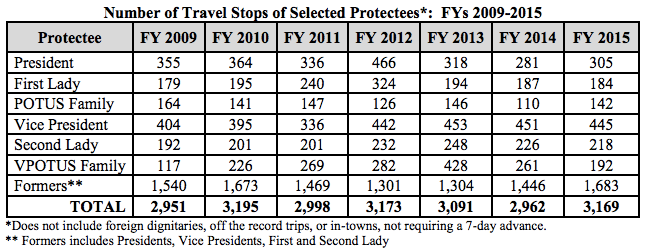
  • Numbers of trips Obama went on per year, durations not listed (page 14 of the section on Operations and Support):

If anyone else has found more or better primary sources for this, please let me know!


* Two caveats: 1) Not all knowable things are knowable using official, original published sources, but that’s the limit I’ve set for myself even when that’s inconvenient or frustrating, and 2) I am a librarian trained in tracking down and evaluating sources — nothing more or less than that. I’m doing my best to find the most authoritative version of the primary sources behind the news, and I welcome suggestions and corrections. If you or someone you know would like to add to my collection of primary sources, please let me know.

Leave a Comment

Journalism, News Media, and Sources: praise and condemnation for 21st century practices

Journalist with Pipe
Schjelderup, C.A.D. “Journalist with Pipe.” Wikimedia Commons.

If you’re constantly wondering if you can believe anything you hear or read these days, constantly worried that you’ll be taken in by some tidbit of fake news (however we’re defining that at the moment), and overwhelmed and exhausted by the prospect of sorting out the real information from the bias, you are not alone. And I would argue that the history and rhetorical traditions of the mainstream media are partly to blame. There’s a lot that’s very, very good about good journalistic practices, but they could do better, and they could do it relatively easily in the age of online news.

First, what are they doing right? Becoming a journalist means becoming trained in ethical standards and methods fact-checking that involve getting independent corroboration from multiple sources before publishing. Another thing that is more invisible but probably more powerful is the publication process itself, which requires that stories get submitted for review by fact-checkers and editors prior to publication. There are multiple points built into the process for people to decide not to publish a story until it has more reliable sources, more or better corroborating sources, etc. This doesn’t mean that sources are unbiased, but it should at least mean that they aren’t deliberately publishing falsehood. And of course, mistakes can happen in journalism just as in the peer reviewed scholarly publishing world, but the system has been set up over journalism’s long history to minimize those chances, there are consequences for messing with the system, and there are multiple levels of staff to do all the work that the system requires.

But the long social and rhetorical history of the news can muddy the waters, too. Printing newspapers back in the day meant strict character and word limits and painstaking type-setting, none of which were conducive to any desire to add full citations to articles like we’re used to in academia. And besides, they were The News — sourced and fact-checked and vetted prior to printing — so readers shouldn’t need full cumbersome citations in order to believe what was being presented.

The problem is that at least for the online version of the news, linking to the study or bill or report when you mention it is trivial. If the New York Times can have an animated gif as its main image for a front page story of the online edition, they can certainly hyperlink these references in the online edition as well. Just as an example I spent over an hour trying to track down “an October government report analyzing White House travel” referenced in a Washington Post article yesterday (and I think I found it, but good grief do you know how many reports from how many parts of “the government” were presented or published in October, and in how many places the different reports could be published??). In fact, my whole recent series of posts has resulted from me asking the very basic question “what publication are they referencing in that article?” or “where did they get that number?” and then essentially providing the footnotes for the news stories I read.

Not only would links or citations help readers consume the news more critically just in general, but they would also help us distinguish between solid journalism and those publications that really are fake news in the original sense of the term. I think it’s long past time for newspapers to do themselves and their readers the courtesy of a citation when they’re referring to published documents.

3 Comments

Healthcare Spending: The source documents behind the news

The Primary Source Crusader (my own mashup of images)

Yesterday the Centers for Medicare & Medicaid Services (CMS) published their projections for National Health Expenditure, covering 2016-2025. Some numbers are floating around the news and social media, and these are the numbers that your lawmakers will (probably) be looking at as they propose healthcare spending legislation. If you’d like to see how accurate those numbers are, here is the report and the data tables for these projections.

Curious about how these projections stack up compared to the years since 1960? Have no fear, the CMS has you covered, summaries and data tables are available.

The projection tables include things like projected population, projected GDP, projected Medicare/Medicaid costs, and even details like projected costs for hospitalization vs medications, so the numbers are sliceable, diceable, and comparable in various ways.

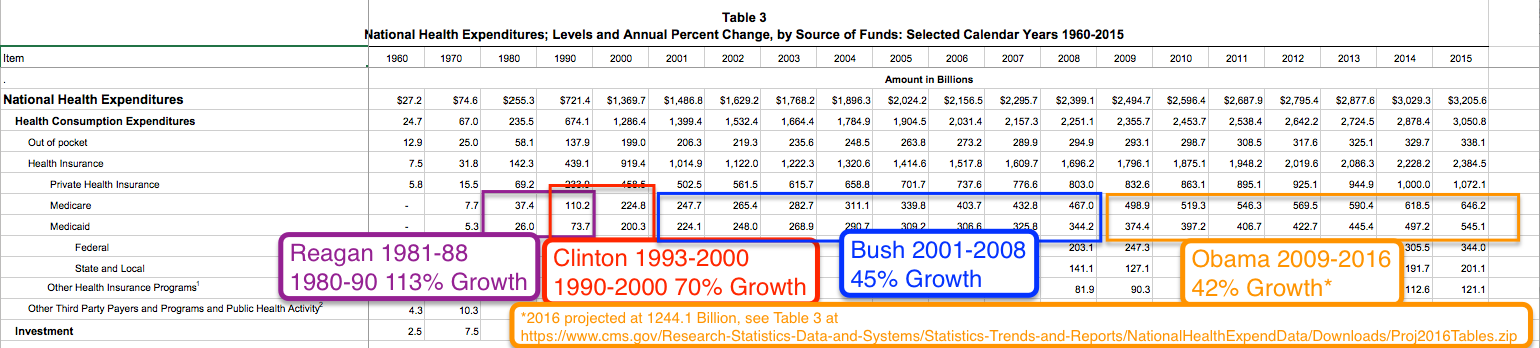
Just to illustrate how you might build context around these numbers, here’s one way of looking at the table laying out total health expenditures (not just Medicare/Medicaid) from 1960-2015 (click to enlarge):

Table 1: National Health Expenditures; Aggregate and Per Capita Amounts, Annual Percent Change and Percent Distribution: Selected Calendar Years 1960-2015. Available from NHE Tables at Historical National Health Expenditure Data. (My annotations)

And then there’s a similar chart for Medicare and Medicaid spending over the same time periods (click to enlarge):

Table 3: National Health Expenditures; Levels and Annual Percent Change, by Source of Funds: Selected Calendar Years 1960-2015. Available from the NHE Tables at Historical National Health Expenditure Data. (My annotations)

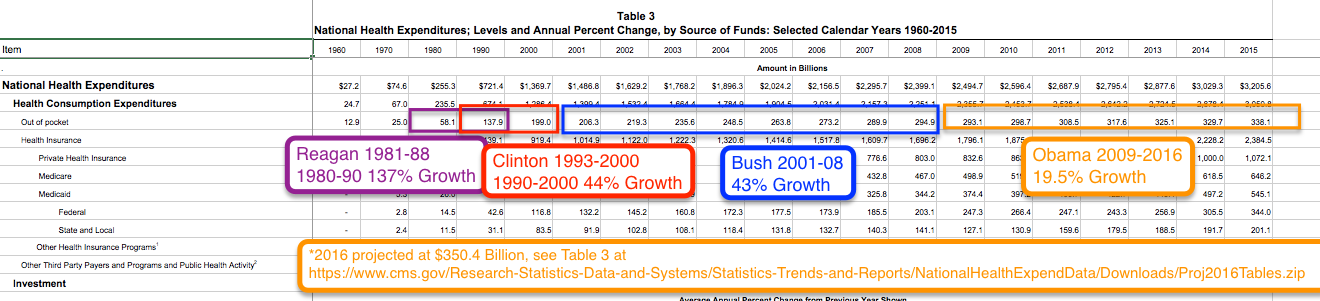
And finally, here’s a similar chart for people’s Out-of-Pocket spending over the same time period (click to enlarge):

Table 3: National Health Expenditures; Levels and Annual Percent Change, by Source of Funds: Selected Calendar Years 1960-2015. Available from the NHE Tables at Historical National Health Expenditure Data. (My annotations)
1 Comment

States Propose Legislation Criminalizing Protests: The source documents behind the news

The Primary Source Crusader (my own mashup of images)

Passions are running high on the topic of protests. Some States have proposed legislation that would criminalize certain protest behaviors, and I was asked for information on exactly what they’re proposing and whether these proposals run afoul of our Constitutional rights.

With my usual caveats for this series,* here’s what I’ve found as I track down the bills referenced in recent news stories.

Last updated: 6/8/2017

Current count:

  • States introducing such bills:
    19
  • Bills introduced:
    31 (plus 1 or more possibly pending in NC)
  • Bills signed into law:
    8 (GA, ND, OK,  SD)
  • Dead bills:
    8 (AZ, CO, FL, MI, MS, ND, TN, VA)

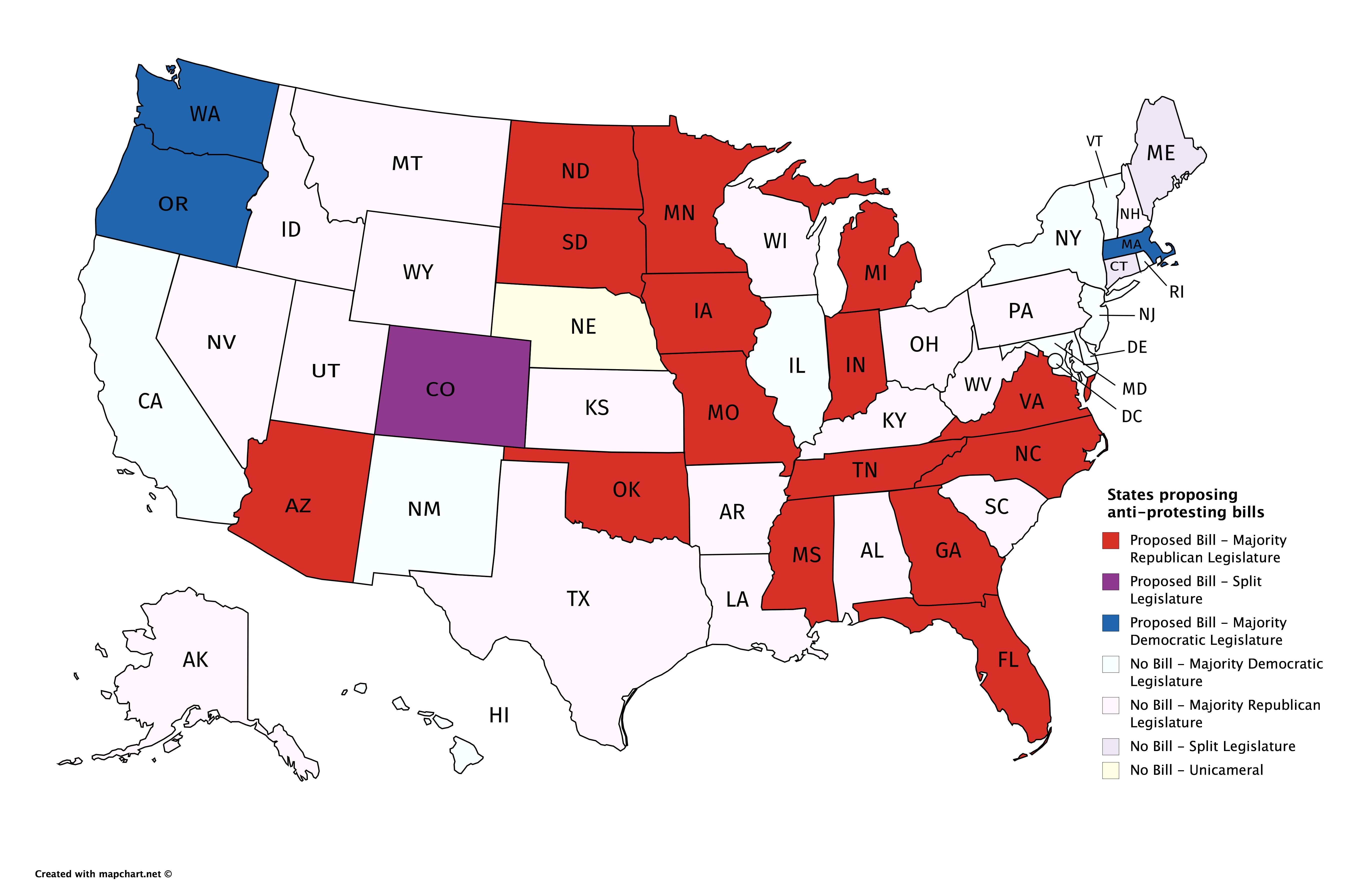
Which states are proposing laws like this?

Map I created April 26th, 2017. Information on partisan control of state legislatures taken from the National Conference of State Legislatures. CC-BY

Put another way:

  • 2 of 14 Democratic legislatures (14%)
  • 1 of 3 split legislatures (33%)
  • 13 of 32 Republican legislatures (40%)

Arizona

  • SB 1142 (text of bill) introduced January 19th, 2017 – Expands the definition of “rioting” to include actions which “either disturbs the public peace or results in damage to the property of another person,” adds rioting to the list of offenses that can constitute “racketeering,” and then combines all of that with expanded definitions of “conspiracy” that explicitly includes planning a riot (here called 13-2903). If a person is guilty of conspiracy or “knows or has reason to know” that someone is conspiring, that person can get the same sentence as the person who committed the offense. Rioting is a Class 5 Felony. “A pattern of racketeering activity” could include a single act of rioting and could be punished in a variety of ways. (Declared Dead)

Colorado

  • SB 17-035 introduced January 13th, 2017 – Deals specifically with protests that involve tampering with oil and gas equipment, making it a class 6 felony. (Passed Senate, Failed in the House)
  • On the other hand, SB 17-062 introduced January 19th, 2017 – Would prohibit public colleges and universities from restricting student protests, such as designating specific times or places where protests are allowed. (Became Law)

Florida

  • SB 1096 introduced March 7th, 2017 – Prohibits obstructing traffic during protests or demonstrations, and exempts drivers from liability for injury or death to a person who is obstructing or interfering with traffic under certain circumstances. (Dead)

Indiana

  • SB 285 introduced January 9th, 2017 –  Defines a “Mass traffic obstruction” as “an incident in which, as part of (or as the result of) a protest, riot, or other assembly, at least ten (10) persons obstruct vehicular traffic in violation of IC 35-44.1-2-13 (obstruction of traffic).” Requires a “responsible public official” to “not later than fifteen (15) minutes after first learning that a mass traffic obstruction exists in the official’s jurisdiction, dispatch all available law enforcement officers to the mass traffic obstruction with directions to use any means necessary to clear the roads of the persons unlawfully obstructing vehicular traffic.” (Passed Senate, in committee in the House)

Georgia

  • SB 160 Introduced February 10th, 2017 – Increases penalties for blocking “any highway, street, sidewalk or other public passage.” (Signed into Law)

Iowa

  • SF 111 Introduced January 19th, 2017 – Would prohibit people from “intentionally blocking the movement of traffic on certain highways.” (referred to committee)

Massachusetts

  • H 807 – “An Act Relative to Attempted Murder By Preventing Highway Access to Emergency Vehicles” introduced January 23rd, 2017 – Adds the words “or by blocking access to or upon the public highway or roadway for any purpose other than road construction, maintenance or official traffic direction by a public safety official” to the current statute. (in committee)
  • H 808 – “An Act Relative to Manslaughter by Protest” introduced January 23rd, 2017 – Adds the words “or manslaughter caused by reckless disregard of life while protesting or blocking highway or roadway access” to the first sentence of the current statute. (in committee)
  • H 809 – “An Act Relative to Intentionally Blocking or Preventing Access to a Public Roadway or Highway while Protesting with the Express Purpose of Preventing Passage of Others” introduced January 23rd, 2017 – Creates the following crime: “Notwithstanding any special or general law, or rule or regulation to the contrary, Any person who intentionally blocks or prevents access to a public roadway or highway while protesting with the express purpose of preventing passage of others shall be punished by imprisonment in state prison for not more than 10 years or by a fine of not more than one thousand dollars and imprisonment in jail or house of correction for not more than two and one half years.” (in committee)

Michigan

  • HB 4643 introduced May 26th, 2015 – “House Bill 4643 would amend Public Act 176 of 1939, which created the Employment Relations Commission, to modify the penalties for mass picketing. In addition to the current misdemeanor penalties, a civil fine could be levied and injunctive relief would be available.” (Passed House in December 2016, in committee in the Senate)

Minnesota

  • HF 390 introduced January 23rd, 2017, and SF 676 introduced February 6th, 2017 – Obstructing a roadway would become a crime, and the penalties for obstructing traffic to a highway or airport are increased. (both versions currently back from committee and awaiting vote)
  • HF 322 introduced January 23rd, 2017, and SF 679 introduced February 6th, 2017  – Governmental units would be allowed to sue to recover costs related to unlawful assemblies and public nuisances. (both versions currently in committee)

Missouri

  • HB 179 introduced December 8th, 2016 – Makes intentionally concealing one’s identity while engaging in “the crime of unlawful assembly or rioting” a class A misdemeanor. (currently in committee)
  • HB 826 introduced February 2nd, 2017 – Makes intentional blocking of traffic unlawful and designate it a class A misdemeanor. (currently in committee)

Mississippi

  • SB 2730 Introduced on or before January 16th, 2017 – Makes obstructing traffic a felony offense. (Officially died in committee 1/41/2017)

North Carolina

  • HB 249 introduced March 2nd, 2017 – Proposes that “A person is guilty of the separate offense of economic terrorism if the person willfully and maliciously or with reckless disregard commits a criminal offense that impedes or disrupts the regular course of business, the disruption results in damages of more than one thousand dollars ($1,000), and the offense is committed with the intent to do either of the following: (1) Intimidate the civilian population at large, or an identifiable group of the 29 civilian population. (2) Influence, through intimidation, the conduct or activities of the government of the United States, a state, or any unit of local government.” (currently in committee)
  • The News & Observer reported that State Senator Dan Bishop plans to introduce a bill making it illegal to “threaten, intimidate, or retaliate against a present or former North Carolina official.” Senator Bishop’s list of introduced bills, however, does not include such a bill. On 3/9/2017 he introduced a bill providing for the protection of former elected officials for 1 year after they’ve completed their terms of office, but it doesn’t specify what these protection officers would protect against. (not yet introduced)

North Dakota

  • HB 1203 (text of the bill) introduced January 9th, 2017 – Creates a “liability exemption” for “a driver of a motor vehicle who negligently causes injury or death to an individual obstructing vehicular traffic.” It also makes it “unlawful” to walk in the road if there is a sidewalk, on the shoulder if there is no sidewalk, or on the right-hand side of a two-way street. (defeated by the House)
  • Four bills that the Governor indicated were in response to the Dakota Access Pipeline Protests
    • HB 1293 (text of bill) introduced January 12th, 2017 – Expands the scope of criminal trespass activity under state law. (Signed into law)
    • HB 1304 (text of bill) introduced January 12th, 2017 – Makes it a Class A misdemeanor for someone to wear a mask, hood or other device that conceals their face when committing a crime. (Signed into law)
    • HB 1426 (text of bill) introduced January 16th, 2017 – Increases the penalties imposed for riot offenses. (Signed into law)
    • SB 2302 (text of bill) introduced January 20th, 2017 – Expands the Attorney General’s authority to appoint ad hoc special agents in response to a request for assistance. (Signed into law)

Oklahoma

  • HB 1123 introduced February 6th, 2017 – Increases penalties for trespassing on or tampering with “critical infrastructure” such as pipelines, refineries, or power plants.  (Signed into Law)

Oregon

  • SB 540 introduced January 9th, 2017 – Would require public institutions of higher education to expel any student convicted of participating in a riot. (currently in committee)

South Dakota

  • HB 1087 introduced January 25th, 2017 – authorizes the recovery of attorney’s fees in civil actions relating to highway obstructions. (Signed into law)
  • SB 176 introduced February 3rd, 2017 – Allows the Governor to declare a “public safety zone” if “an event” looks like it “may consume significant public resources, poses a threat to public or private property, and poses a threat to the health and welfare of the public.”  It would then be a Class 1 misdemeanor to trespass into that zone. Obstructing highways would also be a Class 1 misdemeanor. If passed, this law would expire in 2020. (Signed into law)

Tennessee

  • HB 668 and SB 944 (text of the bill) introduced February 9th, 2017 – Provides civil immunity for the driver of an automobile who injures a protester who is blocking traffic in a public right-of-way if the driver was exercising due care. (The senate version is in committee, the House version failed in committee)

Virginia

  • SB 1055 introduced January 11th, 2017 – Makes it a Class 1 misdemeanor to remain at the scene of a “riot or unlawful assembly” after being told to disperse. (defeated by the Senate)

Washington State

  • SB 5009 introduced December 15th, 2016 – Protests that cause “economic disruption” are illegal. “Sec. 1. The legislature recognizes and fully supports the ability of individuals to exercise their rights of free speech, press, and peaceful assembly, and to engage in other constitutionally protected activities. The legislature finds, however, that there is no right to harm another person or prevent 10 another person from exercising his or her rights. … Sec. 2. The prosecuting attorney may file a special allegation when sufficient evidence exists to show that the accused or an accomplice committed the offense to cause an economic disruption.” (currently in committee)

Can they do that?

The question seems to rest on the exact extent of the 1st and 14th Amendments’ protection for peaceful assembly, and what exactly “peaceful” means.

  • The 1st Amendment prohibits Congress from restricting “the right of the people peaceably to assemble.”
  • The 14th Amendment is the “due process” amendment, and it also prohibits States from making “any law which shall abridge the privileges or immunities of citizens of the United States” (which includes the rights from the 1st Amendment).

These amendments have been the subject of many a court case, and these have helped define the boundaries of “peaceful” and “assembly” and who is covered. — Extra caveats here that I am not a legal scholar, but following citations by people who are legal scholars (starting with Cornell’s Legal Information Institute and the Library of Congress) points to some of the key cases dealing with the right to peaceful assembly.

  • Whitney v. California 274 U.S. 357 (1927). States can impose restrictions if they are “sufficiently clear and explicit to satisfy the requirement of due process of law.”
  • De Jonge v. Oregon, 299 U.S. 353, 364, 365 (1937). Distinguished between the rights themselves and actions that can result from abuse of those rights. The justices ruled that legislation “can find constitutional justification only by dealing with the abuse. The rights themselves must not be curtailed.”
  • Hague v. CIO 307 U.S. 496 (1939). Justice Stone said, “The privilege of a citizen of the United States to use the streets and parks for communication of views on national questions may be regulated in the interest of all; it is not absolute, but relative, and must be exercised in subordination to the general comfort and convenience, and in consonance with peace and good order; but it must not, in the guise of regulation, be abridged or denied.”  Even though this was not part of the main ruling
  • Cole v. Arkansas  338 U.S. 345 (1949). Reaffirmed multiple previous rulings that said the right to peaceful assembly does not include the right to interfere with traffic on public streets or otherwise threaten public safety and order.
  • Ward v. Rock Against Racism 491 U.S. 781 (1989). Held that governments can restrict the time, place, and manner of public assembly and speech as long as these restrictions are “justified without reference to the content of the regulated speech, . . . are narrowly tailored to serve a significant governmental interest, and . . . leave open ample alternative channels for communication of the information.”

* Two caveats: 1) Not all knowable things are knowable using official, original published sources, but that’s the limit I’ve set for myself even when that’s inconvenient or frustrating, and 2) I am a librarian trained in tracking down and evaluating sources — nothing more or less than that. I’m doing my best to find the most authoritative version of the primary sources behind the news, and I welcome suggestions and corrections.

Leave a Comment
css.php