Skip to content

Author: admin

Prioritize or fail

thinkingGreg McKeown was recently on NPR talking about the importance of prioritizing in leadership. He’s been obsessed with the question of why capable people plateau in their fields, and he’s decided that the answer is: success. Success leads to increased opportunity. Increased opportunities lead to diluted focus. Ultimately, he says, “Success can become a catalyst for failure because it leads to the undisciplined pursuit of more.”

After spending a couple of months helping to draft our strategic plan, spending a summer helping to update our mission, vision, and values, and having ongoing conversations about sustainability within my department, McKeown’s ideas seem at once brilliant and impossible.

The fact is, we have been successful, and this has lead to increased opportunities. And personally, my work has broadened in focus from direct reference and instruction about library resources to a myriad of activities aimed at improving teaching and learning on campus as it relates to information literacy. What’s more, I think this broader focus is far healthier and more realistic if my goal is to play a role in graduating information literate seniors (I only ever get to teach a tiny percentage of students, so more systemic information literacy infusions are necessary to my goal). But depending on how I look at it, perhaps I do have a pretty singular goal (graduating information literate seniors), or perhaps I have a plethora of great opportunities that dilute my focus. Where up the hierarchy from the very granular to the very high-level should these focused goals exist?

Comments closed
ArtStudio for iPad: or, PhotoShop for 5 Bucks

Over the Christmas break, someone in my Facebook feed shared a YouTube video of artist Seikou Yamaoka recreating “The Girl With A Pearl Earring” using an iPad. Before I go on, you should watch it too, just for the sheer beauty of it.

Amazing, isn’t it?

So I went to the App Store and searched for ArtStudio and was astounded to find essentially a $5 version of Photoshop. Seriously, layers, dodge, burn, color picker, export in .psd format, all the “Adjust” menus you can think of, filters… everything I ever used back when I had Photoshop, plus a bit more.

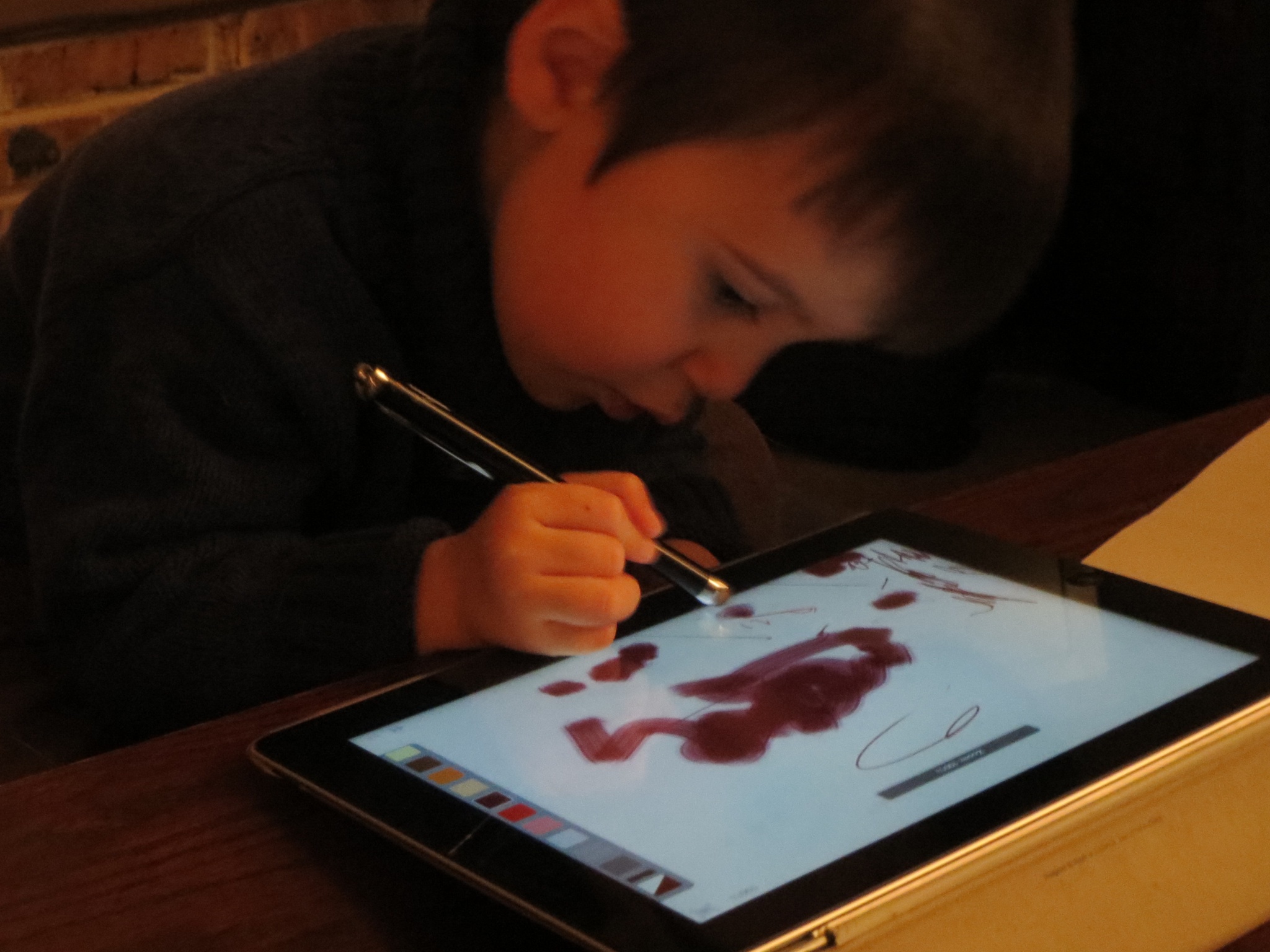
I spent most of a day playing with different paint brushes, specifying just exactly how wet they were, or how much lead and follow opacity I wanted. My little nephew spent long stretches of time on it and even learned to change colors on his own.

Mr 2 using "special pen on iPad"
Mr 2 using “special pen on iPad”

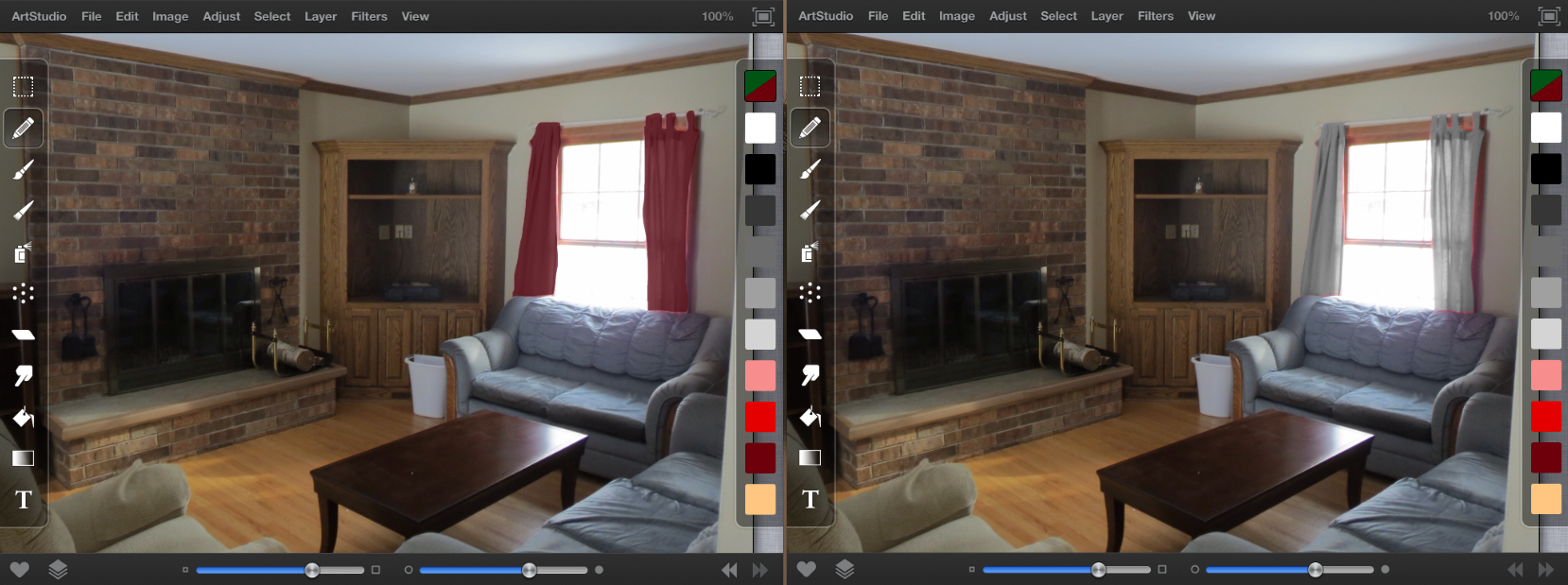
I used a photo of my sister’s new family room to help choose new curtain colors for them. (The original curtains are pink, which, no.)

Red? Grey? Definitely red.

I used a photograph of my parents’ church to design a logo for them.

Building a logo from a picture.

I’m certainly no Seikou Yamaoka, but it’s wonderful to have such a powerful and intuitive art app.

Now, if only GIMP could figure out how to make itself as intuitive, I’d have a desktop image making/manipulation application… Sigh.

Leave a Comment

Joining the Journal of Creative Library Practice

JCLPAnother year, another adventure. This year I’m honored, excited, and a little nervous to be trying my hand at editing a journal!

Joe Kraus recently invited me to join the editorial board of the Journal of Creative Library Practice. As soon as I saw the short list of wonderful librarians editing the journal, I knew I wanted to hang out with them and see what this young journal will become.

I know there are wonderfully creative librarians who read this blog — I’ve learned a lot from the comments and emails I get from you. So if you’ve got an article that highlights an interesting practice or solves a problem in an interesting way, drop us a line or submit a manuscript! Here are the instructions for authors.

Leave a Comment

Being Negative is Safe

It struck me recently that those people who fixate on the flaws in every plan are in safe territory all the time. There are no perfect plans. There are no perfect interfaces. So these people will be right every single time — there are ALWAYS flaws.

But you can’t actually live like that, getting bogged down under the weight of life’s many flaws. And you certainly can’t provide a service or run a business like that. At some point you have to choose a direction and move forward, imperfections and all. This choice to move forward isn’t naiveté, it’s life.

9 Comments

Judging a book by its cover

booksSo here’s a question: If you make your digital humanities project so that the product is a gorgeous website with swoopy interactive capabilities and lush soundscapes, will people engage with it on a deep scholarly level, or will they get stuck in the flash and glam?
This was a question that came up today at a DH workshop on campus, and it got me to thinking about a similar question that had come up at THATcamp in Denver last year — how much web design do you need before people will pay any attention to your site?

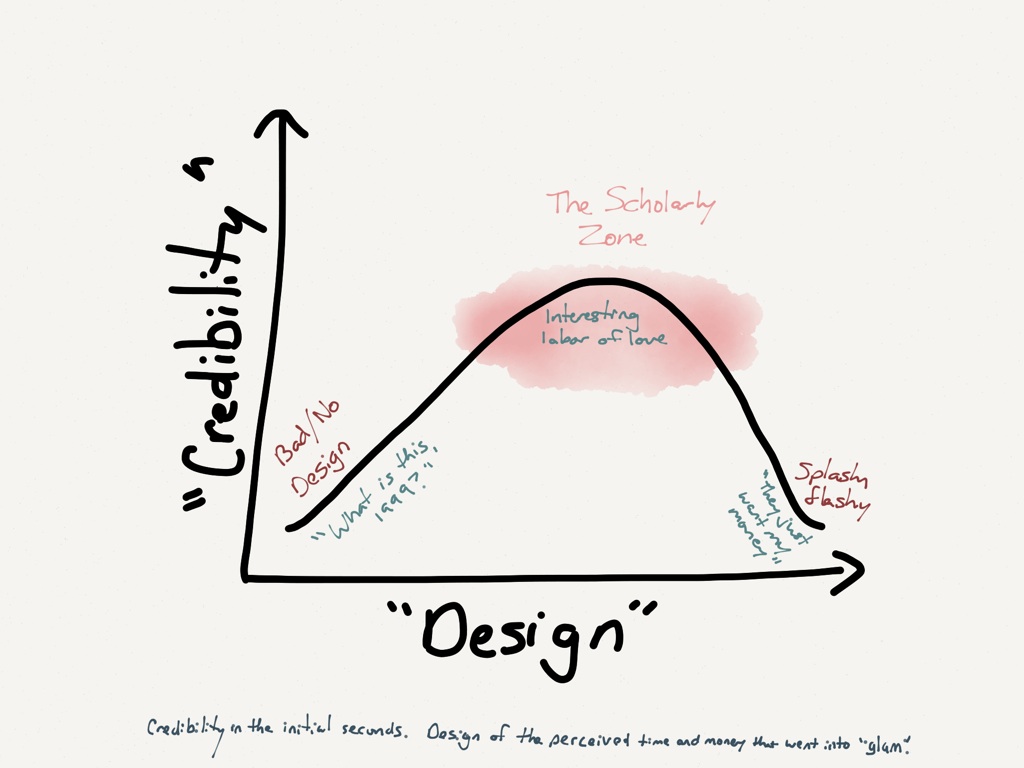
People make snap decisions about website credibility, and they do so largely unconsciously, so research suggests that if you make your site look nice, people will stay on it rather than move on to look for something “better.” This is what people at THATcamp were talking about last year — the need to have enough web design built into their DH projects that their projects will be taken seriously.

On the other end of the spectrum, if a site is TOO beautiful, I start thinking it’s likely to be trying to get money from me. All the money for the custom designing and maintenance has to come from somewhere, right? Likewise, I’m not at all used to seeing scholarly books come out with incredibly designed covers, glossy pages, and custom illustrations.

So maybe there’s some spot part way between “grungy” and “flashy” that would appear the most credible for scholarly DH work. The question is, where along that continuum is the sweet spot?

thoughtgraph

11 Comments

Thesis writing as method acting

theater masks
by Iris


Most of my seniors are in the midst of writing their senior theses at the moment. For some, this is their first time doing any major library research (no kidding). For most, if not all of them, this is the biggest, longest, scariest paper they’ve ever had to write, and they can’t graduate until they’ve successfully completed it.

For students going on to graduate school, this is fantastic practice for their futures as scholars. For everyone else, it’s a really really big paper. And yet everyone is expected to produce work that demonstrates the student’s ability to behave like a young scholar — an almost-expert insider in the community of inquiry that is their major field.

This business of becoming an expert inside in a field is hard enough if you’re aware that that’s your task — it’s harder still if nobody has explained that this is what they want of you. And in my world of information literacy, it’s probably the single most important concept to get across. No evidence that they examine is intrinsically “good” or “bad” evidence. The question is, good or bad for what and for whom and in what context?

“To become an insider requires access to information that is valued and sanctioned with that [conversation] space…. This requires knowing about the sources of information that will inform practice, why they are valued and sanctioned by the community, how they are nuanced and the ways in which they can be accessed” (Lloyd 2010, 10).

I can teach advanced searching of the MLA International Bibliography until I’m blue in the face, but if my students don’t realize they they must first become aware of the norms and conventions of the conversation they’re entering, they have no functional way of selecting appropriate evidence, asking questions of it that are valued within the community, and asserting credible claims for their community.

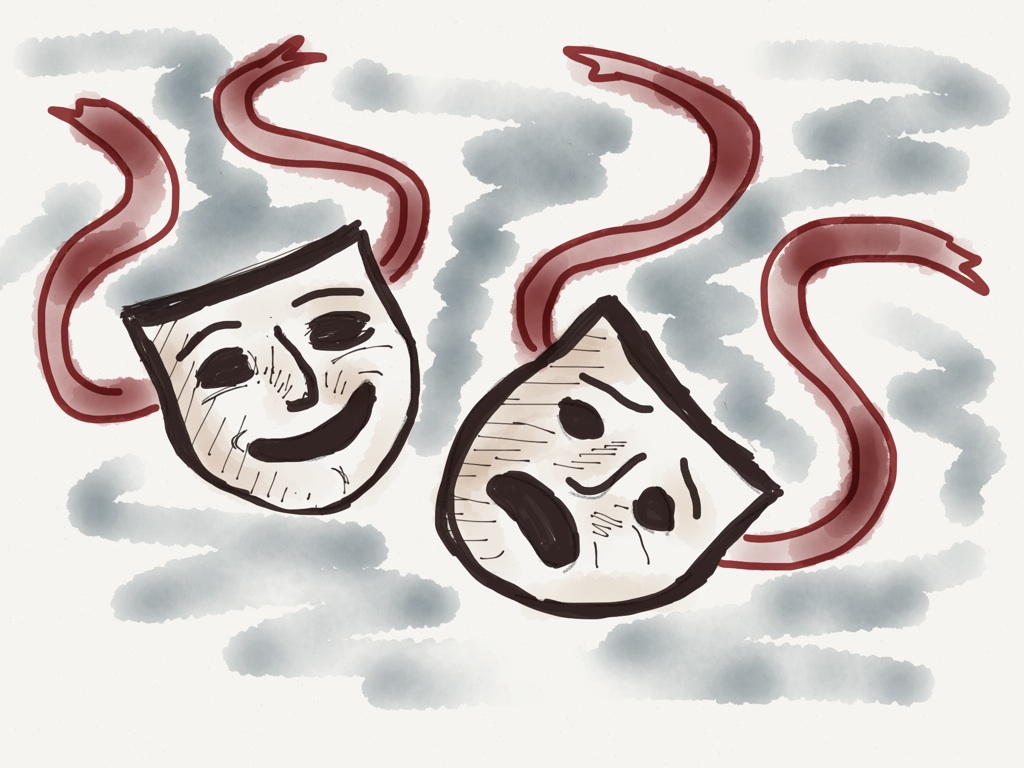
In essence, I’m teaching these students, many of whom will not become PhDs in their chosen fields, to be method actors. See the scholar; be the scholar. Take on the tweed coat, revel in it, and take on the values, characteristics, and moods of that scholar as if they were your own. Only then will they be able to find, select, interrogate, and make appropriate use of the information that surrounds them.

——–

Lloyd, Annemaree. 2010. Information Literacy Landscapes: Information Literacy in Education, Workplace, and Everyday Contexts. Oxford: Chandos Publishing.

Leave a Comment

Having Survived Fall Term

And now, back to your irregularly scheduled librarian mundanity…

The last finals have be given, so Fall term is officially over. Fall terms are always intense, and this one was no exception. The difference this time is that I now have a couple of years of data all in LibAnalytics to look at. Turns out, I do over a third of all my teaching for the whole year in a two-week period in October. Yeow.

This year was also the year of “I wrote the paper, so now I just need some sources,” which is wrenching for both me and the student (particularly because the answer is often “there is no source that says that, so you’ll have to re-write your paper).

I’m also branching out in my projects, helping to run the new Emergency Planning task force. That probably deserves its own post at some point — it’s been a wild ride so far and I now know more than I thought I ever would about our electrical system and the Clery Act.

I ran through my limited energy a couple of weeks ago, so I’m really looking forward to the long weekend this week and the Christmas holidays coming up. I need some quality couch time!

Happy Thanksgiving, everyone. See you in December, most likely.

Leave a Comment

FriendFeed Resurrected: the Afterstory

As with most stories involving hacktivism, major corporations, insanity, and backwater social media platforms, we will probably never know exactly what happened this past weekend when FriendFeed went down for a day and a half.

Theory One

yayfriendfeed
Exhibit A

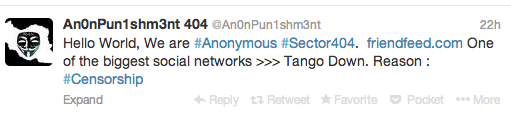
One perfectly plausible theory is that someone accidentally tripped over the FF server’s power cord down in Facebook Headquarters and nobody noticed until Sunday. Meanwhile an Anon thought this would be a good time to protest censorship, little realizing that this would make Anonymous a bit of a laughing stock.


anon
Exhibit B

Evidence for this theory includes: A) the fact that someone at FB HQ could “push the button” that made FF go again, and B) the complete laughability of any Anon thinking FF was one of the biggest social networks in the world.


Theory Two

A snippet of Exhibit A (click to see the full crazy)

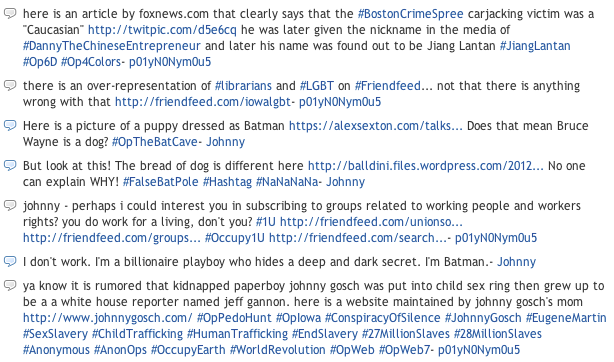
The other theory is that this misguided Anon really did throw an epic tantrum thinking that account deletion (and therefore content deletion) combined with buggy search equals censorship. Evidence for this theory include A) the continuing tantrum that this Anon is throwing over in FF over having had his account deleted as spam and having seen other content disappear and, somehow, images of the Boston Marathon Bombing and an over-representation of librarians on FF… (I believe the technical term is “batshit”)…


help
Exhibit B


…and B) the complete laughability of thinking “here’s a cause that nobody at FB HQ will care about — let’s claim responsibility because then they will PHEER US” when really, nobody at FB noticed until we told them.

Either way, Anonymous (or at least this Anon) didn’t do itself any favors. … And now I’ll probably be DoSed. Sigh.

Anyway…

Whatever the truth, we’ve learned a few things:

  1. Back when FF was still its own thing and they were still developing and improving its code, the data that the search function used was all housed on one machine. Since then, we’ve generated a LOT of data, so essentially old stuff isn’t indexed any more. Probably some new stuff isn’t either. There just isn’t space. So that’s good to know for all of us.
  2. Facebook let us live! And even revived us!
  3. Anonymous, or at least this Anon, doesn’t seem to understand some fundamental things about life, the universe, and everything.
  4. There is apparently an over-representation of librarians on FriendFeed.
  5. It’s a good thing Iain Baker (of Jesus Jones) has an extensive social network. We owe him and his network a whole lot of thanks.

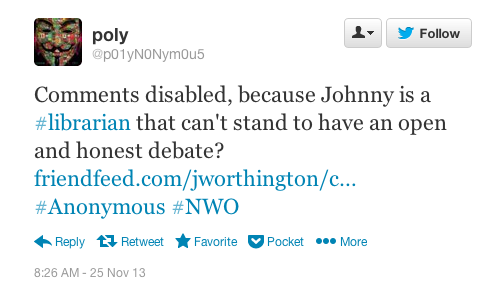
UPDATE for the lulz: The worst insult known to humankind.

lolanon


Johnny is not a librarian. It’s just that Exhibit A for Theory Two started with this post:

Johnny_-_FriendFeed

1 Comment

The day Anonymous took down … FriendFeed?


friendfeedhacker

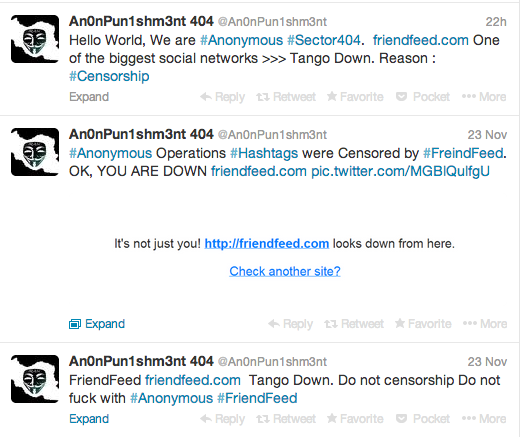
Apparently, Anonymous has mistaken FriendFeed for “One of the biggest social networks” and is therefore venting spleen in the form of a DDoS attack. Why? Because hashtag searching for something Anonymous was interested in didn’t work and therefore must have been censored. Must have! It couldn’t possibly be that FriendFeed is actually the forgotten stepchild of Facebook and the search function hasn’t worked consistently in years for any of us…

Now, for those of us active on FriendFeed, it’s a huge part of our lives and relationships. But none of us kid ourselves that we’re operating on “one of the biggest social networks.” In fact, most of us are simultaneously pleased and baffled that Facebook has let us limp along for 4 years on our preferred platform even after the whole FriendFeed team went to work for Facebook instead. TechCrunch can’t figure out why FriendFeed even still exists to be attacked. I’m mostly worried that this whole attack will remind Facebook that they forgot to pull the plug on us years ago.

So while we wait for Anonymous to realize what a backwater they’ve chosen on which to take their anti-nonexistent-censorship stand, we can speculate about a) how little they actually know about the internet, b) how bored/drunk/high they were when they launched this attack, and c) what they’ll take down next.

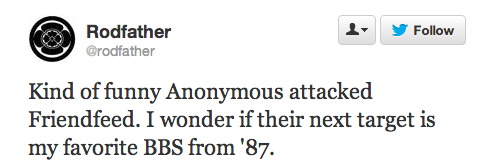
Rodfather has a guess about question C.

twitter-rodfather

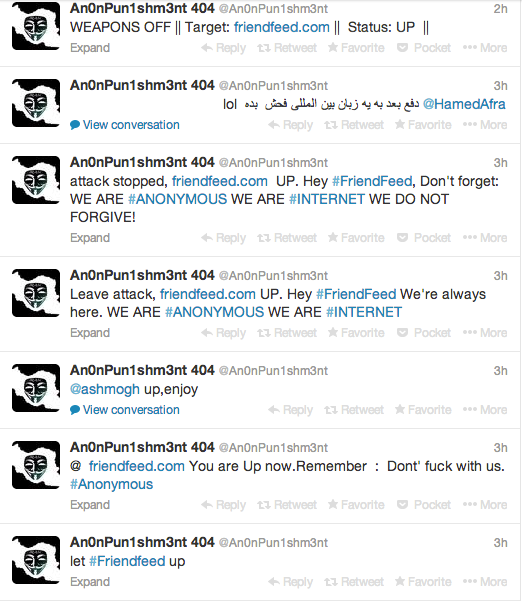
UPDATE: After almost 2 full days of downtime, Facebook got FriendFeed back up and running at 2:30 this afternoon. Rejoice!!!

help

yayfriendfeed

friendfeedup

The story continues in my next post.

9 Comments

Sprucing up the place

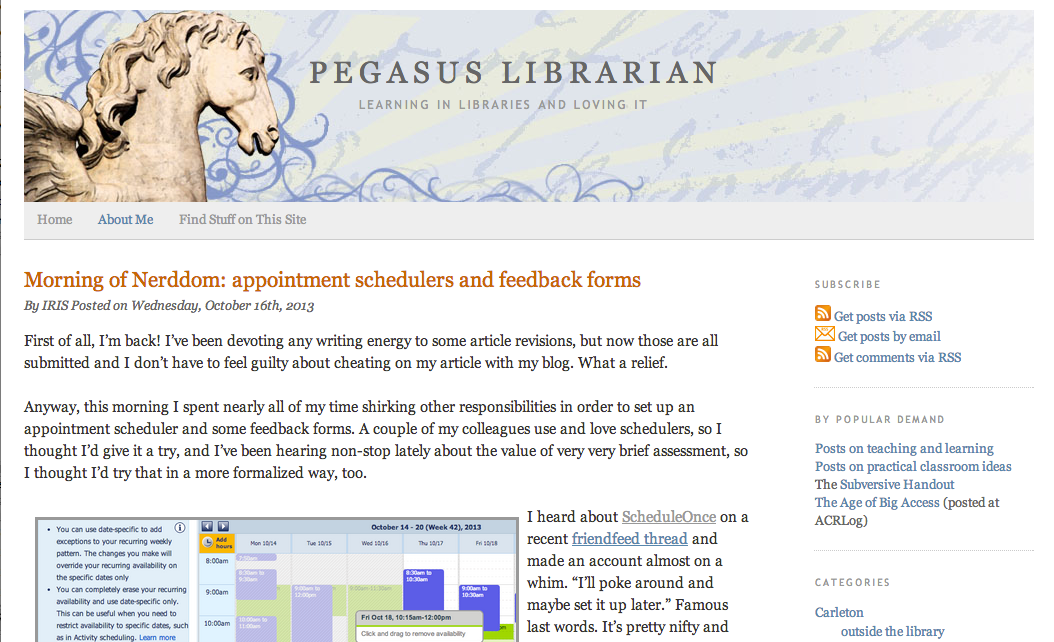
I realized it’s been at least 6 years since I last changed the look around here. Websites probably shouldn’t go that long between updates, so take a moment to remember the old, lush Pegasus while you explore the new site.
a screenshot of Pegasus2013

Leave a Comment
css.php