Skip to content

Month: October 2008

Emerging Themes from Internet Librarian – Ethnography of Online Life

It’s a curious thing, going to a conference. A healthy chunk of the presenters are people I know and talk with all the time, so I’m often familiar with their topics and sometimes even with their approaches. And yet, the experience of going, sitting, and attending sessions back to back, hour after hour, day after day is still enlightening. It’s not so much that I learned new facts (though there was a little of that, too). No, it’s that when you sit through that many sessions, themes emerge from the periphery, gather form and substance, and finally strut around in all their splendor.

The theme that emerged most strongly for me at this conference was ethnography. Previous conferences have trumpeted tools, change, and stories, but this is the first time that I saw a collective desire to understand what it means to inhabit this online world.

Rather than lead us on tours of tools and services, more than one presenter echoed Cliff Landis’ statement that it’s not enough to have an account any more, you have to participate. Over and over we heard about presenting ourselves as humans online, not as institutions. Sometimes this means presenting yourself as a professional (Elizabeth Edwards’ session on an ethnography of Facebook made this point),* but even professionals have personality, and personality is as important online as off. danah boyd spoke compellingly about how an online profile is our digital body that we adorn as if we were getting dressed in the morning.** And both Greg and I spoke about online identity.

Not only are we finally taking a closer look at what it means to inhabit these online spaces, but the online spaces are becoming more integrated with our off-line spaces. As the two worlds come closer together, as the process of switching from one to the other becomes less and less of an action that requires thought and decision, and as computing becomes more and more ubiquitous, these issues of social norms and interpersonal interactions are bubbling to the surface and commanding our attention. How refreshing! This was the first conference in a long while that didn’t rely primarily on listing Tools You Should Know and instead concentrated on interacting with people online.

* A very similar presentation to the one we saw was blogged here.
**For excellent notes on this talk, see Jenica’s blog.

3 Comments

A Side Effect of Social Networks That I Hadn’t Anticipated

I’ve noticed a curious trend here at Internet Librarian. Those sessions led by LSW members are consistently of high quality. They were informative, humorous, to the point, and organized. Those sessions led by non-LSW members are a very mixed bag. A couple were brilliant (I’m thinking of danah boyd, especially). A few were definitely not.

One explanation could be that we’ve managed to amass a group of cool librarians that are also good presenters. And while I think this is definitely true, I don’t think it’s the whole story. For one thing, if this were the whole story, I’d expect to see improvement in those of us who’ve spoken a lot, and I’d expect to see newer presenters from the group playing a bit of catch-up. I’m not really seeing that, though. It seems like the entire group, veteran and newbie speakers alike, churned out really high-quality work.

My theory is that the fact that we keep up with each other online, and the fact that we all know and respect each other, enticed everyone to step up and make sure that what they presented would be top notch. Put simply, everyone was proving to everyone else that they were cool enough to belong in the group. Even those who had never spoken at a national conference before had a reputation to maintain in front of a crowd of seriously talented, smart, and funny peers.

There’s a down-side to this network effect, too. We generally knew a lot of the facts presented already, since we’d already presented them to our peers online. Still, I heard several things expressed in person in ways that I hadn’t heard online. And the sheer mass of presentations and discussions juxtaposed against each other highlighted some trends that I would probably have missed otherwise.

The conference is over now, and we’re all scattering back to our respective homes. The conversation about librarianship will continue, though, as we keep up with each other online. I wonder what this means for the quality of next year’s conference. Only good things, I imagine.

Next up: actual information from sessions. I promise. I’m working on it.

9 Comments

Dispatches from Internet Librarian

I now understand the cult of Internet Librarian. People have been telling me for years that I needed to come, and for years I’ve very prudently stayed away to tend my collection of panicky Fall Term students. But this year I was asked if I wanted to help lead a pre-conference workshop here with pretty much the best group of people ever, and so here I am, and it is wonderful.

I wake up every morning (far too early, I might add, due to the craziness that is the Pacific Time Zone) to the sound of the sea lions singing to each other. There’s good sea food. There’s good company. And there have been several really interesting sessions so far. I might even get around to blogging about a couple of them soon. For example, there was a great session on an ethnographic study that a team at George Washington University did to see how students used Facebook and how librarians might appropriately fit into that world. It’s always great when somebody backs up hunches about the way things work with actual research.

But more on that next time I have a good wireless signal.

1 Comment

Dear EndNote

Dear EndNote,

I use your product to manage my ever-growing collection of PDFs and bibliographic references and, on occasion, to suck those references very handily into the writing I do. I teach your product to students and faculty and have spent quality time figuring out how to present it in a way that’s simple, memorable, and not overwhelming. I tweak custom filters and styles for anyone on campus who asks and even for some who didn’t think to ask. I boldly stand up for your product when people curse its steep learning curve, explaining that there are times when the cost-benefit analysis tips in favor of learning a massive piece of software like this. For those times, there’s EndNote.

I’ve got to say, though, that I’m finding this generally sanguine attitude toward EndNote more and more difficult to maintain. First, there’s the way you always put off releases for the Mac platform until quite some time after releases for the Windows platform. This is not an uncommon practice among software companies, I know, but it’s less and less tenable with each passing year. Have you been to a conference lately? Look around and notice all the Macbooks in the audience. Mac users are no longer a fringe user base.

Now, after years of proving to us that you think the Windows platform is at the top of your value scale, you’ve modified your implicit value system to favor the Windows XP version of your favorite platform. I know people love to complain about Vista, but it’s been out for 2 years now. I should not have to teach tedious work-arounds to my faculty and students who have happily used their Vista computers for years now. There was no excuse for allowing EndNote X1 to have been released last year without full compatibility with Vista. None. You had access to Vista. It was your job to make your software work with the platforms your user base were using, not for Vista to conform to your software. Imagine if I decided that my town should reorganize itself so that my favorite hang-outs were near my home rather than deciding that I should move to be nearer to the places I work and play? Absurd, right? The town was here before I was, and there’s nothing I can do to change it.

EndNote X2 is just out, and I hear that it’s doing better. That’s great, but late. Let me reiterate: if you proclaim your belief that the Windows platform is the platform of choice for EndNote users, you belie yourself by making that same user base wait 2 years for a software upgrade that makes EndNote work correctly. And since many campuses can’t upgrade EndNote until the school year after you release a new version (so that we can make it work with our lab builds, and so that we can have both PC and Mac users on the same version of EndNote without having to teach one version to half our patrons in the first month of Fall term and then suddenly switch all these Mac-using patrons to another version all of a sudden) we’re stuck using X1 for yet another year. My Vista-native computer will be due for replacement before I get an EndNote version that works well for me. I realize this is half our problem and half yours, but even so, none of the other software I use has inflicted this frustration on its customers.

But enough about platform compatibility. What about being a good citizen of the software community? A healthy response to competition is to capitalize on your unique benefit, not to pout that others can do the most basic part of what you do. (Yes, I’m talking about Zotero, here.) Your unique benefit is your vast array of output styles. I mean, really, 3600 citation styles is amazing! And the fact that I can instantly customize these styles to fit my needs or those of my patrons… that’s a unique benefit. When the German department here on campus requires its students to use the early 1970s version of MLA as the citation style for their senior theses, we can accommodate that. When the Music department makes up its own citation style, we can accommodate that. This is a Very Good Thing.

Simply collecting citations is no longer the coolest thing on the planet. Taking bibliographic information and spitting out a citation in one of the top citation styles is also no longer the coolest thing on the planet. These are not functions that set you apart from any number of other products that are now in existence or will be in existence soon.

So if your old kingdom is no longer new enough to be different by default, concentrate on making your unique benefits your selling point, and concentrate on making them even better. You might even take a page out of Zotero’s book and make the data-collection piece of EndNote easier on your users. But for heaven’s sake, whatever actions you take, stop doing things that make your long-time users ashamed of you. That’s no way to grow a user-base.

Yours,
Iris
8 Comments

Nerves

I’ve been diligently getting ready for my part of the preconference workshop that Amanda Etches-Johnson, Jason Griffey, Jenica Rogers-Urbanek, Steve Lawson and I are doing at Internet Librarian. It’s been slow going. I’ve gotten so used to presenting in an instruction-like way, and that’s not what I’m going for with this presentation. I’ve also gotten use to sustaining a complex thought for about the length of a blog post. (Actually, no. I sustain a complex thought the length of a blog post on the good days. The rest of the time I think in one- or two-sentence bursts.) So here I am, trying to sustain a complex thought for an hour’s worth of speaking and trying to make it sound as simple as possible.

I realize this isn’t actually so hard. I’ve done it before. Which left me wondering why I’m rather obsessively going back over details, shuffling things around, thinking up better examples, and then reworking things over and over and over and over. And as odd as it seems, I think it’s because I’m nervous.

I’m not nervous about presenting to the workshop attendees. Goodness, I do that nearly every day. I’m not nervous about my content, though I do think it’s probably of a different tone than most people will be expecting. No, I’m nervous about my co-presenters seeing me present. These are people I’ve looked up to for years. These are people that I look to for inspiration, for clarity, for affirmation. These are people I’ve come to consider friends. Who wouldn’t be nervous revealing their public-speaking selves to such an audience?

5 Comments

Jealous!

I would dearly love not to be here tonight. I would much prefer to be in Denver getting ready for LCOW. But I’m not there. I’m here. And I could almost cry.

2 Comments

Why the Love for “Print” Sources?

Last week one of my co-workers and I met with this year’s new writing tutors over the course of 5 small-group sessions. These sessions always present the unique challenge of building the students’ confidence and facility as tutors while at the same time covering library basics. We need to assume they don’t know these basics, but we also want to treat them as credible professionals.

In amongst all of this, we wanted to introduce them to the strategy of using Ulrich’s to determine if an article found online counts as a “print” source. And we thought we’d explain to them why professors continue to include this now-outdated terminology in their assignments even though they know that the vast majority of the library’s journal collection is online, and even though they will usually agree that even online-only journals count as print sources, and even though students have no context by which to distinguish online-but-count-print materials from unacceptably-online materials. As my co-worker and I thought about it, we realized that “print” is really short-hand for a whole set of assumptions about the publication, most of which have nothing to do with it’s actual format.

“Print” implies editorial oversight at the very least, if not peer-review. There’s a whole structure to the process of printing a journal that exists to protect the publication’s reputation by ensuring the quality of the publication’s contents as much as possible. This process also ensures that authors’ work is distributed by someone other than the author. This history, this structure, this process bestows a beautiful halo of enhanced credibility around those articles that make it through the vetting process and finally appear in print.

I’ve found, as I talk with professors who continue to require print sources, that what they’re really asking for is scholarship that has been inoculated by this process. Every professor I’ve talked to has agreed that even journals that were born-digital would count as legitimate sources for their assignments. “Print” simply stands in for all the layered assumptions.

Clearly we need new terminology because I wholeheartedly support the current assumptions.

5 Comments

Where’s She Been?

Running around like a chicken with her head cut off, that’s where. And sick. (There’s nothing like putting on a good imitation of an enthusiastic librarian while wondering if that sick feeling will finally manifest as a full-blown stomach flu in the middle of a class, let me tell you.) Yes, Fall term has risen up from its lair and beaten me to a pulp while somehow leaving me feeling slightly elated.

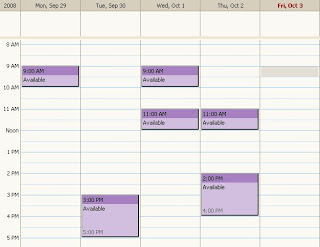
As many of you know, I keep a calendar of “available” time so that students can see when I’ll be in my office. Here’s what this week looked like.

Yes, those were the only unscheduled hours I had this week. Those were the hours in which I prepped the 6 classes I taught, figured out how to help a student find broadcast TV news footage from the beginning of the current Iraq war, figured out how to help another student find the possible connotations surrounding beds in Melville’s time, and then did all the other stuff that I’d normally do in a week at work… while battling the flu. No wonder it seemed like 2 or 3 weeks rather than just one.

Luckily, the classes all went really well, and I’m really pleased that the faculty in my departments have started to call on me so readily. So even though I’m far too tired to celebrate, I will sit here and smile for a minute or two before getting back to the business of being incredibly, bone-jarringly, head-swimmingly tired.

Tomorrow I will do no work before noon. None. I will sit on my couch, hang out online, and watch a DVD. After that I can start getting ready for a class I’m teaching on Monday morning (at 8:30 no less) and getting my act together for Internet Librarian.

2 Comments
css.php