Skip to content

Pegasus Librarian* Posts

Sunday Reference Shifts

I have a love-hate relationship with Sunday reference hours. The library’s full of students and projects are due tomorrow (the traffic really picks up just as I’m leaving at 10:00 at night!), there’s an intresting energy in the place and I get to take a day off later. But at the same time, working all afternoon, evening, and night at the reference desk is kind of draining. And besides, it’s finally BEAUTIFUL outside.

Leave a Comment

MARC in the new millennium

In his essay “The Inevitable Gen X Coup,” Brian Mathews says that “MARC is dead.” I don’t think so. I think MARC is under-exploited. Add a touch of FRBR and some interconnection with user metadata, holdings information, and the like, and MARC is still a hugely viable and valuable source of information. It’s not MARC that’s dead, it’s the container we’re using to manipulate and display that bibliographic information. Well, I guess OPACs are “not dead yet” (as my favorite British comedians would say), but they’re moving in that direction.

(Cool! I just discovered FRBR has its very own blog!)

Leave a Comment

The Lego Age

I was at Paul Miller’s session at CIL where he made the now-famous analogy between new web services and legos. Specifically, he was talking about the ways in which new web applications are made with whole sets of loosely associated and interchangeable bits. (Think Firefox and its extensions.) This theme was applied specifically to ILS vendors in a recent discussion of the Library 2.0 Gang (Thomas Brevik, Michael Casy, Dave Errington, Paul Miller, Michael Stephens, and Richard Wallace). Wouldn’t it be cool if there were a base ILS model onto which you could pile as many or as few “extensions” as you wanted?

Say you wanted RSS functionality, or AJAX pre-searching, or a mashup that would show users the exact locations of their books in the stacks. All you’d have to do is download those extensions. (And by the way, there are catalogs out there that have done each of these things.)

So maybe when we’re talking with vendors we shouldn’t be asking “what features does your ILS have?” Maybe we should be asking who’s developing the plug-ins or add-ons or extensions, where the user forum for suggestions and questions is, and which of the developers have blogs.

(This Library 2.0 Gang also expressed quite a bit of interest in the upcoming Internet Librarian conferences, both the one in California and the one in London. They’re also interested in developing “Conference 2.0” and in the book Ambient Findability.)

Leave a Comment

Course Management Systems — decisions, decisions

My school is currently evaluating two course management systems, Moodle and Sakai. I haven’t worked here very long, only about 9 months, which is apparently about 2 years less than the amount of time they’ve spent thinking about these course management systems. Last term, we finally did a side-by-side comparison of the two systems by having a handful of faculty use each (the faculty got to choose which to use) and then surveying those faculty and their students.

Today, the IT staff, members of the web development team, and librarians met to discuss the survey results, decide what other studies need to be done, and plan for a presentation to the faculty at the end of the term which will announce the winner of this little contest and explain the rational for our choice. What we decided was that we have a lot more studying to do. It turns out we’re comparing a course management system with an “interoperability platform” which can also be used as a course management system. And therein lies the rub. Do we want a system that is a pretty slick (though not perfect) CMS, or do we want to back a system that has potential to be something that it isn’t yet: a comprehensive collaboration and communication system.

As usual, nuts-and-bolts decisions force us to struggle with our goals, priorities, philosophies, and hopes. Philosophy and practicality are proved, yet again, to be inseparable.

Leave a Comment

EverNote


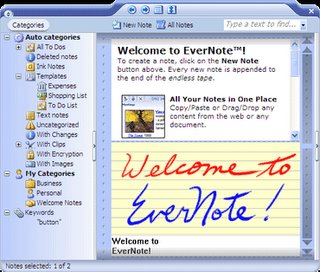
EverNote is cool. I downloaded it in January thinking it might be cool or useful, but pretty sure it was more my inner geek taking over than anything else that prompted me to try it out. Well, I was wrong.

Remember when you got your very first microwave (my family was a very late adopter, so I really do remember my family’s first microwave)? Remember how you thought it might be useful on rare occasions? Remember how within a matter of days you couldn’t even remember life without one? Well, that’s what this has been for me. I now have it open on my computer at all times. I plan all my classes on it. I write my follow-up notes on what went well and what went poorly in my classes on it. I keep track of what I’ve tried and what I’ve found when working on really hard reference questions. And (as many CIL-ers know) I take copious notes at conferences and meetings into it. (People think I’m being “cool” or “hip,” but the reality is that I just can’t remember things I hear at meetings, so I have to take notes.)

I love EverNote. It lets me assign multiple categories to notes (which is much better than putting notes into folders), and I get to make up my own categories. It also lets me keyword search all my notes. It also comes with a “web clipper” that you can click and it’ll import selected parts or all of the web page you’re viewing at the moment into a new note. There are, however, a few things it doesn’t do that it absolutely should do.

  • It doesn’t work on a Mac, so I can’t use it at our reference desk.
  • It isn’t web based, so I can’t access it from all of the many computers I use all day.
  • It doesn’t sync, so you actually have to export from, say, your desktop computer to a flash disk and import into the database living on your laptop. To move back, you have to do all this in reverse. This requires that you remember to update your database on whichever computer you’re using at the moment before taking new notes so that you guard against overwriting old notes that you’ve edited.

But these lacks will (hopefully) be remedied in future upgrades. There’s a highly active user forum, and the developers spend a lot of time participating in the forum. Oh, and did I mention that it’s FREE.

Leave a Comment

Academic Librarians vs Academia?

Two seemingly unrelated events converged to create a clearer picture of what academic librarians are facing these days. One was a stimulating and enlightening meeting with the Twin Cities Writing Professionals group last Friday. At this meeting, members of the group and the librarians they had invited to join them for a day all began to realize that we’re working with students on the same general skills (thinking critically, reading critically, evaluating what you’ve read, and communicating well). But that’s a topic for another evening. The moment of realization came for me when one writing professional attempted to articulate the difference between writing professionals and librarians by saying,

It seems to me that we’re both trying to help students toward good writing, but while writing professionals believe in providing guidance but not answers, librarians are trained to deliver answers to questions.

Needless to say, this provoked quite a bit of lively discussion. I don’t know of a single academic librarian who strives to do his or her students’ homework for them!

The second event occurred today when I attended the presentations given by senior French majors at my campus who had just completed a year-long project (their senior thesis or, as we call them here, “comps”). As I listened to the three girls present on reconciling traditional vs colonized marital arrangements in Madagascar, the French health care system, and stereotypes of “youth” and those riot-ridden “suburbs” in France, it struck me that “successful” comps talks problematize more than they clarify. In academia, we are suspicious of anything that seems to “answer the question” too clearly, too neatly.

So here’s what librarians face on college campuses today: a general conception that we “answer” questions, and a culture that regards finding answers as the cheap and easy way out, as naive, or even as cheating.

3 Comments

Service and Content, the Definition of a Library

I like Eric’s definition of a library, digital or otherwise:

Collections without services are useless, and services without collections are empty. You can’t have one and not the other and call your thing a library. Librarians need to provide equal amounts of both in order to practice balanced librarianship, especially in a digital environment.

Leave a Comment

Library 2.0

Recently (by which I mean the last year or so) people in my profession have been discussing a concept of libraries and librarianship. That’s a clunky sentence, but there’s a reason for that: I hesitate to call this concept “new,” which is a normal word to insert into a sentence such as that one. Another reason is that the name (or rather, nickname) of this concept is even more controversial than the concept itself, so I left that off too. So here’s the concept:

  • Libraries should deliver the services their users need in the format that best serves their users.
  • Libraries should keep up with innovations in their field and in the technology that they and their users can or could harness to help them fill their information needs.
  • Libraries should recognize that there are a lot of kinds of information that their users need (print, digital, prose, image, data, and the list goes on).
  • In short, libraries should be relevant to their users.

Does this sound revolutionary? I think not. I think this is what we’re doing and have been doing for, well, forever. So what’s the big deal? The big deal is that this concept is being spun as something new, and it’s being spun in a way that seems to be intended to be inflammatory. It’s meant to shake us out of our “we’ve always done it this way” funk, but in doing so it alienates two major groups of librarians: those who need the chance to understand the concept before accepting it, and those who have always been exploring the ever-changing topography of user needs.

To deal with the first group of alienated librarians first, I think that arguing that we need to get away from arguing about the name of a concept (as was stated, rather forcefully, at the Dead Tech session of CIL two weeks ago) in effect side-steps a major issue. If people are unable to discuss a concept because the name itself makes them mad, maybe the name is an issue. Librarians of all people should understand that exact words matter. We wouldn’t have so many acronyms if we didn’t believe in thoroughly explaining every service, group, and tool in its name (the Online Public Access Catalog comes immediately to mind…who thought up that little sobriquet?).

So, what’s in a name? The name that’s been pretty firmly attached to the concept at hand is “Library 2.0.” This name immediately does two things that I don’t think were intended by those who coined it: it implies that the skills, services, and holdings in libraries are obsolete, and it names libraries a “technology” fashioned by others and totally reactive rather than a living, vital group of people providing value-added services.

For the second group of alienated librarians, it implies that we haven’t been doing what we should be doing. Now, I’m not saying that the L2 concept actually is telling us to hurry up and do what we’re already doing, but simply by calling it the second iteration (and, by implication, the better iteration) of librarianship, it implies that we’re not doing something that we should be doing. And there’s nothing more annoying than being told to do what you’re already doing.

One final note, and then I’ll quit. I think that the pure volume of the discussions surrounding this concept is part of what makes some librarians uncomfortable. It feels like one more symptom of a disease that is ravishing the library profession. This disease is “Millennial Discomfort,” and it’s systemic in libraries. There’s such hysteria, such frantic runnings around in circles, and (let’s face it) such fear of this new generation and how “different” they are that the profession is on the verge of paralyzing itself. Somehow, we’ve lost sight of the fact the librarians get a whole degree in how to find out about stuff. So what’s so scary about finding out about new technologies, services, and information sources? It’s what we’re trained to do.

So let’s talk about the concept just as a part of librarianship and not as a part of any NEW librarianship. Let’s serve some users and do it well… just like we’ve been doing since librarianship was invented.

p.s. Some other people who are discussing this concept are Stephen Abram, Steven Cohen, Panlibus, and over a hundred thousand others.
1 Comment
css.php