Skip to content

Pegasus Librarian* Posts

College Students’ Perceptions of Libraries and Information Resources

OCLC has re-examined the famous perceptions report data in order to find out what college students think.

Overall, respondents have positive, if outdated, views of the ““Library.”” Younger respondents, teenagers and young adults, do not express positive associations as frequently. These findings, and more, are valuable insights for anyone seeking to know more about the library usage and perceptions of college students and young people.

You can download the 100-page PDF report here, or go to the information page for more access options.

Leave a Comment

Privacy Please?

Privacy. In theory, I’m all for it. In theory I would like to think that people shouldn’t be keeping tabs on me. In theory I would think I shouldn’t be keeping tabs on other people. And there are a lot of librarians who have adopted privacy as one of the primary concerns of their services. (There’s rather a thought-provoking piece over at Library Juice on the topic.) But please don’t lynch me when I confess that there are some aspects of privacy that I just can’t get worked up about.

For example, this morning I heard a piece on NPR that basically said that if you’re driving a car built in the last 5 years there’s a really good chance that it has a tracking device or an “event recorder” built into it. As I listened to the interviewer and interviewee discuss how this violates personal privacy, I found myself unable to care whether people knew what speed I’d been going when I crashed, or how many miles my average trip was. “But that’s just aggregate data,” I told myself, “What if I knew that they could plot my trips, or pinpoint my location at any time.” Just then, the reporter said that in some cases, this would be possible. And still, I had a hard time caring. I mean, I care. And I think people should know when they are transmitting this type of information. And I think they should be able to opt out. But in my head, those are slightly different issues.

Maybe it’s because I’ve gotten used to the idea that cookies, IP address tracking, and referrers online can pretty much guarantee that whoever wants to can figure out exactly what I do online at all times. Maybe it’s because I’m too young and naive to realize what evil could be done to me if people know where my car has gone, or (to bring this to the library) what books I check out, or articles I read.

But with all this privacy talk circulating, it was really good to read Paul Miller’s take on it. Up until that point, I’d thought I really must be stupid because everybody else knew privacy was the most important thing about libraries.

Don’t get me wrong. I don’t think that privacy isn’t important. I think it’s very important. But I think that we need to stop assuming that our users would run screaming from the idea that we could track how often they stop in to the library, or log in to our databases from off campus, or search for books rather than articles, or anything like that. Some of them, many perhaps, wouldn’t care. And we could learn a lot from them. What if we had varying levels of privacy and let the users choose? What if we could use this type of tracking to build recommender systems into our databases? The possibilities are endless. And as long as we provided an easy opt-out option, I don’t see the harm.

But then, I don’t see the harm of a transmitter in my car (if I ever buy a new enough one). So maybe I’m not a good judge.

1 Comment

Planning the World From My Shower


While showering (which is when most of my wild ideas get hatched) I wondered about integrating the catalog and other library resources into my students’ workflow. If we ever get our research portal up and running I’d love to have a firefox extension built into the lab computers that would put “Search the Libe” or “Libe It” (here on campus our library is referred to as “The Libe”) into the Firefox browser search box. I’d like to get “Libe It” into right-click menus all over the place!

Wouldn’t it be great if you could “Libe It” from a document you’re authoring, and a little application would run to analyze your document and suggest search terms? And maybe it could even presearch some databases to point you toward those databases that might be fruitful?

2 Comments

More on the Future of the Catalog


Scream if you’re tired of this subject, but I’m studying hard for my presentation and thought as long as I was keeping notes and collecting URLs I might as well share them with anyone else who’s studying this topic.

First of all, here are some links to catalogs that are doing cool things:

(I’m still trying to find examples of AJAX-enhansed searches, but the only one that I know of is not, I think, public. You can see examples of LiveSearch by OCLC on Lorcan Dempsey’s PowerPoint slides.) [Update: Thom from OCLC Research has pointed me toward Phoenix Live, which uses AJAX to pre-search as you type. Thanks Thom!]

I’ve also just stumbled across Karen Schneider’s three part discussion on what we need to change in our catalogs over on ALA TechSource (found via Panlibus). Food for thought.

Oh, and I’ve decided to try del.icio.us out (been a furl user so far), so I’m collecting these catalog examples there. Collections of blog postings and other research are (so far) only here on my blog.

4 Comments

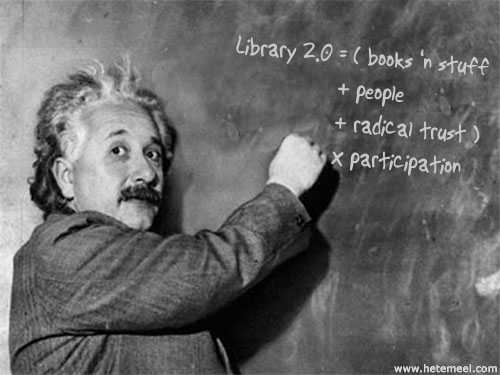
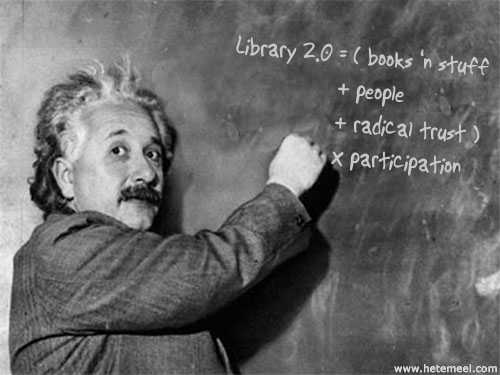
Radical Trust


Ever since Computers in Libraries this spring, people have been talking a lot about Darlene Fitcher’s “Radical Trust” concept. Stephen asks questions like

Are we comfortable with users tagging our MARC records? Can they add post-it note and comments to MARC? Are comments and user recommendations OK with us? Moderated or unmoderated? (Don’t be so fast – Are Amazon, Borders and B&N moderated?)

and

Why does Amazon work as an experience? Can libraries trust their users enough to safely share personal information to create a user recommendation experience like Amazon?

to get us thinking about radical trust. These questions and their kin are exactly the kind of questions we should be answering for ourselves. The answer doesn’t always have to be change. But if we don’t ask the questions and experiment with the ideas they present, how will we ever know if they were the right questions? And the best part is, exploring these questions can never hurt anybody. We aren’t committing to anything or throwing out millions of hours of work. We’re asking questions and thinking about the answers and maybe piloting and experimenting a little. But just because we don’t like one idea or care for one of the questions doesn’t mean that we’re exempt from asking them. That’ll never get us anywhere.

And in the midst of a very busy blog weekend (Wow, bibliobloggers were prolific this weekend!), John Blyberg wrote a fabulous essay called “More Than Just Faith: Radical Trust.” I highly recommend reading it and considering its implications. Two key points emerge from his essay: experimentation is necessary and good, but indiscriminate experimentation isn’t. He says:

What about the risk that your department could turn into a lunatic’s workshop? That’s not a bad concern. Innovation has always been about harnessing creativity to address a need or desire. By brainstorming effectively as a group, you can be selective about what you pursue so that energy is directed properly. What you want, what you should be striving for is focused creativity. This means using planning, communication, and agreement as the perimeter of your experimentation. Inter-organizational collaboration is a useful tact here as well.

But I think that part of radical trust is trusting ourselves. We need to understand that we can ask “crazy” or “out there” questions without ruining our credibility as librarians within our institutions. Too many people worry that if you ask questions about tagging MARC records, you actually want to implement it NOW and label all detractors as luddites and control-freaks. THIS IS NOT THE CASE. We are perfectly within our rights to ask questions and then not end up implementing those ideas. We are NOT within our rights to shut up and not ask the questions in the first place.

Leave a Comment

If Only I Knew What I Think

Thomas, over on TechEssence.Info, has a great post about the problem of forcing users to learn to use the catalog. He poses one of the central questions about the catalog:

And this was the comment that I keep chewing on: ““Students are in college to learn, so what’s so bad about forcing them to learn the catalog?”” I’’m still not sure how best to respond to this (although, “”Isn’’t that what we do now? And why we’re having day-long conferences on why our users are migrating to Google?”” is high on the list).

And like Thomas, I’m anything but sure what a good answer to that comment might be. On the one hand, I’m a firm believer in having catalogs serve users. Who isn’t? But in an academic library, where we get must meet the entire range of research needs, how important is it to have more complicated systems that can perform more complicated searches? I know that I tend to be able to manipulate a system to better advantage when I’ve been forced to figure out it’s inner workings. But then, that’s how I learn. That’s not how everybody learns. And quite frequently, my students only have enough time to work on their assignments, let alone familiarize themselves with an arguably arcane web application that provides very little in the way of automated help.

On the other hand, perhaps we’re finally to the point where technology is good enough that people don’t have to know how a program works in order to use it well. Maybe we can simplify things now without sacrificing valuable knowledge.

2 Comments

The Catalog, The User Experience, and Discovery

I’m still working to figure out what the future of the catalog looks like (in preparation for a short presentation in 10 days), and I’m beginning to realize that I’m doing this at precisely the best time. Nothing’s really been figured out already, so there’s still room for imagination. And yet, it’s becoming a major topic of discussion, so people can learn from each other’s imagination and leapfrog to new possibilities.

I’m particularly interested in a couple of themes that keep cropping up.

  • Allowing user commenting and tagging (the Hennepin County Library’s already doing this – via Library Stuff and TTW).
  • Separating the inventory mechanisms from the end user searching mechanisms.
  • Giving users choices rather than deciding for them what display options are best for them, or what delivery options will fit their needs.
  • Integrating information discovery into the user’s workflow (like Amazon is, via Dempsey).
  • Creating visual representations (such as tag, Dewey, or subject clouds like this one).
  • Leveraging metadata from multiple sources to improve services (metadata from Amazon, WorldCat, and in an academic environment things like class enrollment or year in school might also be useful).
  • Using RSS and other Web 2.0 features to push information out to the user’s environment (such as classes, clubs, etc)

Lorcan Dempsey has a rich set of posts on these and related issues. If you start here he leads you to related posts.

There are some more extreme ideas that may or may not come to fruition (such as eliminating LCSH or eliminating subject classification, as Calhoun mentions as an option and many, many people have critiqued).

There’s also the related issue of what happens when we scan all the books, as Google’s trying to do. There’s been a lot of talk of the NTY Magazine article called “Scan This Book” (Sunday, May 14th, 2006). The Gypsy Librarian, the O’Reilly Radar, and the Library Garden have all written very interesting responses to that article. What would discovery look like if this vision of the future came true? I don’t have answers…just questions.

Leave a Comment

Categories? Tag Clouds? So Many Decisions. (Plus an unrelated note)

I’d just reconciled myself to the idea of not having categories in my blog (because I use Blogger). I’d told myself, “It’s ok. Actually, the tag cloud is better. It’s cooler, more spontaneous, cooler, oh yeah, and cooler. Categories are for old folks.” (I’m very good at rationalizations.) Well, now I find out (via this amazing blog I just found) that there’s a hack that could let me have categories to my heart’s content (you can find it here).

But here’s the thing… My sidebar is pretty full. I keep tweaking it, and moving more of my blogroll to the folders in my bloglines account that don’t get displayed on my sidebar, etc., but I can’t think of a good way to make more space. So now I’m wondering, to category or not to category…that is the question. Would this be more useful than my tag cloud? Does any one have a preference? Do I do both? Oh, the decisions!

On a completely unrelated note, I think Stephen did end up “scratching some assumptions” on Monday, and the future is showing through (see his response to my post). Thanks Stephen! And, as I said in the comments there, I didn’t mind a bit that the talk went long. Great talk.

Leave a Comment
css.php